 Add to Chrome
 Add to Firefox
 Add to Edge
SpatialEvo: Self-Evolving Spatial Intelligence via Deterministic Geometric Environments
Apr 15, 2026
Spatial reasoning over three-dimensional scenes is a core capability for embodied intelligence, yet continuous model improvement remains bottlenecked by the cost of geometric annotation. The self-evolving paradigm offers a promising path, but its reliance on model consensus to construct pseudo-labels causes training to reinforce rather than correct the model's own geometric errors. We identify a property unique to 3D spatial reasoning that circumvents this limitation: ground truth is a deterministic consequence of the underlying geometry, computable exactly from point clouds and camera poses without any model involvement. Building on this insight, we present SpatialEvo, a self-evolving framework for 3D spatial reasoning, centered on the Deterministic Geometric Environment (DGE). The DGE formalizes 16 spatial reasoning task categories under explicit geometric validation rules and converts unannotated 3D scenes into zero-noise interactive oracles, replacing model consensus with objective physical feedback. A single shared-parameter policy co-evolves across questioner and solver roles under DGE constraints: the questioner generates physically valid spatial questions grounded in scene observations, while the solver derives precise answers against DGE-verified ground truth. A task-adaptive scheduler endogenously concentrates training on the model's weakest categories, producing a dynamic curriculum without manual design. Experiments across nine benchmarks demonstrate that SpatialEvo achieves the highest average score at both 3B and 7B scales, with consistent gains on spatial reasoning benchmarks and no degradation on general visual understanding.

WebVR: Benchmarking Multimodal LLMs for WebPage Recreation from Videos via Human-Aligned Visual Rubrics
Mar 11, 2026Existing web-generation benchmarks rely on text prompts or static screenshots as input. However, videos naturally convey richer signals such as interaction flow, transition timing, and motion continuity, which are essential for faithful webpage recreation. Despite this potential, video-conditioned webpage generation remains largely unexplored, with no dedicated benchmark for this task. To fill this gap, we introduce WebVR, a benchmark that evaluates whether MLLMs can faithfully recreate webpages from demonstration videos. WebVR contains 175 webpages across diverse categories, all constructed through a controlled synthesis pipeline rather than web crawling, ensuring varied and realistic demonstrations without overlap with existing online pages. We also design a fine-grained, human-aligned visual rubric that evaluates the generated webpages across multiple dimensions. Experiments on 19 models reveal substantial gaps in recreating fine-grained style and motion quality, while the rubric-based automatic evaluation achieves 96% agreement with human preferences. We release the dataset, evaluation toolkit, and baseline results to support future research on video-to-webpage generation.
Step 3.5 Flash: Open Frontier-Level Intelligence with 11B Active Parameters
Feb 11, 2026We introduce Step 3.5 Flash, a sparse Mixture-of-Experts (MoE) model that bridges frontier-level agentic intelligence and computational efficiency. We focus on what matters most when building agents: sharp reasoning and fast, reliable execution. Step 3.5 Flash pairs a 196B-parameter foundation with 11B active parameters for efficient inference. It is optimized with interleaved 3:1 sliding-window/full attention and Multi-Token Prediction (MTP-3) to reduce the latency and cost of multi-round agentic interactions. To reach frontier-level intelligence, we design a scalable reinforcement learning framework that combines verifiable signals with preference feedback, while remaining stable under large-scale off-policy training, enabling consistent self-improvement across mathematics, code, and tool use. Step 3.5 Flash demonstrates strong performance across agent, coding, and math tasks, achieving 85.4% on IMO-AnswerBench, 86.4% on LiveCodeBench-v6 (2024.08-2025.05), 88.2% on tau2-Bench, 69.0% on BrowseComp (with context management), and 51.0% on Terminal-Bench 2.0, comparable to frontier models such as GPT-5.2 xHigh and Gemini 3.0 Pro. By redefining the efficiency frontier, Step 3.5 Flash provides a high-density foundation for deploying sophisticated agents in real-world industrial environments.
STEP3-VL-10B Technical Report
Jan 15, 2026We present STEP3-VL-10B, a lightweight open-source foundation model designed to redefine the trade-off between compact efficiency and frontier-level multimodal intelligence. STEP3-VL-10B is realized through two strategic shifts: first, a unified, fully unfrozen pre-training strategy on 1.2T multimodal tokens that integrates a language-aligned Perception Encoder with a Qwen3-8B decoder to establish intrinsic vision-language synergy; and second, a scaled post-training pipeline featuring over 1k iterations of reinforcement learning. Crucially, we implement Parallel Coordinated Reasoning (PaCoRe) to scale test-time compute, allocating resources to scalable perceptual reasoning that explores and synthesizes diverse visual hypotheses. Consequently, despite its compact 10B footprint, STEP3-VL-10B rivals or surpasses models 10$\times$-20$\times$ larger (e.g., GLM-4.6V-106B, Qwen3-VL-235B) and top-tier proprietary flagships like Gemini 2.5 Pro and Seed-1.5-VL. Delivering best-in-class performance, it records 92.2% on MMBench and 80.11% on MMMU, while excelling in complex reasoning with 94.43% on AIME2025 and 75.95% on MathVision. We release the full model suite to provide the community with a powerful, efficient, and reproducible baseline.
Step-GUI Technical Report
Dec 19, 2025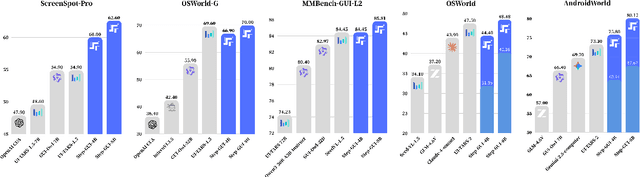
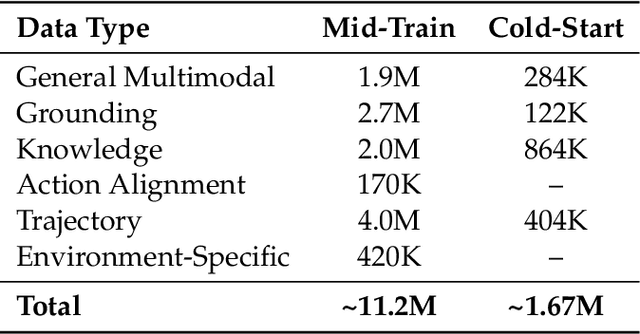
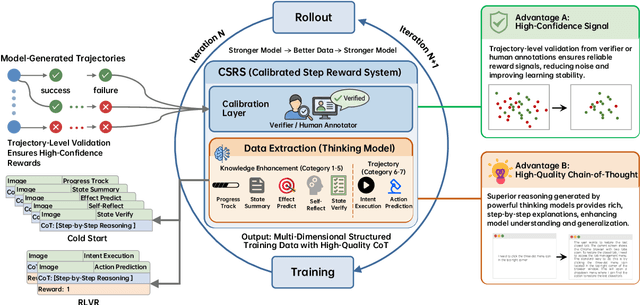
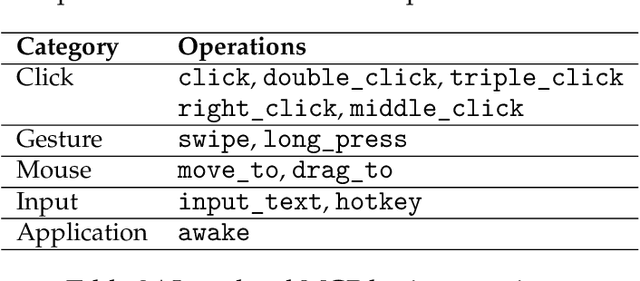
Recent advances in multimodal large language models unlock unprecedented opportunities for GUI automation. However, a fundamental challenge remains: how to efficiently acquire high-quality training data while maintaining annotation reliability? We introduce a self-evolving training pipeline powered by the Calibrated Step Reward System, which converts model-generated trajectories into reliable training signals through trajectory-level calibration, achieving >90% annotation accuracy with 10-100x lower cost. Leveraging this pipeline, we introduce Step-GUI, a family of models (4B/8B) that achieves state-of-the-art GUI performance (8B: 80.2% AndroidWorld, 48.5% OSWorld, 62.6% ScreenShot-Pro) while maintaining robust general capabilities. As GUI agent capabilities improve, practical deployment demands standardized interfaces across heterogeneous devices while protecting user privacy. To this end, we propose GUI-MCP, the first Model Context Protocol for GUI automation with hierarchical architecture that combines low-level atomic operations and high-level task delegation to local specialist models, enabling high-privacy execution where sensitive data stays on-device. Finally, to assess whether agents can handle authentic everyday usage, we introduce AndroidDaily, a benchmark grounded in real-world mobile usage patterns with 3146 static actions and 235 end-to-end tasks across high-frequency daily scenarios (8B: static 89.91%, end-to-end 52.50%). Our work advances the development of practical GUI agents and demonstrates strong potential for real-world deployment in everyday digital interactions.
GeoSense: Evaluating Identification and Application of Geometric Principles in Multimodal Reasoning
Apr 17, 2025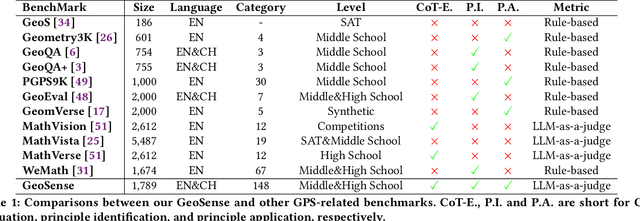
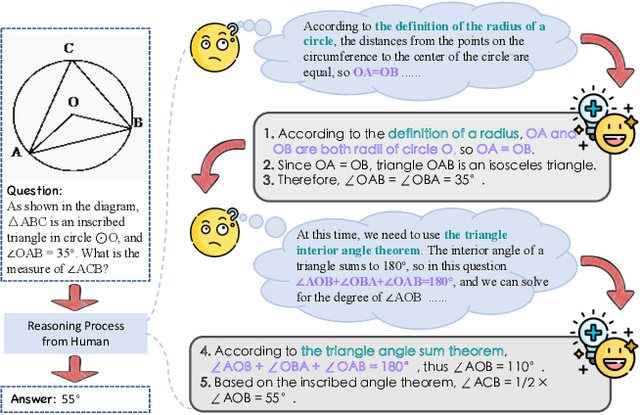
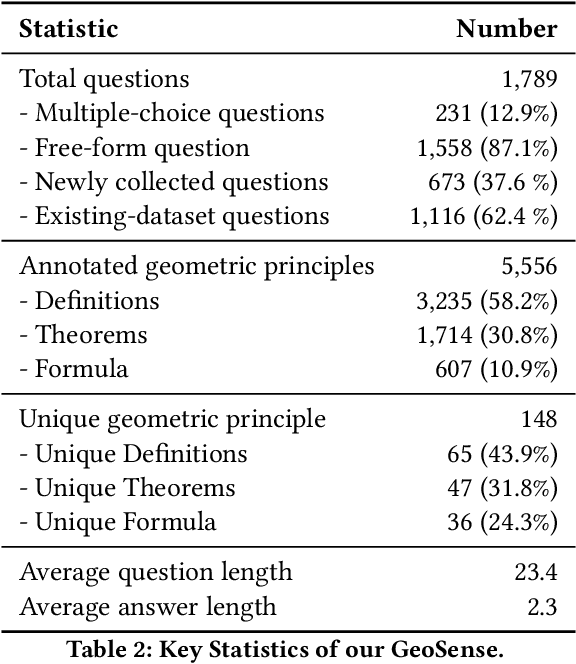
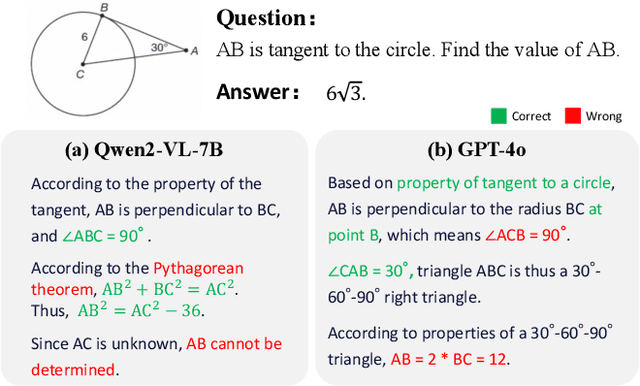
Geometry problem-solving (GPS), a challenging task requiring both visual comprehension and symbolic reasoning, effectively measures the reasoning capabilities of multimodal large language models (MLLMs). Humans exhibit strong reasoning ability in this task through accurate identification and adaptive application of geometric principles within visual contexts. However, existing benchmarks fail to jointly assess both dimensions of the human-like geometric reasoning mechanism in MLLMs, remaining a critical gap in assessing their ability to tackle GPS. To this end, we introduce GeoSense, the first comprehensive bilingual benchmark designed to systematically evaluate the geometric reasoning abilities of MLLMs through the lens of geometric principles. GeoSense features a five-level hierarchical framework of geometric principles spanning plane and solid geometry, an intricately annotated dataset of 1,789 problems, and an innovative evaluation strategy. Through extensive experiments on GeoSense with various open-source and closed-source MLLMs, we observe that Gemini-2.0-pro-flash performs best, achieving an overall score of $65.3$. Our in-depth analysis reveals that the identification and application of geometric principles remain a bottleneck for leading MLLMs, jointly hindering their reasoning abilities. These findings underscore GeoSense's potential to guide future advancements in MLLMs' geometric reasoning capabilities, paving the way for more robust and human-like reasoning in artificial intelligence.
CombatVLA: An Efficient Vision-Language-Action Model for Combat Tasks in 3D Action Role-Playing Games
Mar 12, 2025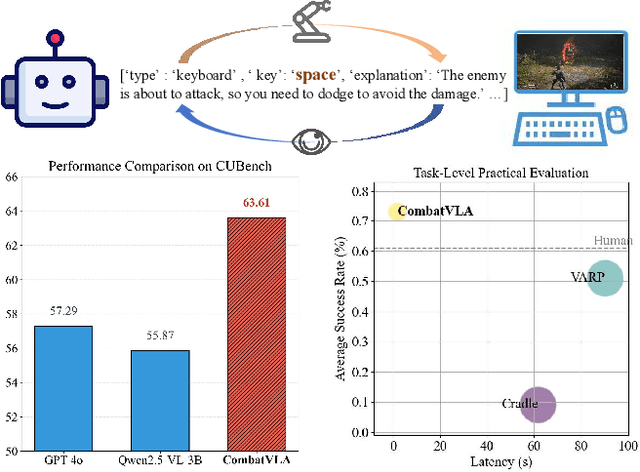
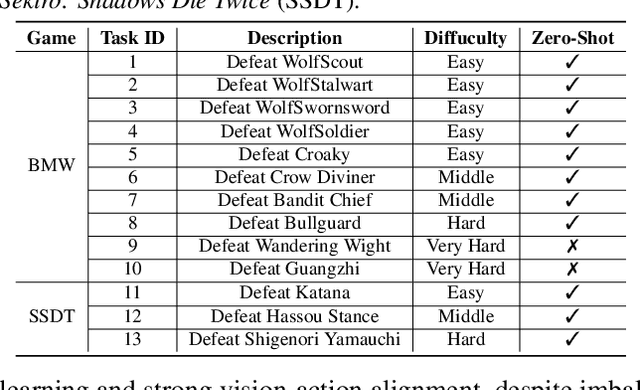
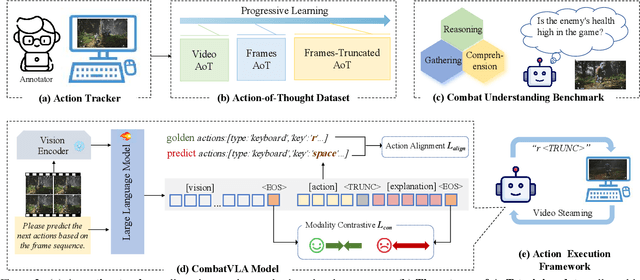
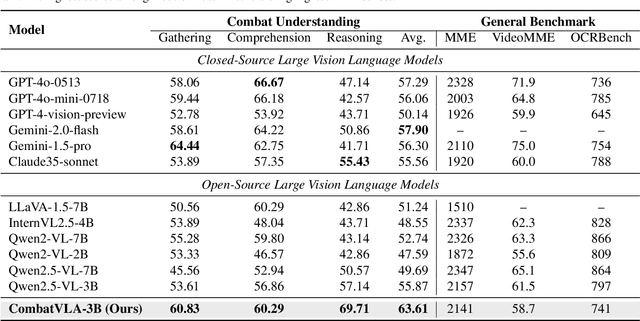
Recent advances in Vision-Language-Action models (VLAs) have expanded the capabilities of embodied intelligence. However, significant challenges remain in real-time decision-making in complex 3D environments, which demand second-level responses, high-resolution perception, and tactical reasoning under dynamic conditions. To advance the field, we introduce CombatVLA, an efficient VLA model optimized for combat tasks in 3D action role-playing games(ARPGs). Specifically, our CombatVLA is a 3B model trained on video-action pairs collected by an action tracker, where the data is formatted as action-of-thought (AoT) sequences. Thereafter, CombatVLA seamlessly integrates into an action execution framework, allowing efficient inference through our truncated AoT strategy. Experimental results demonstrate that CombatVLA not only outperforms all existing models on the combat understanding benchmark but also achieves a 50-fold acceleration in game combat. Moreover, it has a higher task success rate than human players. We will open-source all resources, including the action tracker, dataset, benchmark, model weights, training code, and the implementation of the framework at https://combatvla.github.io/.
ChineseSimpleVQA -- "See the World, Discover Knowledge": A Chinese Factuality Evaluation for Large Vision Language Models
Feb 19, 2025The evaluation of factual accuracy in large vision language models (LVLMs) has lagged behind their rapid development, making it challenging to fully reflect these models' knowledge capacity and reliability. In this paper, we introduce the first factuality-based visual question-answering benchmark in Chinese, named ChineseSimpleVQA, aimed at assessing the visual factuality of LVLMs across 8 major topics and 56 subtopics. The key features of this benchmark include a focus on the Chinese language, diverse knowledge types, a multi-hop question construction, high-quality data, static consistency, and easy-to-evaluate through short answers. Moreover, we contribute a rigorous data construction pipeline and decouple the visual factuality into two parts: seeing the world (i.e., object recognition) and discovering knowledge. This decoupling allows us to analyze the capability boundaries and execution mechanisms of LVLMs. Subsequently, we evaluate 34 advanced open-source and closed-source models, revealing critical performance gaps within this field.
Automatic Instruction Evolving for Large Language Models
Jun 02, 2024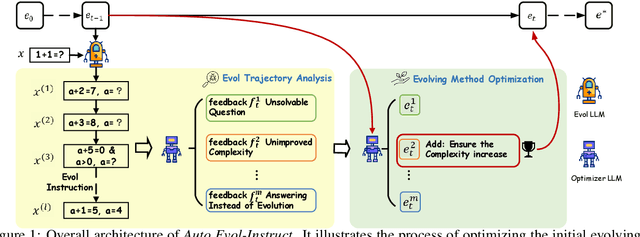

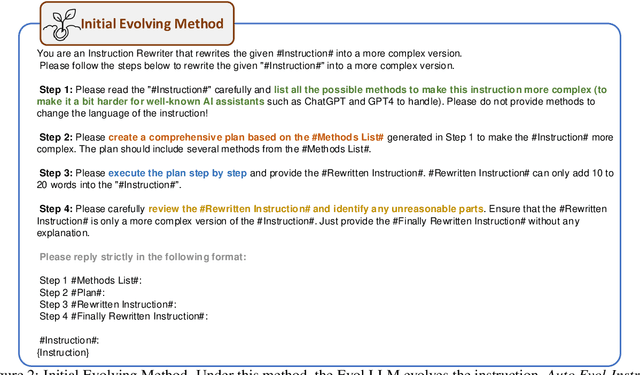
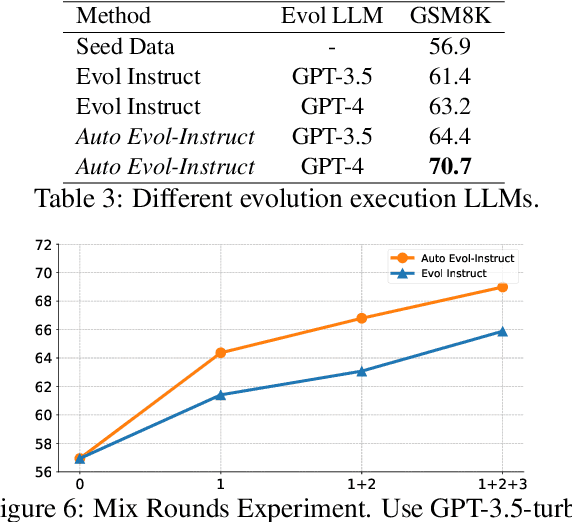
Fine-tuning large pre-trained language models with Evol-Instruct has achieved encouraging results across a wide range of tasks. However, designing effective evolving methods for instruction evolution requires substantial human expertise. This paper proposes Auto Evol-Instruct, an end-to-end framework that evolves instruction datasets using large language models without any human effort. The framework automatically analyzes and summarizes suitable evolutionary strategies for the given instruction data and iteratively improves the evolving method based on issues exposed during the instruction evolution process. Our extensive experiments demonstrate that the best method optimized by Auto Evol-Instruct outperforms human-designed methods on various benchmarks, including MT-Bench, AlpacaEval, GSM8K, and HumanEval.
Tapilot-Crossing: Benchmarking and Evolving LLMs Towards Interactive Data Analysis Agents
Mar 08, 2024
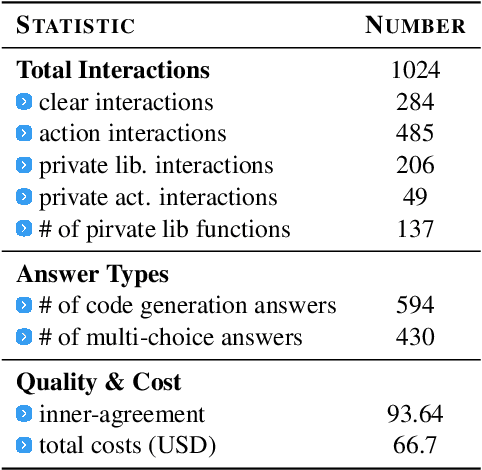

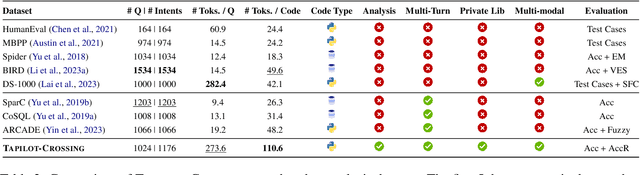
Interactive Data Analysis, the collaboration between humans and LLM agents, enables real-time data exploration for informed decision-making. The challenges and costs of collecting realistic interactive logs for data analysis hinder the quantitative evaluation of Large Language Model (LLM) agents in this task. To mitigate this issue, we introduce Tapilot-Crossing, a new benchmark to evaluate LLM agents on interactive data analysis. Tapilot-Crossing contains 1024 interactions, covering 4 practical scenarios: Normal, Action, Private, and Private Action. Notably, Tapilot-Crossing is constructed by an economical multi-agent environment, Decision Company, with few human efforts. We evaluate popular and advanced LLM agents in Tapilot-Crossing, which underscores the challenges of interactive data analysis. Furthermore, we propose Adaptive Interaction Reflection (AIR), a self-generated reflection strategy that guides LLM agents to learn from successful history. Experiments demonstrate that Air can evolve LLMs into effective interactive data analysis agents, achieving a relative performance improvement of up to 44.5%.