 Add to Chrome
 Add to Firefox
 Add to Edge
FormStruct-Bench:A Hierarchical and Diagnostic Benchmark for Table-Form Document Structure Recognition
Aug 11, 2026
Transforming table-form documents into machine-processable records requires recovering not only their visible content but also the multilevel structure that organizes it. However, existing benchmarks evaluate either holistic document outputs or conventional table grids, and their aggregate scores provide little insight into where structural failures occur. We introduce FormStruct-Bench, a hierarchical and diagnostic benchmark that evaluates table-form document structure recognition at both the document level and progressively finer component levels, allowing aggregate performance to be traced back to specific structural failure modes. To construct auditable ground truth at scale, we annotate 70 reusable templates and expand them into 7,000 verified instances through a provenance-preserving Director--Artist--Verifier pipeline; all 1,100 instances in the template-disjoint test set additionally receive human review. Our evaluation protocol uses five primary metrics and three structure-specific diagnostics across page, schema, and component levels, together with slices over difficulty, structural constraints, and visual degradation. Across 14 API-hosted and locally deployable systems plus two SFT variants, the best document-level score reaches 83.85%, whereas the best reported fine-grained structural score remains below 18%. These results reveal a pronounced gap between reading document content and recovering the hierarchy and regional organization required for reliable table-form understanding.

PreGress: Ranking-Native Pre-training and Prompting for Graph Node Ranking
Aug 10, 2026Node ranking is a fundamental problem in graph information retrieval, measuring the relative importance of nodes and supporting a wide range of applications such as influence analysis, recommendation, and graph-based retrieval augmented generation. However, exact computation of graph-based ranking measures is often computationally prohibitive at scale. Existing GNN-based ranking methods provide scalable approximations, but they are typically tailored to individual ranking criteria and require retraining for each downstream task, which limits their transferability and efficiency. Recent graph pre-training approaches aim to enable knowledge transfer across tasks, yet their learning objectives are largely misaligned with node ranking, resulting in suboptimal adaptability to ranking-oriented applications. To address these limitations, we propose PreGress, the first ranking-native pre-training and prompting framework for supporting a wide range of node ranking tasks. PreGress performs multi-task pre-training using our carefully designed objectives, including degree centrality prediction and attribute reconstruction, to jointly capture structural and attribute information. To support heterogeneous ranking criteria, we design lightweight, task-specific prompt modules that adapt a frozen ranking backbone to downstream tasks without full retraining. Experiments on six public graphs and two real-world query-to-item benchmarks---Yelp2018 and MovieLens-100K---together with a controlled five-criterion graph-access study demonstrate strong ranking quality with low task-specific state overhead.
CAPER: Clause-Aligned Process Supervision for Text-to-SQL
Jun 02, 2026Text-to-SQL systems are typically evaluated by query-level execution correctness, but this terminal signal provides little guidance about which intermediate SQL decision caused success or failure. Token-level dense supervision is also ill-suited: SQL tokens do not align with complete semantic decisions, can penalize execution-equivalent queries, and are difficult to label reliably at scale. We therefore propose CAPER, which automatically derives clause-level supervision via counterfactual intervention on the SQL abstract syntax tree, enabling root-cause error localization for reward modeling; the resulting data is used to train CAPER-9B, a lightweight Clause-PRM that provides clause-boundary feedback for policy optimization and candidate verification. Experiments on BIRD and Spider show that clause-aligned supervision not only improves execution accuracy, achieving up to a 15.3% relative EX improvement over GPT-5.4, but also strengthens failure-localization capability, reaching 84.53% accuracy and 90.60% MRR on held-out failures. Our project page is at https://github.com/banrichard/RL-NL2SQL.
Text2GQL-Bench: A Text to Graph Query Language Benchmark [Experiment, Analysis & Benchmark]
Feb 12, 2026Graph models are fundamental to data analysis in domains rich with complex relationships. Text-to-Graph-Query-Language (Text-to-GQL) systems act as a translator, converting natural language into executable graph queries. This capability allows Large Language Models (LLMs) to directly analyze and manipulate graph data, posi-tioning them as powerful agent infrastructures for Graph Database Management System (GDBMS). Despite recent progress, existing datasets are often limited in domain coverage, supported graph query languages, or evaluation scope. The advancement of Text-to-GQL systems is hindered by the lack of high-quality benchmark datasets and evaluation methods to systematically compare model capabilities across different graph query languages and domains. In this work, we present Text2GQL-Bench, a unified Text-to-GQL benchmark designed to address these limitations. Text2GQL-Bench couples a multi-GQL dataset that has 178,184 (Question, Query) pairs spanning 13 domains, with a scalable construction framework that generates datasets in different domains, question abstraction levels, and GQLs with heterogeneous resources. To support compre-hensive assessment, we introduce an evaluation method that goes beyond a single end-to-end metric by jointly reporting grammatical validity, similarity, semantic alignment, and execution accuracy. Our evaluation uncovers a stark dialect gap in ISO-GQL generation: even strong LLMs achieve only at most 4% execution accuracy (EX) in zero-shot settings, though a fixed 3-shot prompt raises accuracy to around 50%, the grammatical validity remains lower than 70%. Moreover, a fine-tuned 8B open-weight model reaches 45.1% EX, and 90.8% grammatical validity, demonstrating that most of the performance jump is unlocked by exposure to sufficient ISO-GQL examples.
Understanding and Guiding Layer Placement in Parameter-Efficient Fine-Tuning of Large Language Models
Feb 03, 2026As large language models (LLMs) continue to grow, the cost of full-parameter fine-tuning has made parameter-efficient fine-tuning (PEFT) the default strategy for downstream adaptation. Constraints from inference latency in scalable serving and fine-tuning cost in edge or rapid-deployment settings make the choice of which layers to fine-tune unavoidable. Yet current practice typically applies PEFT uniformly across all layers, with limited understanding or leverage of layer selection. This paper develops a unified projected residual view of PEFT on top of a frozen base model. Under a local quadratic approximation, layerwise adaptation is governed by three quantities: (i) the projected residual norm (resnorm), which measures how much correctable bias a layer can capture; (ii) the activation energy, which determines feature conditioning; and (iii) layer coupling, which quantifies how strongly residuals interact across layers. We show that, for squared loss and linear adapters, the resnorm equals a normalized gradient norm, activation energy controls ill-conditioning and noise amplification, and weak coupling yields approximately additive layerwise contributions. Building on these insights, we introduce the Layer Card, a reusable diagnostic that summarizes residual signal strength, compute cost, and performance for each layer of a given model. With an identical model and LoRA configuration, Layer Card-guided placement refines the choice of adapted layers to flexibly prioritize different objectives, such as maximizing performance or reducing fine-tuning cost. Moreover, on Qwen3-8B, we show that selectively adapting a subset of layers can achieve performance close to full-layer LoRA while substantially reducing fine-tuning cost and the number of adapter-augmented layers during inference, offering a more cost-performance-aware alternative to full-layer insertion.
Micro-Act: Mitigate Knowledge Conflict in Question Answering via Actionable Self-Reasoning
Jun 05, 2025Retrieval-Augmented Generation (RAG) systems commonly suffer from Knowledge Conflicts, where retrieved external knowledge contradicts the inherent, parametric knowledge of large language models (LLMs). It adversely affects performance on downstream tasks such as question answering (QA). Existing approaches often attempt to mitigate conflicts by directly comparing two knowledge sources in a side-by-side manner, but this can overwhelm LLMs with extraneous or lengthy contexts, ultimately hindering their ability to identify and mitigate inconsistencies. To address this issue, we propose Micro-Act a framework with a hierarchical action space that automatically perceives context complexity and adaptively decomposes each knowledge source into a sequence of fine-grained comparisons. These comparisons are represented as actionable steps, enabling reasoning beyond the superficial context. Through extensive experiments on five benchmark datasets, Micro-Act consistently achieves significant increase in QA accuracy over state-of-the-art baselines across all 5 datasets and 3 conflict types, especially in temporal and semantic types where all baselines fail significantly. More importantly, Micro-Act exhibits robust performance on non-conflict questions simultaneously, highlighting its practical value in real-world RAG applications.
TRACE: Intra-visit Clinical Event Nowcasting via Effective Patient Trajectory Encoding
Mar 29, 2025Electronic Health Records (EHR) have become a valuable resource for a wide range of predictive tasks in healthcare. However, existing approaches have largely focused on inter-visit event predictions, overlooking the importance of intra-visit nowcasting, which provides prompt clinical insights during an ongoing patient visit. To address this gap, we introduce the task of laboratory measurement prediction within a hospital visit. We study the laboratory data that, however, remained underexplored in previous work. We propose TRACE, a Transformer-based model designed for clinical event nowcasting by encoding patient trajectories. TRACE effectively handles long sequences and captures temporal dependencies through a novel timestamp embedding that integrates decay properties and periodic patterns of data. Additionally, we introduce a smoothed mask for denoising, improving the robustness of the model. Experiments on two large-scale electronic health record datasets demonstrate that the proposed model significantly outperforms previous methods, highlighting its potential for improving patient care through more accurate laboratory measurement nowcasting. The code is available at https://github.com/Amehi/TRACE.
NVR: Vector Runahead on NPUs for Sparse Memory Access
Feb 19, 2025Deep Neural Networks are increasingly leveraging sparsity to reduce the scaling up of model parameter size. However, reducing wall-clock time through sparsity and pruning remains challenging due to irregular memory access patterns, leading to frequent cache misses. In this paper, we present NPU Vector Runahead (NVR), a prefetching mechanism tailored for NPUs to address cache miss problems in sparse DNN workloads. Rather than optimising memory patterns with high overhead and poor portability, NVR adapts runahead execution to the unique architecture of NPUs. NVR provides a general micro-architectural solution for sparse DNN workloads without requiring compiler or algorithmic support, operating as a decoupled, speculative, lightweight hardware sub-thread alongside the NPU, with minimal hardware overhead (under 5%). NVR achieves an average 90% reduction in cache misses compared to SOTA prefetching in general-purpose processors, delivering 4x average speedup on sparse workloads versus NPUs without prefetching. Moreover, we investigate the advantages of incorporating a small cache (16KB) into the NPU combined with NVR. Our evaluation shows that expanding this modest cache delivers 5x higher performance benefits than increasing the L2 cache size by the same amount.
Towards Effective Top-N Hamming Search via Bipartite Graph Contrastive Hashing
Aug 17, 2024


Searching on bipartite graphs serves as a fundamental task for various real-world applications, such as recommendation systems, database retrieval, and document querying. Conventional approaches rely on similarity matching in continuous Euclidean space of vectorized node embeddings. To handle intensive similarity computation efficiently, hashing techniques for graph-structured data have emerged as a prominent research direction. However, despite the retrieval efficiency in Hamming space, previous studies have encountered catastrophic performance decay. To address this challenge, we investigate the problem of hashing with Graph Convolutional Network for effective Top-N search. Our findings indicate the learning effectiveness of incorporating hashing techniques within the exploration of bipartite graph reception fields, as opposed to simply treating hashing as post-processing to output embeddings. To further enhance the model performance, we advance upon these findings and propose Bipartite Graph Contrastive Hashing (BGCH+). BGCH+ introduces a novel dual augmentation approach to both intermediate information and hash code outputs in the latent feature spaces, thereby producing more expressive and robust hash codes within a dual self-supervised learning paradigm. Comprehensive empirical analyses on six real-world benchmarks validate the effectiveness of our dual feature contrastive learning in boosting the performance of BGCH+ compared to existing approaches.
Before Generation, Align it! A Novel and Effective Strategy for Mitigating Hallucinations in Text-to-SQL Generation
May 24, 2024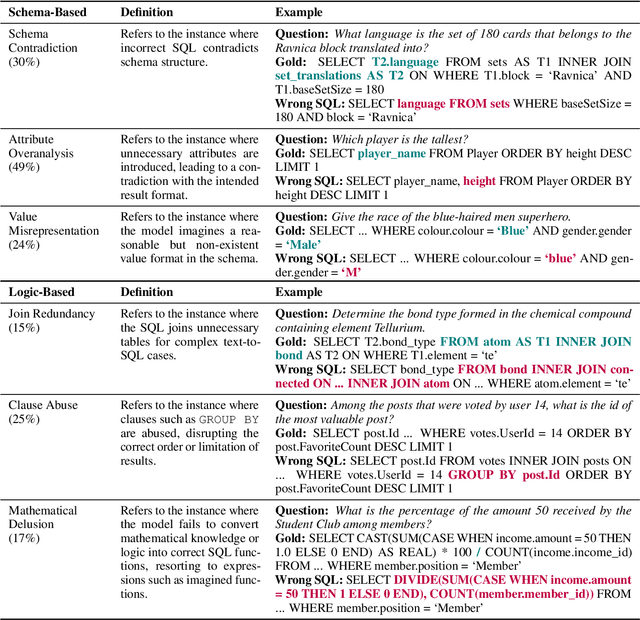
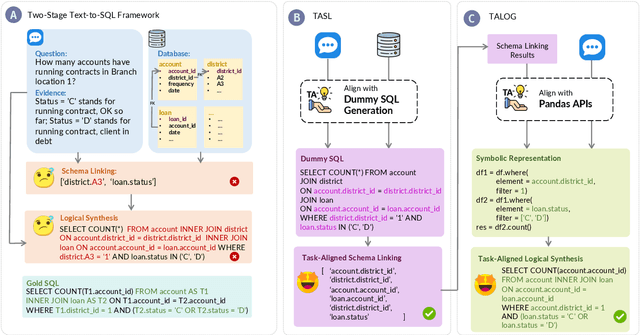
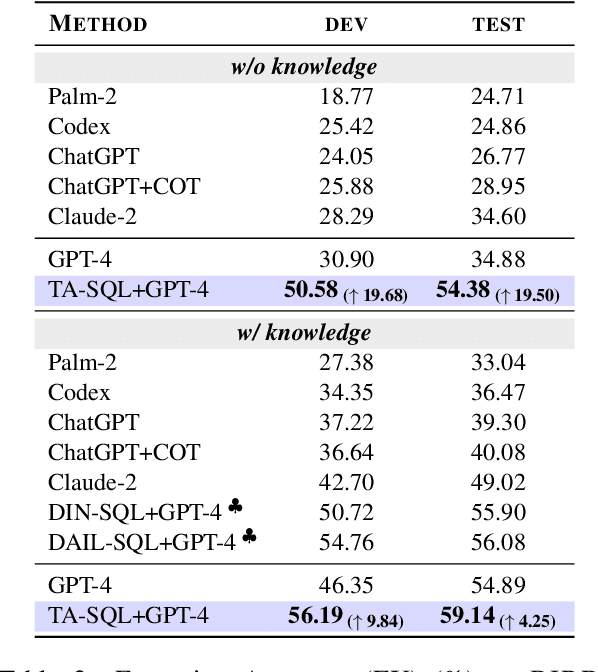
Large Language Models (LLMs) driven by In-Context Learning (ICL) have significantly improved the performance of text-to-SQL. Previous methods generally employ a two-stage reasoning framework, namely 1) schema linking and 2) logical synthesis, making the framework not only effective but also interpretable. Despite these advancements, the inherent bad nature of the generalization of LLMs often results in hallucinations, which limits the full potential of LLMs. In this work, we first identify and categorize the common types of hallucinations at each stage in text-to-SQL. We then introduce a novel strategy, Task Alignment (TA), designed to mitigate hallucinations at each stage. TA encourages LLMs to take advantage of experiences from similar tasks rather than starting the tasks from scratch. This can help LLMs reduce the burden of generalization, thereby mitigating hallucinations effectively. We further propose TA-SQL, a text-to-SQL framework based on this strategy. The experimental results and comprehensive analysis demonstrate the effectiveness and robustness of our framework. Specifically, it enhances the performance of the GPT-4 baseline by 21.23% relatively on BIRD dev and it yields significant improvements across six models and four mainstream, complex text-to-SQL benchmarks.