 Add to Chrome
 Add to Firefox
 Add to Edge
EgoAERO: Learning Dexterous Manipulation from a Single Egocentric Video without Object Assets
Jun 06, 2026
Egocentric RGB-D videos offer a natural source of human dexterous manipulation demonstrations, but existing data is difficult to use for robot learning because object pose, geometry, and contact information are often missing or require pre-scanned object assets. We present EgoAERO, the first framework that learns dexterous manipulation from a single egocentric RGB-D human demonstration without object assets. EgoAERO reconstructs contact-consistent hand-object trajectories through asset-free object tracking and reconstruction, ego motion compensation, and adaptive contact optimization, then converts them into robot policies using two-stage residual learning. We further introduce an online quality assessment mechanism and construct EgoDex-R, a large-scale egocentric dataset with 4.3M RGB-D frames for dexterous policy learning. Simulation and real-world experiments show that EgoAERO enables single-demonstration dexterous manipulation and achieves downstream performance close to CAD-based reconstructions on HOI4D.

Autonomous Navigation System for Library Service Robot Based on Unitree Go2 Edu
Jun 02, 2026Libraries require autonomous robots to move quietly through narrow aisles while remaining safe around readers, chairs, bags, and carts. This paper presents a ROS 2 navigation system for a Unitree Go2 Edu quadruped equipped with a 4D LiDAR, a front depth camera, and an IMU. Rather than assuming the library is rough terrain, we target the practical mobility discontinuities of real deployments, including floor transitions, temporary clutter, and partially blocked passages where low-clearance wheeled platforms are less tolerant. RTAB-Map is used for visual-LiDAR SLAM, AMCL and EKF-based sensor fusion provide localization, and a Nav2 stack with A* and DWA supports planning and local avoidance. In a real library, the system achieves 100%, 96%, and 88% success rates in static, low-density dynamic, and high-density dynamic scenes, while map validation against surveyed control distances yields a mean metric error of 3.7 cm.
DM0: An Embodied-Native Vision-Language-Action Model towards Physical AI
Feb 16, 2026Moving beyond the traditional paradigm of adapting internet-pretrained models to physical tasks, we present DM0, an Embodied-Native Vision-Language-Action (VLA) framework designed for Physical AI. Unlike approaches that treat physical grounding as a fine-tuning afterthought, DM0 unifies embodied manipulation and navigation by learning from heterogeneous data sources from the onset. Our methodology follows a comprehensive three-stage pipeline: Pretraining, Mid-Training, and Post-Training. First, we conduct large-scale unified pretraining on the Vision-Language Model (VLM) using diverse corpora--seamlessly integrating web text, autonomous driving scenarios, and embodied interaction logs-to jointly acquire semantic knowledge and physical priors. Subsequently, we build a flow-matching action expert atop the VLM. To reconcile high-level reasoning with low-level control, DM0 employs a hybrid training strategy: for embodied data, gradients from the action expert are not backpropagated to the VLM to preserve generalized representations, while the VLM remains trainable on non-embodied data. Furthermore, we introduce an Embodied Spatial Scaffolding strategy to construct spatial Chain-of-Thought (CoT) reasoning, effectively constraining the action solution space. Experiments on the RoboChallenge benchmark demonstrate that DM0 achieves state-of-the-art performance in both Specialist and Generalist settings on Table30.
Step 3.5 Flash: Open Frontier-Level Intelligence with 11B Active Parameters
Feb 11, 2026We introduce Step 3.5 Flash, a sparse Mixture-of-Experts (MoE) model that bridges frontier-level agentic intelligence and computational efficiency. We focus on what matters most when building agents: sharp reasoning and fast, reliable execution. Step 3.5 Flash pairs a 196B-parameter foundation with 11B active parameters for efficient inference. It is optimized with interleaved 3:1 sliding-window/full attention and Multi-Token Prediction (MTP-3) to reduce the latency and cost of multi-round agentic interactions. To reach frontier-level intelligence, we design a scalable reinforcement learning framework that combines verifiable signals with preference feedback, while remaining stable under large-scale off-policy training, enabling consistent self-improvement across mathematics, code, and tool use. Step 3.5 Flash demonstrates strong performance across agent, coding, and math tasks, achieving 85.4% on IMO-AnswerBench, 86.4% on LiveCodeBench-v6 (2024.08-2025.05), 88.2% on tau2-Bench, 69.0% on BrowseComp (with context management), and 51.0% on Terminal-Bench 2.0, comparable to frontier models such as GPT-5.2 xHigh and Gemini 3.0 Pro. By redefining the efficiency frontier, Step 3.5 Flash provides a high-density foundation for deploying sophisticated agents in real-world industrial environments.
STEP3-VL-10B Technical Report
Jan 15, 2026We present STEP3-VL-10B, a lightweight open-source foundation model designed to redefine the trade-off between compact efficiency and frontier-level multimodal intelligence. STEP3-VL-10B is realized through two strategic shifts: first, a unified, fully unfrozen pre-training strategy on 1.2T multimodal tokens that integrates a language-aligned Perception Encoder with a Qwen3-8B decoder to establish intrinsic vision-language synergy; and second, a scaled post-training pipeline featuring over 1k iterations of reinforcement learning. Crucially, we implement Parallel Coordinated Reasoning (PaCoRe) to scale test-time compute, allocating resources to scalable perceptual reasoning that explores and synthesizes diverse visual hypotheses. Consequently, despite its compact 10B footprint, STEP3-VL-10B rivals or surpasses models 10$\times$-20$\times$ larger (e.g., GLM-4.6V-106B, Qwen3-VL-235B) and top-tier proprietary flagships like Gemini 2.5 Pro and Seed-1.5-VL. Delivering best-in-class performance, it records 92.2% on MMBench and 80.11% on MMMU, while excelling in complex reasoning with 94.43% on AIME2025 and 75.95% on MathVision. We release the full model suite to provide the community with a powerful, efficient, and reproducible baseline.
Learning Temporal Abstractions via Variational Homomorphisms in Option-Induced Abstract MDPs
Jul 24, 2025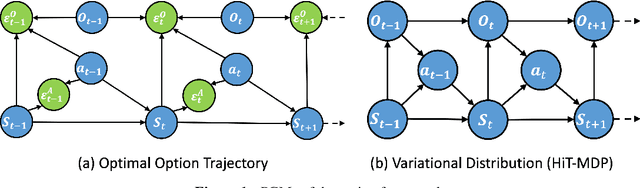
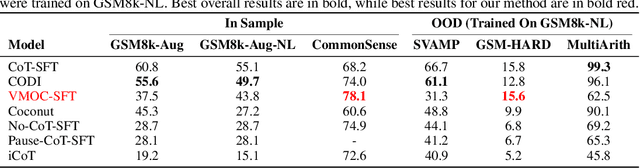
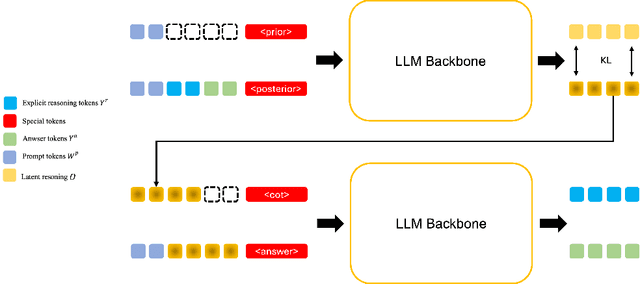
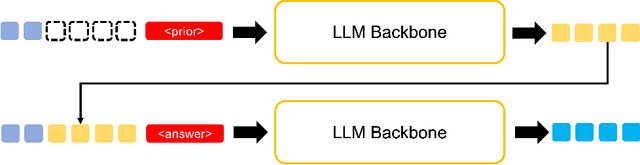
Large Language Models (LLMs) have shown remarkable reasoning ability through explicit Chain-of-Thought (CoT) prompting, but generating these step-by-step textual explanations is computationally expensive and slow. To overcome this, we aim to develop a framework for efficient, implicit reasoning, where the model "thinks" in a latent space without generating explicit text for every step. We propose that these latent thoughts can be modeled as temporally-extended abstract actions, or options, within a hierarchical reinforcement learning framework. To effectively learn a diverse library of options as latent embeddings, we first introduce the Variational Markovian Option Critic (VMOC), an off-policy algorithm that uses variational inference within the HiT-MDP framework. To provide a rigorous foundation for using these options as an abstract reasoning space, we extend the theory of continuous MDP homomorphisms. This proves that learning a policy in the simplified, abstract latent space, for which VMOC is suited, preserves the optimality of the solution to the original, complex problem. Finally, we propose a cold-start procedure that leverages supervised fine-tuning (SFT) data to distill human reasoning demonstrations into this latent option space, providing a rich initialization for the model's reasoning capabilities. Extensive experiments demonstrate that our approach achieves strong performance on complex logical reasoning benchmarks and challenging locomotion tasks, validating our framework as a principled method for learning abstract skills for both language and control.