 Add to Chrome
 Add to Firefox
 Add to Edge
SkillRevise: Improving LLM-Authored Agent Skills via Trace-Conditioned Skill Revision
May 31, 2026
Agent skills are procedural artifacts that enable LLM agents to execute workflows, verify constraints, and recover from failures. Existing self-evolving methods refine skills using accumulated trajectories. However, they struggle in cold-start settings, where only an initial, imperfect skill is available. Consequently, skill construction defaults to expert authoring or one-shot LLM generation. Expert-authored skills are costly and may not align with how LLM agents actually execute tasks, while one-shot generated skills can be syntactically well formed yet behaviorally weak. To bridge this gap, we propose SkillRevise, an execution-grounded framework designed to iteratively refine these initial skills. SkillRevise diagnoses skill defects from execution evidence, retrieves relevant repair principles from a general memory, and applies execution-anchored edits. By re-executing candidates and measuring empirical utility, it systematically retains the optimal skill version. Evaluated across three benchmarks and five LLMs, SkillRevise substantially outperforms one-shot baselines, improving the base agent's success rate on SkillsBench from 36.05% to 61.63%. Furthermore, the revised skills exhibit strong cross-model transferability, capturing generalized procedural knowledge over model-specific artifacts.

Can Retrieval Heads See Images? Multimodal Retrieval Heads in Long-Context Vision-Language Models
May 26, 2026Large vision-language models increasingly rely on long-context modeling to reason over documents, hour-level videos, and long-horizon agent trajectories, requiring them to locate relevant evidence across interleaved text and images. Prior work has studied this behavior using retrieval heads in large language models, but its copy-based criterion does not directly apply when evidence appears in images. We introduce a multimodal retrieval head detection method that scores attention from question tokens to textual or visual evidence. With this method, we show that multimodal retrieval heads are sparse, intrinsic, and causally important: only 4.4-10.2% of attention heads account for 50% of the positive retrieval-score mass, and masking the top-5% selected heads drops MMLongBench-Doc from 48.2% to 5.7% and SlideVQA from 71.2% to 8.9%, while random-head masking is far less damaging. Further analysis shows that these heads are partly shared across modalities yet remain dynamic within each modality, with image retrieval heads changing more than text retrieval heads as context length and haystack modality change. Without further training, we find that these heads can also be used directly to rank visually rich documents: on MMDocIR, Qwen3-VL-8B selected-head scoring improves Recall@1 by 7.7/7.4 macro/micro points for page retrieval and 6.3/6.8 points for layout retrieval over the strongest reported baseline.
MemLens: Benchmarking Multimodal Long-Term Memory in Large Vision-Language Models
May 14, 2026Memory is essential for large vision-language models (LVLMs) to handle long, multimodal interactions, with two method directions providing this capability: long-context LVLMs and memory-augmented agents. However, no existing benchmark conducts a systematic comparison of the two on questions that genuinely require multimodal evidence. To close this gap, we introduce MEMLENS, a comprehensive benchmark for memory in multimodal multi-session conversations, comprising 789 questions across five memory abilities (information extraction, multi-session reasoning, temporal reasoning, knowledge update, and answer refusal) at four standard context lengths (32K-256K tokens) under a cross-modal token-counting scheme. An image-ablation study confirms that solving MEMLENS requires visual evidence: removing evidence images drops two frontier LVLMs below 2% accuracy on the 80.4% of questions whose evidence includes images. Evaluating 27 LVLMs and 7 memory-augmented agents, we find that long-context LVLMs achieve high short-context accuracy through direct visual grounding but degrade as conversations grow, whereas memory agents are length-stable but lose visual fidelity under storage-time compression. Multi-session reasoning caps most systems below 30%, and neither approach alone solves the task. These results motivate hybrid architectures that combine long-context attention with structured multimodal retrieval. Our code is available at https://github.com/xrenaf/MEMLENS.
Toward Trustworthy Evaluation of Sustainability Rating Methodologies: A Human-AI Collaborative Framework for Benchmark Dataset Construction
Feb 19, 2026Sustainability or ESG rating agencies use company disclosures and external data to produce scores or ratings that assess the environmental, social, and governance performance of a company. However, sustainability ratings across agencies for a single company vary widely, limiting their comparability, credibility, and relevance to decision-making. To harmonize the rating results, we propose adopting a universal human-AI collaboration framework to generate trustworthy benchmark datasets for evaluating sustainability rating methodologies. The framework comprises two complementary parts: STRIDE (Sustainability Trust Rating & Integrity Data Equation) provides principled criteria and a scoring system that guide the construction of firm-level benchmark datasets using large language models (LLMs), and SR-Delta, a discrepancy-analysis procedural framework that surfaces insights for potential adjustments. The framework enables scalable and comparable assessment of sustainability rating methodologies. We call on the broader AI community to adopt AI-powered approaches to strengthen and advance sustainability rating methodologies that support and enforce urgent sustainability agendas.
MMLongBench: Benchmarking Long-Context Vision-Language Models Effectively and Thoroughly
May 15, 2025The rapid extension of context windows in large vision-language models has given rise to long-context vision-language models (LCVLMs), which are capable of handling hundreds of images with interleaved text tokens in a single forward pass. In this work, we introduce MMLongBench, the first benchmark covering a diverse set of long-context vision-language tasks, to evaluate LCVLMs effectively and thoroughly. MMLongBench is composed of 13,331 examples spanning five different categories of downstream tasks, such as Visual RAG and Many-Shot ICL. It also provides broad coverage of image types, including various natural and synthetic images. To assess the robustness of the models to different input lengths, all examples are delivered at five standardized input lengths (8K-128K tokens) via a cross-modal tokenization scheme that combines vision patches and text tokens. Through a thorough benchmarking of 46 closed-source and open-source LCVLMs, we provide a comprehensive analysis of the current models' vision-language long-context ability. Our results show that: i) performance on a single task is a weak proxy for overall long-context capability; ii) both closed-source and open-source models face challenges in long-context vision-language tasks, indicating substantial room for future improvement; iii) models with stronger reasoning ability tend to exhibit better long-context performance. By offering wide task coverage, various image types, and rigorous length control, MMLongBench provides the missing foundation for diagnosing and advancing the next generation of LCVLMs.
ComparisonQA: Evaluating Factuality Robustness of LLMs Through Knowledge Frequency Control and Uncertainty
Dec 28, 2024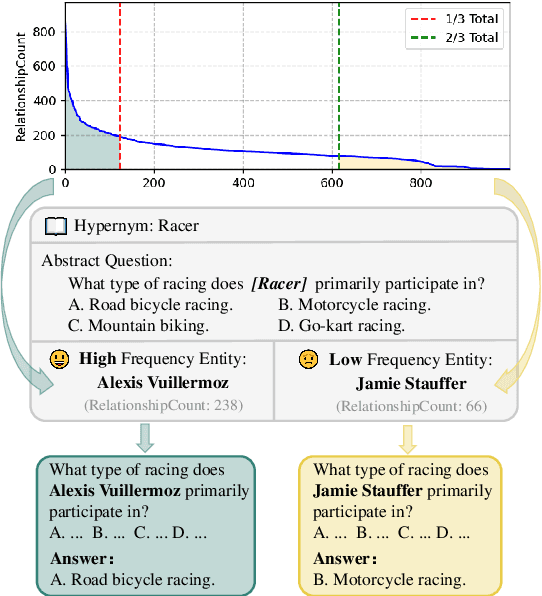
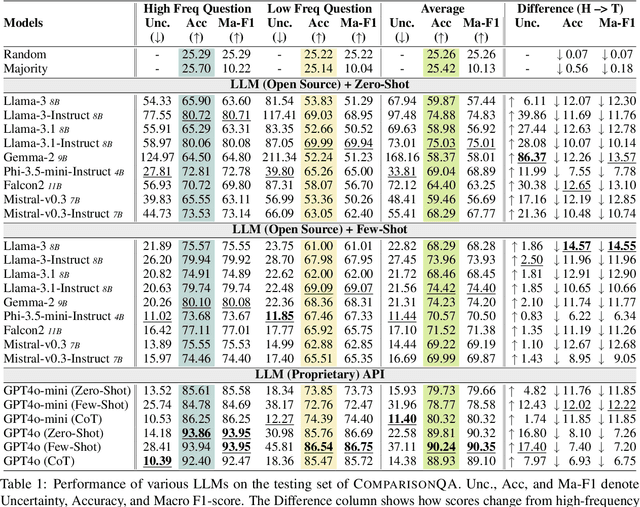
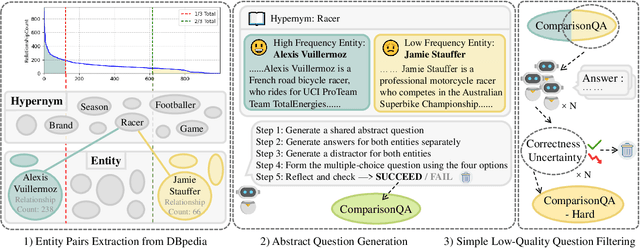
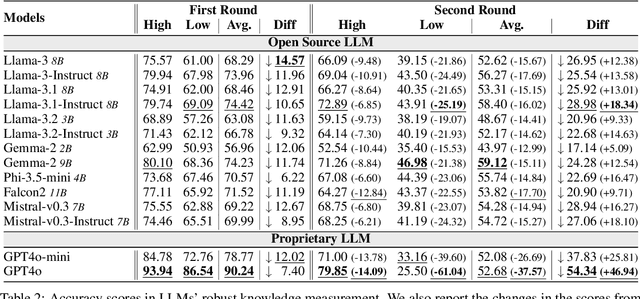
The rapid development of LLMs has sparked extensive research into their factual knowledge. Current works claim that LLMs fall short on questions requiring less frequent knowledge. However, their proof is incomplete since they only study the influence of entity frequency, which can not fully represent knowledge frequency. So we introduce ComparisonQA benchmark, containing 283K abstract questions, each instantiated by a pair of high-frequency and low-frequency entities. It ensures a controllable comparison because the difference of knowledge frequency between such a pair is only related to entity frequency. In addition, to avoid possible semantic shortcuts, which is a severe problem of current LLMs study, we design a two-round method for knowledge robustness measurement utilizing both correctness and uncertainty. Experiments reveal that LLMs exhibit particularly low robustness regarding low-frequency knowledge, and GPT-4o is even the worst under this measurement. Besides, we introduce an automatic method to filter out questions with low-quality and shortcuts to form ComparisonQA-Hard. We find that uncertainty effectively identifies such questions while maintaining the data size.