 Add to Chrome
 Add to Firefox
 Add to Edge
Input-Aware Dynamic Backdoor Attack Against Quantum Neural Networks
Jul 13, 2026
Quantum Neural Networks (QNNs) are a promising framework for quantum machine learning on near-term quantum devices, but their security risks remain insufficiently understood. Studies have shown that QNNs are vulnerable to backdoor attacks, yet existing quantum backdoors mostly rely on a fixed trigger shared by all poisoned inputs. This fixed-trigger design is a major weakness because many defenses detect or weaken the repeated patterns such triggers leave in data representations. Although input-aware dynamic backdoors have been studied in classical neural networks, transferring them to QNNs is difficult because quantum learning introduces new obstacles. In particular, measurement compresses the post-ansatz quantum state into a limited classical output, weakening supervision for a trigger generator, while individual density matrices fluctuate with the input and make per-sample contrastive learning unstable. To address these challenges, we propose Q-DIBA, the first input-aware dynamic backdoor attack for QNNs. Q-DIBA jointly trains a classical trigger generator and a victim QNN through a three-mode mini-batch strategy that supports clean behavior, attack activation, and trigger specificity. To provide stable quantum-level supervision, Q-DIBA introduces an ensemble density contrastive loss that operates on post-ansatz quantum states before measurement and contrasts mode-averaged density matrices rather than individual samples. Experiments on MNIST and Fashion-MNIST across multiple QNN architectures show that Q-DIBA achieves high clean accuracy, strong attack success, and high cross-trigger accuracy, demonstrating effectiveness, stealthiness, and input specificity. The attack also remains resilient against defenses including visual inspection, spectral-signature detection, and fine-tuning, suggesting that input-aware quantum backdoors are an important threat to secure QNN deployment.

RPP: A Certified Poisoned-Sample Detection Framework for Backdoor Attacks under Dataset Imbalance
Jan 30, 2026Deep neural networks are highly susceptible to backdoor attacks, yet most defense methods to date rely on balanced data, overlooking the pervasive class imbalance in real-world scenarios that can amplify backdoor threats. This paper presents the first in-depth investigation of how the dataset imbalance amplifies backdoor vulnerability, showing that (i) the imbalance induces a majority-class bias that increases susceptibility and (ii) conventional defenses degrade significantly as the imbalance grows. To address this, we propose Randomized Probability Perturbation (RPP), a certified poisoned-sample detection framework that operates in a black-box setting using only model output probabilities. For any inspected sample, RPP determines whether the input has been backdoor-manipulated, while offering provable within-domain detectability guarantees and a probabilistic upper bound on the false positive rate. Extensive experiments on five benchmarks (MNIST, SVHN, CIFAR-10, TinyImageNet and ImageNet10) covering 10 backdoor attacks and 12 baseline defenses show that RPP achieves significantly higher detection accuracy than state-of-the-art defenses, particularly under dataset imbalance. RPP establishes a theoretical and practical foundation for defending against backdoor attacks in real-world environments with imbalanced data.
Deep Incomplete Multi-View Clustering via Hierarchical Imputation and Alignment
Jan 14, 2026Incomplete multi-view clustering (IMVC) aims to discover shared cluster structures from multi-view data with partial observations. The core challenges lie in accurately imputing missing views without introducing bias, while maintaining semantic consistency across views and compactness within clusters. To address these challenges, we propose DIMVC-HIA, a novel deep IMVC framework that integrates hierarchical imputation and alignment with four key components: (1) view-specific autoencoders for latent feature extraction, coupled with a view-shared clustering predictor to produce soft cluster assignments; (2) a hierarchical imputation module that first estimates missing cluster assignments based on cross-view contrastive similarity, and then reconstructs missing features using intra-view, intra-cluster statistics; (3) an energy-based semantic alignment module, which promotes intra-cluster compactness by minimizing energy variance around low-energy cluster anchors; and (4) a contrastive assignment alignment module, which enhances cross-view consistency and encourages confident, well-separated cluster predictions. Experiments on benchmarks demonstrate that our framework achieves superior performance under varying levels of missingness.
PL-FSCIL: Harnessing the Power of Prompts for Few-Shot Class-Incremental Learning
Jan 26, 2024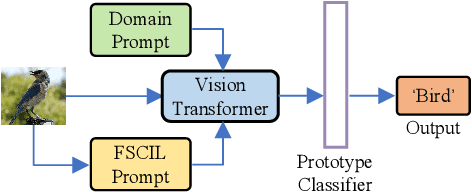
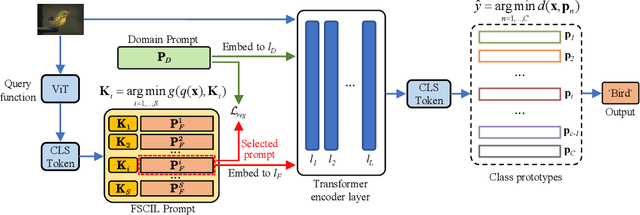
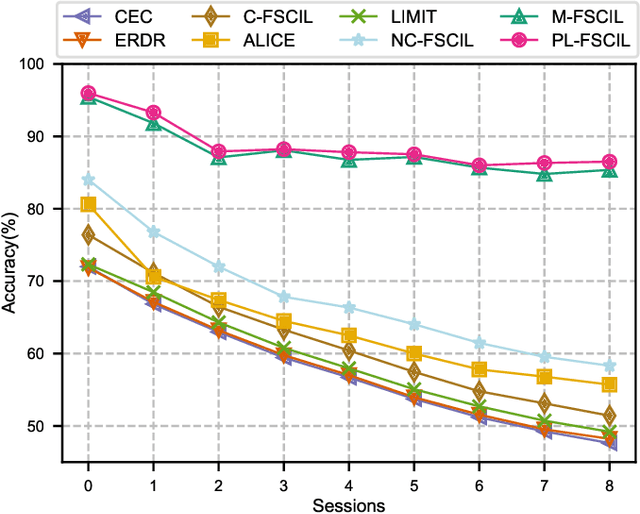
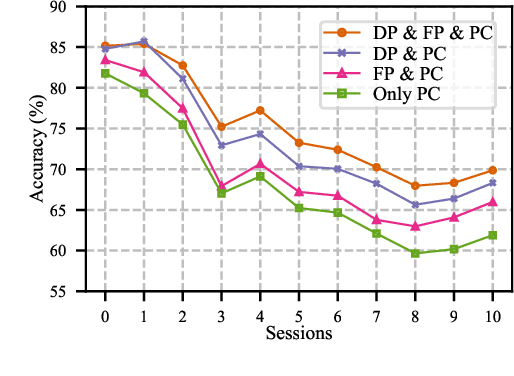
Few-Shot Class-Incremental Learning (FSCIL) aims to enable deep neural networks to learn new tasks incrementally from a small number of labeled samples without forgetting previously learned tasks, closely mimicking human learning patterns. In this paper, we propose a novel approach called Prompt Learning for FSCIL (PL-FSCIL), which harnesses the power of prompts in conjunction with a pre-trained Vision Transformer (ViT) model to address the challenges of FSCIL effectively. Our work pioneers the use of visual prompts in FSCIL, which is characterized by its notable simplicity. PL-FSCIL consists of two distinct prompts: the Domain Prompt and the FSCIL Prompt. Both are vectors that augment the model by embedding themselves into the attention layer of the ViT model. Specifically, the Domain Prompt assists the ViT model in adapting to new data domains. The task-specific FSCIL Prompt, coupled with a prototype classifier, amplifies the model's ability to effectively handle FSCIL tasks. We validate the efficacy of PL-FSCIL on widely used benchmark datasets such as CIFAR-100 and CUB-200. The results showcase competitive performance, underscoring its promising potential for real-world applications where high-quality data is often scarce. The source code is available at: https://github.com/TianSongS/PL-FSCIL.
A Survey on Few-Shot Class-Incremental Learning
Apr 17, 2023Large deep learning models are impressive, but they struggle when real-time data is not available. Few-shot class-incremental learning (FSCIL) poses a significant challenge for deep neural networks to learn new tasks from just a few labeled samples without forgetting the previously learned ones. This setup easily leads to catastrophic forgetting and overfitting problems, severely affecting model performance. Studying FSCIL helps overcome deep learning model limitations on data volume and acquisition time, while improving practicality and adaptability of machine learning models. This paper provides a comprehensive survey on FSCIL. Unlike previous surveys, we aim to synthesize few-shot learning and incremental learning, focusing on introducing FSCIL from two perspectives, while reviewing over 30 theoretical research studies and more than 20 applied research studies. From the theoretical perspective, we provide a novel categorization approach that divides the field into five subcategories, including traditional machine learning methods, meta-learning based methods, feature and feature space-based methods, replay-based methods, and dynamic network structure-based methods. We also evaluate the performance of recent theoretical research on benchmark datasets of FSCIL. From the application perspective, FSCIL has achieved impressive achievements in various fields of computer vision such as image classification, object detection, and image segmentation, as well as in natural language processing and graph. We summarize the important applications. Finally, we point out potential future research directions, including applications, problem setups, and theory development. Overall, this paper offers a comprehensive analysis of the latest advances in FSCIL from a methodological, performance, and application perspective.
NoiseCAM: Explainable AI for the Boundary Between Noise and Adversarial Attacks
Mar 09, 2023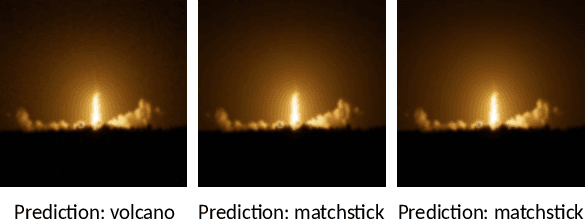
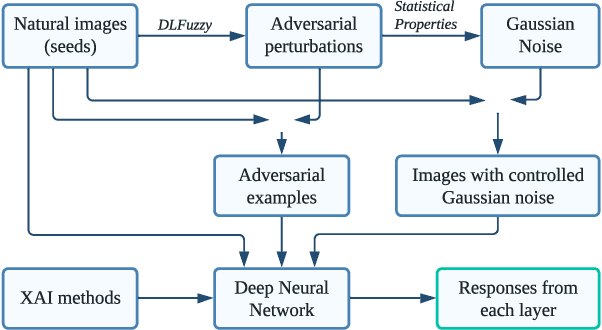
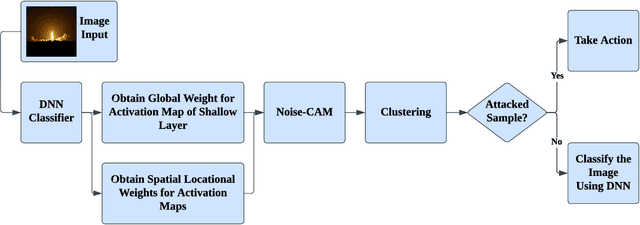
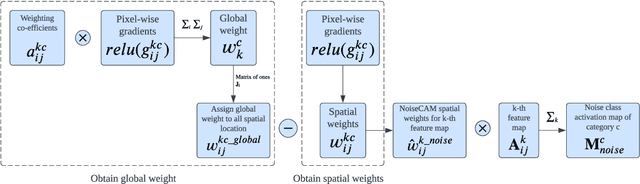
Deep Learning (DL) and Deep Neural Networks (DNNs) are widely used in various domains. However, adversarial attacks can easily mislead a neural network and lead to wrong decisions. Defense mechanisms are highly preferred in safety-critical applications. In this paper, firstly, we use the gradient class activation map (GradCAM) to analyze the behavior deviation of the VGG-16 network when its inputs are mixed with adversarial perturbation or Gaussian noise. In particular, our method can locate vulnerable layers that are sensitive to adversarial perturbation and Gaussian noise. We also show that the behavior deviation of vulnerable layers can be used to detect adversarial examples. Secondly, we propose a novel NoiseCAM algorithm that integrates information from globally and pixel-level weighted class activation maps. Our algorithm is susceptible to adversarial perturbations and will not respond to Gaussian random noise mixed in the inputs. Third, we compare detecting adversarial examples using both behavior deviation and NoiseCAM, and we show that NoiseCAM outperforms behavior deviation modeling in its overall performance. Our work could provide a useful tool to defend against certain adversarial attacks on deep neural networks.