 Add to Chrome
 Add to Firefox
 Add to Edge
Ensuring Safe and High-Quality Outputs: A Guideline Library Approach for Language Models
Mar 23, 2024
Large Language Models (LLMs) exhibit impressive capabilities but also present risks such as biased content generation and privacy issues. One of the current alignment techniques includes principle-driven integration, but it faces challenges arising from the imprecision of manually crafted rules and inadequate risk perception in models without safety training. To address these, we introduce Guide-Align, a two-stage approach. Initially, a safety-trained model identifies potential risks and formulates specific guidelines for various inputs, establishing a comprehensive library of guidelines and a model for input-guidelines retrieval. Subsequently, the retrieval model correlates new inputs with relevant guidelines, which guide LLMs in response generation to ensure safe and high-quality outputs, thereby aligning with human values. An additional optional stage involves fine-tuning a model with well-aligned datasets generated through the process implemented in the second stage. Our method customizes guidelines to accommodate diverse inputs, thereby enhancing the fine-grainedness and comprehensiveness of the guideline library. Furthermore, it incorporates safety expertise from a safety-trained LLM through a lightweight retrieval model. We evaluate our approach on three benchmarks, demonstrating significant improvements in LLM security and quality. Notably, our fine-tuned model, Labrador, even at 13 billion parameters, outperforms GPT-3.5-turbo and surpasses GPT-4 in alignment capabilities.

Key-Point-Driven Data Synthesis with its Enhancement on Mathematical Reasoning
Mar 04, 2024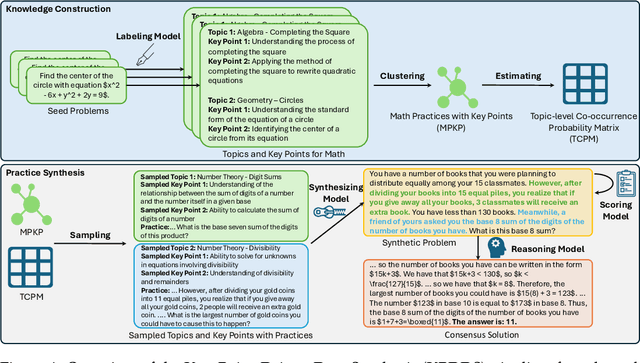
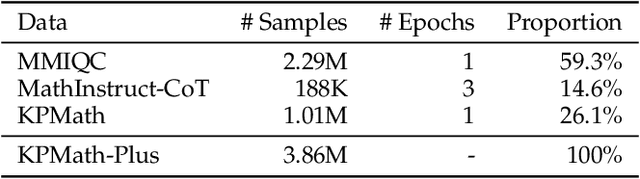
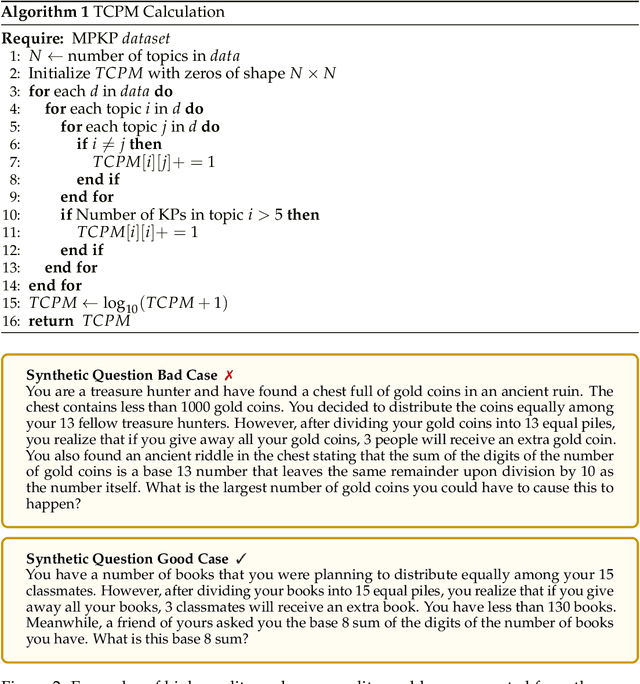
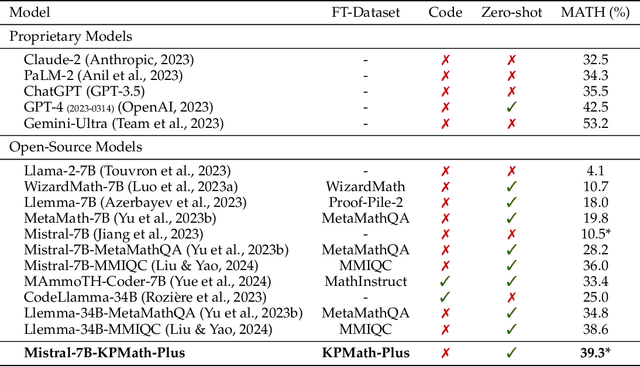
Large language models (LLMs) have shown great potential in complex reasoning tasks, yet their performance is often hampered by the scarcity of high-quality, reasoning-focused training datasets. Addressing this challenge, we propose Key-Point-Driven Data Synthesis (KPDDS), a novel data synthesis framework that synthesizes question-answer pairs by leveraging key points and exemplar pairs from authentic data sources. KPDDS ensures the generation of novel questions with rigorous quality control and substantial scalability. As a result, we present KPMath, the most extensive synthetic dataset tailored for mathematical reasoning to date, comprising over one million question-answer pairs. Utilizing KPMath and augmenting it with additional reasoning-intensive corpora, we create the comprehensive KPMath-Plus dataset. Fine-tuning the Mistral-7B model on KPMath-Plus yields a zero-shot PASS@1 accuracy of 39.3% on the MATH test set, a performance that not only outpaces other finetuned 7B models but also exceeds that of certain 34B models. Our ablation studies further confirm the substantial enhancement in mathematical reasoning across various subtopics, marking a significant stride in LLMs' reasoning capabilities.
Competition-Level Problems are Effective LLM Evaluators
Dec 05, 2023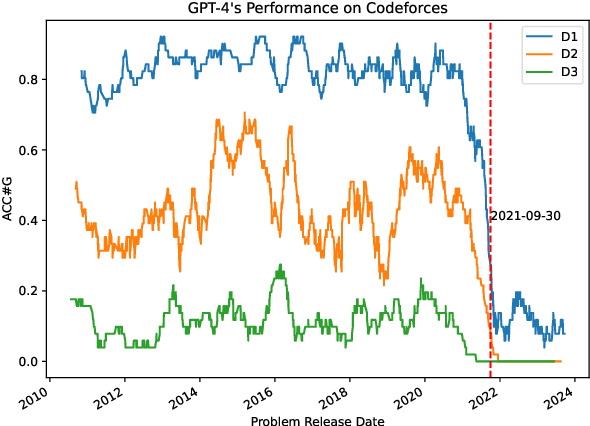
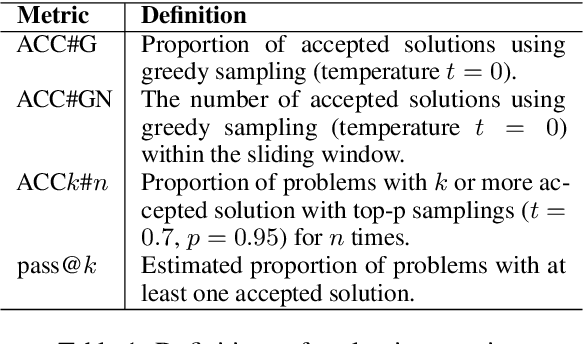
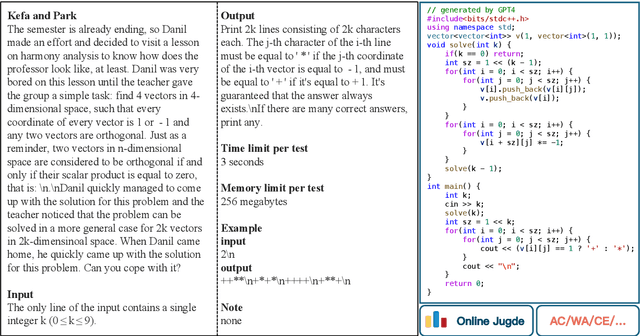
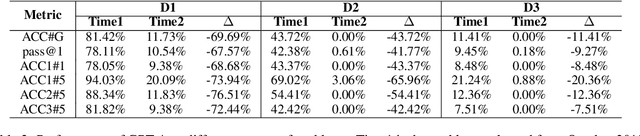
Large language models (LLMs) have demonstrated impressive reasoning capabilities, yet there is ongoing debate about these abilities and the potential data contamination problem recently. This paper aims to evaluate the reasoning capacities of LLMs, specifically in solving recent competition-level programming problems in Codeforces, which are expert-crafted and unique, requiring deep understanding and robust reasoning skills. We first provide a comprehensive evaluation of GPT-4's peiceived zero-shot performance on this task, considering various aspects such as problems' release time, difficulties, and types of errors encountered. Surprisingly, the peiceived performance of GPT-4 has experienced a cliff like decline in problems after September 2021 consistently across all the difficulties and types of problems, which shows the potential data contamination, as well as the challenges for any existing LLM to solve unseen complex reasoning problems. We further explore various approaches such as fine-tuning, Chain-of-Thought prompting and problem description simplification, unfortunately none of them is able to consistently mitigate the challenges. Through our work, we emphasis the importance of this excellent data source for assessing the genuine reasoning capabilities of LLMs, and foster the development of LLMs with stronger reasoning abilities and better generalization in the future.
Noisy Pair Corrector for Dense Retrieval
Nov 07, 2023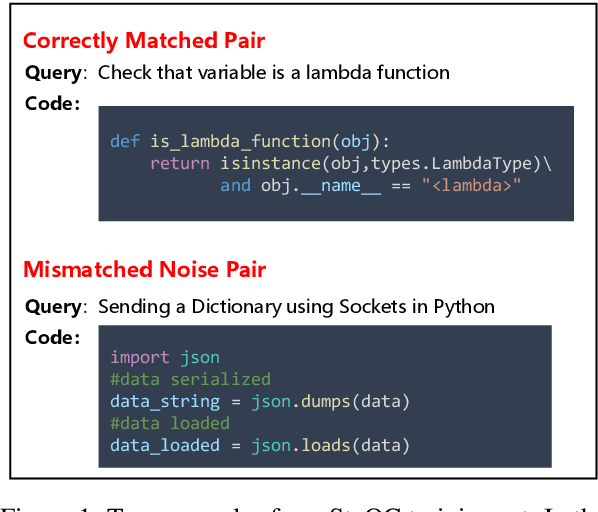
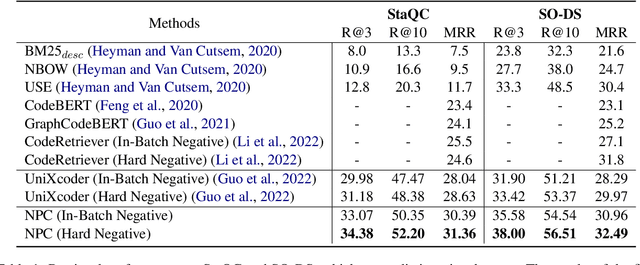
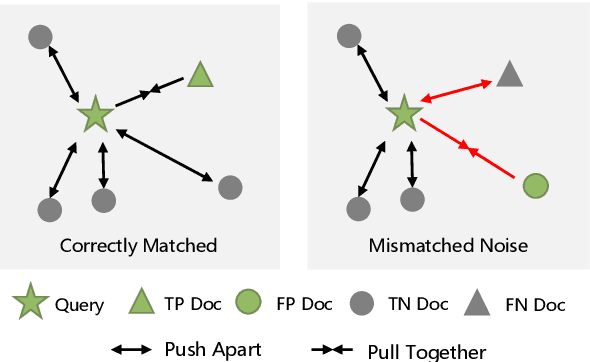
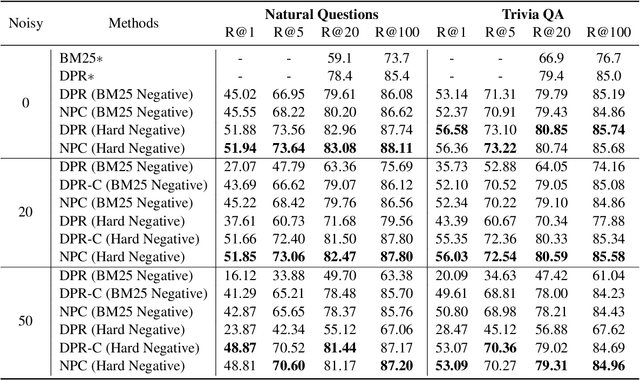
Most dense retrieval models contain an implicit assumption: the training query-document pairs are exactly matched. Since it is expensive to annotate the corpus manually, training pairs in real-world applications are usually collected automatically, which inevitably introduces mismatched-pair noise. In this paper, we explore an interesting and challenging problem in dense retrieval, how to train an effective model with mismatched-pair noise. To solve this problem, we propose a novel approach called Noisy Pair Corrector (NPC), which consists of a detection module and a correction module. The detection module estimates noise pairs by calculating the perplexity between annotated positive and easy negative documents. The correction module utilizes an exponential moving average (EMA) model to provide a soft supervised signal, aiding in mitigating the effects of noise. We conduct experiments on text-retrieval benchmarks Natural Question and TriviaQA, code-search benchmarks StaQC and SO-DS. Experimental results show that NPC achieves excellent performance in handling both synthetic and realistic noise.
Adapting LLM Agents Through Communication
Oct 10, 2023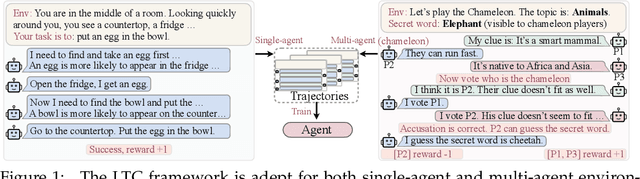
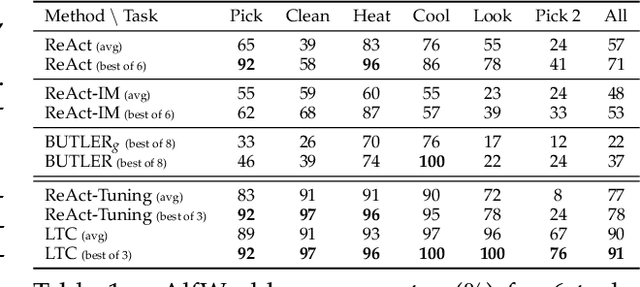

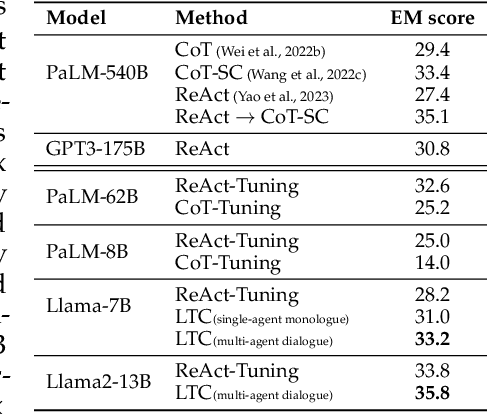
Recent advancements in large language models (LLMs) have shown potential for human-like agents. To help these agents adapt to new tasks without extensive human supervision, we propose the Learning through Communication (LTC) paradigm, a novel training approach enabling LLM agents to improve continuously through interactions with their environments and other agents. Recent advancements in large language models (LLMs) have shown potential for human-like agents. To help these agents adapt to new tasks without extensive human supervision, we propose the Learning through Communication (LTC) paradigm, a novel training approach enabling LLM agents to improve continuously through interactions with their environments and other agents. Through iterative exploration and PPO training, LTC empowers the agent to assimilate short-term experiences into long-term memory. To optimize agent interactions for task-specific learning, we introduce three structured communication patterns: Monologue, Dialogue, and Analogue-tailored for common tasks such as decision-making, knowledge-intensive reasoning, and numerical reasoning. We evaluated LTC on three datasets: ALFWorld (decision-making), HotpotQA (knowledge-intensive reasoning), and GSM8k (numerical reasoning). On ALFWorld, it exceeds the instruction tuning baseline by 12% in success rate. On HotpotQA, LTC surpasses the instruction-tuned LLaMA-7B agent by 5.1% in EM score, and it outperforms the instruction-tuned 9x larger PaLM-62B agent by 0.6%. On GSM8k, LTC outperforms the CoT-Tuning baseline by 3.6% in accuracy. The results showcase the versatility and efficiency of the LTC approach across diverse domains. We will open-source our code to promote further development of the community.
ToRA: A Tool-Integrated Reasoning Agent for Mathematical Problem Solving
Oct 04, 2023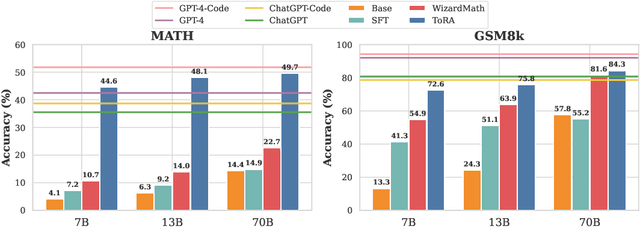

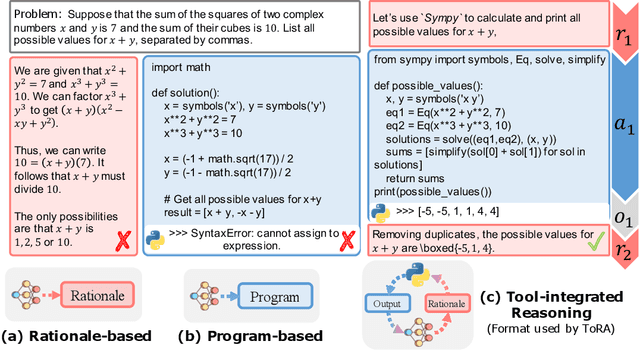
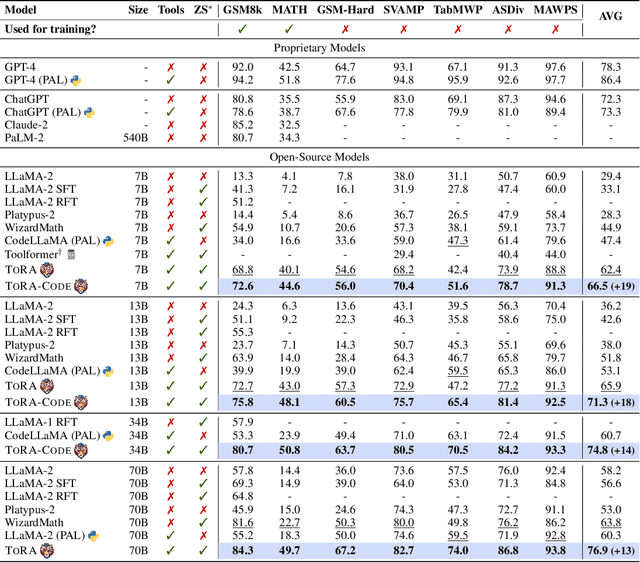
Large language models have made significant progress in various language tasks, yet they still struggle with complex mathematics. In this paper, we propose ToRA a series of Tool-integrated Reasoning Agents designed to solve challenging mathematical problems by seamlessly integrating natural language reasoning with the utilization of external tools (e.g., computation libraries and symbolic solvers), thereby amalgamating the analytical prowess of language and the computational efficiency of tools. To train ToRA, we curate interactive tool-use trajectories on mathematical datasets, apply imitation learning on the annotations, and propose output space shaping to further refine models' reasoning behavior. As a result, ToRA models significantly outperform open-source models on 10 mathematical reasoning datasets across all scales with 13%-19% absolute improvements on average. Notably, ToRA-7B reaches 44.6% on the competition-level dataset MATH, surpassing the best open-source model WizardMath-70B by 22% absolute. ToRA-Code-34B is also the first open-source model that achieves an accuracy exceeding 50% on MATH, which significantly outperforms GPT-4's CoT result, and is competitive with GPT-4 solving problems with programs. Additionally, we conduct a comprehensive analysis of the benefits and remaining challenges of tool interaction for mathematical reasoning, providing valuable insights for future research.
Think-on-Graph: Deep and Responsible Reasoning of Large Language Model with Knowledge Graph
Jul 15, 2023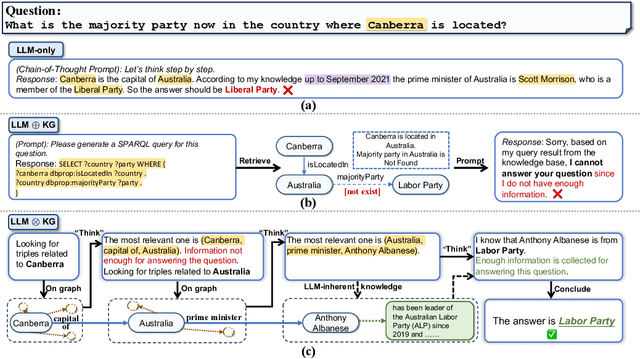


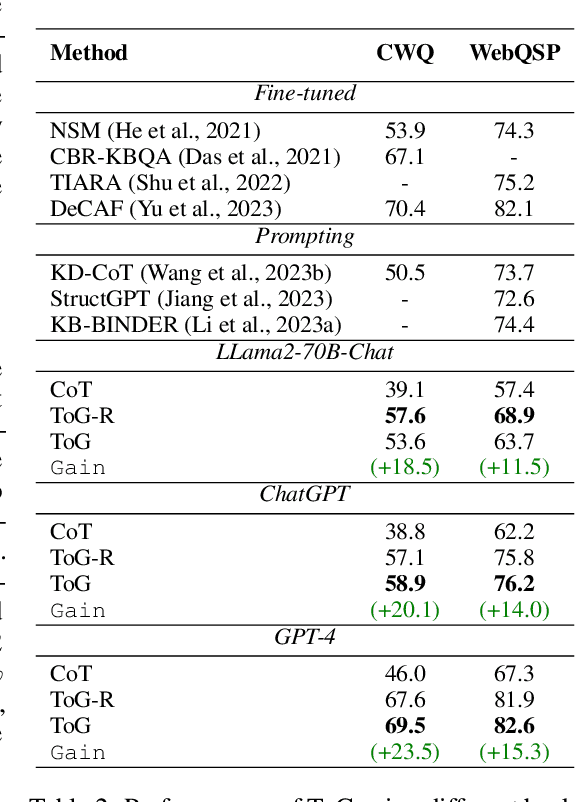
Large language models (LLMs) have made significant strides in various tasks, yet they often struggle with complex reasoning and exhibit poor performance in scenarios where knowledge traceability, timeliness, and accuracy are crucial. To address these limitations, we present Think-on-Graph (ToG), a novel framework that leverages knowledge graphs to enhance LLMs' ability for deep and responsible reasoning. By employing ToG, we can identify entities relevant to a given question and conduct exploration and reasoning to retrieve related triples from an external knowledge database. This iterative procedure generates multiple reasoning pathways consisting of sequentially connected triplets until sufficient information is gathered to answer the question or the maximum depth is reached. Through experiments on complex multi-hop reasoning question-answering tasks, we demonstrate that ToG outperforms existing methods, effectively addressing the aforementioned limitations of LLMs without incurring additional training costs.
CMMLU: Measuring massive multitask language understanding in Chinese
Jun 15, 2023


As the capabilities of large language models (LLMs) continue to advance, evaluating their performance becomes increasingly crucial and challenging. This paper aims to bridge this gap by introducing CMMLU, a comprehensive Chinese benchmark that covers various subjects, including natural science, social sciences, engineering, and humanities. We conduct a thorough evaluation of 18 advanced multilingual- and Chinese-oriented LLMs, assessing their performance across different subjects and settings. The results reveal that most existing LLMs struggle to achieve an average accuracy of 50%, even when provided with in-context examples and chain-of-thought prompts, whereas the random baseline stands at 25%. This highlights significant room for improvement in LLMs. Additionally, we conduct extensive experiments to identify factors impacting the models' performance and propose directions for enhancing LLMs. CMMLU fills the gap in evaluating the knowledge and reasoning capabilities of large language models within the Chinese context.
Enhancing Retrieval-Augmented Large Language Models with Iterative Retrieval-Generation Synergy
May 24, 2023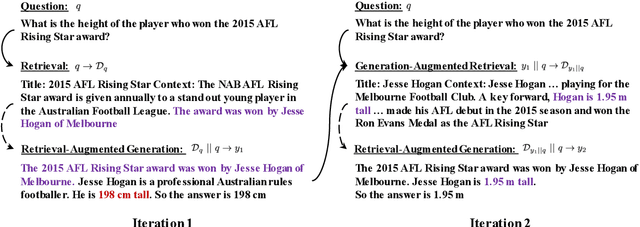
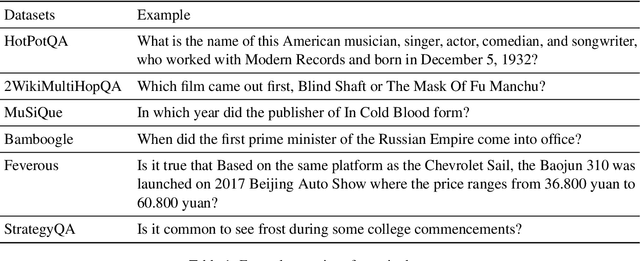
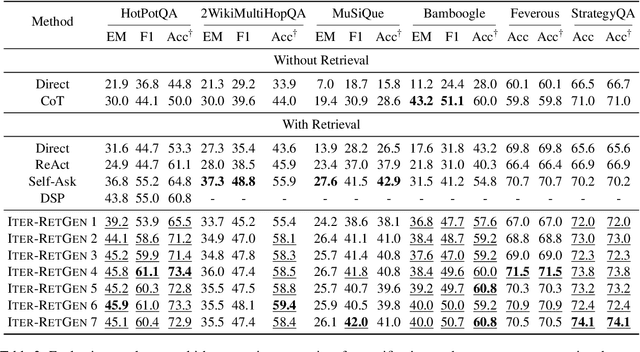

Large language models are powerful text processors and reasoners, but are still subject to limitations including outdated knowledge and hallucinations, which necessitates connecting them to the world. Retrieval-augmented large language models have raised extensive attention for grounding model generation on external knowledge. However, retrievers struggle to capture relevance, especially for queries with complex information needs. Recent work has proposed to improve relevance modeling by having large language models actively involved in retrieval, i.e., to improve retrieval with generation. In this paper, we show that strong performance can be achieved by a method we call Iter-RetGen, which synergizes retrieval and generation in an iterative manner. A model output shows what might be needed to finish a task, and thus provides an informative context for retrieving more relevant knowledge which in turn helps generate a better output in the next iteration. Compared with recent work which interleaves retrieval with generation when producing an output, Iter-RetGen processes all retrieved knowledge as a whole and largely preserves the flexibility in generation without structural constraints. We evaluate Iter-RetGen on multi-hop question answering, fact verification, and commonsense reasoning, and show that it can flexibly leverage parametric knowledge and non-parametric knowledge, and is superior to or competitive with state-of-the-art retrieval-augmented baselines while causing fewer overheads of retrieval and generation. We can further improve performance via generation-augmented retrieval adaptation.
BeamSearchQA: Large Language Models are Strong Zero-Shot QA Solver
May 24, 2023Open-domain question answering is a crucial task that often requires accessing external information. Existing methods typically adopt a single-turn retrieve-then-read approach, where relevant documents are first retrieved, and questions are then answered based on the retrieved information. However, there are cases where answering a question requires implicit knowledge that is not directly retrievable from the question itself. In this work, we propose a novel question-answering pipeline called eamSearchQA. Our approach leverages large language models(LLMs) to iteratively generate new questions about the original question, enabling an iterative reasoning process. By iteratively refining and expanding the scope of the question, our method aims to capture and utilize hidden knowledge that may not be directly obtainable through retrieval. We evaluate our approach on the widely-used open-domain NQ and WebQ datasets. The experimental results demonstrate that BeamSearchQA significantly outperforms other zero-shot baselines, indicating its effectiveness in tackling the challenges of open-domain question answering.