 Add to Chrome
 Add to Firefox
 Add to Edge
SAE-V: Interpreting Multimodal Models for Enhanced Alignment
Feb 22, 2025
With the integration of image modality, the semantic space of multimodal large language models (MLLMs) is more complex than text-only models, making their interpretability more challenging and their alignment less stable, particularly susceptible to low-quality data, which can lead to inconsistencies between modalities, hallucinations, and biased outputs. As a result, developing interpretability methods for MLLMs is crucial for improving alignment quality and efficiency. In text-only LLMs, Sparse Autoencoders (SAEs) have gained attention for their ability to interpret latent representations. However, extending SAEs to multimodal settings presents new challenges due to modality fusion and the difficulty of isolating cross-modal representations. To address these challenges, we introduce SAE-V, a mechanistic interpretability framework that extends the SAE paradigm to MLLMs. By identifying and analyzing interpretable features along with their corresponding data, SAE-V enables fine-grained interpretation of both model behavior and data quality, facilitating a deeper understanding of cross-modal interactions and alignment dynamics. Moreover, by utilizing cross-modal feature weighting, SAE-V provides an intrinsic data filtering mechanism to enhance model alignment without requiring additional models. Specifically, when applied to the alignment process of MLLMs, SAE-V-based data filtering methods could achieve more than 110% performance with less than 50% data. Our results highlight SAE-V's ability to enhance interpretability and alignment in MLLMs, providing insights into their internal mechanisms.

Model Evolution Framework with Genetic Algorithm for Multi-Task Reinforcement Learning
Feb 19, 2025Multi-task reinforcement learning employs a single policy to complete various tasks, aiming to develop an agent with generalizability across different scenarios. Given the shared characteristics of tasks, the agent's learning efficiency can be enhanced through parameter sharing. Existing approaches typically use a routing network to generate specific routes for each task and reconstruct a set of modules into diverse models to complete multiple tasks simultaneously. However, due to the inherent difference between tasks, it is crucial to allocate resources based on task difficulty, which is constrained by the model's structure. To this end, we propose a Model Evolution framework with Genetic Algorithm (MEGA), which enables the model to evolve during training according to the difficulty of the tasks. When the current model is insufficient for certain tasks, the framework will automatically incorporate additional modules, enhancing the model's capabilities. Moreover, to adapt to our model evolution framework, we introduce a genotype module-level model, using binary sequences as genotype policies for model reconstruction, while leveraging a non-gradient genetic algorithm to optimize these genotype policies. Unlike routing networks with fixed output dimensions, our approach allows for the dynamic adjustment of the genotype policy length, enabling it to accommodate models with a varying number of modules. We conducted experiments on various robotics manipulation tasks in the Meta-World benchmark. Our state-of-the-art performance demonstrated the effectiveness of the MEGA framework. We will release our source code to the public.
Dual Ensembled Multiagent Q-Learning with Hypernet Regularizer
Feb 04, 2025Overestimation in single-agent reinforcement learning has been extensively studied. In contrast, overestimation in the multiagent setting has received comparatively little attention although it increases with the number of agents and leads to severe learning instability. Previous works concentrate on reducing overestimation in the estimation process of target Q-value. They ignore the follow-up optimization process of online Q-network, thus making it hard to fully address the complex multiagent overestimation problem. To solve this challenge, in this study, we first establish an iterative estimation-optimization analysis framework for multiagent value-mixing Q-learning. Our analysis reveals that multiagent overestimation not only comes from the computation of target Q-value but also accumulates in the online Q-network's optimization. Motivated by it, we propose the Dual Ensembled Multiagent Q-Learning with Hypernet Regularizer algorithm to tackle multiagent overestimation from two aspects. First, we extend the random ensemble technique into the estimation of target individual and global Q-values to derive a lower update target. Second, we propose a novel hypernet regularizer on hypernetwork weights and biases to constrain the optimization of online global Q-network to prevent overestimation accumulation. Extensive experiments in MPE and SMAC show that the proposed method successfully addresses overestimation across various tasks.
RedStar: Does Scaling Long-CoT Data Unlock Better Slow-Reasoning Systems?
Jan 20, 2025Can scaling transform reasoning? In this work, we explore the untapped potential of scaling Long Chain-of-Thought (Long-CoT) data to 1000k samples, pioneering the development of a slow-thinking model, RedStar. Through extensive experiments with various LLMs and different sizes, we uncover the ingredients for specialization and scale for Long-CoT training. Surprisingly, even smaller models show significant performance gains with limited data, revealing the sample efficiency of Long-CoT and the critical role of sample difficulty in the learning process. Our findings demonstrate that Long-CoT reasoning can be effectively triggered with just a few thousand examples, while larger models achieve unparalleled improvements. We also introduce reinforcement learning (RL)-scale training as a promising direction for advancing slow-thinking systems. RedStar shines across domains: on the MATH-Hard benchmark, RedStar-code-math boosts performance from 66.2\% to 81.6\%, and on the USA Math Olympiad (AIME), it solves 46.7\% of problems using only 21k mixed-code-math datasets. In multimodal tasks like GeoQA and MathVista-GEO, RedStar-Geo achieves competitive results with minimal Long-CoT data, outperforming other slow-thinking systems like QvQ-Preview. Compared to QwQ, RedStar strikes the perfect balance between reasoning and generalizability. Our work highlights that, with careful tuning, scaling Long-CoT can unlock extraordinary reasoning capabilities-even with limited dataset and set a new standard for slow-thinking models across diverse challenges. Our data and models are released at https://huggingface.co/RedStar-Reasoning.
Stream Aligner: Efficient Sentence-Level Alignment via Distribution Induction
Jan 09, 2025The rapid advancement of large language models (LLMs) has led to significant improvements in their capabilities, but also to increased concerns about their alignment with human values and intentions. Current alignment strategies, including adaptive training and inference-time methods, have demonstrated potential in this area. However, these approaches still struggle to balance deployment complexity and capability across various tasks and difficulties. In this work, we introduce the Streaming Distribution Induce Aligner (Stream Aligner), a novel alignment paradigm that combines efficiency with enhanced performance in various tasks throughout the generation process. Stream Aligner achieves dynamic sentence-level correction by using a small model to learn the preferences of the suffix sentence, iteratively correcting the suffix sentence output by the upstream model, and then using the corrected sentence to replace the suffix sentence in subsequent generations. Compared to Aligner, our experiments demonstrate that Stream Aligner reduces reliance on the capabilities of additional models, enhances the reasoning abilities of LLMs, and decreases latency during user interaction. Specifically, Stream Aligner-2B model has achieved an improvement of 76.1% in helpfulness, 36.0% in harmlessness on the tested Llama2-70B-chat model, and Stream Aligner-8B has achieved an improvement of 3.5% on the math ability of the tested Llama3-70B-Instruct model.
Libra-Leaderboard: Towards Responsible AI through a Balanced Leaderboard of Safety and Capability
Dec 24, 2024


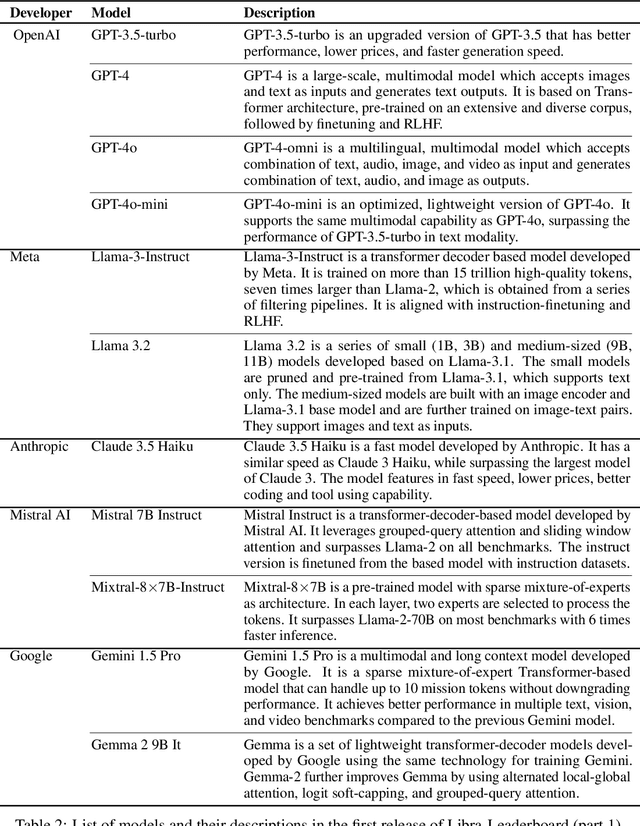
To address this gap, we introduce Libra-Leaderboard, a comprehensive framework designed to rank LLMs through a balanced evaluation of performance and safety. Combining a dynamic leaderboard with an interactive LLM arena, Libra-Leaderboard encourages the joint optimization of capability and safety. Unlike traditional approaches that average performance and safety metrics, Libra-Leaderboard uses a distance-to-optimal-score method to calculate the overall rankings. This approach incentivizes models to achieve a balance rather than excelling in one dimension at the expense of some other ones. In the first release, Libra-Leaderboard evaluates 26 mainstream LLMs from 14 leading organizations, identifying critical safety challenges even in state-of-the-art models.
Align Anything: Training All-Modality Models to Follow Instructions with Language Feedback
Dec 20, 2024


Reinforcement learning from human feedback (RLHF) has proven effective in enhancing the instruction-following capabilities of large language models; however, it remains underexplored in the cross-modality domain. As the number of modalities increases, aligning all-modality models with human intentions -- such as instruction following -- becomes a pressing challenge. In this work, we make the first attempt to fine-tune all-modality models (i.e. input and output with any modality, also named any-to-any models) using human preference data across all modalities (including text, image, audio, and video), ensuring its behavior aligns with human intentions. This endeavor presents several challenges. First, there is no large-scale all-modality human preference data in existing open-source resources, as most datasets are limited to specific modalities, predominantly text and image. Secondly, the effectiveness of binary preferences in RLHF for post-training alignment in complex all-modality scenarios remains an unexplored area. Finally, there is a lack of a systematic framework to evaluate the capabilities of all-modality models, particularly regarding modality selection and synergy. To address these challenges, we propose the align-anything framework, which includes meticulously annotated 200k all-modality human preference data. Then, we introduce an alignment method that learns from unified language feedback, effectively capturing complex modality-specific human preferences and enhancing the model's instruction-following capabilities. Furthermore, to assess performance improvements in all-modality models after post-training alignment, we construct a challenging all-modality capability evaluation framework -- eval-anything. All data, models, and code frameworks have been open-sourced for the community. For more details, please refer to https://github.com/PKU-Alignment/align-anything.
Safe Reinforcement Learning using Finite-Horizon Gradient-based Estimation
Dec 15, 2024A key aspect of Safe Reinforcement Learning (Safe RL) involves estimating the constraint condition for the next policy, which is crucial for guiding the optimization of safe policy updates. However, the existing Advantage-based Estimation (ABE) method relies on the infinite-horizon discounted advantage function. This dependence leads to catastrophic errors in finite-horizon scenarios with non-discounted constraints, resulting in safety-violation updates. In response, we propose the first estimation method for finite-horizon non-discounted constraints in deep Safe RL, termed Gradient-based Estimation (GBE), which relies on the analytic gradient derived along trajectories. Our theoretical and empirical analyses demonstrate that GBE can effectively estimate constraint changes over a finite horizon. Constructing a surrogate optimization problem with GBE, we developed a novel Safe RL algorithm called Constrained Gradient-based Policy Optimization (CGPO). CGPO identifies feasible optimal policies by iteratively resolving sub-problems within trust regions. Our empirical results reveal that CGPO, unlike baseline algorithms, successfully estimates the constraint functions of subsequent policies, thereby ensuring the efficiency and feasibility of each update.
RAT: Adversarial Attacks on Deep Reinforcement Agents for Targeted Behaviors
Dec 14, 2024Evaluating deep reinforcement learning (DRL) agents against targeted behavior attacks is critical for assessing their robustness. These attacks aim to manipulate the victim into specific behaviors that align with the attacker's objectives, often bypassing traditional reward-based defenses. Prior methods have primarily focused on reducing cumulative rewards; however, rewards are typically too generic to capture complex safety requirements effectively. As a result, focusing solely on reward reduction can lead to suboptimal attack strategies, particularly in safety-critical scenarios where more precise behavior manipulation is needed. To address these challenges, we propose RAT, a method designed for universal, targeted behavior attacks. RAT trains an intention policy that is explicitly aligned with human preferences, serving as a precise behavioral target for the adversary. Concurrently, an adversary manipulates the victim's policy to follow this target behavior. To enhance the effectiveness of these attacks, RAT dynamically adjusts the state occupancy measure within the replay buffer, allowing for more controlled and effective behavior manipulation. Our empirical results on robotic simulation tasks demonstrate that RAT outperforms existing adversarial attack algorithms in inducing specific behaviors. Additionally, RAT shows promise in improving agent robustness, leading to more resilient policies. We further validate RAT by guiding Decision Transformer agents to adopt behaviors aligned with human preferences in various MuJoCo tasks, demonstrating its effectiveness across diverse tasks.
Random Feature Models with Learnable Activation Functions
Nov 29, 2024Current random feature models typically rely on fixed activation functions, limiting their ability to capture diverse patterns in data. To address this, we introduce the Random Feature model with Learnable Activation Functions (RFLAF), a novel model that significantly enhances the expressivity and interpretability of traditional random feature (RF) models. We begin by studying the RF model with a single radial basis function, where we discover a new kernel and provide the first theoretical analysis on it. By integrating the basis functions with learnable weights, we show that RFLAF can represent a broad class of random feature models whose activation functions belong in $C_c(\mathbb{R})$. Theoretically, we prove that the model requires only about twice the parameter number compared to a traditional RF model to achieve the significant leap in expressivity. Experimentally, RFLAF demonstrates two key advantages: (1) it performs better across various tasks compared to traditional RF model with the same number of parameters, and (2) the optimized weights offer interpretability, as the learned activation function can be directly inferred from these weights. Our model paves the way for developing more expressive and interpretable frameworks within random feature models.