 Add to Chrome
 Add to Firefox
 Add to Edge
Frequency-Aware Flow Matching for Continuous and Consistent Robotic Action Generation
Jun 18, 2026
Flow matching has emerged as a standard paradigm for robotic manipulation owing to its strong expressive power for modelling complex, multimodal action distributions, alongside similar approaches like diffusion policy. However, existing methods rely on discretized action chunks, making them brittle to demonstrations collected at heterogeneous control frequencies and prone to temporally inconsistent actions that degrade control stability. In this paper, we propose Frequency-Aware Flow Matching (FAFM), which outputs continuous, temporally consistent actions. To handle heterogeneous frequency input, we transform discrete action sequences into the frequency domain with the discrete cosine transform (DCT), perform flow matching over the resulting coefficients, and reconstruct continuous actions via cosine basis expansion. To generate temporally consistent actions, we regularize the first-order temporal derivative to promote smooth actions. This corresponds to a Sobolev-type constraint that suppresses high-frequency errors and discourages abrupt action changes. Our FAFM is simple, introduces no additional network parameters and applies to standalone flow-matching policies and vision-language action models. Across synthetic toy benchmark, obstacle avoidance, LapGym, and LIBERO, FAFM improves success rates, multimodal expressivity, motion smoothness, convergence speed, robustness to mechanical bias and mixed-frequency input. These gains are consistent when deployed on a real-world Franka robot. Code available at https://anonymous.4open.science/r/FAFM.

Finding Kissing Numbers with Game-theoretic Reinforcement Learning
Nov 17, 2025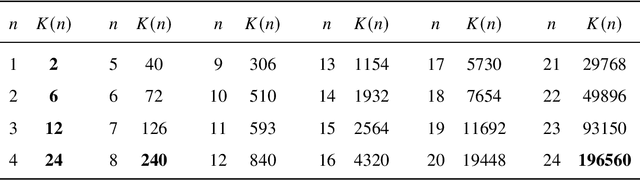
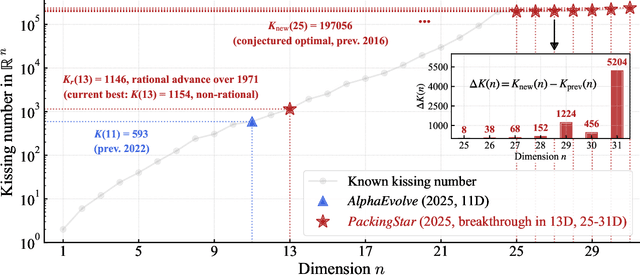
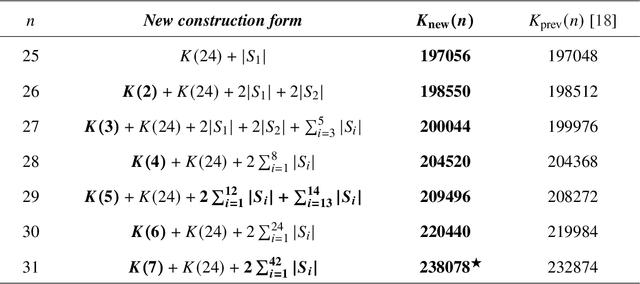
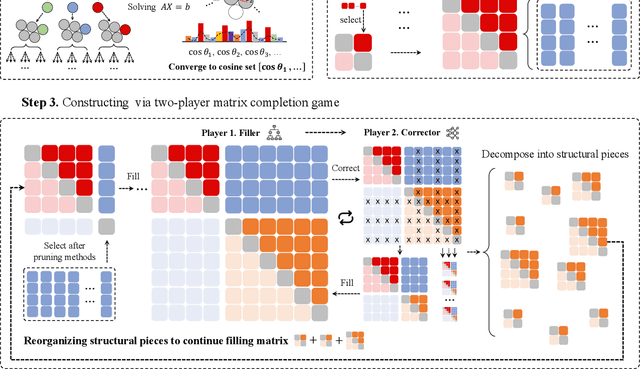
Since Isaac Newton first studied the Kissing Number Problem in 1694, determining the maximal number of non-overlapping spheres around a central sphere has remained a fundamental challenge. This problem represents the local analogue of Hilbert's 18th problem on sphere packing, bridging geometry, number theory, and information theory. Although significant progress has been made through lattices and codes, the irregularities of high-dimensional geometry and exponentially growing combinatorial complexity beyond 8 dimensions, which exceeds the complexity of Go game, limit the scalability of existing methods. Here we model this problem as a two-player matrix completion game and train the game-theoretic reinforcement learning system, PackingStar, to efficiently explore high-dimensional spaces. The matrix entries represent pairwise cosines of sphere center vectors; one player fills entries while another corrects suboptimal ones, jointly maximizing the matrix size, corresponding to the kissing number. This cooperative dynamics substantially improves sample quality, making the extremely large spaces tractable. PackingStar reproduces previous configurations and surpasses all human-known records from dimensions 25 to 31, with the configuration in 25 dimensions geometrically corresponding to the Leech lattice and suggesting possible optimality. It achieves the first breakthrough beyond rational structures from 1971 in 13 dimensions and discovers over 6000 new structures in 14 and other dimensions. These results demonstrate AI's power to explore high-dimensional spaces beyond human intuition and open new pathways for the Kissing Number Problem and broader geometry problems.
Vulnerable Agent Identification in Large-Scale Multi-Agent Reinforcement Learning
Sep 18, 2025Partial agent failure becomes inevitable when systems scale up, making it crucial to identify the subset of agents whose compromise would most severely degrade overall performance. In this paper, we study this Vulnerable Agent Identification (VAI) problem in large-scale multi-agent reinforcement learning (MARL). We frame VAI as a Hierarchical Adversarial Decentralized Mean Field Control (HAD-MFC), where the upper level involves an NP-hard combinatorial task of selecting the most vulnerable agents, and the lower level learns worst-case adversarial policies for these agents using mean-field MARL. The two problems are coupled together, making HAD-MFC difficult to solve. To solve this, we first decouple the hierarchical process by Fenchel-Rockafellar transform, resulting a regularized mean-field Bellman operator for upper level that enables independent learning at each level, thus reducing computational complexity. We then reformulate the upper-level combinatorial problem as a MDP with dense rewards from our regularized mean-field Bellman operator, enabling us to sequentially identify the most vulnerable agents by greedy and RL algorithms. This decomposition provably preserves the optimal solution of the original HAD-MFC. Experiments show our method effectively identifies more vulnerable agents in large-scale MARL and the rule-based system, fooling system into worse failures, and learns a value function that reveals the vulnerability of each agent.