 Add to Chrome
 Add to Firefox
 Add to Edge
SportsGPT: An LLM-driven Framework for Interpretable Sports Motion Assessment and Training Guidance
Dec 19, 2025
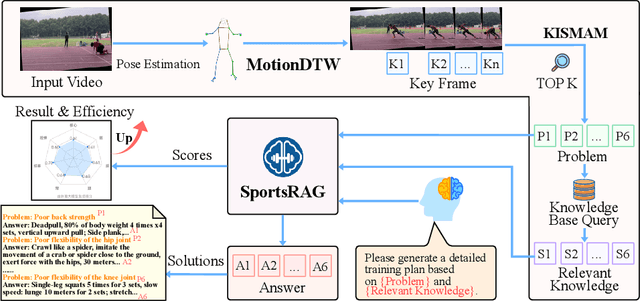
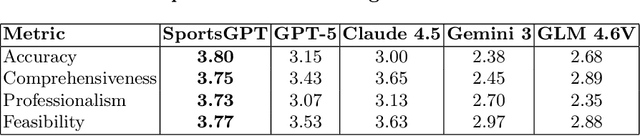
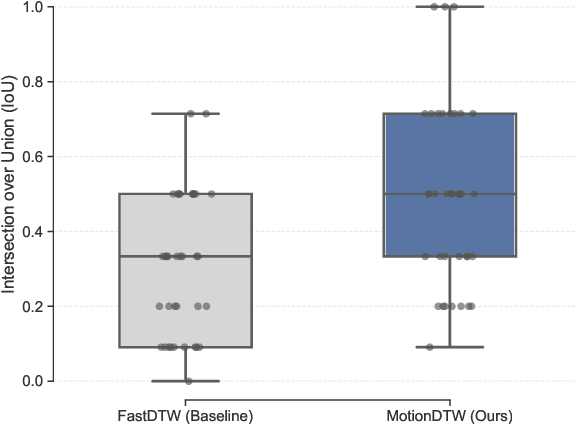

Existing intelligent sports analysis systems mainly focus on "scoring and visualization," often lacking automatic performance diagnosis and interpretable training guidance. Recent advances in Large Language Models (LLMs) and motion analysis techniques provide new opportunities to address the above limitations. In this paper, we propose SportsGPT, an LLM-driven framework for interpretable sports motion assessment and training guidance, which establishes a closed loop from motion time-series input to professional training guidance. First, given a set of high-quality target models, we introduce MotionDTW, a two-stage time series alignment algorithm designed for accurate keyframe extraction from skeleton-based motion sequences. Subsequently, we design a Knowledge-based Interpretable Sports Motion Assessment Model (KISMAM) to obtain a set of interpretable assessment metrics (e.g., insufficient extension) by contrasting the keyframes with the target models. Finally, we propose SportsRAG, a RAG-based training guidance model built upon Qwen3. Leveraging a 6B-token knowledge base, it prompts the LLM to generate professional training guidance by retrieving domain-specific QA pairs. Experimental results demonstrate that MotionDTW significantly outperforms traditional methods with lower temporal error and higher IoU scores. Furthermore, ablation studies validate the KISMAM and SportsRAG, confirming that SportsGPT surpasses general LLMs in diagnostic accuracy and professionalism.

A Visual Perception-Based Tunable Framework and Evaluation Benchmark for H.265/HEVC ROI Encryption
Nov 09, 2025ROI selective encryption, as an efficient privacy protection technique, encrypts only the key regions in the video, thereby ensuring security while minimizing the impact on coding efficiency. However, existing ROI-based video encryption methods suffer from insufficient flexibility and lack of a unified evaluation system. To address these issues, we propose a visual perception-based tunable framework and evaluation benchmark for H.265/HEVC ROI encryption. Our scheme introduces three key contributions: 1) A ROI region recognition module based on visual perception network is proposed to accurately identify the ROI region in videos. 2) A three-level tunable encryption strategy is implemented while balancing security and real-time performance. 3) A unified ROI encryption evaluation benchmark is developed to provide a standardized quantitative platform for subsequent research. This triple strategy provides new solution and significant unified performance evaluation methods for ROI selective encryption field. Experimental results indicate that the proposed benchmark can comprehensively measure the performance of the ROI selective encryption. Compared to existing ROI encryption algorithms, our proposed enhanced and advanced level encryption exhibit superior performance in multiple performance metrics. In general, the proposed framework effectively meets the privacy protection requirements in H.265/HEVC and provides a reliable solution for secure and efficient processing of sensitive video content.