 Add to Chrome
 Add to Firefox
 Add to Edge
Implicit Virtual Leader: Decentralized Vision-Only Relative Pose Estimation for Multi-Robot Formations
Jul 17, 2026
Classical leader-follower formation control suffers from single points of failure and error propagation, and relies on absolute localization sensors that are ill-suited for GPS-denied environments. We address these limitations by introducing a fully decentralized, vision-only relative pose estimation framework based on Graph Neural Networks (GNNs). The key idea is the implicit virtual leader (IVL): a non-physical formation reference frame that is not tied to any individual robot but is implicitly learned within the GNN using only monocular images and inter-robot communication. We attach a heteroscedastic GNLL head for aleatoric uncertainty and MC~Dropout for epistemic uncertainty, and conduct a systematic comparison across simulation and real-world test sets. Our framework achieves competitive pose estimation accuracy and generalizes naturally to heterogeneous robot platforms and varying formation sizes.

FabriVLA: A Lightweight Vision-Language-Action Model for Precise Multi-Task Manipulation
Jul 09, 2026We present FabriVLA, a lightweight Vision-Language-Action model for Precise Multi-Task Manipulation. FabriVLA combines an InternVL3.5 vision-language backbone with a flow-matching action head featuring gated self-attention across action tokens and shallow VLM layer fusion for enriched spatial context. The model is trained via single stage joint optimization from a pretrained VLM and randomly initialized action head. On the Meta-World MT50 benchmark spanning 50 diverse manipulation tasks, FabriVLA achieves a tier-average success rate of 90.0%, demonstrating that a compact VLA built on a 1B scale VLM can achieve strong performance without relying on multi billion parameter VLA backbones.
RedVLA: Physical Red Teaming for Vision-Language-Action Models
Apr 24, 2026The real-world deployment of Vision-Language-Action (VLA) models remains limited by the risk of unpredictable and irreversible physical harm. However, we currently lack effective mechanisms to proactively detect these physical safety risks before deployment. To address this gap, we propose \textbf{RedVLA}, the first red teaming framework for physical safety in VLA models. We systematically uncover unsafe behaviors through a two-stage process: (I) \textbf{Risk Scenario Synthesis} constructs a valid and task-feasible initial risk scene. Specifically, it identifies critical interaction regions from benign trajectories and positions the risk factor within these regions, aiming to entangle it with the VLA's execution flow and elicit a target unsafe behavior. (II) \textbf{Risk Amplification} ensures stable elicitation across heterogeneous models. It iteratively refines the risk factor state through gradient-free optimization guided by trajectory features. Experiments on six representative VLA models show that RedVLA uncovers diverse unsafe behaviors and achieves the ASR up to 95.5\% within 10 optimization iterations. To mitigate these risks, we further propose SimpleVLA-Guard, a lightweight safety guard built from RedVLA-generated data. Our data, assets, and code are available \href{https://redvla.github.io}{here}.
120 Minutes and a Laptop: Minimalist Image-goal Navigation via Unsupervised Exploration and Offline RL
Mar 27, 2026The prevailing paradigm for image-goal visual navigation often assumes access to large-scale datasets, substantial pretraining, and significant computational resources. In this work, we challenge this assumption. We show that we can collect a dataset, train an in-domain policy, and deploy it to the real world (1) in less than 120 minutes, (2) on a consumer laptop, (3) without any human intervention. Our method, MINav, formulates image-goal navigation as an offline goal-conditioned reinforcement learning problem, combining unsupervised data collection with hindsight goal relabeling and offline policy learning. Experiments in simulation and the real world show that MINav improves exploration efficiency, outperforms zero-shot navigation baselines in target environments, and scales favorably with dataset size. These results suggest that effective real-world robotic learning can be achieved with high computational efficiency, lowering the barrier to rapid policy prototyping and deployment.
VLA-Arena: An Open-Source Framework for Benchmarking Vision-Language-Action Models
Dec 27, 2025While Vision-Language-Action models (VLAs) are rapidly advancing towards generalist robot policies, it remains difficult to quantitatively understand their limits and failure modes. To address this, we introduce a comprehensive benchmark called VLA-Arena. We propose a novel structured task design framework to quantify difficulty across three orthogonal axes: (1) Task Structure, (2) Language Command, and (3) Visual Observation. This allows us to systematically design tasks with fine-grained difficulty levels, enabling a precise measurement of model capability frontiers. For Task Structure, VLA-Arena's 170 tasks are grouped into four dimensions: Safety, Distractor, Extrapolation, and Long Horizon. Each task is designed with three difficulty levels (L0-L2), with fine-tuning performed exclusively on L0 to assess general capability. Orthogonal to this, language (W0-W4) and visual (V0-V4) perturbations can be applied to any task to enable a decoupled analysis of robustness. Our extensive evaluation of state-of-the-art VLAs reveals several critical limitations, including a strong tendency toward memorization over generalization, asymmetric robustness, a lack of consideration for safety constraints, and an inability to compose learned skills for long-horizon tasks. To foster research addressing these challenges and ensure reproducibility, we provide the complete VLA-Arena framework, including an end-to-end toolchain from task definition to automated evaluation and the VLA-Arena-S/M/L datasets for fine-tuning. Our benchmark, data, models, and leaderboard are available at https://vla-arena.github.io.
SafeVLA: Towards Safety Alignment of Vision-Language-Action Model via Safe Reinforcement Learning
Mar 05, 2025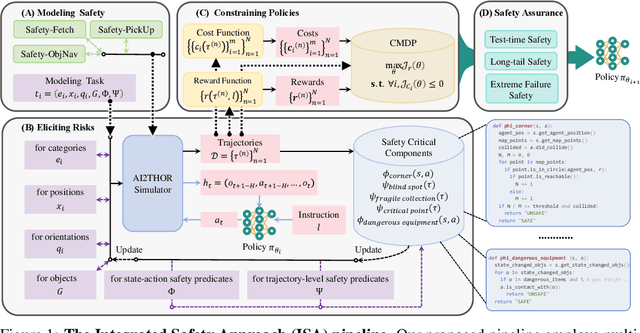
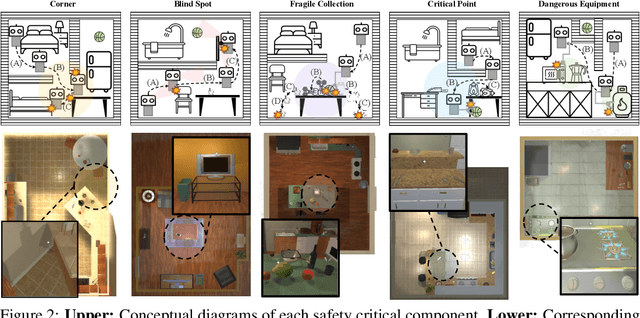
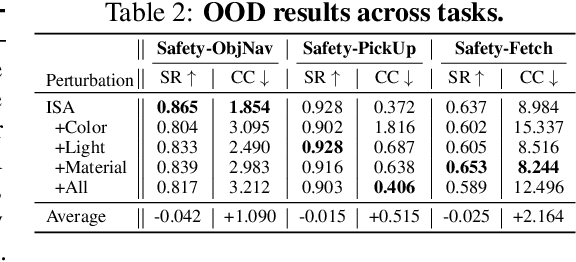
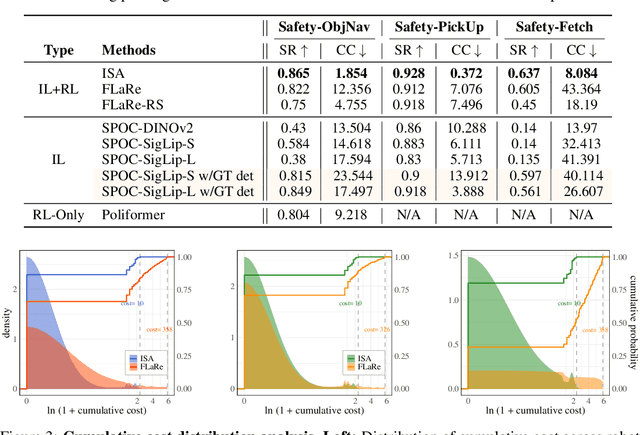
Vision-language-action models (VLAs) have shown great potential as generalist robot policies. However, these models pose urgent safety challenges during deployment, including the risk of physical harm to the environment, the robot itself, and humans. How can safety be explicitly incorporated into VLAs? In this work, we propose SafeVLA, a novel algorithm designed to integrate safety into VLAs, ensuring the protection of the environment, robot hardware and humans in real-world settings. SafeVLA effectively balances safety and task performance by employing large-scale constrained learning within simulated environments. We demonstrate that SafeVLA outperforms the current state-of-the-art method in both safety and task performance, achieving average improvements of 83.58% and 3.85%, respectively, in simulation. By prioritizing safety, our approach eliminates high-risk behaviors and reduces the upper bound of unsafe behaviors to 1/35 of that in the current state-of-the-art, thereby significantly mitigating long-tail risks. Furthermore, the learned safety constraints generalize to diverse, unseen scenarios, including multiple out-of-distribution perturbations and tasks. Our data, models and newly proposed benchmark environment are available at https://sites.google.com/view/pku-safevla.
Back-Projection Diffusion: Solving the Wideband Inverse Scattering Problem with Diffusion Models
Aug 05, 2024


We present \textit{Wideband back-projection diffusion}, an end-to-end probabilistic framework for approximating the posterior distribution induced by the inverse scattering map from wideband scattering data. This framework leverages conditional diffusion models coupled with the underlying physics of wave-propagation and symmetries in the problem, to produce highly accurate reconstructions. The framework introduces a factorization of the score function into a physics-based latent representation inspired by the filtered back-propagation formula and a conditional score function conditioned on this latent representation. These two steps are also constrained to obey symmetries in the formulation while being amenable to compression by imposing the rank structure found in the filtered back-projection formula. As a result, empirically, our framework is able to provide sharp reconstructions effortlessly, even recovering sub-Nyquist features in the multiple-scattering regime. It has low-sample and computational complexity, its number of parameters scales sub-linearly with the target resolution, and it has stable training dynamics.
PKU-SafeRLHF: A Safety Alignment Preference Dataset for Llama Family Models
Jun 20, 2024
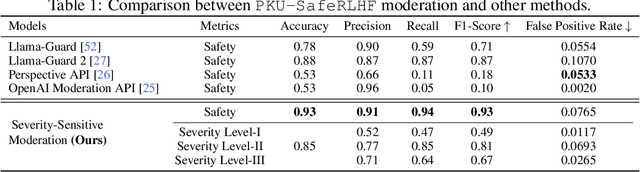


In this work, we introduce the PKU-SafeRLHF dataset, designed to promote research on safety alignment in large language models (LLMs). As a sibling project to SafeRLHF and BeaverTails, we separate annotations of helpfulness and harmlessness for question-answering pairs, providing distinct perspectives on these coupled attributes. Overall, we provide 44.6k refined prompts and 265k question-answer pairs with safety meta-labels for 19 harm categories and three severity levels ranging from minor to severe, with answers generated by Llama-family models. Based on this, we collected 166.8k preference data, including dual-preference (helpfulness and harmlessness decoupled) and single-preference data (trade-off the helpfulness and harmlessness from scratch), respectively. Using the large-scale annotation data, we further train severity-sensitive moderation for the risk control of LLMs and safety-centric RLHF algorithms for the safety alignment of LLMs. We believe this dataset will be a valuable resource for the community, aiding in the safe deployment of LLMs.
Aligner: Achieving Efficient Alignment through Weak-to-Strong Correction
Feb 06, 2024Efforts to align Large Language Models (LLMs) are mainly conducted via Reinforcement Learning from Human Feedback (RLHF) methods. However, RLHF encounters major challenges including training reward models, actor-critic engineering, and importantly, it requires access to LLM parameters. Here we introduce Aligner, a new efficient alignment paradigm that bypasses the whole RLHF process by learning the correctional residuals between the aligned and the unaligned answers. Our Aligner offers several key advantages. Firstly, it is an autoregressive seq2seq model that is trained on the query-answer-correction dataset via supervised learning; this offers a parameter-efficient alignment solution with minimal resources. Secondly, the Aligner facilitates weak-to-strong generalization; finetuning large pretrained models by Aligner's supervisory signals demonstrates strong performance boost. Thirdly, Aligner functions as a model-agnostic plug-and-play module, allowing for its direct application on different open-source and API-based models. Remarkably, Aligner-7B improves 11 different LLMs by 21.9% in helpfulness and 23.8% in harmlessness on average (GPT-4 by 17.5% and 26.9%). When finetuning (strong) Llama2-70B with (weak) Aligner-13B's supervision, we can improve Llama2 by 8.2% in helpfulness and 61.6% in harmlessness. See our dataset and code at https://aligner2024.github.io
AI Alignment: A Comprehensive Survey
Nov 01, 2023AI alignment aims to make AI systems behave in line with human intentions and values. As AI systems grow more capable, the potential large-scale risks associated with misaligned AI systems become salient. Hundreds of AI experts and public figures have expressed concerns about AI risks, arguing that "mitigating the risk of extinction from AI should be a global priority, alongside other societal-scale risks such as pandemics and nuclear war". To provide a comprehensive and up-to-date overview of the alignment field, in this survey paper, we delve into the core concepts, methodology, and practice of alignment. We identify the RICE principles as the key objectives of AI alignment: Robustness, Interpretability, Controllability, and Ethicality. Guided by these four principles, we outline the landscape of current alignment research and decompose them into two key components: forward alignment and backward alignment. The former aims to make AI systems aligned via alignment training, while the latter aims to gain evidence about the systems' alignment and govern them appropriately to avoid exacerbating misalignment risks. Forward alignment and backward alignment form a recurrent process where the alignment of AI systems from the forward process is verified in the backward process, meanwhile providing updated objectives for forward alignment in the next round. On forward alignment, we discuss learning from feedback and learning under distribution shift. On backward alignment, we discuss assurance techniques and governance practices that apply to every stage of AI systems' lifecycle. We also release and continually update the website (www.alignmentsurvey.com) which features tutorials, collections of papers, blog posts, and other resources.