 Add to Chrome
 Add to Firefox
 Add to Edge
Towards Unsupervised Speech Recognition Without Pronunciation Models
Jun 12, 2024
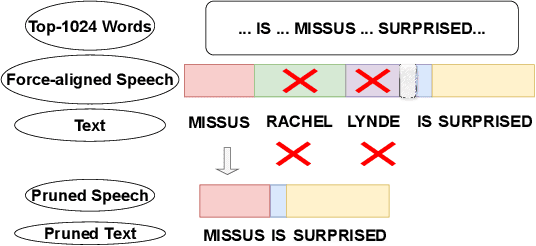
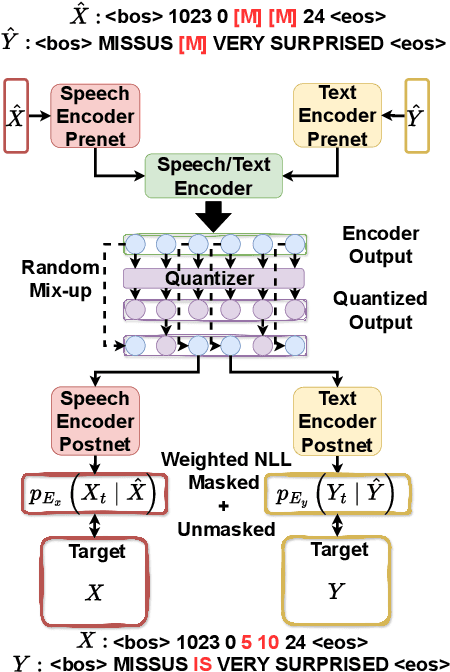

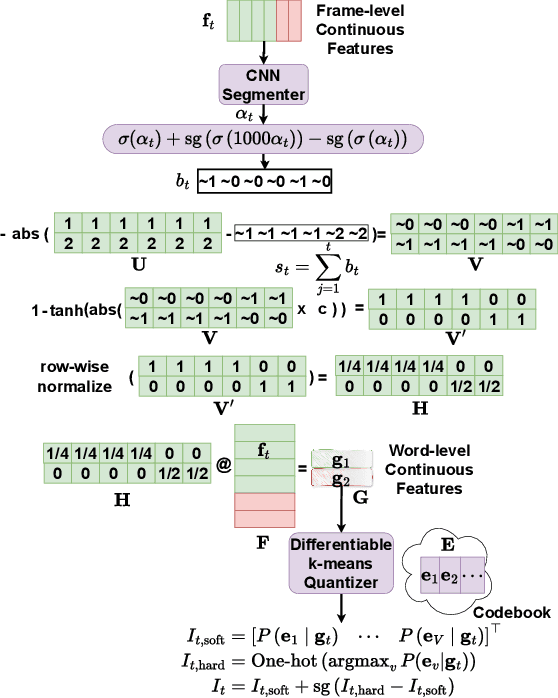
Recent advancements in supervised automatic speech recognition (ASR) have achieved remarkable performance, largely due to the growing availability of large transcribed speech corpora. However, most languages lack sufficient paired speech and text data to effectively train these systems. In this article, we tackle the challenge of developing ASR systems without paired speech and text corpora by proposing the removal of reliance on a phoneme lexicon. We explore a new research direction: word-level unsupervised ASR. Using a curated speech corpus containing only high-frequency English words, our system achieves a word error rate of nearly 20% without parallel transcripts or oracle word boundaries. Furthermore, we experimentally demonstrate that an unsupervised speech recognizer can emerge from joint speech-to-speech and text-to-text masked token-infilling. This innovative model surpasses the performance of previous unsupervised ASR models trained with direct distribution matching.

A Probabilistic Framework for LLM Hallucination Detection via Belief Tree Propagation
Jun 11, 2024



This paper focuses on the task of hallucination detection, which aims to determine the truthfulness of LLM-generated statements. To address this problem, a popular class of methods utilize the LLM's self-consistencies in its beliefs in a set of logically related augmented statements generated by the LLM, which does not require external knowledge databases and can work with both white-box and black-box LLMs. However, in many existing approaches, the augmented statements tend to be very monotone and unstructured, which makes it difficult to integrate meaningful information from the LLM beliefs in these statements. Also, many methods work with the binarized version of the LLM's belief, instead of the continuous version, which significantly loses information. To overcome these limitations, in this paper, we propose Belief Tree Propagation (BTProp), a probabilistic framework for LLM hallucination detection. BTProp introduces a belief tree of logically related statements by recursively decomposing a parent statement into child statements with three decomposition strategies, and builds a hidden Markov tree model to integrate the LLM's belief scores in these statements in a principled way. Experiment results show that our method improves baselines by 3%-9% (evaluated by AUROC and AUC-PR) on multiple hallucination detection benchmarks. Code is available at https://github.com/UCSB-NLP-Chang/BTProp.
Methodology and Real-World Applications of Dynamic Uncertain Causality Graph for Clinical Diagnosis with Explainability and Invariance
Jun 09, 2024AI-aided clinical diagnosis is desired in medical care. Existing deep learning models lack explainability and mainly focus on image analysis. The recently developed Dynamic Uncertain Causality Graph (DUCG) approach is causality-driven, explainable, and invariant across different application scenarios, without problems of data collection, labeling, fitting, privacy, bias, generalization, high cost and high energy consumption. Through close collaboration between clinical experts and DUCG technicians, 46 DUCG models covering 54 chief complaints were constructed. Over 1,000 diseases can be diagnosed without triage. Before being applied in real-world, the 46 DUCG models were retrospectively verified by third-party hospitals. The verified diagnostic precisions were no less than 95%, in which the diagnostic precision for every disease including uncommon ones was no less than 80%. After verifications, the 46 DUCG models were applied in the real-world in China. Over one million real diagnosis cases have been performed, with only 17 incorrect diagnoses identified. Due to DUCG's transparency, the mistakes causing the incorrect diagnoses were found and corrected. The diagnostic abilities of the clinicians who applied DUCG frequently were improved significantly. Following the introduction to the earlier presented DUCG methodology, the recommendation algorithm for potential medical checks is presented and the key idea of DUCG is extracted.
Text-like Encoding of Collaborative Information in Large Language Models for Recommendation
Jun 05, 2024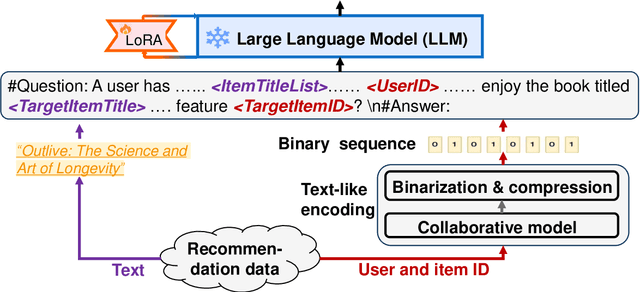

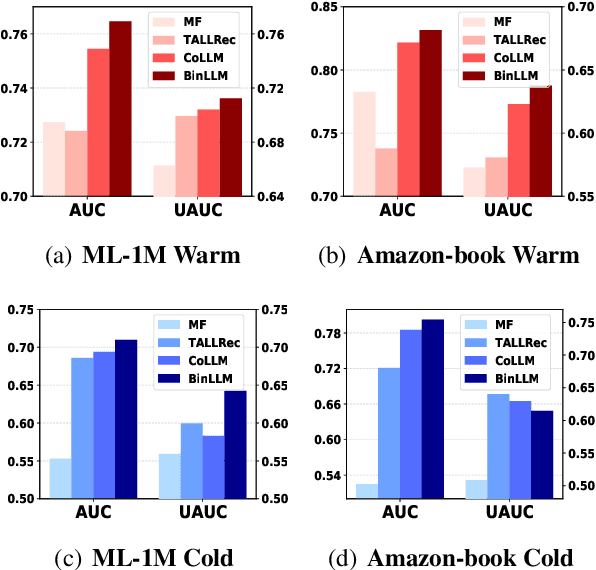
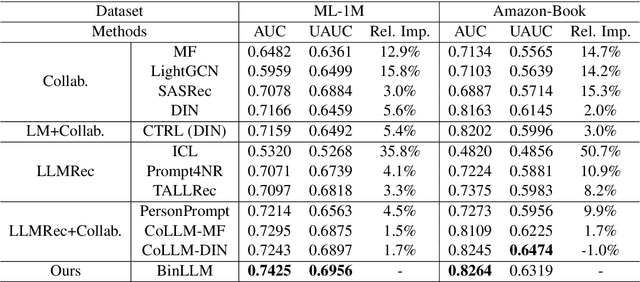
When adapting Large Language Models for Recommendation (LLMRec), it is crucial to integrate collaborative information. Existing methods achieve this by learning collaborative embeddings in LLMs' latent space from scratch or by mapping from external models. However, they fail to represent the information in a text-like format, which may not align optimally with LLMs. To bridge this gap, we introduce BinLLM, a novel LLMRec method that seamlessly integrates collaborative information through text-like encoding. BinLLM converts collaborative embeddings from external models into binary sequences -- a specific text format that LLMs can understand and operate on directly, facilitating the direct usage of collaborative information in text-like format by LLMs. Additionally, BinLLM provides options to compress the binary sequence using dot-decimal notation to avoid excessively long lengths. Extensive experiments validate that BinLLM introduces collaborative information in a manner better aligned with LLMs, resulting in enhanced performance. We release our code at https://github.com/zyang1580/BinLLM.
Seed-TTS: A Family of High-Quality Versatile Speech Generation Models
Jun 04, 2024


We introduce Seed-TTS, a family of large-scale autoregressive text-to-speech (TTS) models capable of generating speech that is virtually indistinguishable from human speech. Seed-TTS serves as a foundation model for speech generation and excels in speech in-context learning, achieving performance in speaker similarity and naturalness that matches ground truth human speech in both objective and subjective evaluations. With fine-tuning, we achieve even higher subjective scores across these metrics. Seed-TTS offers superior controllability over various speech attributes such as emotion and is capable of generating highly expressive and diverse speech for speakers in the wild. Furthermore, we propose a self-distillation method for speech factorization, as well as a reinforcement learning approach to enhance model robustness, speaker similarity, and controllability. We additionally present a non-autoregressive (NAR) variant of the Seed-TTS model, named $\text{Seed-TTS}_\text{DiT}$, which utilizes a fully diffusion-based architecture. Unlike previous NAR-based TTS systems, $\text{Seed-TTS}_\text{DiT}$ does not depend on pre-estimated phoneme durations and performs speech generation through end-to-end processing. We demonstrate that this variant achieves comparable performance to the language model-based variant and showcase its effectiveness in speech editing. We encourage readers to listen to demos at \url{https://bytedancespeech.github.io/seedtts_tech_report}.
Evaluating Mathematical Reasoning of Large Language Models: A Focus on Error Identification and Correction
Jun 02, 2024The rapid advancement of Large Language Models (LLMs) in the realm of mathematical reasoning necessitates comprehensive evaluations to gauge progress and inspire future directions. Existing assessments predominantly focus on problem-solving from the examinee perspective, overlooking a dual perspective of examiner regarding error identification and correction. From the examiner perspective, we define four evaluation tasks for error identification and correction along with a new dataset with annotated error types and steps. We also design diverse prompts to thoroughly evaluate eleven representative LLMs. Our principal findings indicate that GPT-4 outperforms all models, while open-source model LLaMA-2-7B demonstrates comparable abilities to closed-source models GPT-3.5 and Gemini Pro. Notably, calculation error proves the most challenging error type. Moreover, prompting LLMs with the error types can improve the average correction accuracy by 47.9\%. These results reveal potential directions for developing the mathematical reasoning abilities of LLMs. Our code and dataset is available on https://github.com/LittleCirc1e/EIC.
Voice Jailbreak Attacks Against GPT-4o
May 29, 2024Recently, the concept of artificial assistants has evolved from science fiction into real-world applications. GPT-4o, the newest multimodal large language model (MLLM) across audio, vision, and text, has further blurred the line between fiction and reality by enabling more natural human-computer interactions. However, the advent of GPT-4o's voice mode may also introduce a new attack surface. In this paper, we present the first systematic measurement of jailbreak attacks against the voice mode of GPT-4o. We show that GPT-4o demonstrates good resistance to forbidden questions and text jailbreak prompts when directly transferring them to voice mode. This resistance is primarily due to GPT-4o's internal safeguards and the difficulty of adapting text jailbreak prompts to voice mode. Inspired by GPT-4o's human-like behaviors, we propose VoiceJailbreak, a novel voice jailbreak attack that humanizes GPT-4o and attempts to persuade it through fictional storytelling (setting, character, and plot). VoiceJailbreak is capable of generating simple, audible, yet effective jailbreak prompts, which significantly increases the average attack success rate (ASR) from 0.033 to 0.778 in six forbidden scenarios. We also conduct extensive experiments to explore the impacts of interaction steps, key elements of fictional writing, and different languages on VoiceJailbreak's effectiveness and further enhance the attack performance with advanced fictional writing techniques. We hope our study can assist the research community in building more secure and well-regulated MLLMs.
FinerCut: Finer-grained Interpretable Layer Pruning for Large Language Models
May 28, 2024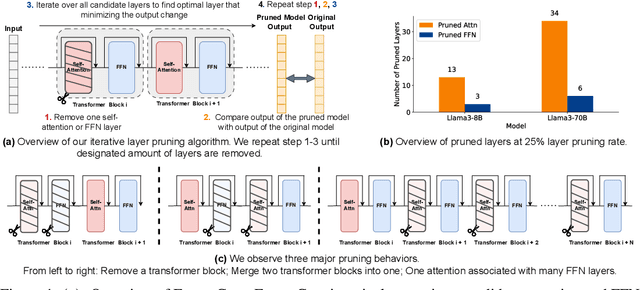
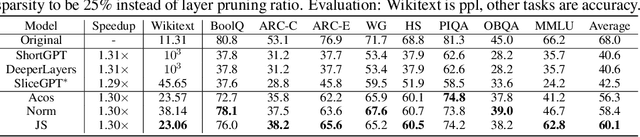
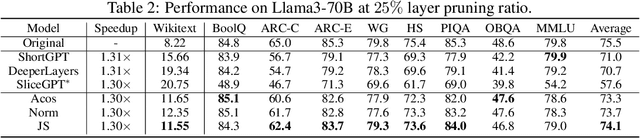
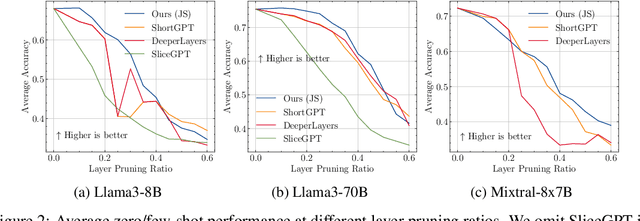
Overparametrized transformer networks are the state-of-the-art architecture for Large Language Models (LLMs). However, such models contain billions of parameters making large compute a necessity, while raising environmental concerns. To address these issues, we propose FinerCut, a new form of fine-grained layer pruning, which in contrast to prior work at the transformer block level, considers all self-attention and feed-forward network (FFN) layers within blocks as individual pruning candidates. FinerCut prunes layers whose removal causes minimal alternation to the model's output -- contributing to a new, lean, interpretable, and task-agnostic pruning method. Tested across 9 benchmarks, our approach retains 90% performance of Llama3-8B with 25% layers removed, and 95% performance of Llama3-70B with 30% layers removed, all without fine-tuning or post-pruning reconstruction. Strikingly, we observe intriguing results with FinerCut: 42% (34 out of 80) of the self-attention layers in Llama3-70B can be removed while preserving 99% of its performance -- without additional fine-tuning after removal. Moreover, FinerCut provides a tool to inspect the types and locations of pruned layers, allowing to observe interesting pruning behaviors. For instance, we observe a preference for pruning self-attention layers, often at deeper consecutive decoder layers. We hope our insights inspire future efficient LLM architecture designs.
Towards Efficient LLM Grounding for Embodied Multi-Agent Collaboration
May 23, 2024Grounding the reasoning ability of large language models (LLMs) for embodied tasks is challenging due to the complexity of the physical world. Especially, LLM planning for multi-agent collaboration requires communication of agents or credit assignment as the feedback to re-adjust the proposed plans and achieve effective coordination. However, existing methods that overly rely on physical verification or self-reflection suffer from excessive and inefficient querying of LLMs. In this paper, we propose a novel framework for multi-agent collaboration that introduces Reinforced Advantage feedback (ReAd) for efficient self-refinement of plans. Specifically, we perform critic regression to learn a sequential advantage function from LLM-planned data, and then treat the LLM planner as an optimizer to generate actions that maximize the advantage function. It endows the LLM with the foresight to discern whether the action contributes to accomplishing the final task. We provide theoretical analysis by extending advantage-weighted regression in reinforcement learning to multi-agent systems. Experiments on Overcooked-AI and a difficult variant of RoCoBench show that ReAd surpasses baselines in success rate, and also significantly decreases the interaction steps of agents and query rounds of LLMs, demonstrating its high efficiency for grounding LLMs. More results are given at \url{https://read-llm.github.io/}.
Contrastive Representation for Data Filtering in Cross-Domain Offline Reinforcement Learning
May 10, 2024


Cross-domain offline reinforcement learning leverages source domain data with diverse transition dynamics to alleviate the data requirement for the target domain. However, simply merging the data of two domains leads to performance degradation due to the dynamics mismatch. Existing methods address this problem by measuring the dynamics gap via domain classifiers while relying on the assumptions of the transferability of paired domains. In this paper, we propose a novel representation-based approach to measure the domain gap, where the representation is learned through a contrastive objective by sampling transitions from different domains. We show that such an objective recovers the mutual-information gap of transition functions in two domains without suffering from the unbounded issue of the dynamics gap in handling significantly different domains. Based on the representations, we introduce a data filtering algorithm that selectively shares transitions from the source domain according to the contrastive score functions. Empirical results on various tasks demonstrate that our method achieves superior performance, using only 10% of the target data to achieve 89.2% of the performance on 100% target dataset with state-of-the-art methods.