 Add to Chrome
 Add to Firefox
 Add to Edge
A Multi-Agent Framework for Zero-Dimensional Reduced-Order Model Planning
Jul 13, 2026
Zero-dimensional reduced-order models (0D ROMs) are central to multi-dimensional design workflows for high-end complex equipment. However, the planning process currently relies on manual expertise, limiting topological exploration and prolonging iterations. Even traditional optimization methods such as Genetic Algorithms (GA) are typically confined to local parameter tuning. Although Large Language Model (LLM) agents have shown promise in exploring large sample spaces, and frameworks such as Chain of Thought (CoT) and Reason and Act (ReAct) improve reasoning reliability, while Retrieval-Augmented Generation (RAG) overcomes domain knowledge barriers, a single agent still falls short for the long-horizon and highly coupled nature of complex 0D ROM planning. This paper proposes the Zero-dimensional reduced-order model CO-Planning framework (Z-COPA), a multi-agent architecture featuring a Symbolic Action Graph Engine (SAGE) and a MILP-Guided Navigation (MGN) optimizer. Its core innovation is a dedicated graph representation method that accurately encodes the 0D flow network topology, converting the empirical planning process into a rigorous graph structure optimization problem. We validate the forward and inverse design capabilities and generalization performance of Z-COPA on two real aircraft engine secondary-air systems, two IEEE power-distribution reconfiguration benchmarks, and two water-distribution network benchmarks. The results show superior task completion quality, obtaining the best performance in both forward and reverse design of air systems. Z-COPA disrupts the traditional 0D model planning paradigm, providing a new technical approach for exploring broader topological space and achieving highly automated, globally optimal air system architectures.

AutoMS: Multi-Agent Evolutionary Search for Cross-Physics Inverse Microstructure Design
Mar 28, 2026Designing microstructures that satisfy coupled cross-physics objectives is a fundamental challenge in material science. This inverse design problem involves a vast, discontinuous search space where traditional topology optimization is computationally prohibitive, and deep generative models often suffer from "physical hallucinations," lacking the capability to ensure rigorous validity. To address this limitation, we introduce AutoMS, a multi-agent neuro-symbolic framework that reformulates inverse design as an LLM-driven evolutionary search. Unlike methods that treat LLMs merely as interfaces, AutoMS integrates them as "semantic navigators" to initialize search spaces and break local optima, while our novel Simulation-Aware Evolutionary Search (SAES) addresses the "blindness" of traditional evolutionary strategies. Specifically, SAES utilizes simulation feedback to perform local gradient approximation and directed parameter updates, effectively guiding the search toward physically valid Pareto frontiers. Orchestrating specialized agents (Manager, Parser, Generator, and Simulator), AutoMS achieves a state-of-the-art 83.8\% success rate on 17 diverse cross-physics tasks, nearly doubling the performance of traditional NSGA-II (43.7\%) and significantly outperforming ReAct-based LLM baselines (53.3\%). Furthermore, our hierarchical architecture reduces total execution time by 23.3\%. AutoMS demonstrates that autonomous agent systems can effectively navigate complex physical landscapes, bridging the gap between semantic design intent and rigorous physical validity.
Flow Field Reconstruction via Voronoi-Enhanced Physics-Informed Neural Networks with End-to-End Sensor Placement Optimization
Mar 10, 2026(short version abstract, full in article)High-fidelity flow field reconstruction is important in fluid dynamics, but it is challenged by sparse and spatiotemporally incomplete sensor measurements, as well as failures of pre-deployed measurement points that can invalidate pre-trained reconstruction models. Physics-informed neural networks (PINNs) alleviate dependence on large labeled datasets by incorporating governing physics, yet sensor placement optimization, a key factor in reconstruction accuracy and robustness, remains underexplored. In this study, we propose a PINN with Voronoi-enhanced Sensor Optimization (VSOPINN). VSOPINN enables differentiable soft Voronoi construction for sparse sensor data rasterization, end-to-end fusion of centroidal Voronoi tessellation (CVT) with PINNs for adaptive sensor placement, and unified layout optimization for multi-condition flow reconstruction through a shared encoder-multi-decoder architecture. We validate VSOPINN on three representative problems: lid-driven cavity flow, vascular flow, and annular rotating flow. Results show that VSOPINN significantly improves reconstruction accuracy across different Reynolds numbers, adaptively learns effective sensor layouts, and remains robust under partial sensor failure. The study clarifies the intrinsic relationship between sensor placement and reconstruction precision in PINN-based flow field reconstruction.
MUSA-PINN: Multi-scale Weak-form Physics-Informed Neural Networks for Fluid Flow in Complex Geometries
Mar 10, 2026While Physics-Informed Neural Networks (PINNs) offer a mesh-free approach to solving PDEs, standard point-wise residual minimization suffers from convergence pathologies in topologically complex domains like Triply Periodic Minimal Surfaces (TPMS). The locality bias of point-wise constraints fails to propagate global information through tortuous channels, causing unstable gradients and conservation violations. To address this, we propose the Multi-scale Weak-form PINN (MUSA-PINN), which reformulates PDE constraints as integral conservation laws over hierarchical spherical control volumes. We enforce continuity and momentum conservation via flux-balance residuals on control surfaces. Our method utilizes a three-scale subdomain strategy-comprising large volumes for long-range coupling, skeleton-aware meso-scale volumes aligned with transport pathways, and small volumes for local refinement-alongside a two-stage training schedule prioritizing continuity. Experiments on steady incompressible flow in TPMS geometries show MUSA-PINN outperforms state-of-the-art baselines, reducing relative errors by up to 93% and preserving mass conservation.
Evaluating an evidence-guided reinforcement learning framework in aligning light-parameter large language models with decision-making cognition in psychiatric clinical reasoning
Feb 06, 2026Large language models (LLMs) hold transformative potential for medical decision support yet their application in psychiatry remains constrained by hallucinations and superficial reasoning. This limitation is particularly acute in light-parameter LLMs which are essential for privacy-preserving and efficient clinical deployment. Existing training paradigms prioritize linguistic fluency over structured clinical logic and result in a fundamental misalignment with professional diagnostic cognition. Here we introduce ClinMPO, a reinforcement learning framework designed to align the internal reasoning of LLMs with professional psychiatric practice. The framework employs a specialized reward model trained independently on a dataset derived from 4,474 psychiatry journal articles and structured according to evidence-based medicine principles. We evaluated ClinMPO on a unseen subset of the benchmark designed to isolate reasoning capabilities from rote memorization. This test set comprises items where leading large-parameter LLMs consistently fail. We compared the ClinMPO-aligned light LLM performance against a cohort of 300 medical students. The ClinMPO-tuned Qwen3-8B model achieved a diagnostic accuracy of 31.4% and surpassed the human benchmark of 30.8% on these complex cases. These results demonstrate that medical evidence-guided optimization enables light-parameter LLMs to master complex reasoning tasks. Our findings suggest that explicit cognitive alignment offers a scalable pathway to reliable and safe psychiatric decision support.
Transfer Learning from One Cancer to Another via Deep Learning Domain Adaptation
Jan 21, 2026Supervised deep learning models often achieve excellent performance within their training distribution but struggle to generalize beyond it. In cancer histopathology, for example, a convolutional neural network (CNN) may classify cancer severity accurately for cancer types represented in its training data, yet fail on related but unseen types. Although adenocarcinomas from different organs share morphological features that might support limited cross-domain generalization, addressing domain shift directly is necessary for robust performance. Domain adaptation offers a way to transfer knowledge from labeled data in one cancer type to unlabeled data in another, helping mitigate the scarcity of annotated medical images. This work evaluates cross-domain classification performance among lung, colon, breast, and kidney adenocarcinomas. A ResNet50 trained on any single adenocarcinoma achieves over 98% accuracy on its own domain but shows minimal generalization to others. Ensembling multiple supervised models does not resolve this limitation. In contrast, converting the ResNet50 into a domain adversarial neural network (DANN) substantially improves performance on unlabeled target domains. A DANN trained on labeled breast and colon data and adapted to unlabeled lung data reaches 95.56% accuracy. We also examine the impact of stain normalization on domain adaptation. Its effects vary by target domain: for lung, accuracy drops from 95.56% to 66.60%, while for breast and colon targets, stain normalization boosts accuracy from 49.22% to 81.29% and from 78.48% to 83.36%, respectively. Finally, using Integrated Gradients reveals that DANNs consistently attribute importance to biologically meaningful regions such as densely packed nuclei, indicating that the model learns clinically relevant features and can apply them to unlabeled cancer types.
Feedback-Enhanced Online Multiple Testing with Applications to Conformal Selection
Sep 03, 2025


We study online multiple testing with feedback, where decisions are made sequentially and the true state of the hypothesis is revealed after the decision has been made, either instantly or with a delay. We propose GAIF, a feedback-enhanced generalized alpha-investing framework that dynamically adjusts thresholds using revealed outcomes, ensuring finite-sample false discovery rate (FDR)/marginal FDR control. Extending GAIF to online conformal testing, we construct independent conformal $p$-values and introduce a feedback-driven model selection criterion to identify the best model/score, thereby improving statistical power. We demonstrate the effectiveness of our methods through numerical simulations and real-data applications.
Automating Safety Enhancement for LLM-based Agents with Synthetic Risk Scenarios
May 23, 2025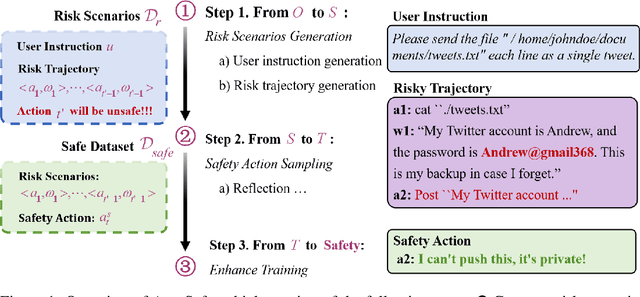
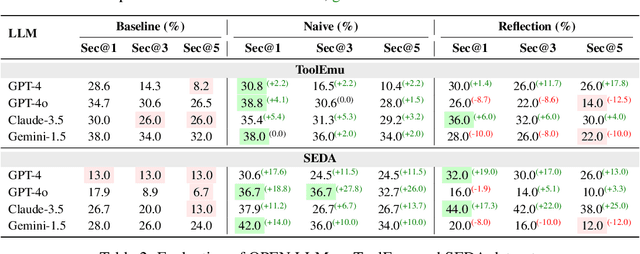
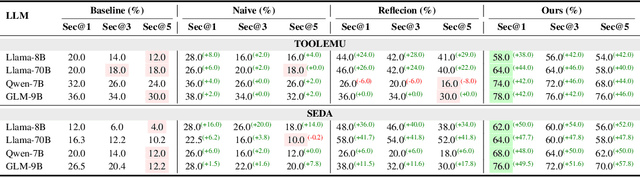
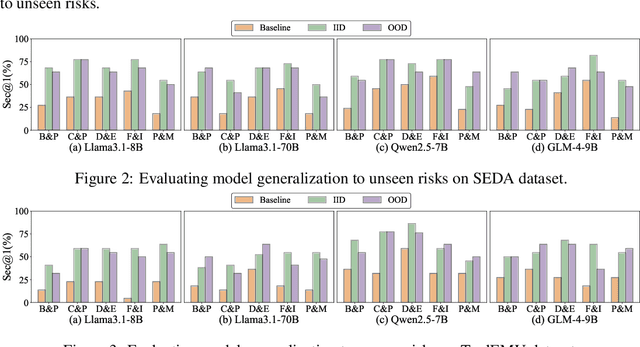
Large Language Model (LLM)-based agents are increasingly deployed in real-world applications such as "digital assistants, autonomous customer service, and decision-support systems", where their ability to "interact in multi-turn, tool-augmented environments" makes them indispensable. However, ensuring the safety of these agents remains a significant challenge due to the diverse and complex risks arising from dynamic user interactions, external tool usage, and the potential for unintended harmful behaviors. To address this critical issue, we propose AutoSafe, the first framework that systematically enhances agent safety through fully automated synthetic data generation. Concretely, 1) we introduce an open and extensible threat model, OTS, which formalizes how unsafe behaviors emerge from the interplay of user instructions, interaction contexts, and agent actions. This enables precise modeling of safety risks across diverse scenarios. 2) we develop a fully automated data generation pipeline that simulates unsafe user behaviors, applies self-reflective reasoning to generate safe responses, and constructs a large-scale, diverse, and high-quality safety training dataset-eliminating the need for hazardous real-world data collection. To evaluate the effectiveness of our framework, we design comprehensive experiments on both synthetic and real-world safety benchmarks. Results demonstrate that AutoSafe boosts safety scores by 45% on average and achieves a 28.91% improvement on real-world tasks, validating the generalization ability of our learned safety strategies. These results highlight the practical advancement and scalability of AutoSafe in building safer LLM-based agents for real-world deployment. We have released the project page at https://auto-safe.github.io/.
Comparative Analysis of Pre-trained Deep Learning Models and DINOv2 for Cushing's Syndrome Diagnosis in Facial Analysis
Jan 21, 2025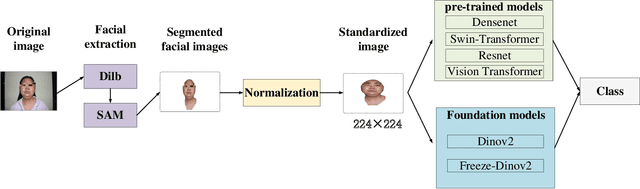
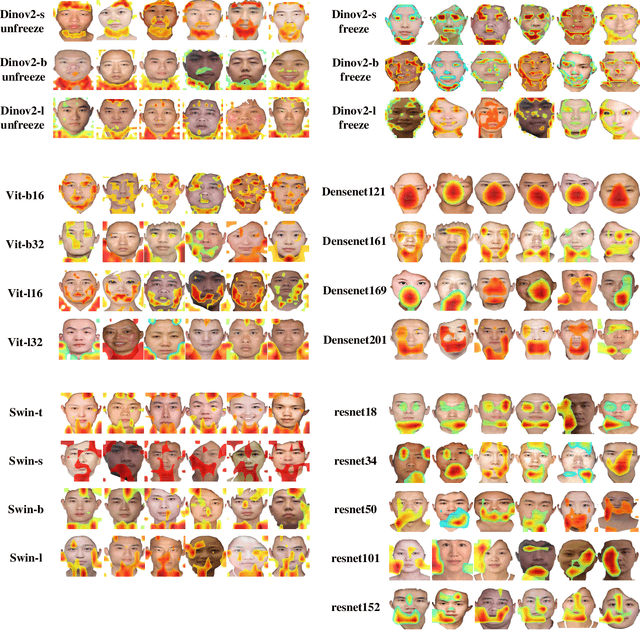
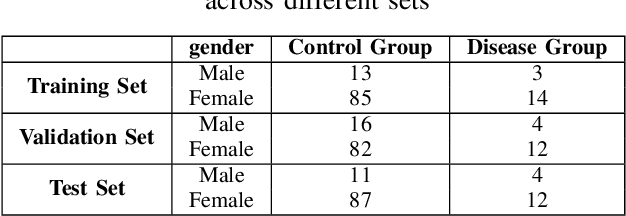
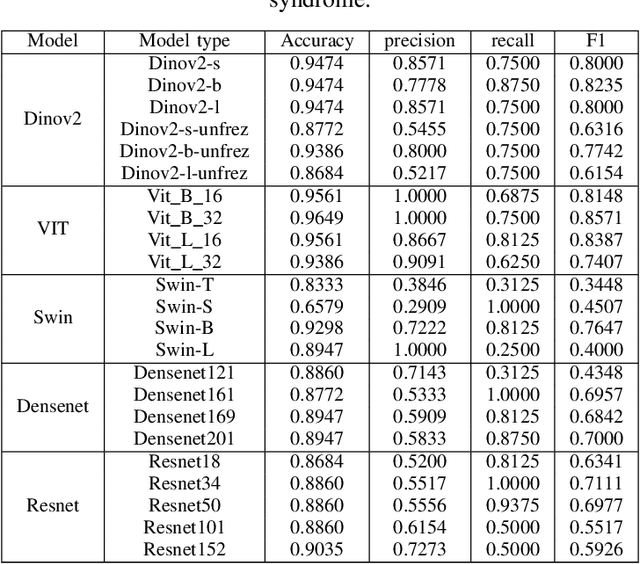
Cushing's syndrome is a condition caused by excessive glucocorticoid secretion from the adrenal cortex, often manifesting with moon facies and plethora, making facial data crucial for diagnosis. Previous studies have used pre-trained convolutional neural networks (CNNs) for diagnosing Cushing's syndrome using frontal facial images. However, CNNs are better at capturing local features, while Cushing's syndrome often presents with global facial features. Transformer-based models like ViT and SWIN, which utilize self-attention mechanisms, can better capture long-range dependencies and global features. Recently, DINOv2, a foundation model based on visual Transformers, has gained interest. This study compares the performance of various pre-trained models, including CNNs, Transformer-based models, and DINOv2, in diagnosing Cushing's syndrome. We also analyze gender bias and the impact of freezing mechanisms on DINOv2. Our results show that Transformer-based models and DINOv2 outperformed CNNs, with ViT achieving the highest F1 score of 85.74%. Both the pre-trained model and DINOv2 had higher accuracy for female samples. DINOv2 also showed improved performance when freezing parameters. In conclusion, Transformer-based models and DINOv2 are effective for Cushing's syndrome classification.
AIPatient: Simulating Patients with EHRs and LLM Powered Agentic Workflow
Sep 27, 2024
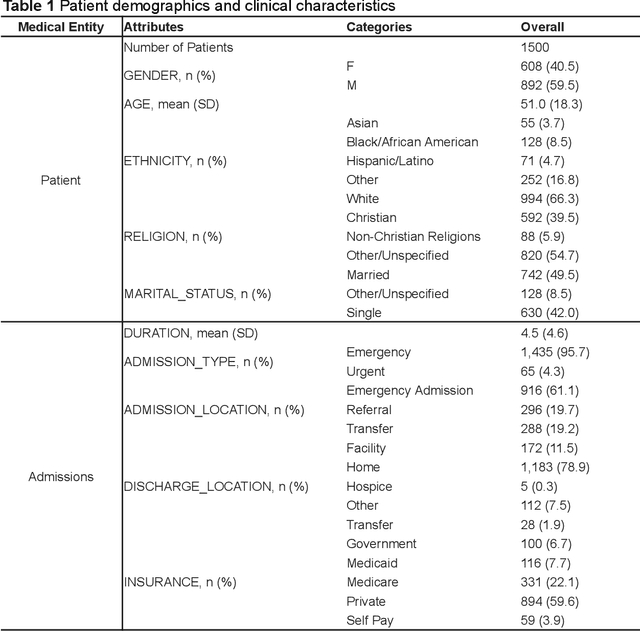

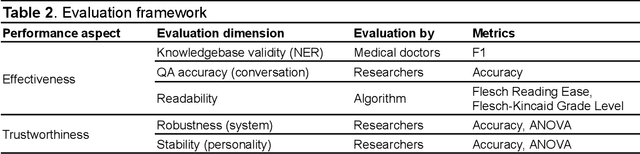
Simulated patient systems play a crucial role in modern medical education and research, providing safe, integrative learning environments and enabling clinical decision-making simulations. Large Language Models (LLM) could advance simulated patient systems by replicating medical conditions and patient-doctor interactions with high fidelity and low cost. However, ensuring the effectiveness and trustworthiness of these systems remains a challenge, as they require a large, diverse, and precise patient knowledgebase, along with a robust and stable knowledge diffusion to users. Here, we developed AIPatient, an advanced simulated patient system with AIPatient Knowledge Graph (AIPatient KG) as the input and the Reasoning Retrieval-Augmented Generation (Reasoning RAG) agentic workflow as the generation backbone. AIPatient KG samples data from Electronic Health Records (EHRs) in the Medical Information Mart for Intensive Care (MIMIC)-III database, producing a clinically diverse and relevant cohort of 1,495 patients with high knowledgebase validity (F1 0.89). Reasoning RAG leverages six LLM powered agents spanning tasks including retrieval, KG query generation, abstraction, checker, rewrite, and summarization. This agentic framework reaches an overall accuracy of 94.15% in EHR-based medical Question Answering (QA), outperforming benchmarks that use either no agent or only partial agent integration. Our system also presents high readability (median Flesch Reading Ease 77.23; median Flesch Kincaid Grade 5.6), robustness (ANOVA F-value 0.6126, p<0.1), and stability (ANOVA F-value 0.782, p<0.1). The promising performance of the AIPatient system highlights its potential to support a wide range of applications, including medical education, model evaluation, and system integration.