 Add to Chrome
 Add to Firefox
 Add to Edge
Measuring Data Diversity for Instruction Tuning: A Systematic Analysis and A Reliable Metric
Feb 25, 2025
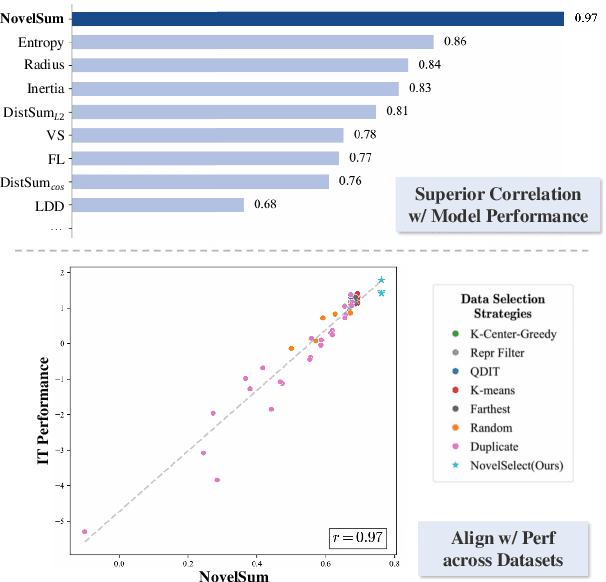
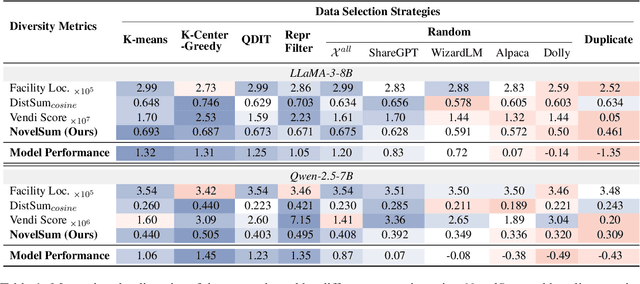
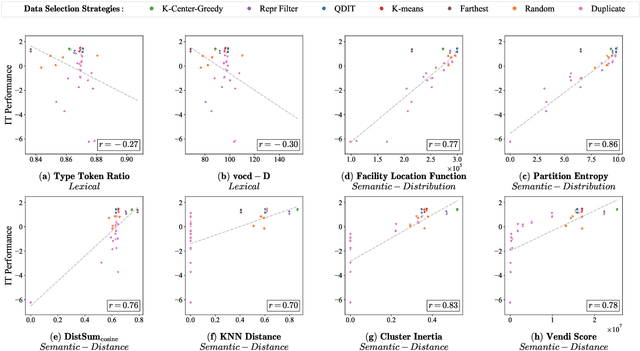
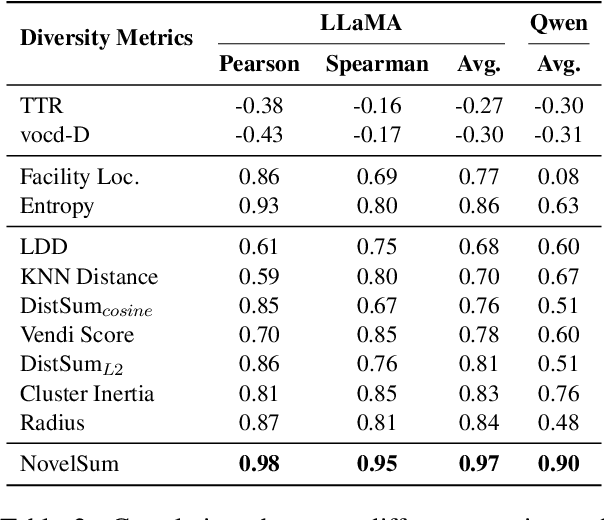
Data diversity is crucial for the instruction tuning of large language models. Existing studies have explored various diversity-aware data selection methods to construct high-quality datasets and enhance model performance. However, the fundamental problem of precisely defining and measuring data diversity remains underexplored, limiting clear guidance for data engineering. To address this, we systematically analyze 11 existing diversity measurement methods by evaluating their correlation with model performance through extensive fine-tuning experiments. Our results indicate that a reliable diversity measure should properly account for both inter-sample differences and the information distribution in the sample space. Building on this, we propose NovelSum, a new diversity metric based on sample-level "novelty." Experiments on both simulated and real-world data show that NovelSum accurately captures diversity variations and achieves a 0.97 correlation with instruction-tuned model performance, highlighting its value in guiding data engineering practices. With NovelSum as an optimization objective, we further develop a greedy, diversity-oriented data selection strategy that outperforms existing approaches, validating both the effectiveness and practical significance of our metric.

Thus Spake Long-Context Large Language Model
Feb 24, 2025Long context is an important topic in Natural Language Processing (NLP), running through the development of NLP architectures, and offers immense opportunities for Large Language Models (LLMs) giving LLMs the lifelong learning potential akin to humans. Unfortunately, the pursuit of a long context is accompanied by numerous obstacles. Nevertheless, long context remains a core competitive advantage for LLMs. In the past two years, the context length of LLMs has achieved a breakthrough extension to millions of tokens. Moreover, the research on long-context LLMs has expanded from length extrapolation to a comprehensive focus on architecture, infrastructure, training, and evaluation technologies. Inspired by the symphonic poem, Thus Spake Zarathustra, we draw an analogy between the journey of extending the context of LLM and the attempts of humans to transcend its mortality. In this survey, We will illustrate how LLM struggles between the tremendous need for a longer context and its equal need to accept the fact that it is ultimately finite. To achieve this, we give a global picture of the lifecycle of long-context LLMs from four perspectives: architecture, infrastructure, training, and evaluation, showcasing the full spectrum of long-context technologies. At the end of this survey, we will present 10 unanswered questions currently faced by long-context LLMs. We hope this survey can serve as a systematic introduction to the research on long-context LLMs.
AutoLogi: Automated Generation of Logic Puzzles for Evaluating Reasoning Abilities of Large Language Models
Feb 24, 2025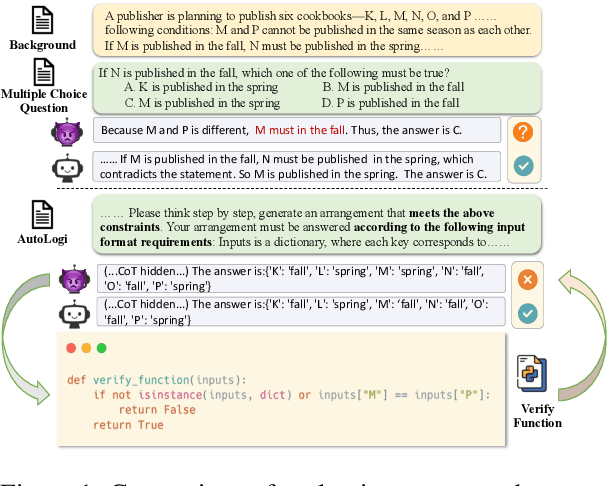

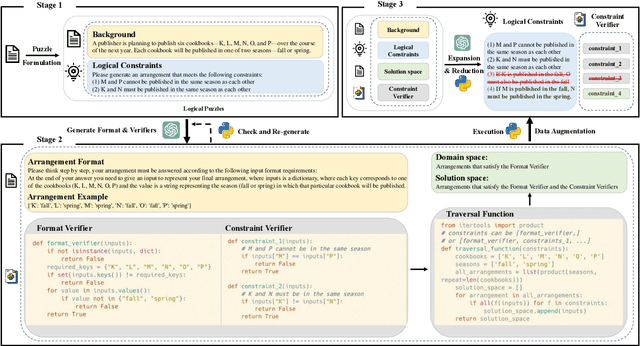
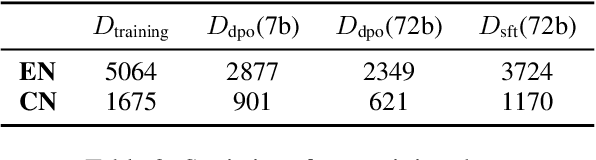
While logical reasoning evaluation of Large Language Models (LLMs) has attracted significant attention, existing benchmarks predominantly rely on multiple-choice formats that are vulnerable to random guessing, leading to overestimated performance and substantial performance fluctuations. To obtain more accurate assessments of models' reasoning capabilities, we propose an automated method for synthesizing open-ended logic puzzles, and use it to develop a bilingual benchmark, AutoLogi. Our approach features program-based verification and controllable difficulty levels, enabling more reliable evaluation that better distinguishes models' reasoning abilities. Extensive evaluation of eight modern LLMs shows that AutoLogi can better reflect true model capabilities, with performance scores spanning from 35% to 73% compared to the narrower range of 21% to 37% on the source multiple-choice dataset. Beyond benchmark creation, this synthesis method can generate high-quality training data by incorporating program verifiers into the rejection sampling process, enabling systematic enhancement of LLMs' reasoning capabilities across diverse datasets.
How Jailbreak Defenses Work and Ensemble? A Mechanistic Investigation
Feb 20, 2025Jailbreak attacks, where harmful prompts bypass generative models' built-in safety, raise serious concerns about model vulnerability. While many defense methods have been proposed, the trade-offs between safety and helpfulness, and their application to Large Vision-Language Models (LVLMs), are not well understood. This paper systematically examines jailbreak defenses by reframing the standard generation task as a binary classification problem to assess model refusal tendencies for both harmful and benign queries. We identify two key defense mechanisms: safety shift, which increases refusal rates across all queries, and harmfulness discrimination, which improves the model's ability to distinguish between harmful and benign inputs. Using these mechanisms, we develop two ensemble defense strategies-inter-mechanism ensembles and intra-mechanism ensembles-to balance safety and helpfulness. Experiments on the MM-SafetyBench and MOSSBench datasets with LLaVA-1.5 models show that these strategies effectively improve model safety or optimize the trade-off between safety and helpfulness.
Self-Consistency of the Internal Reward Models Improves Self-Rewarding Language Models
Feb 13, 2025Aligning Large Language Models (LLMs) with human preferences is crucial for their deployment in real-world applications. Recent advancements in Self-Rewarding Language Models suggest that an LLM can use its internal reward models (such as LLM-as-a-Judge) \cite{yuanself} to generate preference data, improving alignment performance without costly human annotation. However, we find that different internal reward models within the same LLM often generate inconsistent preferences. This inconsistency raises concerns about the reliability of self-generated preference data, hinders overall alignment performance, and highlights the need for further research to ensure reliable and coherent alignment with human preferences. To address this limitation, we propose Self-Consistent Internal Rewards (SCIR), a novel framework designed to enhance consistency among internal reward models during training. In each training step, we collect preference predictions from multiple pre-defined internal reward models and enforce consistency and confidence through an inconsistency penalty mechanism, thereby improving the reliability of these internal reward models. We selectively use data with consistent predictions for preference optimization, ensuring the quality of the preference data. By employing self-consistent internal rewards, our method significantly improves the alignment performance and reward modeling capability of LLMs, outperforming baseline methods by a notable margin.
Multi-Agent Simulator Drives Language Models for Legal Intensive Interaction
Feb 08, 2025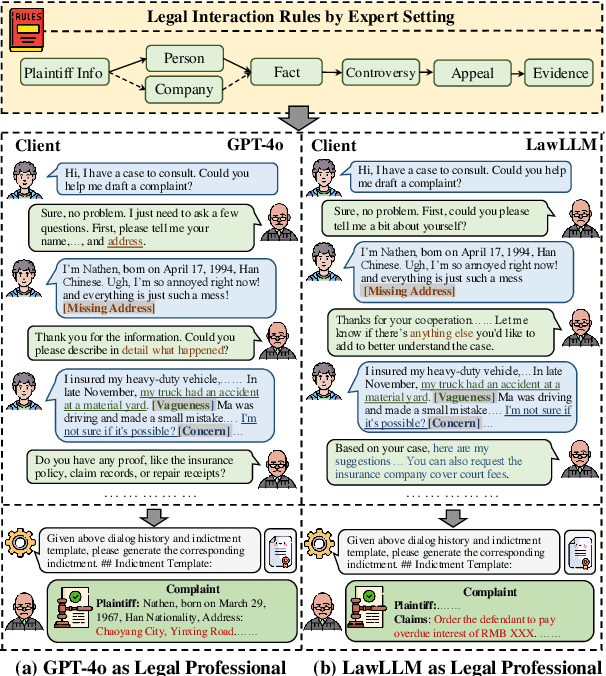
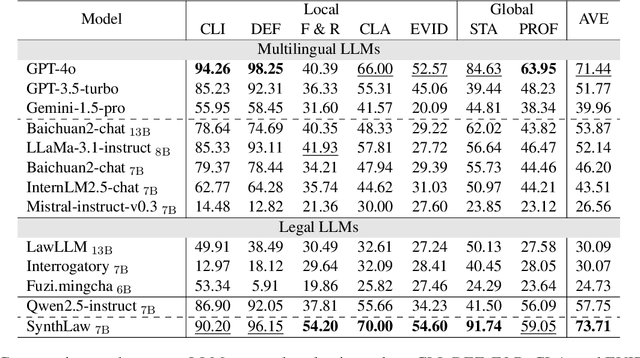
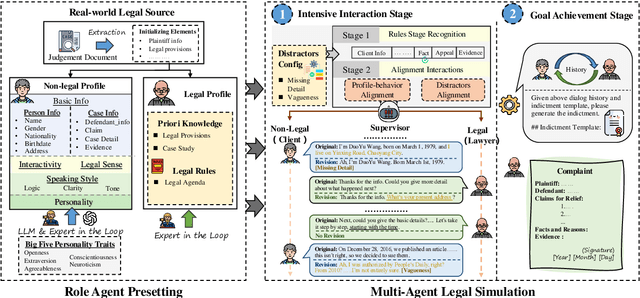
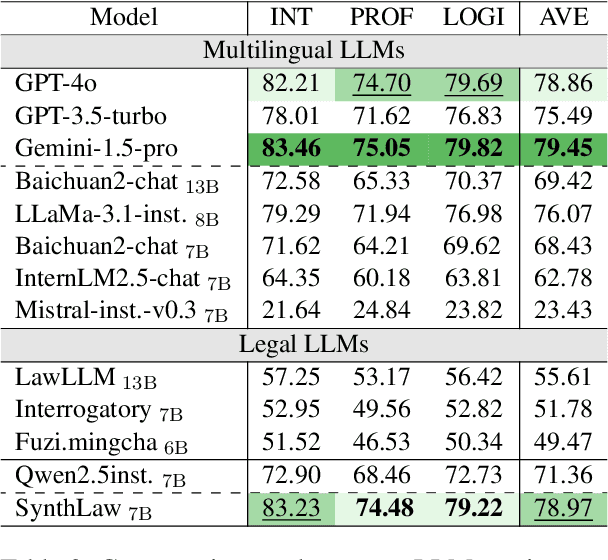
Large Language Models (LLMs) have significantly advanced legal intelligence, but the scarcity of scenario data impedes the progress toward interactive legal scenarios. This paper introduces a Multi-agent Legal Simulation Driver (MASER) to scalably generate synthetic data by simulating interactive legal scenarios. Leveraging real-legal case sources, MASER ensures the consistency of legal attributes between participants and introduces a supervisory mechanism to align participants' characters and behaviors as well as addressing distractions. A Multi-stage Interactive Legal Evaluation (MILE) benchmark is further constructed to evaluate LLMs' performance in dynamic legal scenarios. Extensive experiments confirm the effectiveness of our framework.
Predicting Large Language Model Capabilities on Closed-Book QA Tasks Using Only Information Available Prior to Training
Feb 06, 2025The GPT-4 technical report from OpenAI suggests that model performance on specific tasks can be predicted prior to training, though methodologies remain unspecified. This approach is crucial for optimizing resource allocation and ensuring data alignment with target tasks. To achieve this vision, we focus on predicting performance on Closed-book Question Answering (CBQA) tasks, which are closely tied to pre-training data and knowledge retention. We address three major challenges: 1) mastering the entire pre-training process, especially data construction; 2) evaluating a model's knowledge retention; and 3) predicting task-specific knowledge retention using only information available prior to training. To tackle these challenges, we pre-train three large language models (i.e., 1.6B, 7B, and 13B) using 560k dollars and 520k GPU hours. We analyze the pre-training data with knowledge triples and assess knowledge retention using established methods. Additionally, we introduce the SMI metric, an information-theoretic measure that quantifies the relationship between pre-training data, model size, and task-specific knowledge retention. Our experiments reveal a strong linear correlation ($\text{R}^2 > 0.84$) between the SMI metric and the model's accuracy on CBQA tasks across models of varying sizes (i.e., 1.1B, 1.6B, 7B, and 13B). The dataset, model, and code are available at https://github.com/yuhui1038/SMI.
Toward Relative Positional Encoding in Spiking Transformers
Jan 28, 2025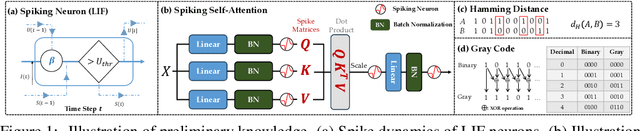
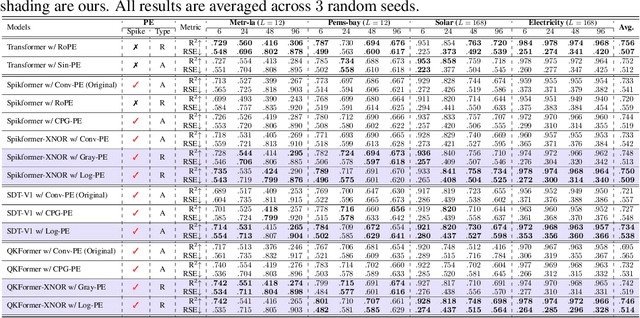
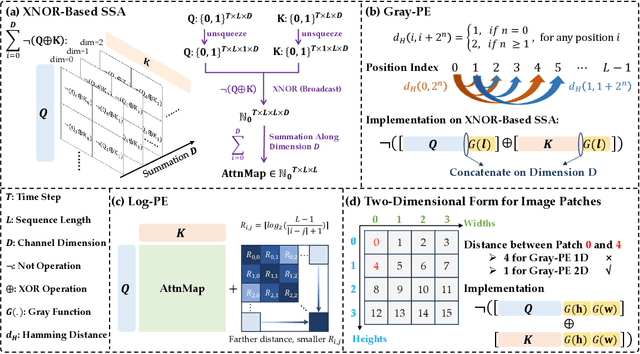

Spiking neural networks (SNNs) are bio-inspired networks that model how neurons in the brain communicate through discrete spikes, which have great potential in various tasks due to their energy efficiency and temporal processing capabilities. SNNs with self-attention mechanisms (Spiking Transformers) have recently shown great advancements in various tasks such as sequential modeling and image classifications. However, integrating positional information, which is essential for capturing sequential relationships in data, remains a challenge in Spiking Transformers. In this paper, we introduce an approximate method for relative positional encoding (RPE) in Spiking Transformers, leveraging Gray Code as the foundation for our approach. We provide comprehensive proof of the method's effectiveness in partially capturing relative positional information for sequential tasks. Additionally, we extend our RPE approach by adapting it to a two-dimensional form suitable for image patch processing. We evaluate the proposed RPE methods on several tasks, including time series forecasting, text classification, and patch-based image classification. Our experimental results demonstrate that the incorporation of RPE significantly enhances performance by effectively capturing relative positional information.
Error Classification of Large Language Models on Math Word Problems: A Dynamically Adaptive Framework
Jan 26, 2025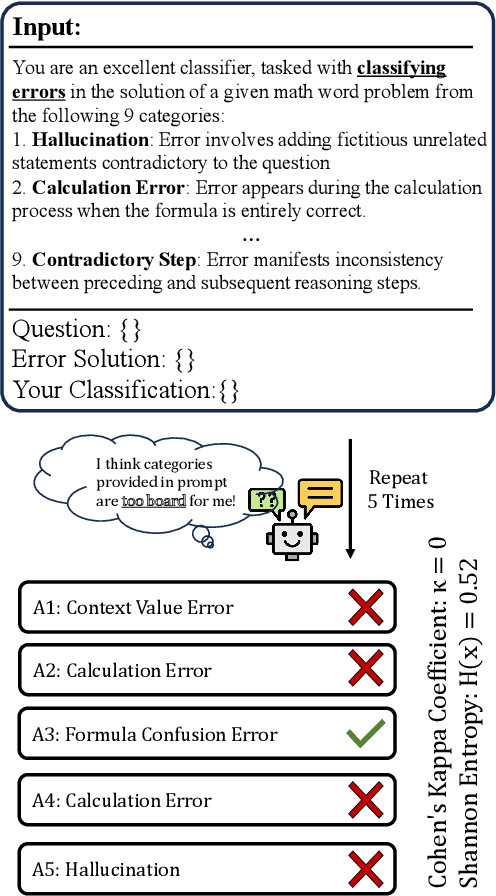
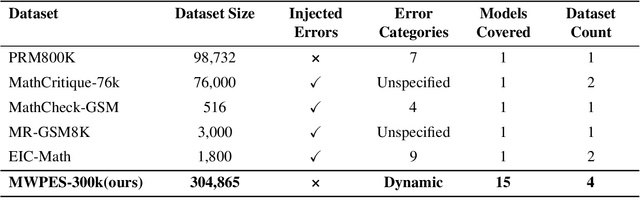
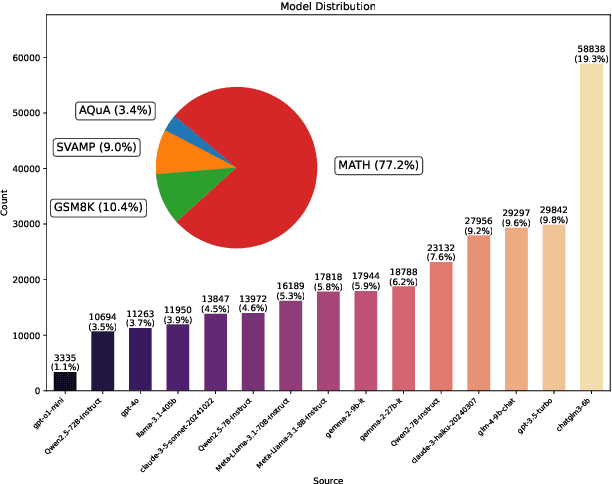
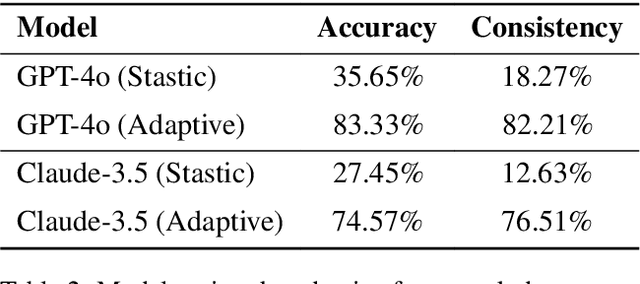
Large Language Models (LLMs) have demonstrated remarkable capabilities across various domains. Math Word Problems (MWPs) serve as a crucial benchmark for evaluating LLMs' reasoning abilities. While most research primarily focuses on improving accuracy, it often neglects understanding and addressing the underlying patterns of errors. Current error classification methods rely on static and predefined categories, which limit their ability to capture the full spectrum of error patterns in mathematical reasoning. To enable systematic error analysis, we collect error samples from 15 different LLMs of varying sizes across four distinct MWP datasets using multiple sampling strategies. Based on this extensive collection, we introduce MWPES-300K, a comprehensive dataset containing 304,865 error samples that cover diverse error patterns and reasoning paths. To reduce human bias and enable fine-grained analysis of error patterns, we propose a novel framework for automated dynamic error classification in mathematical reasoning. Experimental results demonstrate that dataset characteristics significantly shape error patterns, which evolve from basic to complex manifestations as model capabilities increase. With deeper insights into error patterns, we propose error-aware prompting that incorporates common error patterns as explicit guidance, leading to significant improvements in mathematical reasoning performance.
Dendritic Localized Learning: Toward Biologically Plausible Algorithm
Jan 17, 2025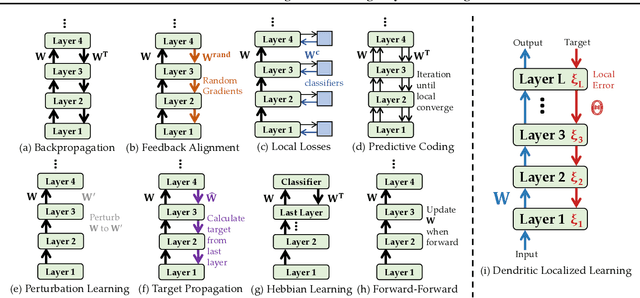
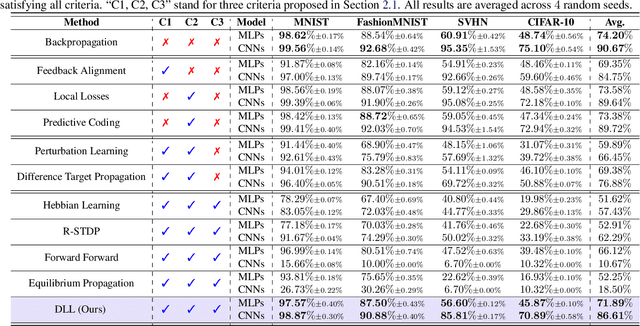
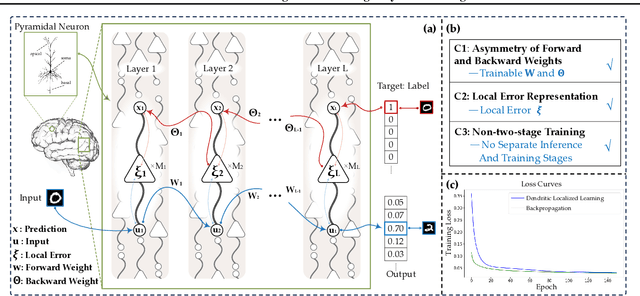

Backpropagation is the foundational algorithm for training neural networks and a key driver of deep learning's success. However, its biological plausibility has been challenged due to three primary limitations: weight symmetry, reliance on global error signals, and the dual-phase nature of training, as highlighted by the existing literature. Although various alternative learning approaches have been proposed to address these issues, most either fail to satisfy all three criteria simultaneously or yield suboptimal results. Inspired by the dynamics and plasticity of pyramidal neurons, we propose Dendritic Localized Learning (DLL), a novel learning algorithm designed to overcome these challenges. Extensive empirical experiments demonstrate that DLL satisfies all three criteria of biological plausibility while achieving state-of-the-art performance among algorithms that meet these requirements. Furthermore, DLL exhibits strong generalization across a range of architectures, including MLPs, CNNs, and RNNs. These results, benchmarked against existing biologically plausible learning algorithms, offer valuable empirical insights for future research. We hope this study can inspire the development of new biologically plausible algorithms for training multilayer networks and advancing progress in both neuroscience and machine learning.