 Add to Chrome
 Add to Firefox
 Add to Edge
MuseCritic: Learning Multi-Aspect Song Rewards through Natural-Language Aesthetic Critiques
Aug 12, 2026
Long-form song generation models continue to improve in duration, structural integrity, and acoustic complexity, making reliable aesthetic rewards increasingly important for aligning these models with human preferences. However, reward models for complete songs remain limited, and existing evaluators typically predict scores in a single forward pass without providing readable explanations. We introduce MUSECRITIC, a semi-scalar reward model that generates a natural-language critique covering five aesthetic dimensions and uses it as an intermediate representation to predict continuous reward scores. MUSECRITIC follows a two-stage training pipeline: a teacher model first provides high-quality critiques for supervised fine-tuning, after which the fine-tuned model generates its own critiques for reward learning, mitigating distribution shift between training and inference. On an in-domain test set of 200 SongEval songs, MUSECRITIC reduces macro-averaged mean squared error from 0.2875 to 0.2316 and improves macro-averaged LCC, SRCC, and Kendall's tau to 0.9068, 0.8838, and 0.7178, respectively. On the out-of-domain Music Arena benchmark with 733 preference pairs, it achieves the highest accuracy of 71.35%. Moreover, using MUSECRITIC with GRPO improves Muse-0.6B on all nine aesthetic metrics from SongEval and Audiobox Aesthetics. These results demonstrate that critique-conditioned reward modeling reduces scoring error and provides an effective optimization signal for song generation. The project repository is available at https://github.com/WuqnEl/MuseCritic.

EgoHieraLoc: A Cortically Inspired Hierarchical Segmentation-Guided Framework for Egocentric Visual Query Localization
Aug 10, 2026Visual query localization (VQL) aims to retrieve and re-localize a queried object in egocentric videos, yet remains challenging when object boundaries are ambiguous and global context cannot effectively guide fine-grained localization. Human vision handles such ambiguity through a hierarchical process: it rapidly screens foreground candidates, selectively attends to the target despite distractors, refines perception via feedback between global context and local detail, and, when a single view is unreliable, integrates evidence across viewpoints according to its credibility. Inspired by these competencies, we propose \textbf{EgoHieraLoc}, a unified framework for VQL-2D and VQL-3D. A Discriminative Parsing Module first extracts foreground-aware query representations using segmentation priors; a Query-Aware Module then performs robust target localization through discriminative correlation filtering with deformable modeling; and a Regional Adaptation Module feeds multi-scale context back into local regions to recover precise object boundaries. To extend this perceptual hierarchy to 3D localization, we introduce Geometric-Semantic Joint Confidence (GSJC), which multiplicatively couples segmentation confidence with local depth consistency, multi-view back-projection consistency, and triangulation-baseline quality, so that a viewpoint contributes to the 3D estimate only when it is credible both semantically and geometrically. Extensive experiments demonstrate state-of-the-art performance on both VQL-2D and -3D benchmarks.
Energy-Aware NECO for Single-Pass Pixel-wise Out-of-Distribution Detection in Semantic Segmentation
May 28, 2026Reliable semantic segmentation for mobile robots requires both accurate dense prediction and robust uncertainty estimation under distribution shift. Strong uncertainty baselines such as Monte Carlo Dropout often require repeated stochastic forward passes and are difficult to deploy on edge platforms. We propose Energy-Aware NECO, a single-pass pixel-wise out-of-distribution (OOD) detector for semantic segmentation. The method combines a centered NECO-style geometric ratio computed from decoder features with a logit-based Energy score. Both components are standardized using statistics fitted on a pure in-distribution validation split and fused through a convex combination. We evaluate the method on the miniMUAD subset using true pixel-level OOD labels. The proposed hybrid score achieves an AUROC of 0.8539, outperforming NECO-only (0.8280), Energy-only (0.8171), and an ensemble predictive-entropy baseline (0.8124). Additional qualitative and operating-point analyses show that the hybrid detector improves overall ranking performance while preserving the efficiency advantages of a single-pass design. Code is available at https://github.com/boyuan-zhangx/Energy-Aware_NECO
LongCat-Next: Lexicalizing Modalities as Discrete Tokens
Mar 29, 2026The prevailing Next-Token Prediction (NTP) paradigm has driven the success of large language models through discrete autoregressive modeling. However, contemporary multimodal systems remain language-centric, often treating non-linguistic modalities as external attachments, leading to fragmented architectures and suboptimal integration. To transcend this limitation, we introduce Discrete Native Autoregressive (DiNA), a unified framework that represents multimodal information within a shared discrete space, enabling a consistent and principled autoregressive modeling across modalities. A key innovation is the Discrete Native Any-resolution Visual Transformer (dNaViT), which performs tokenization and de-tokenization at arbitrary resolutions, transforming continuous visual signals into hierarchical discrete tokens. Building on this foundation, we develop LongCat-Next, a native multimodal model that processes text, vision, and audio under a single autoregressive objective with minimal modality-specific design. As an industrial-strength foundation model, it excels at seeing, painting, and talking within a single framework, achieving strong performance across a wide range of multimodal benchmarks. In particular, LongCat-Next addresses the long-standing performance ceiling of discrete vision modeling on understanding tasks and provides a unified approach to effectively reconcile the conflict between understanding and generation. As an attempt toward native multimodality, we open-source the LongCat-Next and its tokenizers, hoping to foster further research and development in the community. GitHub: https://github.com/meituan-longcat/LongCat-Next
Muse: Towards Reproducible Long-Form Song Generation with Fine-Grained Style Control
Jan 08, 2026Recent commercial systems such as Suno demonstrate strong capabilities in long-form song generation, while academic research remains largely non-reproducible due to the lack of publicly available training data, hindering fair comparison and progress. To this end, we release a fully open-source system for long-form song generation with fine-grained style conditioning, including a licensed synthetic dataset, training and evaluation pipelines, and Muse, an easy-to-deploy song generation model. The dataset consists of 116k fully licensed synthetic songs with automatically generated lyrics and style descriptions paired with audio synthesized by SunoV5. We train Muse via single-stage supervised finetuning of a Qwen-based language model extended with discrete audio tokens using MuCodec, without task-specific losses, auxiliary objectives, or additional architectural components. Our evaluations find that although Muse is trained with a modest data scale and model size, it achieves competitive performance on phoneme error rate, text--music style similarity, and audio aesthetic quality, while enabling controllable segment-level generation across different musical structures. All data, model weights, and training and evaluation pipelines will be publicly released, paving the way for continued progress in controllable long-form song generation research. The project repository is available at https://github.com/yuhui1038/Muse.
EAGLE: Episodic Appearance- and Geometry-aware Memory for Unified 2D-3D Visual Query Localization in Egocentric Vision
Nov 12, 2025Egocentric visual query localization is vital for embodied AI and VR/AR, yet remains challenging due to camera motion, viewpoint changes, and appearance variations. We present EAGLE, a novel framework that leverages episodic appearance- and geometry-aware memory to achieve unified 2D-3D visual query localization in egocentric vision. Inspired by avian memory consolidation, EAGLE synergistically integrates segmentation guided by an appearance-aware meta-learning memory (AMM), with tracking driven by a geometry-aware localization memory (GLM). This memory consolidation mechanism, through structured appearance and geometry memory banks, stores high-confidence retrieval samples, effectively supporting both long- and short-term modeling of target appearance variations. This enables precise contour delineation with robust spatial discrimination, leading to significantly improved retrieval accuracy. Furthermore, by integrating the VQL-2D output with a visual geometry grounded Transformer (VGGT), we achieve a efficient unification of 2D and 3D tasks, enabling rapid and accurate back-projection into 3D space. Our method achieves state-ofthe-art performance on the Ego4D-VQ benchmark.
From Scores to Preferences: Redefining MOS Benchmarking for Speech Quality Reward Modeling
Oct 01, 2025Assessing the perceptual quality of synthetic speech is crucial for guiding the development and refinement of speech generation models. However, it has traditionally relied on human subjective ratings such as the Mean Opinion Score (MOS), which depend on manual annotations and often suffer from inconsistent rating standards and poor reproducibility. To address these limitations, we introduce MOS-RMBench, a unified benchmark that reformulates diverse MOS datasets into a preference-comparison setting, enabling rigorous evaluation across different datasets. Building on MOS-RMBench, we systematically construct and evaluate three paradigms for reward modeling: scalar reward models, semi-scalar reward models, and generative reward models (GRMs). Our experiments reveal three key findings: (1) scalar models achieve the strongest overall performance, consistently exceeding 74% accuracy; (2) most models perform considerably worse on synthetic speech than on human speech; and (3) all models struggle on pairs with very small MOS differences. To improve performance on these challenging pairs, we propose a MOS-aware GRM that incorporates an MOS-difference-based reward function, enabling the model to adaptively scale rewards according to the difficulty of each sample pair. Experimental results show that the MOS-aware GRM significantly improves fine-grained quality discrimination and narrows the gap with scalar models on the most challenging cases. We hope this work will establish both a benchmark and a methodological framework to foster more rigorous and scalable research in automatic speech quality assessment.
MDAR: A Multi-scene Dynamic Audio Reasoning Benchmark
Sep 26, 2025The ability to reason from audio, including speech, paralinguistic cues, environmental sounds, and music, is essential for AI agents to interact effectively in real-world scenarios. Existing benchmarks mainly focus on static or single-scene settings and do not fully capture scenarios where multiple speakers, unfolding events, and heterogeneous audio sources interact. To address these challenges, we introduce MDAR, a benchmark for evaluating models on complex, multi-scene, and dynamically evolving audio reasoning tasks. MDAR comprises 3,000 carefully curated question-answer pairs linked to diverse audio clips, covering five categories of complex reasoning and spanning three question types. We benchmark 26 state-of-the-art audio language models on MDAR and observe that they exhibit limitations in complex reasoning tasks. On single-choice questions, Qwen2.5-Omni (open-source) achieves 76.67% accuracy, whereas GPT-4o Audio (closed-source) reaches 68.47%; however, GPT-4o Audio substantially outperforms Qwen2.5-Omni on the more challenging multiple-choice and open-ended tasks. Across all three question types, no model achieves 80% performance. These findings underscore the unique challenges posed by MDAR and its value as a benchmark for advancing audio reasoning research.Code and benchmark can be found at https://github.com/luckyerr/MDAR.
Speech-Language Models with Decoupled Tokenizers and Multi-Token Prediction
Jun 14, 2025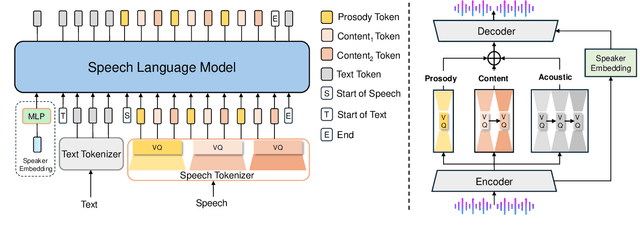
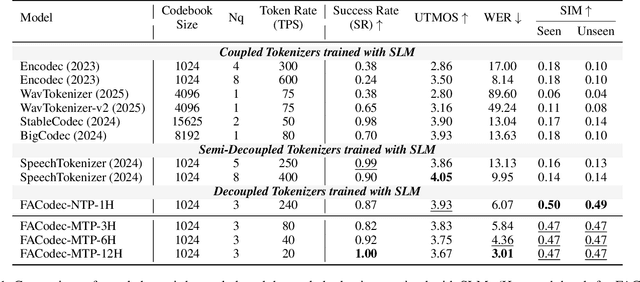
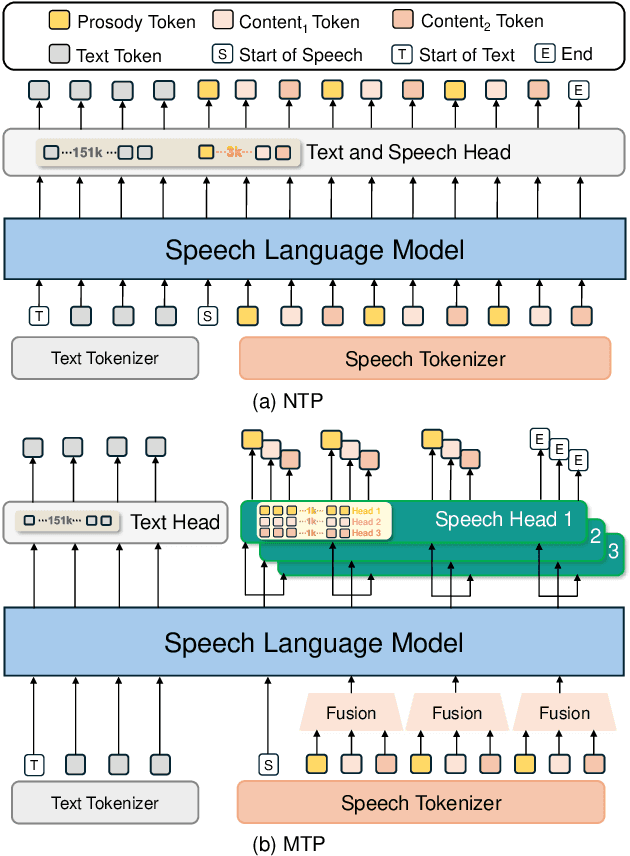
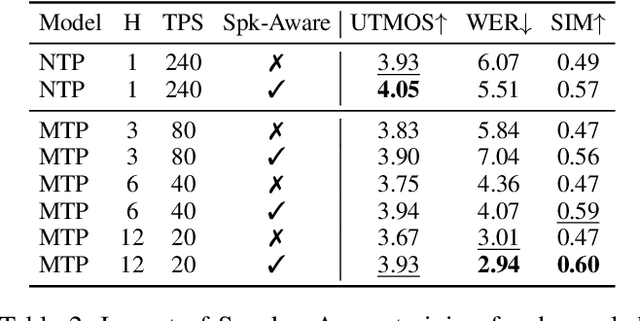
Speech-language models (SLMs) offer a promising path toward unifying speech and text understanding and generation. However, challenges remain in achieving effective cross-modal alignment and high-quality speech generation. In this work, we systematically investigate the impact of key components (i.e., speech tokenizers, speech heads, and speaker modeling) on the performance of LLM-centric SLMs. We compare coupled, semi-decoupled, and fully decoupled speech tokenizers under a fair SLM framework and find that decoupled tokenization significantly improves alignment and synthesis quality. To address the information density mismatch between speech and text, we introduce multi-token prediction (MTP) into SLMs, enabling each hidden state to decode multiple speech tokens. This leads to up to 12$\times$ faster decoding and a substantial drop in word error rate (from 6.07 to 3.01). Furthermore, we propose a speaker-aware generation paradigm and introduce RoleTriviaQA, a large-scale role-playing knowledge QA benchmark with diverse speaker identities. Experiments demonstrate that our methods enhance both knowledge understanding and speaker consistency.
Predicting Large Language Model Capabilities on Closed-Book QA Tasks Using Only Information Available Prior to Training
Feb 06, 2025The GPT-4 technical report from OpenAI suggests that model performance on specific tasks can be predicted prior to training, though methodologies remain unspecified. This approach is crucial for optimizing resource allocation and ensuring data alignment with target tasks. To achieve this vision, we focus on predicting performance on Closed-book Question Answering (CBQA) tasks, which are closely tied to pre-training data and knowledge retention. We address three major challenges: 1) mastering the entire pre-training process, especially data construction; 2) evaluating a model's knowledge retention; and 3) predicting task-specific knowledge retention using only information available prior to training. To tackle these challenges, we pre-train three large language models (i.e., 1.6B, 7B, and 13B) using 560k dollars and 520k GPU hours. We analyze the pre-training data with knowledge triples and assess knowledge retention using established methods. Additionally, we introduce the SMI metric, an information-theoretic measure that quantifies the relationship between pre-training data, model size, and task-specific knowledge retention. Our experiments reveal a strong linear correlation ($\text{R}^2 > 0.84$) between the SMI metric and the model's accuracy on CBQA tasks across models of varying sizes (i.e., 1.1B, 1.6B, 7B, and 13B). The dataset, model, and code are available at https://github.com/yuhui1038/SMI.