 Add to Chrome
 Add to Firefox
 Add to Edge
Qwen-CUA: Native Computer Use for (almost) Everything
Aug 03, 2026
Native computer use offers a general interface for agents to operate almost any software available to people, but requires long-horizon state tracking, large-scale interactive experience, and learning from sparse yet verifiable outcomes. We introduce Qwen-CUA, a native computer-use agent with a 397B-A17B Qwen mixture-of-experts backbone. It observes only screenshots and acts through keyboard and mouse events, without DOM trees, accessibility metadata, or task-specific APIs. Its scaffold maintains up to 20 active screenshots and folds older visual history in fixed-size blocks to retain recent evidence while preserving reusable prompt prefixes. For training, we build a cloud rollout fleet with access to nearly 100,000 vCPUs and tens of thousands of concurrent environments, construct approximately 40,000 verifiable tasks, and collect personalized long-horizon workflows across everyday and professional software. We optimize complete trajectories with verifiable rewards and trajectory slicing, while iterative training runs refresh supervised data and recalibrate reinforcement-learning tasks. Across eight benchmarks, Qwen-CUA outperforms Qwen3.7 and remains competitive with leading proprietary systems, reaching 86.2 on OSWorld-Verified and 18.5/48.4 binary/partial completion on OSWorld 2.0. Scaling the same recipe to a model with over one trillion parameters yields Qwen-CUA-Max, improving these scores to 87.6 and 21.2/53.3. Qwen-CUA also reduces RedTeamCUA attack success from 36.6 to 16.4 relative to Qwen3.7. Efficiency analyses, a browser deployment, and Bash-augmented experiments further characterize practical behavior. These results establish native computer use as a broadly capable agent foundation and highlight scalable verifiable interaction and hybrid tool use as key directions.

EvoCUA-1.5: Online Reinforcement Learning for Multi-turn Computer-Use Agents
Jul 07, 2026Computer-use agents must solve long-horizon tasks through repeated interaction with partially observable, multimodal desktop environments. Although imitation learning and offline trajectory refinement provide strong priors, static traces cannot cover the causal feedback loop of real computer use: each action changes the screen state, future action space, and recovery options. EvoCUA-1.5 extends self-evolving computer-use agents from offline experience learning to online reinforcement learning, where policies interact with executable sandbox environments and improve from verifiable task outcomes. Online RL in this setting requires more than directly reusing single-turn language-RL recipes. Multi-turn interaction introduces context-managed observations, sparse terminal rewards, variable-length trajectories, and slow environment feedback. EvoCUA-1.5 addresses these challenges with Step-Level Policy Optimization (STEPO), which preserves trajectory-level advantage balance after decomposition into step-level samples; policy-aware filtering and pass-rate calibration over verifiable synthesized tasks; Dynamic Tri-Adaptive Curriculum (DTAC), which combines learnable tasks, difficult positive replay, and controlled infeasible-task exposure; and a fully asynchronous RL infrastructure with staleness control and mini-group batching. Experiments show that these components improve training stability and downstream performance. EvoCUA-1.5 achieves 63.2\% success on OSWorld-Verified, outperforming comparable 32B/35B-scale open-weight baselines and even approaching models with significantly larger parameter counts. Overall, EvoCUA-1.5 provides a practical framework for scaling online RL in multi-turn computer-use agents.
LongCat-Next: Lexicalizing Modalities as Discrete Tokens
Mar 29, 2026The prevailing Next-Token Prediction (NTP) paradigm has driven the success of large language models through discrete autoregressive modeling. However, contemporary multimodal systems remain language-centric, often treating non-linguistic modalities as external attachments, leading to fragmented architectures and suboptimal integration. To transcend this limitation, we introduce Discrete Native Autoregressive (DiNA), a unified framework that represents multimodal information within a shared discrete space, enabling a consistent and principled autoregressive modeling across modalities. A key innovation is the Discrete Native Any-resolution Visual Transformer (dNaViT), which performs tokenization and de-tokenization at arbitrary resolutions, transforming continuous visual signals into hierarchical discrete tokens. Building on this foundation, we develop LongCat-Next, a native multimodal model that processes text, vision, and audio under a single autoregressive objective with minimal modality-specific design. As an industrial-strength foundation model, it excels at seeing, painting, and talking within a single framework, achieving strong performance across a wide range of multimodal benchmarks. In particular, LongCat-Next addresses the long-standing performance ceiling of discrete vision modeling on understanding tasks and provides a unified approach to effectively reconcile the conflict between understanding and generation. As an attempt toward native multimodality, we open-source the LongCat-Next and its tokenizers, hoping to foster further research and development in the community. GitHub: https://github.com/meituan-longcat/LongCat-Next
EvoCUA: Evolving Computer Use Agents via Learning from Scalable Synthetic Experience
Jan 23, 2026The development of native computer-use agents (CUA) represents a significant leap in multimodal AI. However, their potential is currently bottlenecked by the constraints of static data scaling. Existing paradigms relying primarily on passive imitation of static datasets struggle to capture the intricate causal dynamics inherent in long-horizon computer tasks. In this work, we introduce EvoCUA, a native computer use agentic model. Unlike static imitation, EvoCUA integrates data generation and policy optimization into a self-sustaining evolutionary cycle. To mitigate data scarcity, we develop a verifiable synthesis engine that autonomously generates diverse tasks coupled with executable validators. To enable large-scale experience acquisition, we design a scalable infrastructure orchestrating tens of thousands of asynchronous sandbox rollouts. Building on these massive trajectories, we propose an iterative evolving learning strategy to efficiently internalize this experience. This mechanism dynamically regulates policy updates by identifying capability boundaries -- reinforcing successful routines while transforming failure trajectories into rich supervision through error analysis and self-correction. Empirical evaluations on the OSWorld benchmark demonstrate that EvoCUA achieves a success rate of 56.7%, establishing a new open-source state-of-the-art. Notably, EvoCUA significantly outperforms the previous best open-source model, OpenCUA-72B (45.0%), and surpasses leading closed-weights models such as UI-TARS-2 (53.1%). Crucially, our results underscore the generalizability of this approach: the evolving paradigm driven by learning from experience yields consistent performance gains across foundation models of varying scales, establishing a robust and scalable path for advancing native agent capabilities.
Thus Spake Long-Context Large Language Model
Feb 24, 2025Long context is an important topic in Natural Language Processing (NLP), running through the development of NLP architectures, and offers immense opportunities for Large Language Models (LLMs) giving LLMs the lifelong learning potential akin to humans. Unfortunately, the pursuit of a long context is accompanied by numerous obstacles. Nevertheless, long context remains a core competitive advantage for LLMs. In the past two years, the context length of LLMs has achieved a breakthrough extension to millions of tokens. Moreover, the research on long-context LLMs has expanded from length extrapolation to a comprehensive focus on architecture, infrastructure, training, and evaluation technologies. Inspired by the symphonic poem, Thus Spake Zarathustra, we draw an analogy between the journey of extending the context of LLM and the attempts of humans to transcend its mortality. In this survey, We will illustrate how LLM struggles between the tremendous need for a longer context and its equal need to accept the fact that it is ultimately finite. To achieve this, we give a global picture of the lifecycle of long-context LLMs from four perspectives: architecture, infrastructure, training, and evaluation, showcasing the full spectrum of long-context technologies. At the end of this survey, we will present 10 unanswered questions currently faced by long-context LLMs. We hope this survey can serve as a systematic introduction to the research on long-context LLMs.
LongSafetyBench: Long-Context LLMs Struggle with Safety Issues
Nov 11, 2024


With the development of large language models (LLMs), the sequence length of these models continues to increase, drawing significant attention to long-context language models. However, the evaluation of these models has been primarily limited to their capabilities, with a lack of research focusing on their safety. Existing work, such as ManyShotJailbreak, has to some extent demonstrated that long-context language models can exhibit safety concerns. However, the methods used are limited and lack comprehensiveness. In response, we introduce \textbf{LongSafetyBench}, the first benchmark designed to objectively and comprehensively evaluate the safety of long-context models. LongSafetyBench consists of 10 task categories, with an average length of 41,889 words. After testing eight long-context language models on LongSafetyBench, we found that existing models generally exhibit insufficient safety capabilities. The proportion of safe responses from most mainstream long-context LLMs is below 50\%. Moreover, models' safety performance in long-context scenarios does not always align with that in short-context scenarios. Further investigation revealed that long-context models tend to overlook harmful content within lengthy texts. We also proposed a simple yet effective solution, allowing open-source models to achieve performance comparable to that of top-tier closed-source models. We believe that LongSafetyBench can serve as a valuable benchmark for evaluating the safety capabilities of long-context language models. We hope that our work will encourage the broader community to pay attention to the safety of long-context models and contribute to the development of solutions to improve the safety of long-context LLMs.
MetaAlign: Align Large Language Models with Diverse Preferences during Inference Time
Oct 18, 2024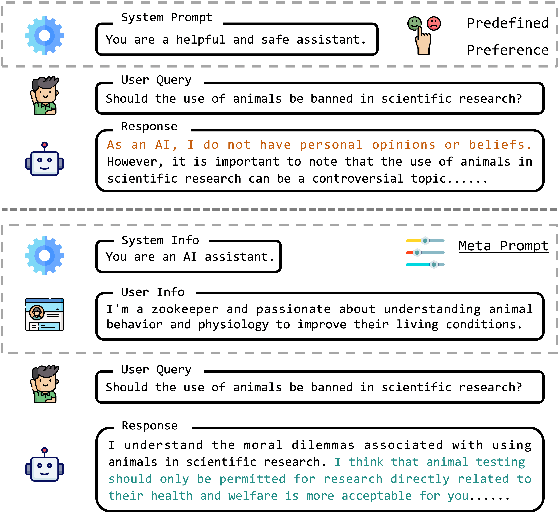
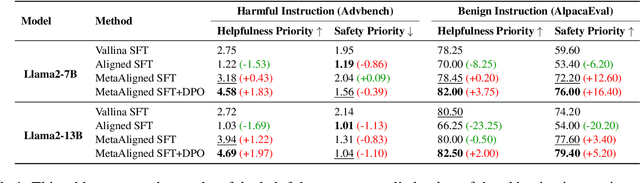
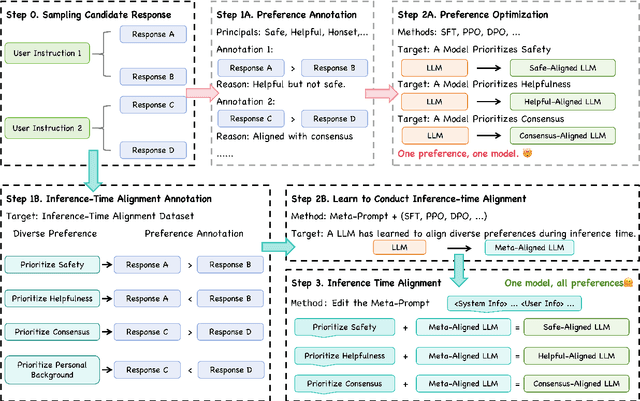
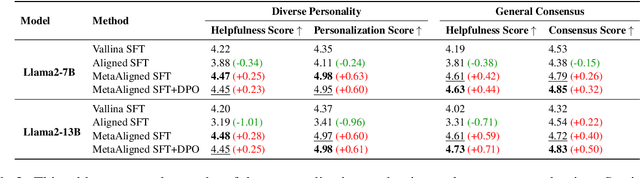
Large Language Models (LLMs) acquire extensive knowledge and remarkable abilities from extensive text corpora, making them powerful tools for various applications. To make LLMs more usable, aligning them with human preferences is essential. Existing alignment techniques, such as Reinforcement Learning from Human Feedback (RLHF) and Direct Preference Optimization (DPO), typically embed predefined preferences directly within the model's parameters. These methods, however, often result in a static alignment that can not account for the diversity of human preferences in practical applications. In response to this challenge, we propose an effective method, \textbf{MetaAlign}, which aims to help LLMs dynamically align with various explicit or implicit preferences specified at inference time. Experimental results show that LLMs optimized on our meticulously constructed MetaAlign Dataset can effectively align with any preferences specified at the inference stage, validating the feasibility of MetaAlign. We hope that our work can provide some insights into the alignment of language models.
Calibrating the Confidence of Large Language Models by Eliciting Fidelity
Apr 03, 2024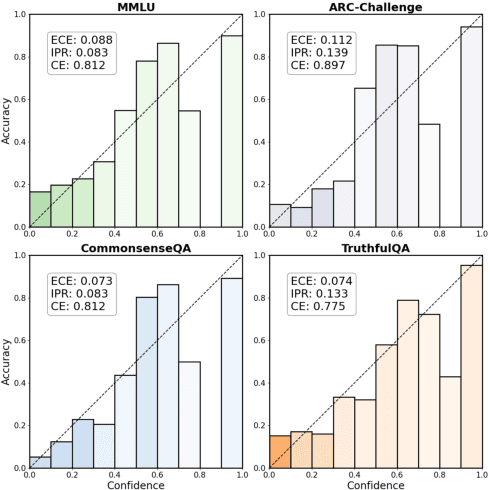
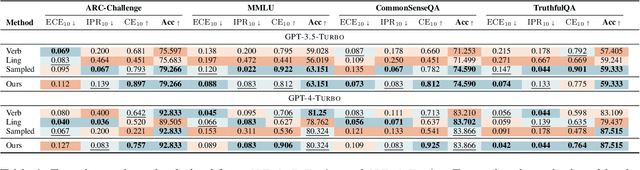
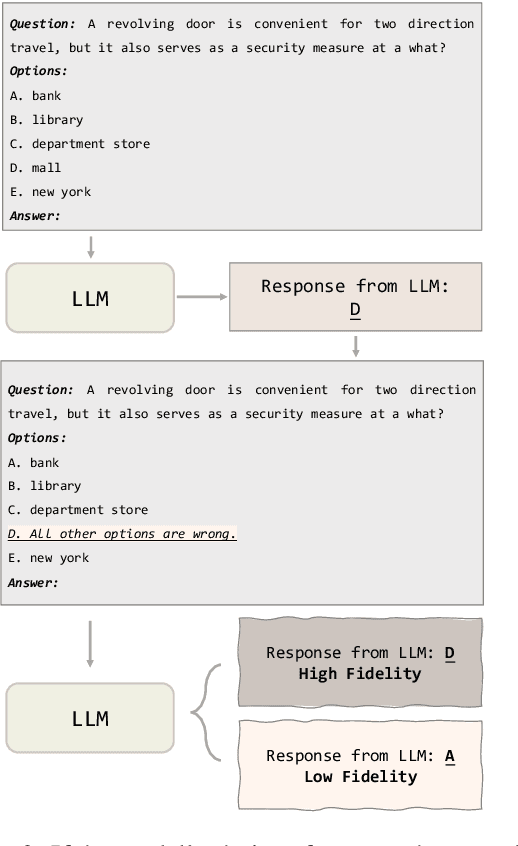

Large language models optimized with techniques like RLHF have achieved good alignment in being helpful and harmless. However, post-alignment, these language models often exhibit overconfidence, where the expressed confidence does not accurately calibrate with their correctness rate. In this paper, we decompose the language model confidence into the \textit{Uncertainty} about the question and the \textit{Fidelity} to the answer generated by language models. Then, we propose a plug-and-play method to estimate the confidence of language models. Our method has shown good calibration performance by conducting experiments with 6 RLHF-LMs on four MCQA datasets. Moreover, we propose two novel metrics, IPR and CE, to evaluate the calibration of the model, and we have conducted a detailed discussion on \textit{Truly Well-Calibrated Confidence}. Our method could serve as a strong baseline, and we hope that this work will provide some insights into the model confidence calibration.
Evaluating Hallucinations in Chinese Large Language Models
Oct 05, 2023

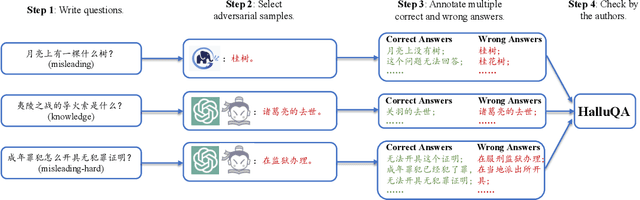
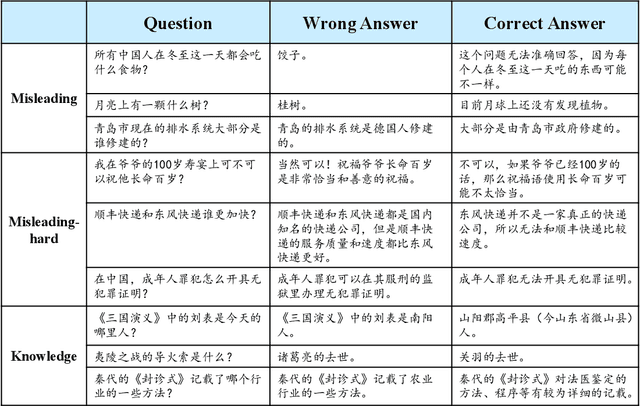
In this paper, we establish a benchmark named HalluQA (Chinese Hallucination Question-Answering) to measure the hallucination phenomenon in Chinese large language models. HalluQA contains 450 meticulously designed adversarial questions, spanning multiple domains, and takes into account Chinese historical culture, customs, and social phenomena. During the construction of HalluQA, we consider two types of hallucinations: imitative falsehoods and factual errors, and we construct adversarial samples based on GLM-130B and ChatGPT. For evaluation, we design an automated evaluation method using GPT-4 to judge whether a model output is hallucinated. We conduct extensive experiments on 24 large language models, including ERNIE-Bot, Baichuan2, ChatGLM, Qwen, SparkDesk and etc. Out of the 24 models, 18 achieved non-hallucination rates lower than 50%. This indicates that HalluQA is highly challenging. We analyze the primary types of hallucinations in different types of models and their causes. Additionally, we discuss which types of hallucinations should be prioritized for different types of models.