 Add to Chrome
 Add to Firefox
 Add to Edge
LegalWorld: A Life-Cycle Interactive Environment for Legal Agents
Jun 17, 2026
Civil litigation is inherently a life-cycle process: what a lawyer drafts on day one constrains what unfolds at trial months later. Yet existing legal benchmarks evaluate isolated subtasks, and prior legal-agent simulators reinitialize each scenario from shared ground truth, leaving cross-stage causal dependencies unmodeled. We present LegalWorld, a life-cycle interactive environment that models Chinese civil litigation as a causally connected state chain of five stages (seven sub-scenarios), grounded in 75,309 paired Chinese civil judgments. We pair it with reusable infrastructure (local memory, global case memory, a Skill/Tool library) that keeps each dispute consistent across its full life cycle. Building on this environment, we construct LongJud-Bench to evaluate agent capability across all five connected stages. 18,992 ratings from 217 legal-background evaluators confirm that LegalWorld trajectories are procedurally faithful and role-consistent; and a capability-level cross-model evaluation reveals sharp divergences that aggregate scores cannot expose, with no single backbone leading across consultation, drafting, and courtroom advocacy. Detailed resources will be released publicly.

Multi-Agent Simulator Drives Language Models for Legal Intensive Interaction
Feb 08, 2025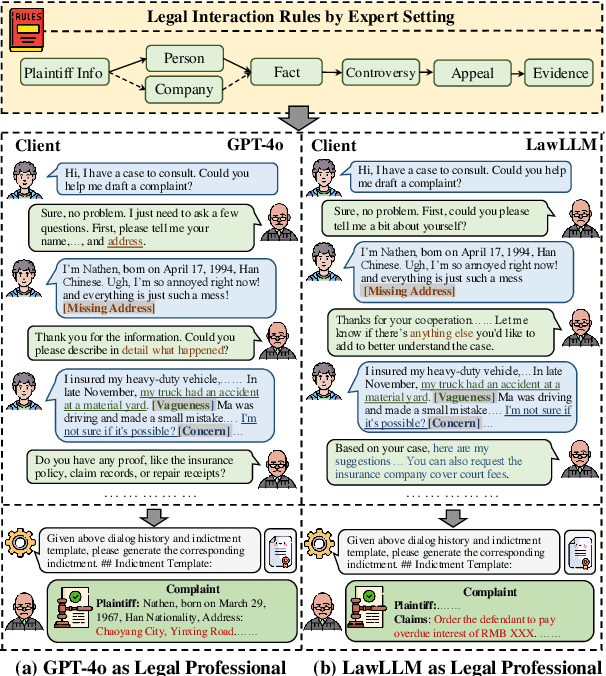
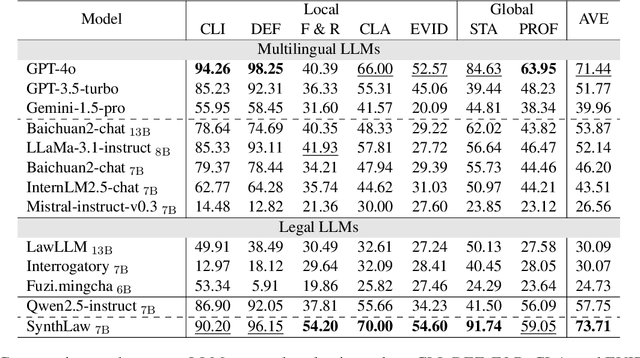
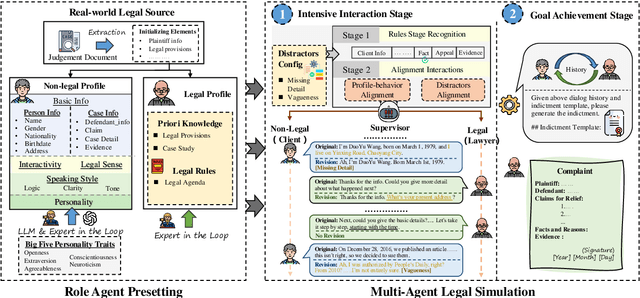
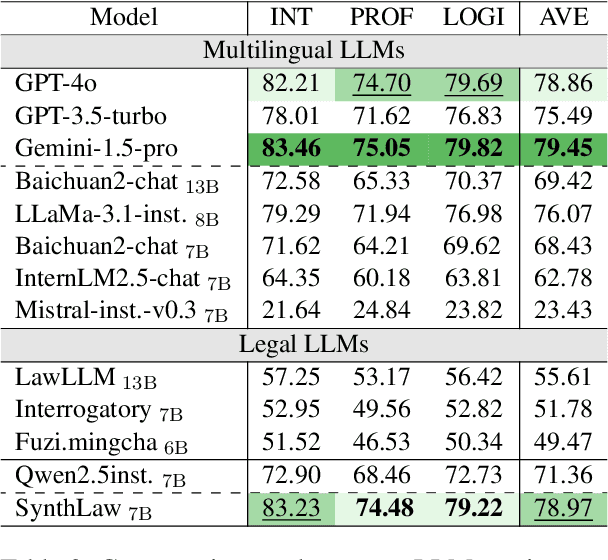
Large Language Models (LLMs) have significantly advanced legal intelligence, but the scarcity of scenario data impedes the progress toward interactive legal scenarios. This paper introduces a Multi-agent Legal Simulation Driver (MASER) to scalably generate synthetic data by simulating interactive legal scenarios. Leveraging real-legal case sources, MASER ensures the consistency of legal attributes between participants and introduces a supervisory mechanism to align participants' characters and behaviors as well as addressing distractions. A Multi-stage Interactive Legal Evaluation (MILE) benchmark is further constructed to evaluate LLMs' performance in dynamic legal scenarios. Extensive experiments confirm the effectiveness of our framework.
Overview of the CAIL 2023 Argument Mining Track
Jun 20, 2024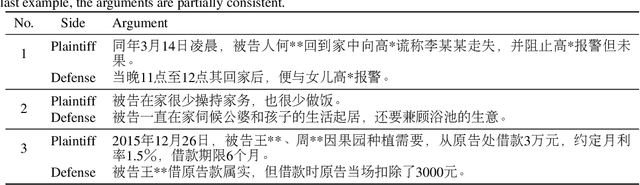
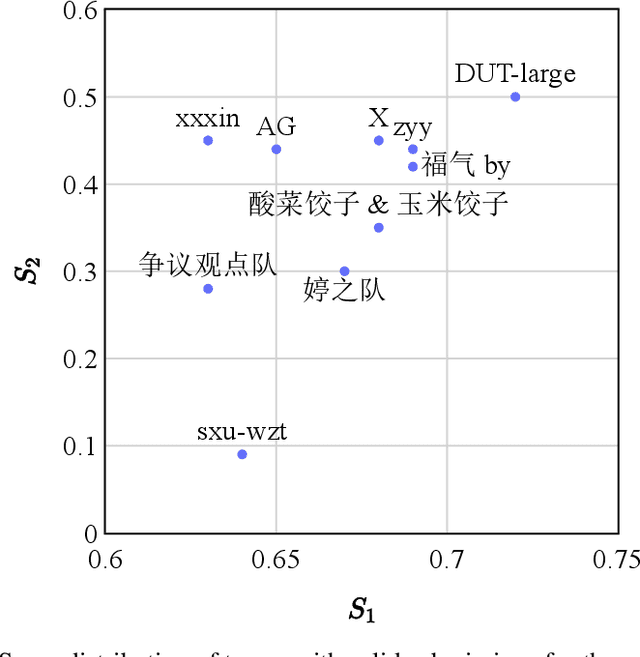
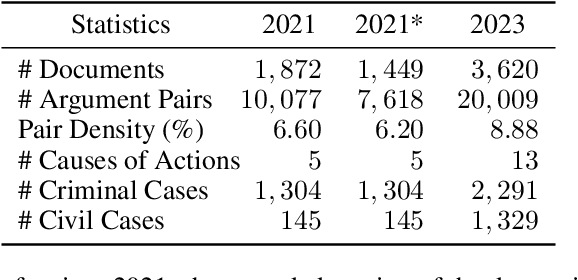
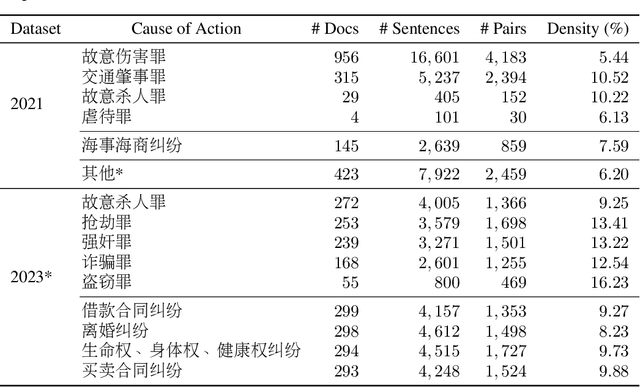
We give a detailed overview of the CAIL 2023 Argument Mining Track, one of the Chinese AI and Law Challenge (CAIL) 2023 tracks. The main goal of the track is to identify and extract interacting argument pairs in trial dialogs. It mainly uses summarized judgment documents but can also refer to trial recordings. The track consists of two stages, and we introduce the tasks designed for each stage; we also extend the data from previous events into a new dataset -- CAIL2023-ArgMine -- with annotated new cases from various causes of action. We outline several submissions that achieve the best results, including their methods for different stages. While all submissions rely on language models, they have incorporated strategies that may benefit future work in this field.