 Add to Chrome
 Add to Firefox
 Add to Edge
TeleChat Technical Report
Jan 08, 2024



In this technical report, we present TeleChat, a collection of large language models (LLMs) with parameters of 3 billion, 7 billion and 12 billion. It includes pretrained language models as well as fine-tuned chat models that is aligned with human preferences. TeleChat is initially pretrained on an extensive corpus containing a diverse collection of texts from both English and Chinese languages, including trillions of tokens. Subsequently, the model undergoes fine-tuning to align with human preferences, following a detailed methodology that we describe. We evaluate the performance of TeleChat on various tasks, including language understanding, mathematics, reasoning, code generation, and knowledge-based question answering. Our findings indicate that TeleChat achieves comparable performance to other open-source models of similar size across a wide range of public benchmarks. To support future research and applications utilizing LLMs, we release the fine-tuned model checkpoints of TeleChat's 7B and 12B variant, along with code and a portion of our pretraining data, to the public community.

IoT in the Era of Generative AI: Vision and Challenges
Jan 06, 2024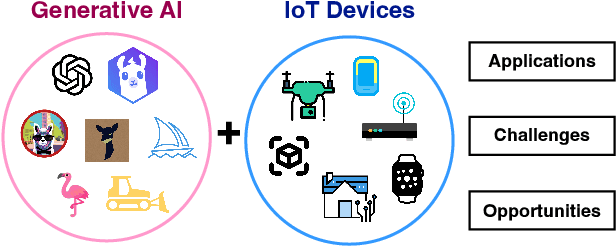
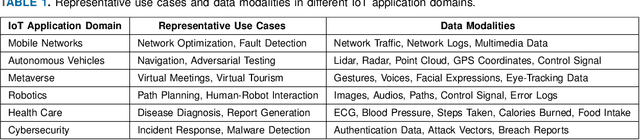
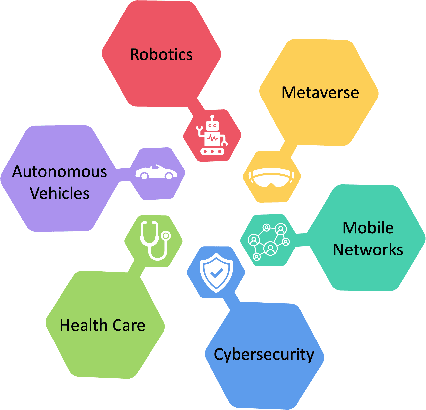
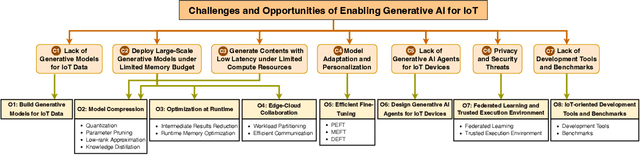
Equipped with sensing, networking, and computing capabilities, Internet of Things (IoT) such as smartphones, wearables, smart speakers, and household robots have been seamlessly weaved into our daily lives. Recent advancements in Generative AI exemplified by GPT, LLaMA, DALL-E, and Stable Difussion hold immense promise to push IoT to the next level. In this article, we share our vision and views on the benefits that Generative AI brings to IoT, and discuss some of the most important applications of Generative AI in IoT-related domains. Fully harnessing Generative AI in IoT is a complex challenge. We identify some of the most critical challenges including high resource demands of the Generative AI models, prompt engineering, on-device inference, offloading, on-device fine-tuning, federated learning, security, as well as development tools and benchmarks, and discuss current gaps as well as promising opportunities on enabling Generative AI for IoT. We hope this article can inspire new research on IoT in the era of Generative AI.
Bayesian Intrinsic Groupwise Image Registration: Unsupervised Disentanglement of Anatomy and Geometry
Jan 04, 2024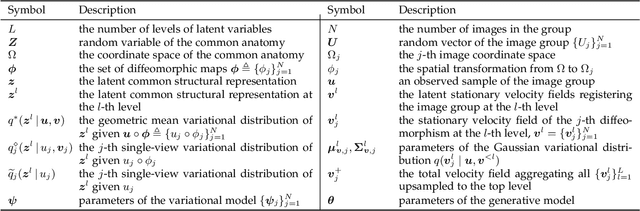
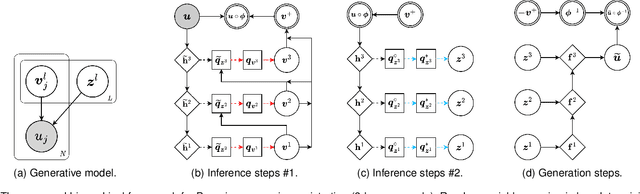
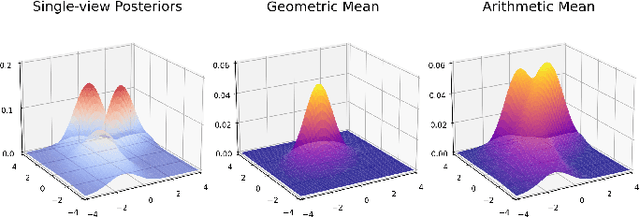
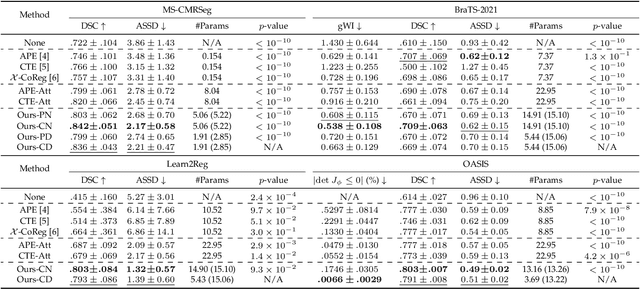
This article presents a general Bayesian learning framework for multi-modal groupwise registration on medical images. The method builds on probabilistic modelling of the image generative process, where the underlying common anatomy and geometric variations of the observed images are explicitly disentangled as latent variables. Thus, groupwise registration is achieved through the solution to Bayesian inference. We propose a novel hierarchical variational auto-encoding architecture to realize the inference procedure of the latent variables, where the registration parameters can be calculated in a mathematically interpretable fashion. Remarkably, this new paradigm can learn groupwise registration in an unsupervised closed-loop self-reconstruction process, sparing the burden of designing complex intensity-based similarity measures. The computationally efficient disentangled architecture is also inherently scalable and flexible, allowing for groupwise registration on large-scale image groups with variable sizes. Furthermore, the inferred structural representations from disentanglement learning are capable of capturing the latent anatomy of the observations with visual semantics. Extensive experiments were conducted to validate the proposed framework, including four datasets from cardiac, brain and abdominal medical images. The results have demonstrated the superiority of our method over conventional similarity-based approaches in terms of accuracy, efficiency, scalability and interpretability.
Grounding-Prompter: Prompting LLM with Multimodal Information for Temporal Sentence Grounding in Long Videos
Dec 28, 2023Temporal Sentence Grounding (TSG), which aims to localize moments from videos based on the given natural language queries, has attracted widespread attention. Existing works are mainly designed for short videos, failing to handle TSG in long videos, which poses two challenges: i) complicated contexts in long videos require temporal reasoning over longer moment sequences, and ii) multiple modalities including textual speech with rich information require special designs for content understanding in long videos. To tackle these challenges, in this work we propose a Grounding-Prompter method, which is capable of conducting TSG in long videos through prompting LLM with multimodal information. In detail, we first transform the TSG task and its multimodal inputs including speech and visual, into compressed task textualization. Furthermore, to enhance temporal reasoning under complicated contexts, a Boundary-Perceptive Prompting strategy is proposed, which contains three folds: i) we design a novel Multiscale Denoising Chain-of-Thought (CoT) to combine global and local semantics with noise filtering step by step, ii) we set up validity principles capable of constraining LLM to generate reasonable predictions following specific formats, and iii) we introduce one-shot In-Context-Learning (ICL) to boost reasoning through imitation, enhancing LLM in TSG task understanding. Experiments demonstrate the state-of-the-art performance of our Grounding-Prompter method, revealing the benefits of prompting LLM with multimodal information for TSG in long videos.
LLM4VG: Large Language Models Evaluation for Video Grounding
Dec 28, 2023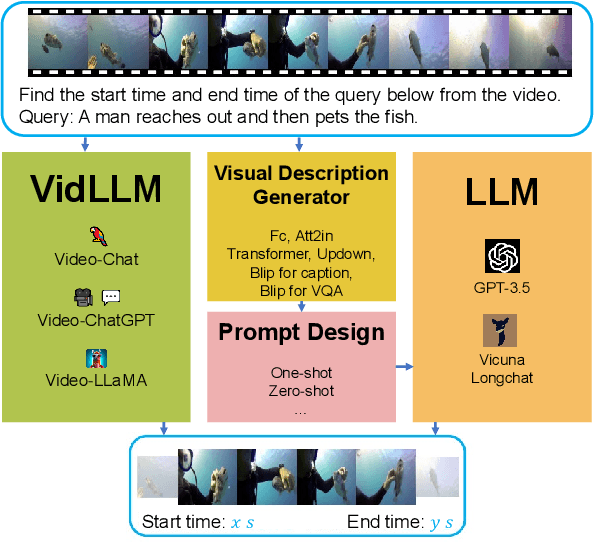
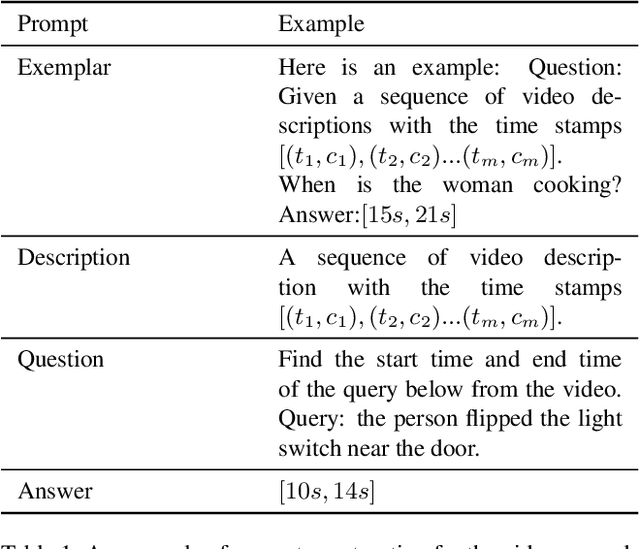
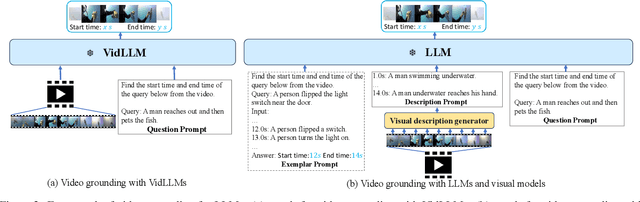
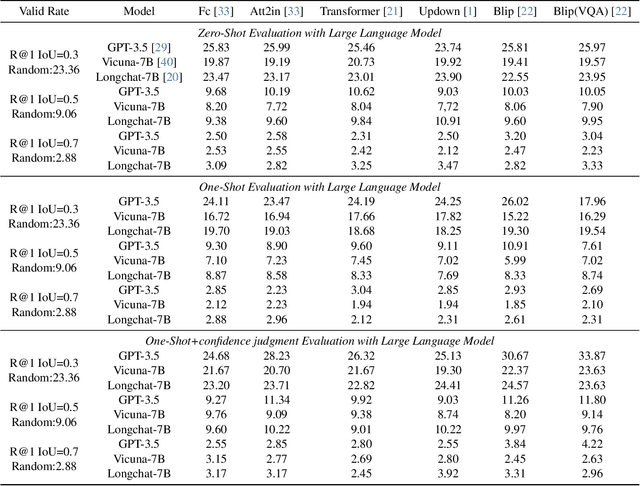
Recently, researchers have attempted to investigate the capability of LLMs in handling videos and proposed several video LLM models. However, the ability of LLMs to handle video grounding (VG), which is an important time-related video task requiring the model to precisely locate the start and end timestamps of temporal moments in videos that match the given textual queries, still remains unclear and unexplored in literature. To fill the gap, in this paper, we propose the LLM4VG benchmark, which systematically evaluates the performance of different LLMs on video grounding tasks. Based on our proposed LLM4VG, we design extensive experiments to examine two groups of video LLM models on video grounding: (i) the video LLMs trained on the text-video pairs (denoted as VidLLM), and (ii) the LLMs combined with pretrained visual description models such as the video/image captioning model. We propose prompt methods to integrate the instruction of VG and description from different kinds of generators, including caption-based generators for direct visual description and VQA-based generators for information enhancement. We also provide comprehensive comparisons of various VidLLMs and explore the influence of different choices of visual models, LLMs, prompt designs, etc, as well. Our experimental evaluations lead to two conclusions: (i) the existing VidLLMs are still far away from achieving satisfactory video grounding performance, and more time-related video tasks should be included to further fine-tune these models, and (ii) the combination of LLMs and visual models shows preliminary abilities for video grounding with considerable potential for improvement by resorting to more reliable models and further guidance of prompt instructions.
PokeMQA: Programmable knowledge editing for Multi-hop Question Answering
Dec 23, 2023
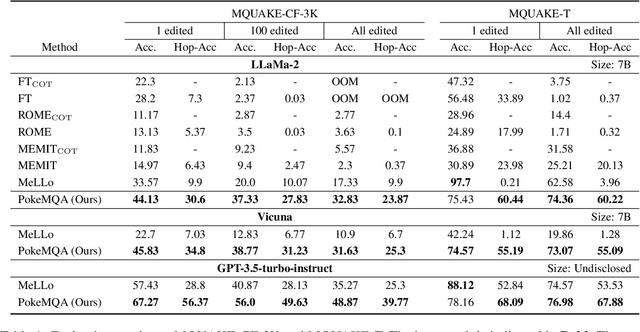
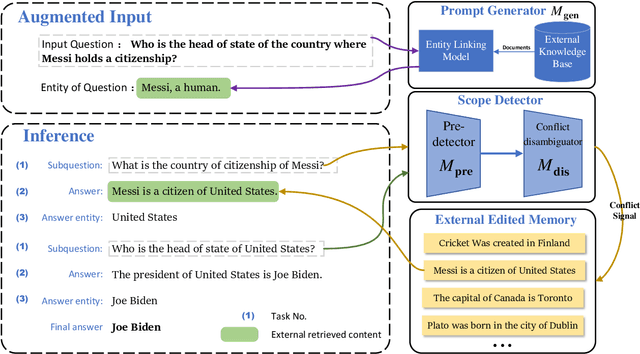
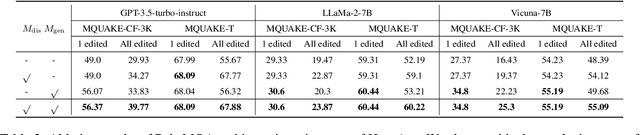
Multi-hop question answering (MQA) is one of the challenging tasks to evaluate machine's comprehension and reasoning abilities, where large language models (LLMs) have widely achieved the human-comparable performance. Due to the dynamics of knowledge facts in real world, knowledge editing has been explored to update model with the up-to-date facts while avoiding expensive re-training or fine-tuning. Starting from the edited fact, the updated model needs to provide cascading changes in the chain of MQA. The previous art simply adopts a mix-up prompt to instruct LLMs conducting multiple reasoning tasks sequentially, including question decomposition, answer generation, and conflict checking via comparing with edited facts. However, the coupling of these functionally-diverse reasoning tasks inhibits LLMs' advantages in comprehending and answering questions while disturbing them with the unskilled task of conflict checking. We thus propose a framework, Programmable knowledge editing for Multi-hop Question Answering (PokeMQA), to decouple the jobs. Specifically, we prompt LLMs to decompose knowledge-augmented multi-hop question, while interacting with a detached trainable scope detector to modulate LLMs behavior depending on external conflict signal. The experiments on three LLM backbones and two benchmark datasets validate our superiority in knowledge editing of MQA, outperforming all competitors by a large margin in almost all settings and consistently producing reliable reasoning process.
Efficient Large Language Models: A Survey
Dec 23, 2023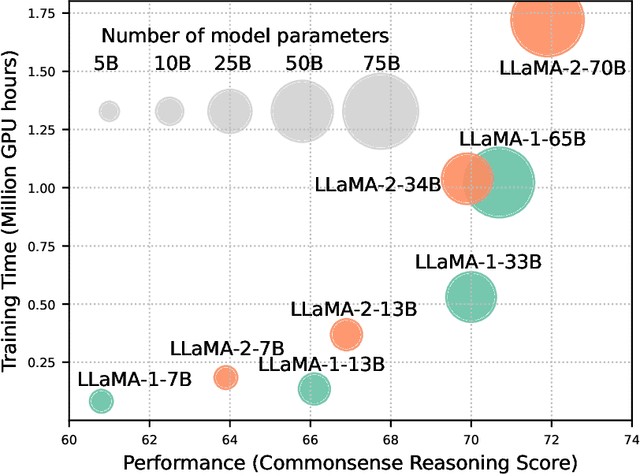


Large Language Models (LLMs) have demonstrated remarkable capabilities in important tasks such as natural language understanding, language generation, and complex reasoning and have the potential to make a substantial impact on our society. Such capabilities, however, come with the considerable resources they demand, highlighting the strong need to develop effective techniques for addressing their efficiency challenges. In this survey, we provide a systematic and comprehensive review of efficient LLMs research. We organize the literature in a taxonomy consisting of three main categories, covering distinct yet interconnected efficient LLMs topics from model-centric, data-centric, and framework-centric perspective, respectively. We have also created a GitHub repository where we compile the papers featured in this survey at https://github.com/AIoT-MLSys-Lab/EfficientLLMs, and will actively maintain this repository and incorporate new research as it emerges. We hope our survey can serve as a valuable resource to help researchers and practitioners gain a systematic understanding of the research developments in efficient LLMs and inspire them to contribute to this important and exciting field.
ZMM-TTS: Zero-shot Multilingual and Multispeaker Speech Synthesis Conditioned on Self-supervised Discrete Speech Representations
Dec 22, 2023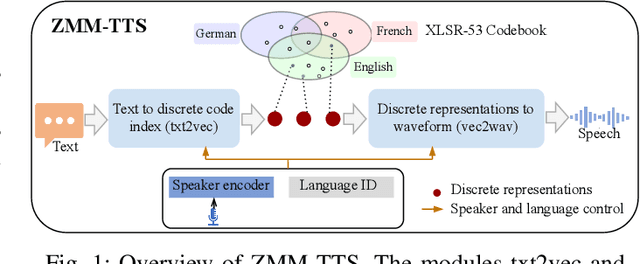
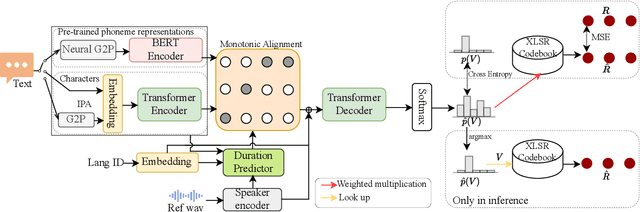
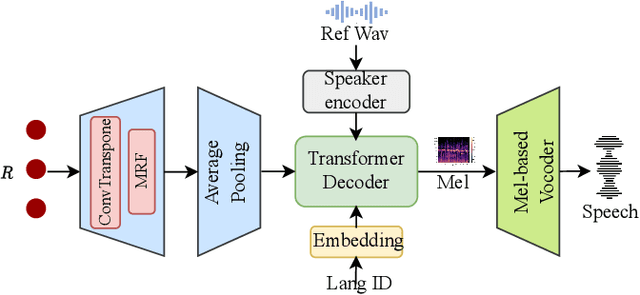
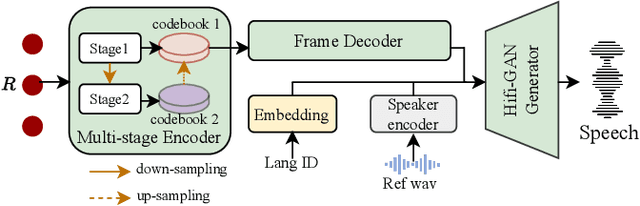
Neural text-to-speech (TTS) has achieved human-like synthetic speech for single-speaker, single-language synthesis. Multilingual TTS systems are limited to resource-rich languages due to the lack of large paired text and studio-quality audio data. In most cases, TTS systems are built using a single speaker's voice. However, there is growing interest in developing systems that can synthesize voices for new speakers using only a few seconds of their speech. This paper presents ZMM-TTS, a multilingual and multispeaker framework utilizing quantized latent speech representations from a large-scale, pre-trained, self-supervised model. Our paper is the first to incorporate the representations from text-based and speech-based self-supervised learning models into multilingual speech synthesis tasks. We conducted comprehensive subjective and objective evaluations through a series of experiments. Our model has been proven effective in terms of speech naturalness and similarity for both seen and unseen speakers in six high-resource languages. We also tested the efficiency of our method on two hypothetical low-resource languages. The results are promising, indicating that our proposed approach can synthesize audio that is intelligible and has a high degree of similarity to the target speaker's voice, even without any training data for the new, unseen language.
In2SET: Intra-Inter Similarity Exploiting Transformer for Dual-Camera Compressive Hyperspectral Imaging
Dec 20, 2023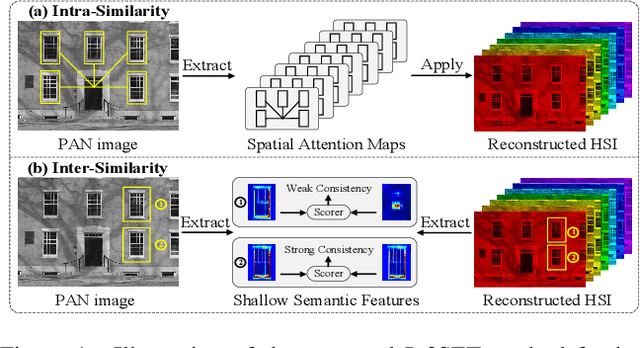
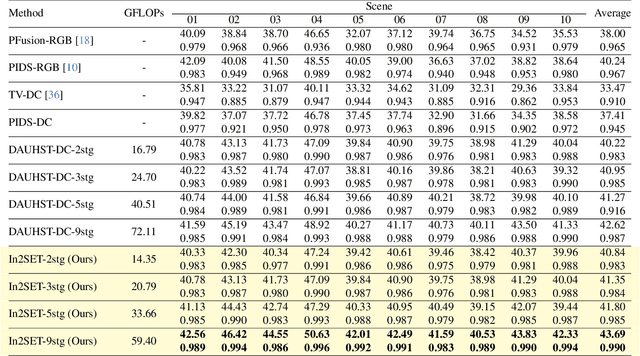
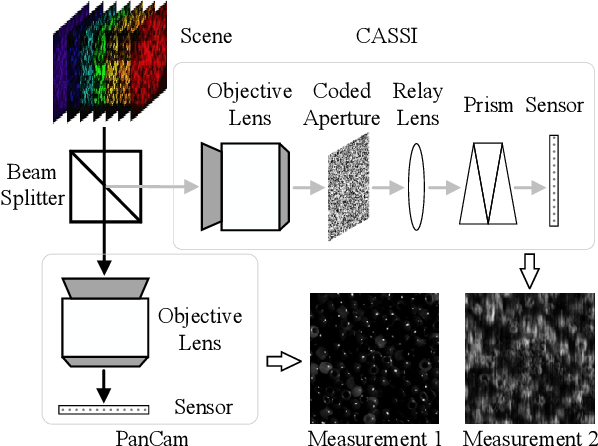
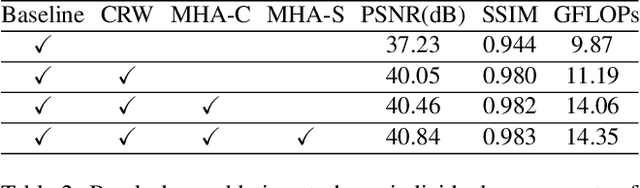
Dual-Camera Compressed Hyperspectral Imaging (DCCHI) offers the capability to reconstruct 3D Hyperspectral Image (HSI) by fusing compressive and Panchromatic (PAN) image, which has shown great potential for snapshot hyperspectral imaging in practice. In this paper, we introduce a novel DCCHI reconstruction network, the Intra-Inter Similarity Exploiting Transformer (In2SET). Our key insight is to make full use of the PAN image to assist the reconstruction. To this end, we propose using the intra-similarity within the PAN image as a proxy for approximating the intra-similarity in the original HSI, thereby offering an enhanced content prior for more accurate HSI reconstruction. Furthermore, we aim to align the features from the underlying HSI with those of the PAN image, maintaining semantic consistency and introducing new contextual information for the reconstruction process. By integrating In2SET into a PAN-guided unrolling framework, our method substantially enhances the spatial-spectral fidelity and detail of the reconstructed images, providing a more comprehensive and accurate depiction of the scene. Extensive experiments conducted on both real and simulated datasets demonstrate that our approach consistently outperforms existing state-of-the-art methods in terms of reconstruction quality and computational complexity. Code will be released.
ConvD: Attention Enhanced Dynamic Convolutional Embeddings for Knowledge Graph Completion
Dec 11, 2023
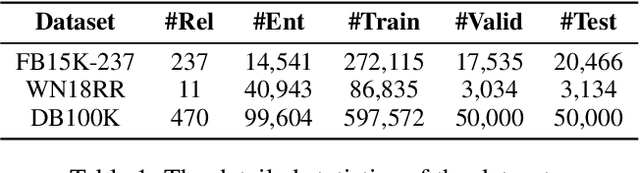

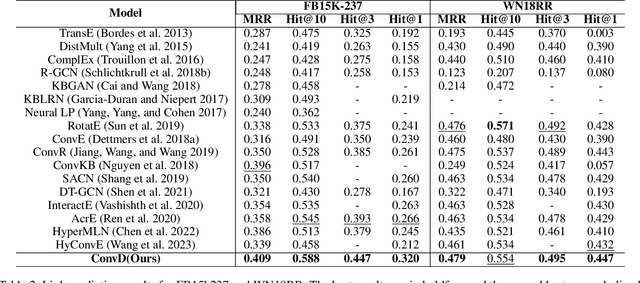
Knowledge graphs generally suffer from incompleteness, which can be alleviated by completing the missing information. Deep knowledge convolutional embedding models based on neural networks are currently popular methods for knowledge graph completion. However, most existing methods use external convolution kernels and traditional plain convolution processes, which limits the feature interaction capability of the model. In this paper, we propose a novel dynamic convolutional embedding model ConvD for knowledge graph completion, which directly reshapes the relation embeddings into multiple internal convolution kernels to improve the external convolution kernels of the traditional convolutional embedding model. The internal convolution kernels can effectively augment the feature interaction between the relation embeddings and entity embeddings, thus enhancing the model embedding performance. Moreover, we design a priori knowledge-optimized attention mechanism, which can assign different contribution weight coefficients to multiple relation convolution kernels for dynamic convolution to improve the expressiveness of the model further. Extensive experiments on various datasets show that our proposed model consistently outperforms the state-of-the-art baseline methods, with average improvements ranging from 11.30\% to 16.92\% across all model evaluation metrics. Ablation experiments verify the effectiveness of each component module of the ConvD model.