 Add to Chrome
 Add to Firefox
 Add to Edge
Localizing Safety Alignment: MLP Layers and Mid-Network Blocks Encode Refusal Behavior in Large Language Models
Aug 12, 2026
Safety alignment in large language models is often treated as a distributed property of the entire network, yet its practical brittleness suggests that refusal behavior may be concentrated in a smaller set of parameters. This work addresses where safety-aligned refusal is encoded by transplanting weights from aligned models into matched unaligned base models at multiple levels of granularity. Using two open-weight model pairs and four safety benchmarks, we conducted experiments to compare the effects of replacing attention weights, MLP weights, contiguous layer regions, and MLP blocks. Across both model families, refusal transfer is dominated by MLP weights: replacing MLP parameters recovers substantially more malicious-prompt refusal than replacing attention parameters, with gains of at least 2.7 times more across benchmarks. Within the MLP stack, refusal-relevant parameters exhibit a consistent mid-network concentration, as the block spanning layers 8-11 is selected first in all six greedy searches over model-dataset pairs. The results also show that the composition of safety-relevant components is non-additive: in five of six greedy trajectories, adding more aligned blocks can reduce refusal performance, and selective block subsets can outperform full MLP transplantation on malicious refusal, benign over-refusal, or both. Finally, greedy orders transferred to OR-Bench vary with the source benchmark used to derive them, indicating a benchmark-dependent precision-coverage trade-off. These results suggest that safety alignment in current LLMs is both localized and interaction-sensitive, offering insight into alignment brittleness and potential avenues for targeted safety interventions.

Can an LLM-Powered Socially Assistive Robot Effectively and Safely Deliver Cognitive Behavioral Therapy? A Study With University Students
Feb 27, 2024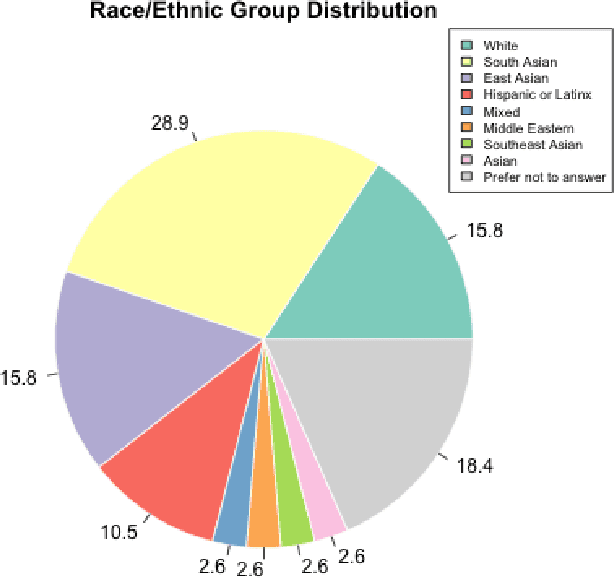



Cognitive behavioral therapy (CBT) is a widely used therapeutic method for guiding individuals toward restructuring their thinking patterns as a means of addressing anxiety, depression, and other challenges. We developed a large language model (LLM)-powered prompt-engineered socially assistive robot (SAR) that guides participants through interactive CBT at-home exercises. We evaluated the performance of the SAR through a 15-day study with 38 university students randomly assigned to interact daily with the robot or a chatbot (using the same LLM), or complete traditional CBT worksheets throughout the duration of the study. We measured weekly therapeutic outcomes, changes in pre-/post-session anxiety measures, and adherence to completing CBT exercises. We found that self-reported measures of general psychological distress significantly decreased over the study period in the robot and worksheet conditions but not the chatbot condition. Furthermore, the SAR enabled significant single-session improvements for more sessions than the other two conditions combined. Our findings suggest that SAR-guided LLM-powered CBT may be as effective as traditional worksheet methods in supporting therapeutic progress from the beginning to the end of the study and superior in decreasing user anxiety immediately after completing the CBT exercise.
IoT in the Era of Generative AI: Vision and Challenges
Jan 06, 2024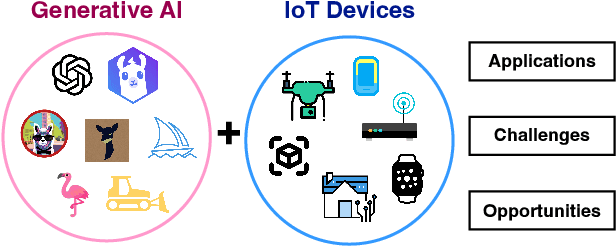
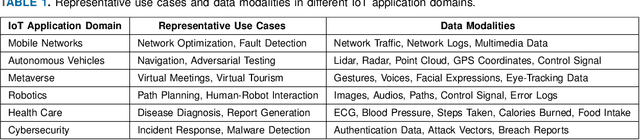
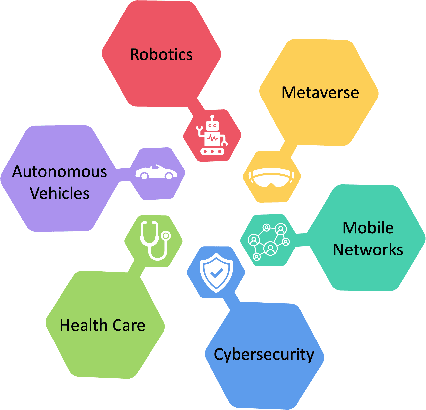
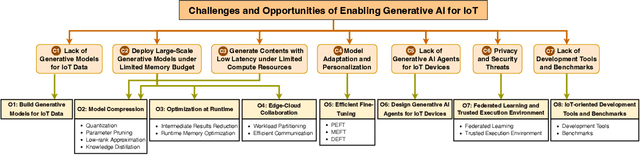
Equipped with sensing, networking, and computing capabilities, Internet of Things (IoT) such as smartphones, wearables, smart speakers, and household robots have been seamlessly weaved into our daily lives. Recent advancements in Generative AI exemplified by GPT, LLaMA, DALL-E, and Stable Difussion hold immense promise to push IoT to the next level. In this article, we share our vision and views on the benefits that Generative AI brings to IoT, and discuss some of the most important applications of Generative AI in IoT-related domains. Fully harnessing Generative AI in IoT is a complex challenge. We identify some of the most critical challenges including high resource demands of the Generative AI models, prompt engineering, on-device inference, offloading, on-device fine-tuning, federated learning, security, as well as development tools and benchmarks, and discuss current gaps as well as promising opportunities on enabling Generative AI for IoT. We hope this article can inspire new research on IoT in the era of Generative AI.
a survey on GPT-3
Dec 01, 2022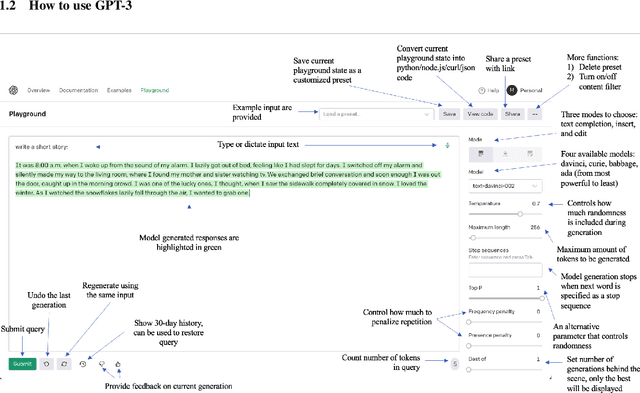
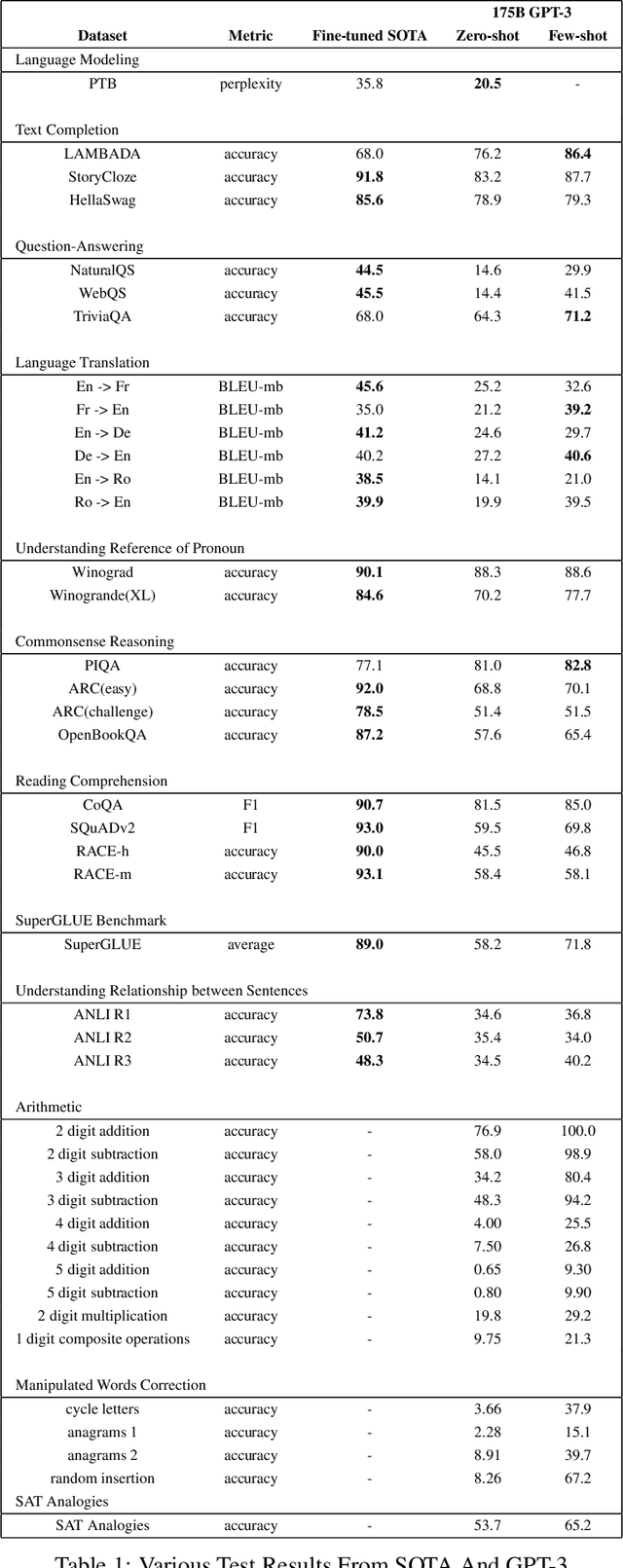
This paper provides an introductory survey to GPT-3. We cover some of the historical development behind this technology, some of the key features of GPT-3, and discuss the machine learning model and the datasets used. We survey both academic and commercial efforts applying GPT-3 in diverse domains such as developing conversational AI chatbots, software development, creative work, domain knowledge, and business productivity. We discuss some of the challenges that GPT-3 faces such as the problems of training complexity, bias, and hallucination/incorrect answers. We also discuss the future research opportunities in this area.