 Add to Chrome
 Add to Firefox
 Add to Edge
Measuring Epistemic Resilience of LLMs Under Misleading Medical Context
Jun 10, 2026
Large language models (LLMs) now reach expert-level scores on medical licensing exams, encouraging the assumption that high scores imply safe medical judgment while patients increasingly use them for health advice. We show this assumption is fragile: when misleading context is injected into questions that LLMs originally answer correctly, they abandon the correct answer. We call the ability to maintain correct judgment under adversarial context epistemic resilience, and introduce MedMisBench to measure it. MedMisBench contains 10,932 medical question items and 48,889 misleading context-option pairs spanning medical reasoning, agentic capability, and patient-journey evaluation. Across 11 model configurations, mean accuracy falls from 71.1% on original questions to 38.0% under focused misleading context, with 51.5% attack success. The most damaging injections are formal, rule-like fabrications: authority-framed falsehoods reach 69.5% attack success and exception-poisoning claims reach 64.1%. A 14-member clinical panel from 7 countries identified serious potential harm in 38.2% of reviewed cases. MedMisBench exposes a structural blind spot in LLM evaluation in medical settings: existing benchmarks measure what models know, but not whether they preserve correct medical judgment under misleading context.

Imaginative Perception Tokens Enhance Spatial Reasoning in Multimodal Language Models
Jun 03, 2026Vision language models (VLMs) excel at many tasks but still struggle with spatial reasoning when critical information is not directly observable. Many such problems require imaginative perception: inferring what would be seen from an unseen viewpoint, tracing paths through occluded spaces, or integrating partial observations into a coherent spatial representation. We introduce Imaginative Perception Tokens (IPT), intermediate perceptual representations that externalize what a VLM would perceive under alternative spatial configurations while remaining consistent with the observed input. To study this capability, we formulate three tasks, Perspective Taking (PET), Path Tracing (PT), and Multiview Counting (MVC), and construct datasets of approximately 20K examples with ground truth imaginations, answers, and evaluation benchmarks. Using the unified VLM BAGEL as the backbone, IPT supervision consistently improves spatial reasoning and often outperforms textual chain of thought training, even without generating images at inference time. On MVC, IPT improves accuracy by 3.4% and achieves competitive performance with strong closed-source models on PT. We further find that combining IPT and label-only supervision yields additional gains, whereas textual chain of thought can substantially degrade performance, suggesting a modality mismatch when spatial computation is forced through language. Overall, IPT provides a principled supervision signal for reasoning about unobserved spatial structure, improving generalization while producing interpretable intermediate representations.
Detector-in-the-Loop Tracking: Active Memory Rectification for Stable Glottic Opening Localization
Feb 22, 2026Temporal stability in glottic opening localization remains challenging due to the complementary weaknesses of single-frame detectors and foundation-model trackers: the former lacks temporal context, while the latter suffers from memory drift. Specifically, in video laryngoscopy, rapid tissue deformation, occlusions, and visual ambiguities in emergency settings require a robust, temporally aware solution that can prevent progressive tracking errors. We propose Closed-Loop Memory Correction (CL-MC), a detector-in-the-loop framework that supervises Segment Anything Model 2(SAM2) through confidence-aligned state decisions and active memory rectification. High-confidence detections trigger semantic resets that overwrite corrupted tracker memory, effectively mitigating drift accumulation with a training-free foundation tracker in complex endoscopic scenes. On emergency intubation videos, CL-MC achieves state-of-the-art performance, significantly reducing drift and missing rate compared with the SAM2 variants and open loop based methods. Our results establish memory correction as a crucial component for reliable clinical video tracking. Our code will be available in https://github.com/huayuww/CL-MR.
Unified and Semantically Grounded Domain Adaptation for Medical Image Segmentation
Aug 12, 2025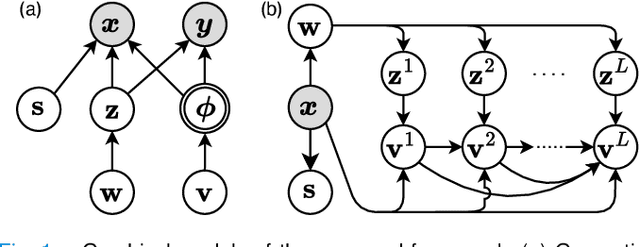
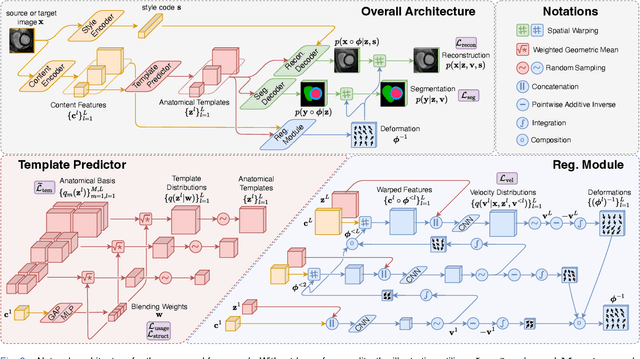
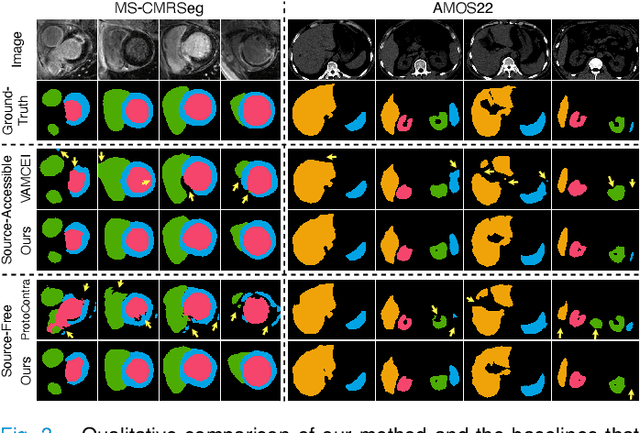
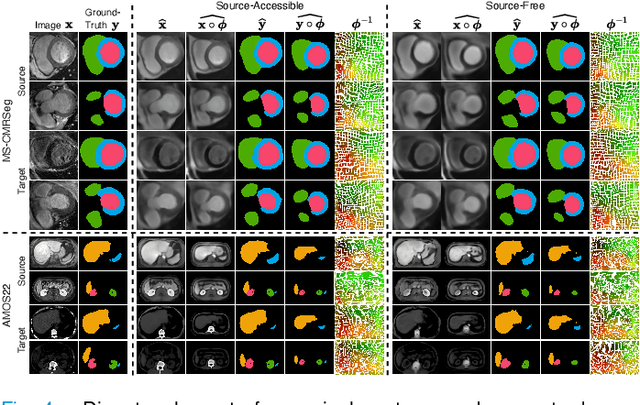
Most prior unsupervised domain adaptation approaches for medical image segmentation are narrowly tailored to either the source-accessible setting, where adaptation is guided by source-target alignment, or the source-free setting, which typically resorts to implicit supervision mechanisms such as pseudo-labeling and model distillation. This substantial divergence in methodological designs between the two settings reveals an inherent flaw: the lack of an explicit, structured construction of anatomical knowledge that naturally generalizes across domains and settings. To bridge this longstanding divide, we introduce a unified, semantically grounded framework that supports both source-accessible and source-free adaptation. Fundamentally distinct from all prior works, our framework's adaptability emerges naturally as a direct consequence of the model architecture, without the need for any handcrafted adaptation strategies. Specifically, our model learns a domain-agnostic probabilistic manifold as a global space of anatomical regularities, mirroring how humans establish visual understanding. Thus, the structural content in each image can be interpreted as a canonical anatomy retrieved from the manifold and a spatial transformation capturing individual-specific geometry. This disentangled, interpretable formulation enables semantically meaningful prediction with intrinsic adaptability. Extensive experiments on challenging cardiac and abdominal datasets show that our framework achieves state-of-the-art results in both settings, with source-free performance closely approaching its source-accessible counterpart, a level of consistency rarely observed in prior works. Beyond quantitative improvement, we demonstrate strong interpretability of the proposed framework via manifold traversal for smooth shape manipulation.
BADGR: Bundle Adjustment Diffusion Conditioned by GRadients for Wide-Baseline Floor Plan Reconstruction
Mar 25, 2025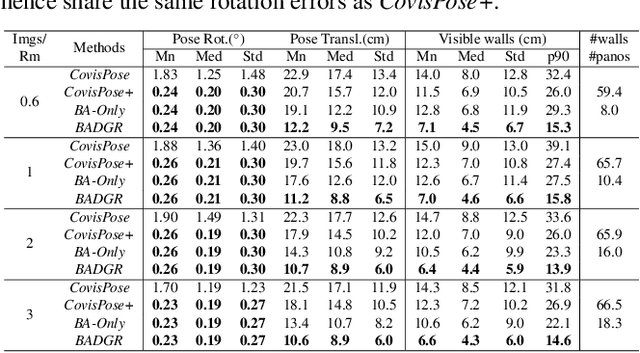

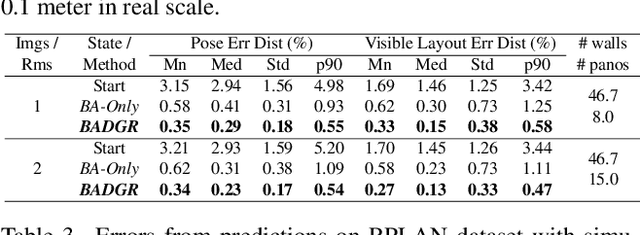
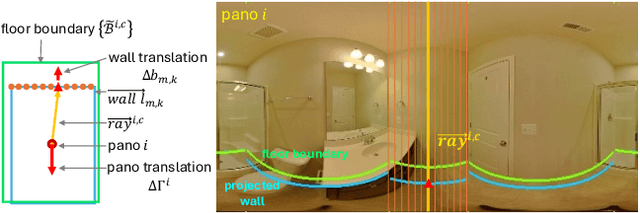
Reconstructing precise camera poses and floor plan layouts from wide-baseline RGB panoramas is a difficult and unsolved problem. We introduce BADGR, a novel diffusion model that jointly performs reconstruction and bundle adjustment (BA) to refine poses and layouts from a coarse state, using 1D floor boundary predictions from dozens of images of varying input densities. Unlike a guided diffusion model, BADGR is conditioned on dense per-entity outputs from a single-step Levenberg Marquardt (LM) optimizer and is trained to predict camera and wall positions while minimizing reprojection errors for view-consistency. The objective of layout generation from denoising diffusion process complements BA optimization by providing additional learned layout-structural constraints on top of the co-visible features across images. These constraints help BADGR to make plausible guesses on spatial relations which help constrain pose graph, such as wall adjacency, collinearity, and learn to mitigate errors from dense boundary observations with global contexts. BADGR trains exclusively on 2D floor plans, simplifying data acquisition, enabling robust augmentation, and supporting variety of input densities. Our experiments and analysis validate our method, which significantly outperforms the state-of-the-art pose and floor plan layout reconstruction with different input densities.
CrossFusion: A Multi-Scale Cross-Attention Convolutional Fusion Model for Cancer Survival Prediction
Mar 03, 2025Cancer survival prediction from whole slide images (WSIs) is a challenging task in computational pathology due to the large size, irregular shape, and high granularity of the WSIs. These characteristics make it difficult to capture the full spectrum of patterns, from subtle cellular abnormalities to complex tissue interactions, which are crucial for accurate prognosis. To address this, we propose CrossFusion, a novel multi-scale feature integration framework that extracts and fuses information from patches across different magnification levels. By effectively modeling both scale-specific patterns and their interactions, CrossFusion generates a rich feature set that enhances survival prediction accuracy. We validate our approach across six cancer types from public datasets, demonstrating significant improvements over existing state-of-the-art methods. Moreover, when coupled with domain-specific feature extraction backbones, our method shows further gains in prognostic performance compared to general-purpose backbones. The source code is available at: https://github.com/RustinS/CrossFusion
PathFinder: A Multi-Modal Multi-Agent System for Medical Diagnostic Decision-Making Applied to Histopathology
Feb 13, 2025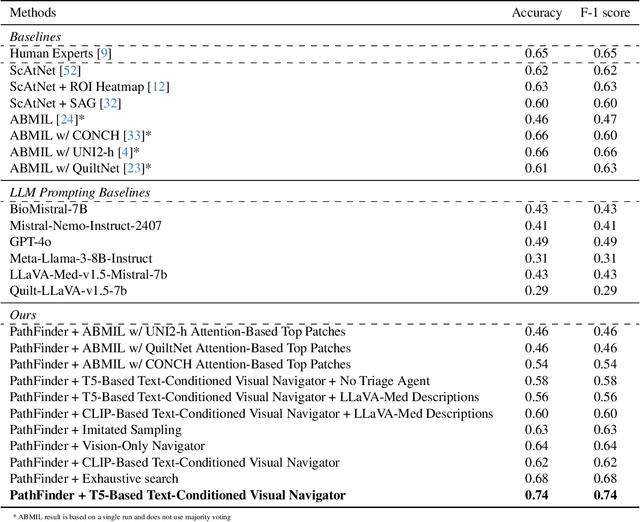
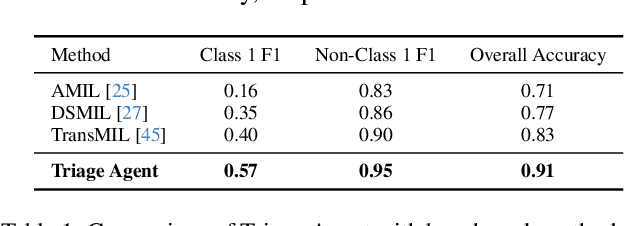

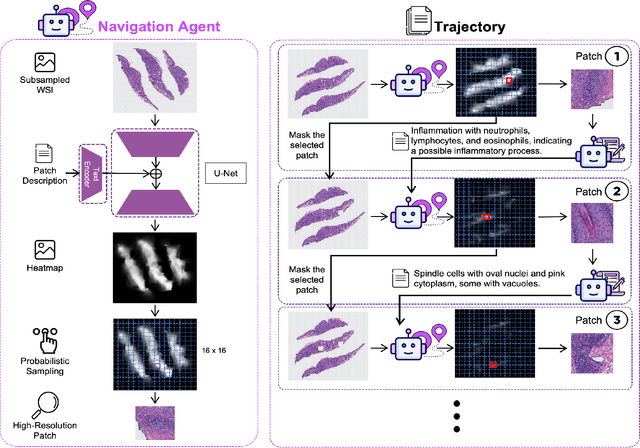
Diagnosing diseases through histopathology whole slide images (WSIs) is fundamental in modern pathology but is challenged by the gigapixel scale and complexity of WSIs. Trained histopathologists overcome this challenge by navigating the WSI, looking for relevant patches, taking notes, and compiling them to produce a final holistic diagnostic. Traditional AI approaches, such as multiple instance learning and transformer-based models, fail short of such a holistic, iterative, multi-scale diagnostic procedure, limiting their adoption in the real-world. We introduce PathFinder, a multi-modal, multi-agent framework that emulates the decision-making process of expert pathologists. PathFinder integrates four AI agents, the Triage Agent, Navigation Agent, Description Agent, and Diagnosis Agent, that collaboratively navigate WSIs, gather evidence, and provide comprehensive diagnoses with natural language explanations. The Triage Agent classifies the WSI as benign or risky; if risky, the Navigation and Description Agents iteratively focus on significant regions, generating importance maps and descriptive insights of sampled patches. Finally, the Diagnosis Agent synthesizes the findings to determine the patient's diagnostic classification. Our Experiments show that PathFinder outperforms state-of-the-art methods in skin melanoma diagnosis by 8% while offering inherent explainability through natural language descriptions of diagnostically relevant patches. Qualitative analysis by pathologists shows that the Description Agent's outputs are of high quality and comparable to GPT-4o. PathFinder is also the first AI-based system to surpass the average performance of pathologists in this challenging melanoma classification task by 9%, setting a new record for efficient, accurate, and interpretable AI-assisted diagnostics in pathology. Data, code and models available at https://pathfinder-dx.github.io/
MedicalNarratives: Connecting Medical Vision and Language with Localized Narratives
Jan 07, 2025
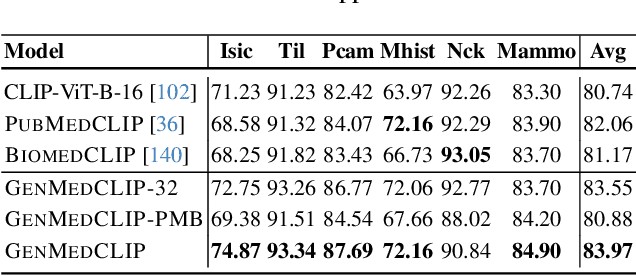

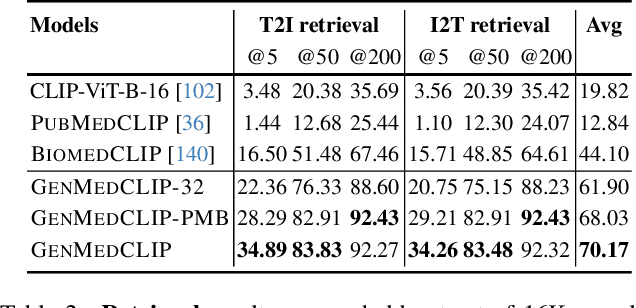
We propose MedicalNarratives, a dataset curated from medical pedagogical videos similar in nature to data collected in Think-Aloud studies and inspired by Localized Narratives, which collects grounded image-text data by curating instructors' speech and mouse cursor movements synchronized in time. MedicalNarratives enables pretraining of both semantic and dense objectives, alleviating the need to train medical semantic and dense tasks disparately due to the lack of reasonably sized datasets. Our dataset contains 4.7M image-text pairs from videos and articles, with 1M samples containing dense annotations in the form of traces and bounding boxes. To evaluate the utility of MedicalNarratives, we train GenMedClip based on the CLIP architecture using our dataset spanning 12 medical domains and demonstrate that it outperforms previous state-of-the-art models on a newly constructed medical imaging benchmark that comprehensively evaluates performance across all modalities. Data, demo, code and models available at https://medical-narratives.github.io
Generating Seamless Virtual Immunohistochemical Whole Slide Images with Content and Color Consistency
Oct 01, 2024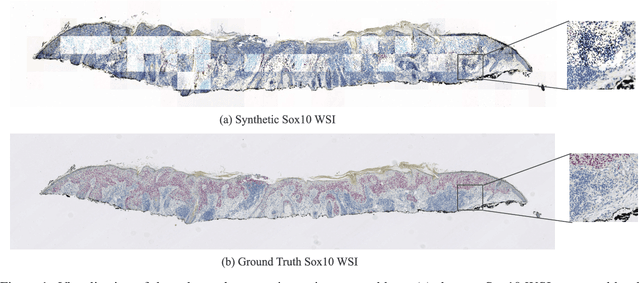
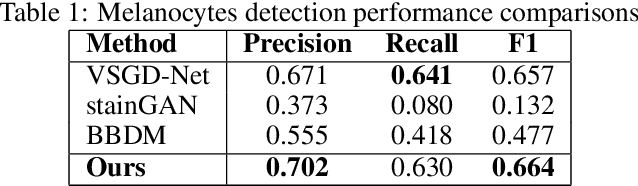
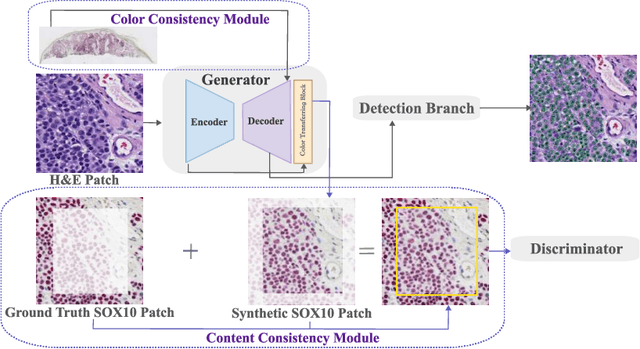
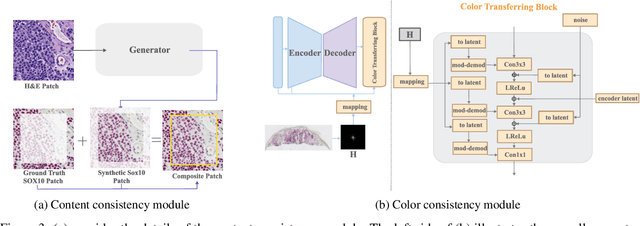
Immunohistochemical (IHC) stains play a vital role in a pathologist's analysis of medical images, providing crucial diagnostic information for various diseases. Virtual staining from hematoxylin and eosin (H&E)-stained whole slide images (WSIs) allows the automatic production of other useful IHC stains without the expensive physical staining process. However, current virtual WSI generation methods based on tile-wise processing often suffer from inconsistencies in content, texture, and color at tile boundaries. These inconsistencies lead to artifacts that compromise image quality and potentially hinder accurate clinical assessment and diagnoses. To address this limitation, we propose a novel consistent WSI synthesis network, CC-WSI-Net, that extends GAN models to produce seamless synthetic whole slide images. Our CC-WSI-Net integrates a content- and color-consistency supervisor, ensuring consistency across tiles and facilitating the generation of seamless synthetic WSIs while ensuring Sox10 immunohistochemistry accuracy in melanocyte detection. We validate our method through extensive image-quality analyses, objective detection assessments, and a subjective survey with pathologists. By generating high-quality synthetic WSIs, our method opens doors for advanced virtual staining techniques with broader applications in research and clinical care.
Bayesian Intrinsic Groupwise Image Registration: Unsupervised Disentanglement of Anatomy and Geometry
Jan 04, 2024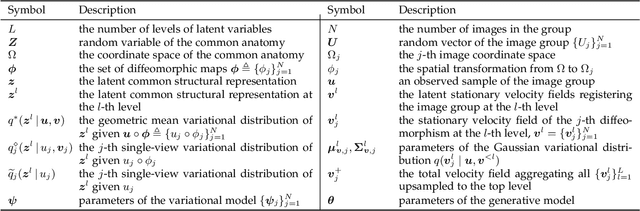
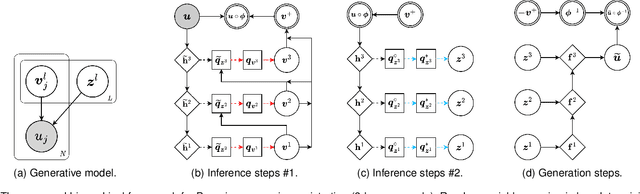
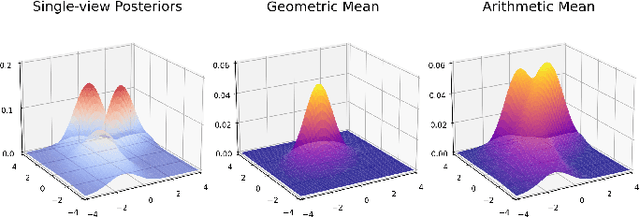
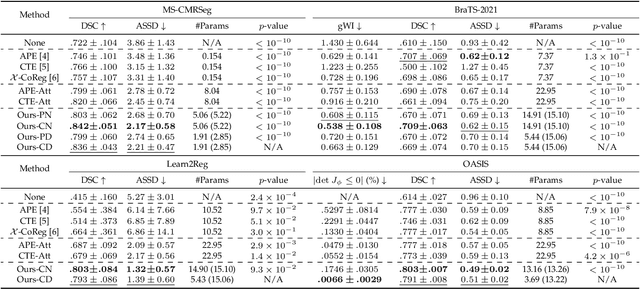
This article presents a general Bayesian learning framework for multi-modal groupwise registration on medical images. The method builds on probabilistic modelling of the image generative process, where the underlying common anatomy and geometric variations of the observed images are explicitly disentangled as latent variables. Thus, groupwise registration is achieved through the solution to Bayesian inference. We propose a novel hierarchical variational auto-encoding architecture to realize the inference procedure of the latent variables, where the registration parameters can be calculated in a mathematically interpretable fashion. Remarkably, this new paradigm can learn groupwise registration in an unsupervised closed-loop self-reconstruction process, sparing the burden of designing complex intensity-based similarity measures. The computationally efficient disentangled architecture is also inherently scalable and flexible, allowing for groupwise registration on large-scale image groups with variable sizes. Furthermore, the inferred structural representations from disentanglement learning are capable of capturing the latent anatomy of the observations with visual semantics. Extensive experiments were conducted to validate the proposed framework, including four datasets from cardiac, brain and abdominal medical images. The results have demonstrated the superiority of our method over conventional similarity-based approaches in terms of accuracy, efficiency, scalability and interpretability.