 Add to Chrome
 Add to Firefox
 Add to Edge
Video = World + Event Stream
Jul 16, 2026
We present Wan-Streamer v0.3, which reframes our native-streaming interaction model under a single organizing view: a video is a world plus an event stream. The world is the persistent context in which a video unfolds, including the environment, scene, subjects, ambient acoustic conditions, voice characteristics, and other relatively stable conditions. The event stream is everything that changes over time within that world, including scene or environmental changes, subject behavior, speech, and other sounds. This yields a general-purpose pretraining task over large amounts of real video: given a world and incoming input, predict how the world moves, changes, and responds in real time. The resulting competence can be specialized to a broad family of real-time downstream tasks. We instantiate it on real-time full-duplex audio-visual interaction, where the event stream is the agent's speech together with free-form behavior. Functionally, the model's multimodal understanding process is vision-language-action-like: it maps multimodal user input to language-form speech and behavior actions. Wan-Streamer v0.3 preserves the v0.2 operating point: 640x368 video at 25 FPS, a 160 ms streaming unit, approximately 200 ms model-side response latency, and approximately 550 ms total interaction latency under a 350 ms bidirectional network budget.

Wan-Streamer v0.2: Higher Resolution, Same Latency
Jul 05, 2026We present Wan-Streamer v0.2, a latency-preserving upgrade of the native-streaming, end-to-end audio-visual interaction model. v0.2 keeps the v0.1 modeling formulation, but raises the interactive output stream from 192x336 to 640x368 while preserving approximately 200 ms model-side signal-to-signal latency at 25 FPS. The higher-resolution stream supports scene-grounded mid-shot agents whose posture, gaze, hands, nearby objects, and local scene layout remain legible during real-time conversation. To support the larger visual stream without adding user-visible delay, v0.2 keeps the thinker as a single-GPU low-latency path for streaming perception, the short language/state Transformer pass that builds the generation cache, and final decoding. The performer becomes a multi-GPU Ulysses-style context-parallel group for the expensive next-unit latent generation. Each performer rank writes incoming K/V into a pre-sharded local cache. The long high-resolution latent video sequence is split across ranks for denoising and gathered through Ulysses communication, while the much shorter audio latent sequence is generated without sequence sharding. In this split, the thinker's language/state computation reaches the performer only as K/V conditioning, so no separate language sequence has to be communicated inside the performer group. This concentrates additional hardware on visual generation while preserving the compact thinker-performer boundary, keeping total remote interaction latency at approximately 550 ms when a 350 ms bidirectional network budget is included.
Wan-Streamer v0.1: End-to-end Real-time Interactive Foundation Models
Jun 25, 2026We present Wan-Streamer, a native-streaming, end-to-end interactive foundation model designed from the ground up for real-time, low-latency, full-duplex audio-visual interaction. Wan-Streamer seamlessly models language, audio, and video as both input and output within a single Transformer, where the sequence is represented as interleaved visual, audio, and text input tokens together with visual, audio, and text output tokens, coordinated by block-causal attention for incremental streaming. Unlike cascaded interactive systems that rely on separate VAD, ASR, language, TTS, audio-driven animation, or video-generation modules, Wan-Streamer does not rely on external language, speech, avatar, or video-generation modules: perception, reasoning, generation, response timing, turn management, and cross-modal synchronization are learned jointly within one unified model, reducing pipeline latency and error accumulation. To support natural audio-visual responsiveness, we redesign the entire stack around streamability, including causal encoders, causal decoders, block-causal attention, and low-latency multimodal token scheduling, enabling streaming units as short as 160 ms at 25 fps. Wan-Streamer achieves approximately 200 ms model-side response latency and approximately 550 ms total interaction latency when combined with 350 ms bidirectional network latency, supporting sub-second duplex audio-visual communication. These results position Wan-Streamer as a unified, end-to-end, multimodal interactive foundation model for low-latency streaming interaction.
Wan-Image: Pushing the Boundaries of Generative Visual Intelligence
Apr 21, 2026We present Wan-Image, a unified visual generation system explicitly engineered to paradigm-shift image generation models from casual synthesizers into professional-grade productivity tools. While contemporary diffusion models excel at aesthetic generation, they frequently encounter critical bottlenecks in rigorous design workflows that demand absolute controllability, complex typography rendering, and strict identity preservation. To address these challenges, Wan-Image features a natively unified multi-modal architecture by synergizing the cognitive capabilities of large language models with the high-fidelity pixel synthesis of diffusion transformers, which seamlessly translates highly nuanced user intents into precise visual outputs. It is fundamentally powered by large-scale multi-modal data scaling, a systematic fine-grained annotation engine, and curated reinforcement learning data to surpass basic instruction following and unlock expert-level professional capabilities. These include ultra-long complex text rendering, hyper-diverse portrait generation, palette-guided generation, multi-subject identity preservation, coherent sequential visual generation, precise multi-modal interactive editing, native alpha-channel generation, and high-efficiency 4K synthesis. Across diverse human evaluations, Wan-Image exceeds Seedream 5.0 Lite and GPT Image 1.5 in overall performance, reaching parity with Nano Banana Pro in challenging tasks. Ultimately, Wan-Image revolutionizes visual content creation across e-commerce, entertainment, education, and personal productivity, redefining the boundaries of professional visual synthesis.
Skrull: Towards Efficient Long Context Fine-tuning through Dynamic Data Scheduling
May 26, 2025Long-context supervised fine-tuning (Long-SFT) plays a vital role in enhancing the performance of large language models (LLMs) on long-context tasks. To smoothly adapt LLMs to long-context scenarios, this process typically entails training on mixed datasets containing both long and short sequences. However, this heterogeneous sequence length distribution poses significant challenges for existing training systems, as they fail to simultaneously achieve high training efficiency for both long and short sequences, resulting in sub-optimal end-to-end system performance in Long-SFT. In this paper, we present a novel perspective on data scheduling to address the challenges posed by the heterogeneous data distributions in Long-SFT. We propose Skrull, a dynamic data scheduler specifically designed for efficient long-SFT. Through dynamic data scheduling, Skrull balances the computation requirements of long and short sequences, improving overall training efficiency. Furthermore, we formulate the scheduling process as a joint optimization problem and thoroughly analyze the trade-offs involved. Based on those analysis, Skrull employs a lightweight scheduling algorithm to achieve near-zero cost online scheduling in Long-SFT. Finally, we implement Skrull upon DeepSpeed, a state-of-the-art distributed training system for LLMs. Experimental results demonstrate that Skrull outperforms DeepSpeed by 3.76x on average (up to 7.54x) in real-world long-SFT scenarios.
Wan: Open and Advanced Large-Scale Video Generative Models
Mar 26, 2025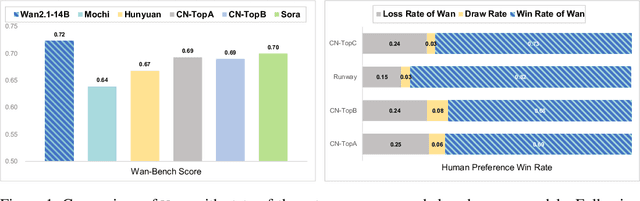
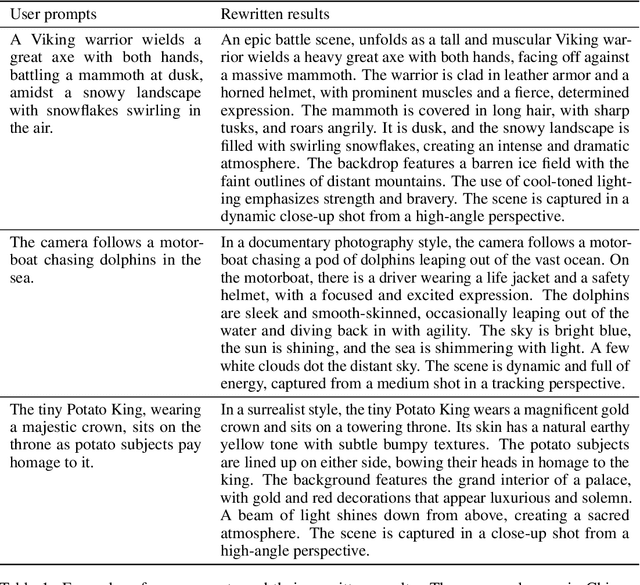
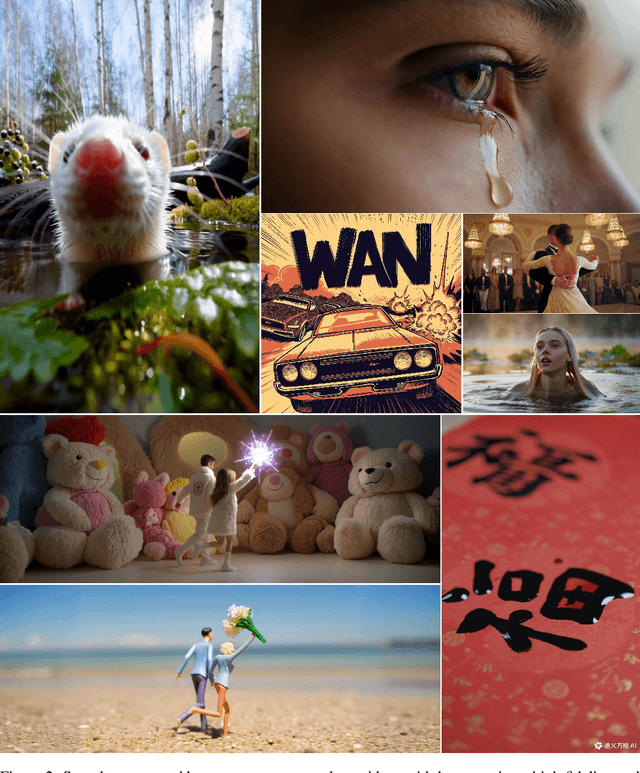
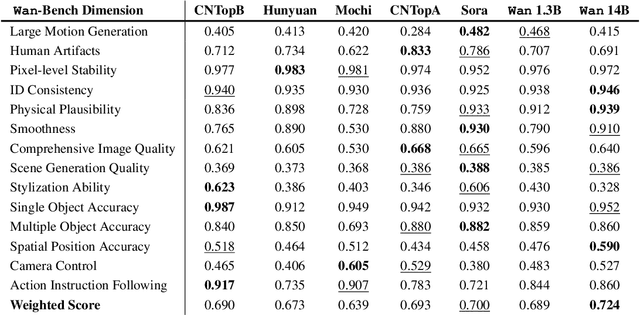
This report presents Wan, a comprehensive and open suite of video foundation models designed to push the boundaries of video generation. Built upon the mainstream diffusion transformer paradigm, Wan achieves significant advancements in generative capabilities through a series of innovations, including our novel VAE, scalable pre-training strategies, large-scale data curation, and automated evaluation metrics. These contributions collectively enhance the model's performance and versatility. Specifically, Wan is characterized by four key features: Leading Performance: The 14B model of Wan, trained on a vast dataset comprising billions of images and videos, demonstrates the scaling laws of video generation with respect to both data and model size. It consistently outperforms the existing open-source models as well as state-of-the-art commercial solutions across multiple internal and external benchmarks, demonstrating a clear and significant performance superiority. Comprehensiveness: Wan offers two capable models, i.e., 1.3B and 14B parameters, for efficiency and effectiveness respectively. It also covers multiple downstream applications, including image-to-video, instruction-guided video editing, and personal video generation, encompassing up to eight tasks. Consumer-Grade Efficiency: The 1.3B model demonstrates exceptional resource efficiency, requiring only 8.19 GB VRAM, making it compatible with a wide range of consumer-grade GPUs. Openness: We open-source the entire series of Wan, including source code and all models, with the goal of fostering the growth of the video generation community. This openness seeks to significantly expand the creative possibilities of video production in the industry and provide academia with high-quality video foundation models. All the code and models are available at https://github.com/Wan-Video/Wan2.1.
SWIFT:A Scalable lightWeight Infrastructure for Fine-Tuning
Aug 13, 2024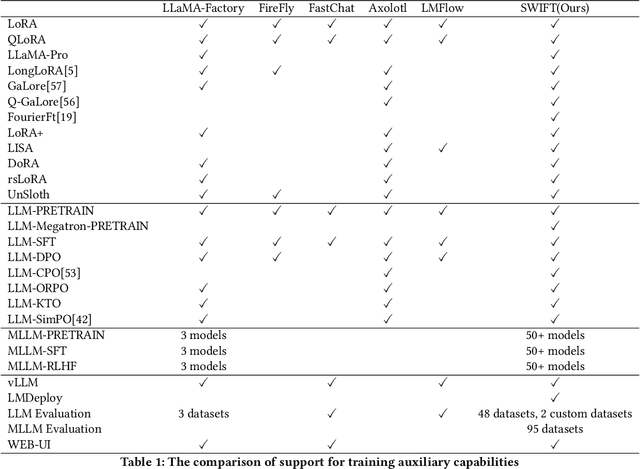
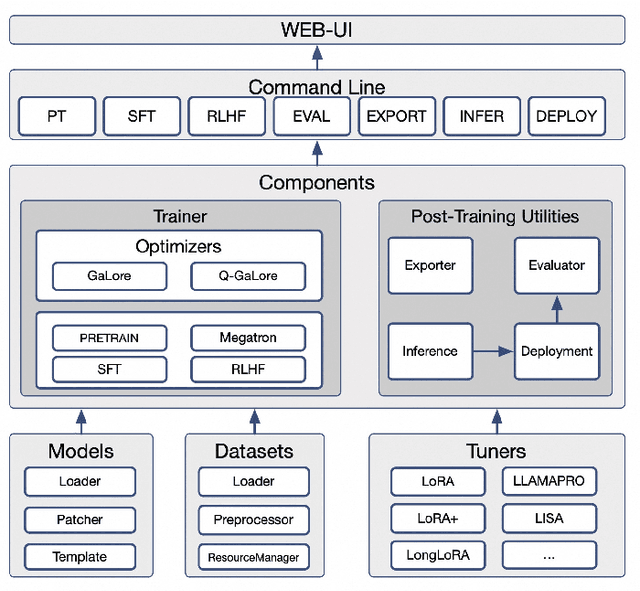
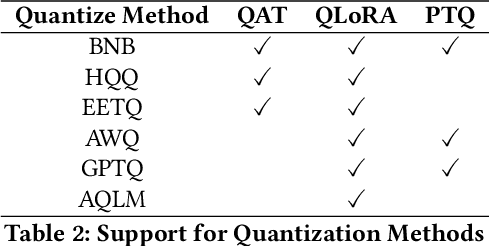
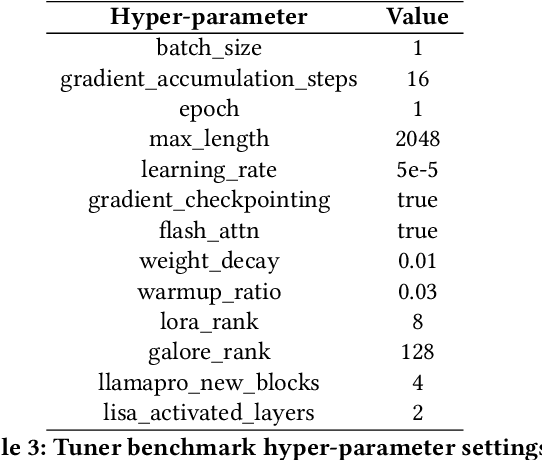
Recent development in Large Language Models (LLMs) and Multi-modal Large Language Models (MLLMs) have leverage Attention-based Transformer architectures and achieved superior performance and generalization capabilities. They have since covered extensive areas of traditional learning tasks. For instance, text-based tasks such as text-classification and sequence-labeling, as well as multi-modal tasks like Visual Question Answering (VQA) and Optical Character Recognition (OCR), which were previously addressed using different models, can now be tackled based on one foundation model. Consequently, the training and lightweight fine-tuning of LLMs and MLLMs, especially those based on Transformer architecture, has become particularly important. In recognition of these overwhelming needs, we develop SWIFT, a customizable one-stop infrastructure for large models. With support of over $300+$ LLMs and $50+$ MLLMs, SWIFT stands as the open-source framework that provide the \textit{most comprehensive support} for fine-tuning large models. In particular, it is the first training framework that provides systematic support for MLLMs. In addition to the core functionalities of fine-tuning, SWIFT also integrates post-training processes such as inference, evaluation, and model quantization, to facilitate fast adoptions of large models in various application scenarios. With a systematic integration of various training techniques, SWIFT offers helpful utilities such as benchmark comparisons among different training techniques for large models. For fine-tuning models specialized in agent framework, we show that notable improvements on the ToolBench leader-board can be achieved by training with customized dataset on SWIFT, with an increase of 5.2%-21.8% in the Act.EM metric over various baseline models, a reduction in hallucination by 1.6%-14.1%, and an average performance improvement of 8%-17%.
ROAM: memory-efficient large DNN training via optimized operator ordering and memory layout
Oct 30, 2023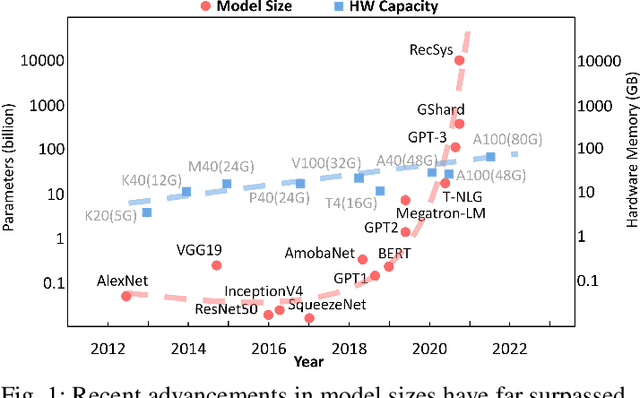
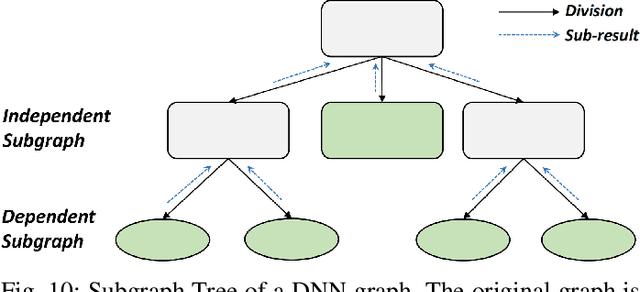
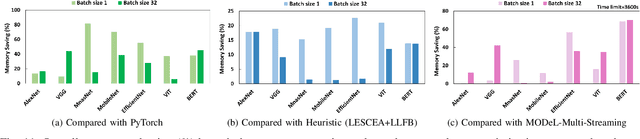
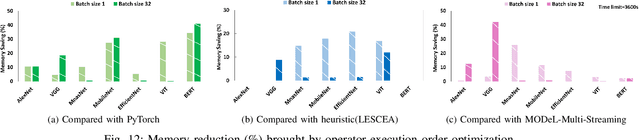
As deep learning models continue to increase in size, the memory requirements for training have surged. While high-level techniques like offloading, recomputation, and compression can alleviate memory pressure, they also introduce overheads. However, a memory-efficient execution plan that includes a reasonable operator execution order and tensor memory layout can significantly increase the models' memory efficiency and reduce overheads from high-level techniques. In this paper, we propose ROAM which operates on computation graph level to derive memory-efficient execution plan with optimized operator order and tensor memory layout for models. We first propose sophisticated theories that carefully consider model structure and training memory load to support optimization for large complex graphs that have not been well supported in the past. An efficient tree-based algorithm is further proposed to search task divisions automatically, along with delivering high performance and effectiveness to solve the problem. Experiments show that ROAM achieves a substantial memory reduction of 35.7%, 13.3%, and 27.2% compared to Pytorch and two state-of-the-art methods and offers a remarkable 53.7x speedup. The evaluation conducted on the expansive GPT2-XL further validates ROAM's scalability.
TAP: Accelerating Large-Scale DNN Training Through Tensor Automatic Parallelisation
Feb 01, 2023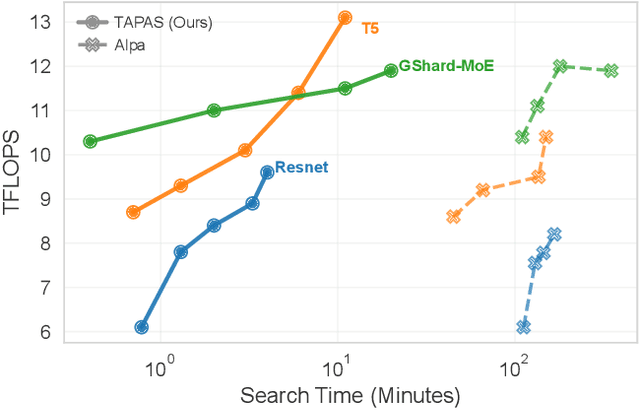

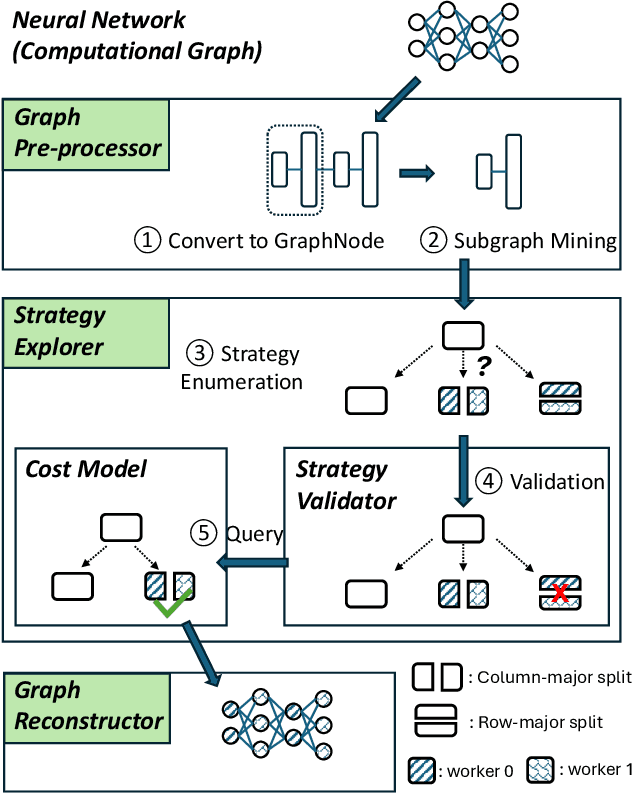
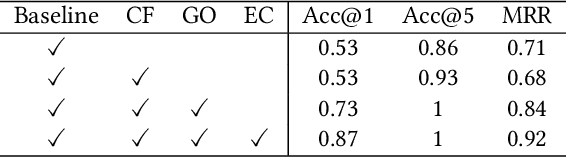
Model parallelism has become necessary to train large neural networks. However, finding a suitable model parallel schedule for an arbitrary neural network is a non-trivial task due to the exploding search space. In this work, we present a model parallelism framework TAP that automatically searches for the best data and tensor parallel schedules. Leveraging the key insight that a neural network can be represented as a directed acyclic graph, within which may only exist a limited set of frequent subgraphs, we design a graph pruning algorithm to fold the search space efficiently. TAP runs at sub-linear complexity concerning the neural network size. Experiments show that TAP is $20\times- 160\times$ faster than the state-of-the-art automatic parallelism framework, and the performance of its discovered schedules is competitive with the expert-engineered ones.
Revisiting and Advancing Chinese Natural Language Understanding with Accelerated Heterogeneous Knowledge Pre-training
Oct 12, 2022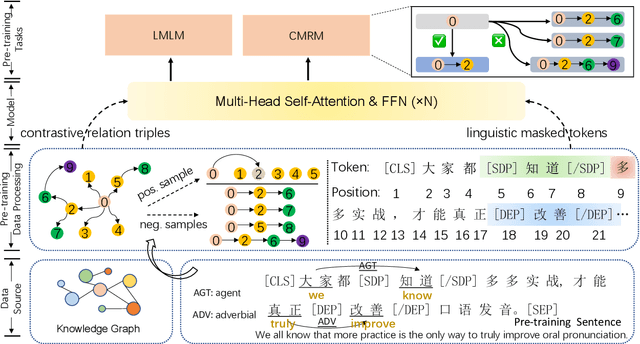
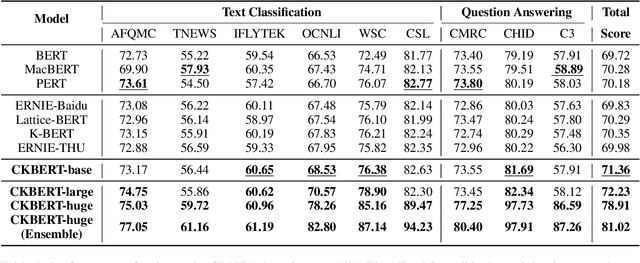
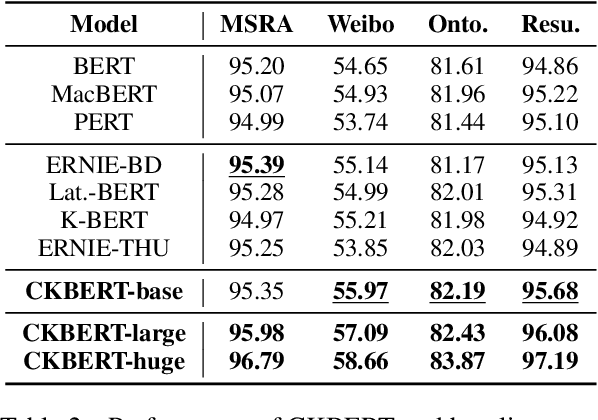
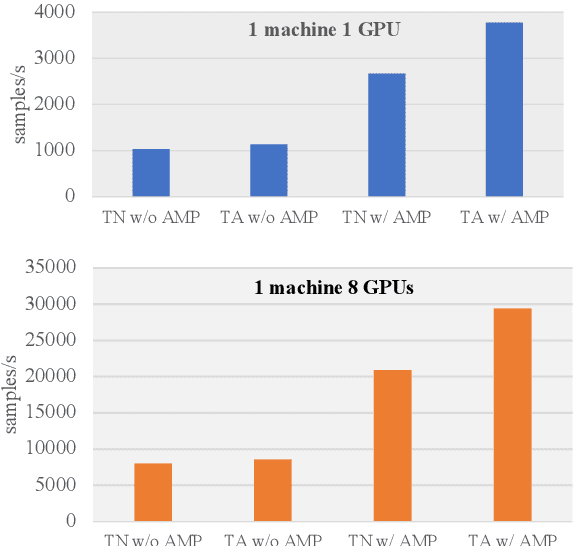
Recently, knowledge-enhanced pre-trained language models (KEPLMs) improve context-aware representations via learning from structured relations in knowledge graphs, and/or linguistic knowledge from syntactic or dependency analysis. Unlike English, there is a lack of high-performing open-source Chinese KEPLMs in the natural language processing (NLP) community to support various language understanding applications. In this paper, we revisit and advance the development of Chinese natural language understanding with a series of novel Chinese KEPLMs released in various parameter sizes, namely CKBERT (Chinese knowledge-enhanced BERT).Specifically, both relational and linguistic knowledge is effectively injected into CKBERT based on two novel pre-training tasks, i.e., linguistic-aware masked language modeling and contrastive multi-hop relation modeling. Based on the above two pre-training paradigms and our in-house implemented TorchAccelerator, we have pre-trained base (110M), large (345M) and huge (1.3B) versions of CKBERT efficiently on GPU clusters. Experiments demonstrate that CKBERT outperforms strong baselines for Chinese over various benchmark NLP tasks and in terms of different model sizes.