 Add to Chrome
 Add to Firefox
 Add to Edge
Less is More: Towards Green Code Large Language Models via Unified Structural Pruning
Dec 20, 2024
The extensive application of Large Language Models (LLMs) in generative coding tasks has raised concerns due to their high computational demands and energy consumption. Unlike previous structural pruning methods designed for classification models that deal with lowdimensional classification logits, generative Code LLMs produce high-dimensional token logit sequences, making traditional pruning objectives inherently limited. Moreover, existing single component pruning approaches further constrain the effectiveness when applied to generative Code LLMs. In response, we propose Flab-Pruner, an innovative unified structural pruning method that combines vocabulary, layer, and Feed-Forward Network (FFN) pruning. This approach effectively reduces model parameters while maintaining performance. Additionally, we introduce a customized code instruction data strategy for coding tasks to enhance the performance recovery efficiency of the pruned model. Through extensive evaluations on three state-of-the-art Code LLMs across multiple generative coding tasks, the results demonstrate that Flab-Pruner retains 97% of the original performance after pruning 22% of the parameters and achieves the same or even better performance after post-training. The pruned models exhibit significant improvements in storage, GPU usage, computational efficiency, and environmental impact, while maintaining well robustness. Our research provides a sustainable solution for green software engineering and promotes the efficient deployment of LLMs in real-world generative coding intelligence applications.

Threshold Neuron: A Brain-inspired Artificial Neuron for Efficient On-device Inference
Dec 18, 2024Enhancing the computational efficiency of on-device Deep Neural Networks (DNNs) remains a significant challengein mobile and edge computing. As we aim to execute increasingly complex tasks with constrained computational resources, much of the research has focused on compressing neural network structures and optimizing systems. Although many studies have focused on compressing neural network structures and parameters or optimizing underlying systems, there has been limited attention on optimizing the fundamental building blocks of neural networks: the neurons. In this study, we deliberate on a simple but important research question: Can we design artificial neurons that offer greater efficiency than the traditional neuron paradigm? Inspired by the threshold mechanisms and the excitation-inhibition balance observed in biological neurons, we propose a novel artificial neuron model, Threshold Neurons. Using Threshold Neurons, we can construct neural networks similar to those with traditional artificial neurons, while significantly reducing hardware implementation complexity. Our extensive experiments validate the effectiveness of neural networks utilizing Threshold Neurons, achieving substantial power savings of 7.51x to 8.19x and area savings of 3.89x to 4.33x at the kernel level, with minimal loss in precision. Furthermore, FPGA-based implementations of these networks demonstrate 2.52x power savings and 1.75x speed enhancements at the system level. The source code will be made available upon publication.
Numerical Pruning for Efficient Autoregressive Models
Dec 17, 2024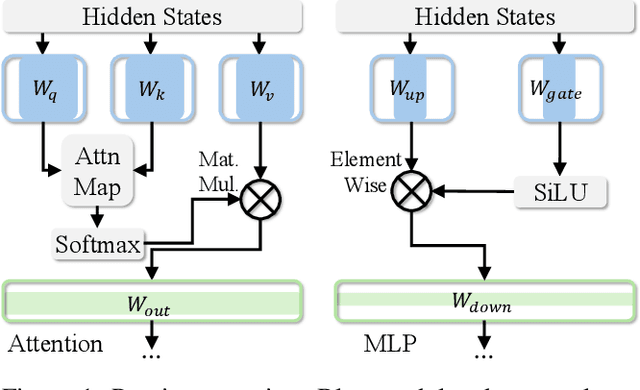


Transformers have emerged as the leading architecture in deep learning, proving to be versatile and highly effective across diverse domains beyond language and image processing. However, their impressive performance often incurs high computational costs due to their substantial model size. This paper focuses on compressing decoder-only transformer-based autoregressive models through structural weight pruning to improve the model efficiency while preserving performance for both language and image generation tasks. Specifically, we propose a training-free pruning method that calculates a numerical score with Newton's method for the Attention and MLP modules, respectively. Besides, we further propose another compensation algorithm to recover the pruned model for better performance. To verify the effectiveness of our method, we provide both theoretical support and extensive experiments. Our experiments show that our method achieves state-of-the-art performance with reduced memory usage and faster generation speeds on GPUs.
Depth-Centric Dehazing and Depth-Estimation from Real-World Hazy Driving Video
Dec 16, 2024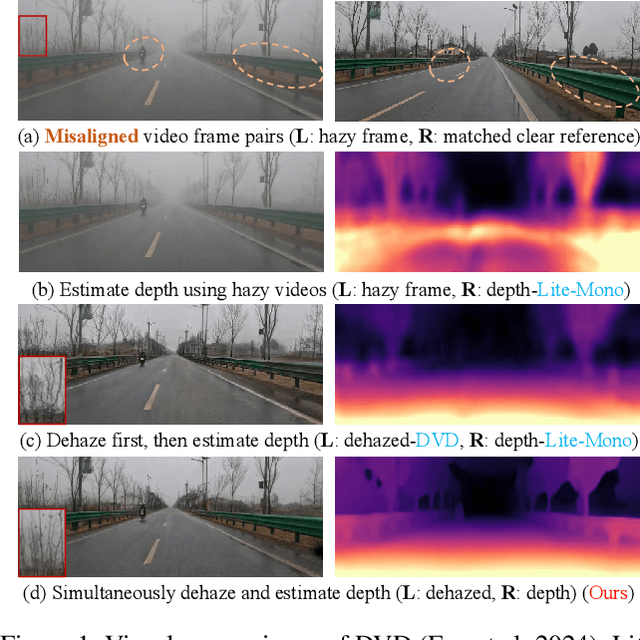
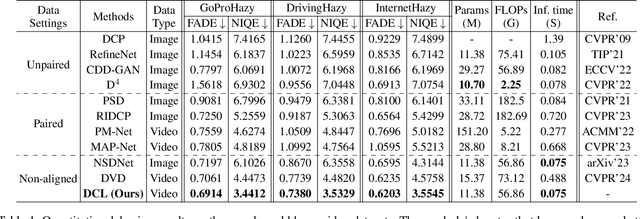
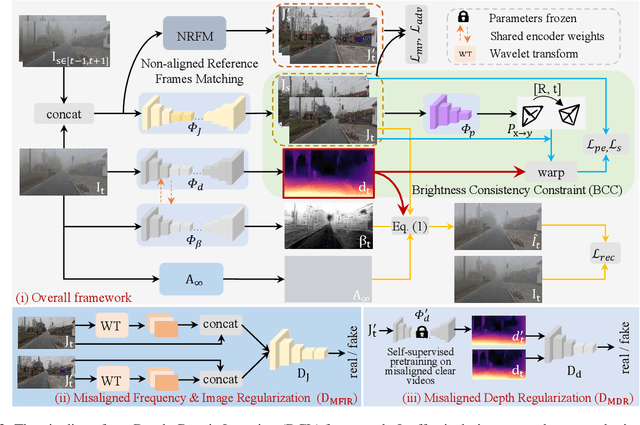
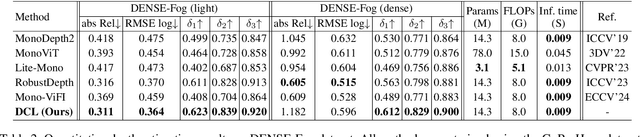
In this paper, we study the challenging problem of simultaneously removing haze and estimating depth from real monocular hazy videos. These tasks are inherently complementary: enhanced depth estimation improves dehazing via the atmospheric scattering model (ASM), while superior dehazing contributes to more accurate depth estimation through the brightness consistency constraint (BCC). To tackle these intertwined tasks, we propose a novel depth-centric learning framework that integrates the ASM model with the BCC constraint. Our key idea is that both ASM and BCC rely on a shared depth estimation network. This network simultaneously exploits adjacent dehazed frames to enhance depth estimation via BCC and uses the refined depth cues to more effectively remove haze through ASM. Additionally, we leverage a non-aligned clear video and its estimated depth to independently regularize the dehazing and depth estimation networks. This is achieved by designing two discriminator networks: $D_{MFIR}$ enhances high-frequency details in dehazed videos, and $D_{MDR}$ reduces the occurrence of black holes in low-texture regions. Extensive experiments demonstrate that the proposed method outperforms current state-of-the-art techniques in both video dehazing and depth estimation tasks, especially in real-world hazy scenes. Project page: https://fanjunkai1.github.io/projectpage/DCL/index.html.
LMDM:Latent Molecular Diffusion Model For 3D Molecule Generation
Dec 05, 2024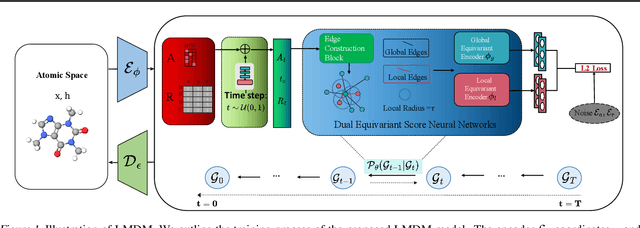

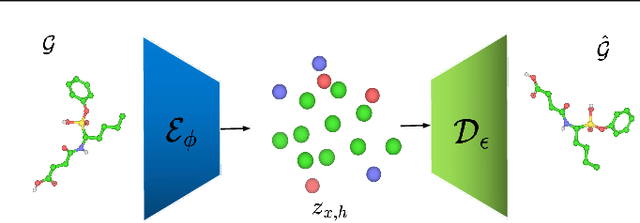
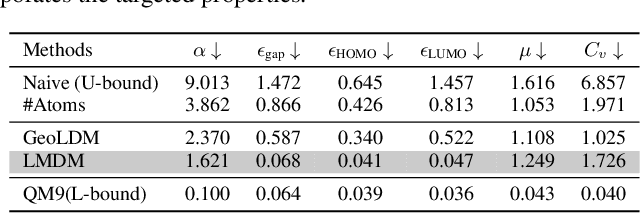
n this work, we propose a latent molecular diffusion model that can make the generated 3D molecules rich in diversity and maintain rich geometric features. The model captures the information of the forces and local constraints between atoms so that the generated molecules can maintain Euclidean transformation and high level of effectiveness and diversity. We also use the lowerrank manifold advantage of the latent variables of the latent model to fuse the information of the forces between atoms to better maintain the geometric equivariant properties of the molecules. Because there is no need to perform information fusion encoding in stages like traditional encoders and decoders, this reduces the amount of calculation in the back-propagation process. The model keeps the forces and local constraints of particle bonds in the latent variable space, reducing the impact of underfitting on the surface of the network on the large position drift of the particle geometry, so that our model can converge earlier. We introduce a distribution control variable in each backward step to strengthen exploration and improve the diversity of generation. In the experiment, the quality of the samples we generated and the convergence speed of the model have been significantly improved.
Personalized Multimodal Large Language Models: A Survey
Dec 03, 2024Multimodal Large Language Models (MLLMs) have become increasingly important due to their state-of-the-art performance and ability to integrate multiple data modalities, such as text, images, and audio, to perform complex tasks with high accuracy. This paper presents a comprehensive survey on personalized multimodal large language models, focusing on their architecture, training methods, and applications. We propose an intuitive taxonomy for categorizing the techniques used to personalize MLLMs to individual users, and discuss the techniques accordingly. Furthermore, we discuss how such techniques can be combined or adapted when appropriate, highlighting their advantages and underlying rationale. We also provide a succinct summary of personalization tasks investigated in existing research, along with the evaluation metrics commonly used. Additionally, we summarize the datasets that are useful for benchmarking personalized MLLMs. Finally, we outline critical open challenges. This survey aims to serve as a valuable resource for researchers and practitioners seeking to understand and advance the development of personalized multimodal large language models.
FoundIR: Unleashing Million-scale Training Data to Advance Foundation Models for Image Restoration
Dec 02, 2024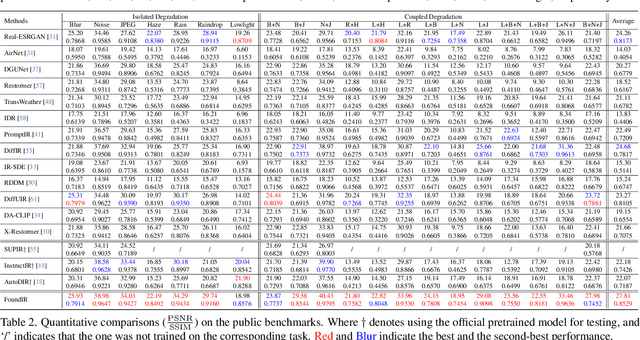
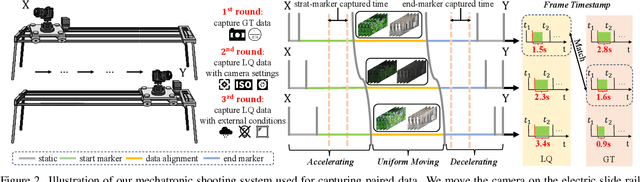

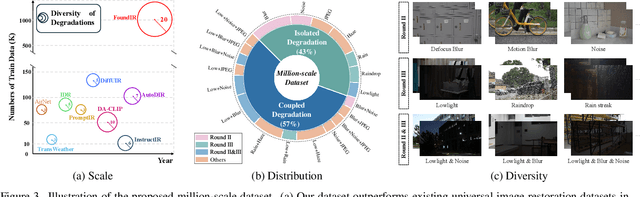
Despite the significant progress made by all-in-one models in universal image restoration, existing methods suffer from a generalization bottleneck in real-world scenarios, as they are mostly trained on small-scale synthetic datasets with limited degradations. Therefore, large-scale high-quality real-world training data is urgently needed to facilitate the emergence of foundational models for image restoration. To advance this field, we spare no effort in contributing a million-scale dataset with two notable advantages over existing training data: real-world samples with larger-scale, and degradation types with higher diversity. By adjusting internal camera settings and external imaging conditions, we can capture aligned image pairs using our well-designed data acquisition system over multiple rounds and our data alignment criterion. Moreover, we propose a robust model, FoundIR, to better address a broader range of restoration tasks in real-world scenarios, taking a further step toward foundation models. Specifically, we first utilize a diffusion-based generalist model to remove degradations by learning the degradation-agnostic common representations from diverse inputs, where incremental learning strategy is adopted to better guide model training. To refine the model's restoration capability in complex scenarios, we introduce degradation-aware specialist models for achieving final high-quality results. Extensive experiments show the value of our dataset and the effectiveness of our method.
Spatially Visual Perception for End-to-End Robotic Learning
Nov 26, 2024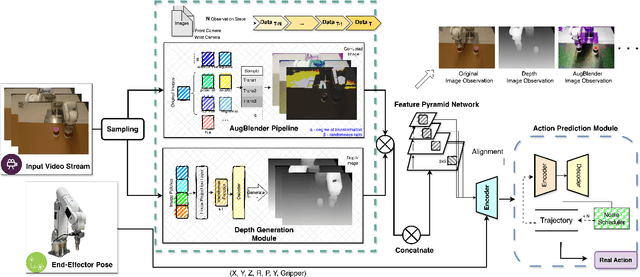

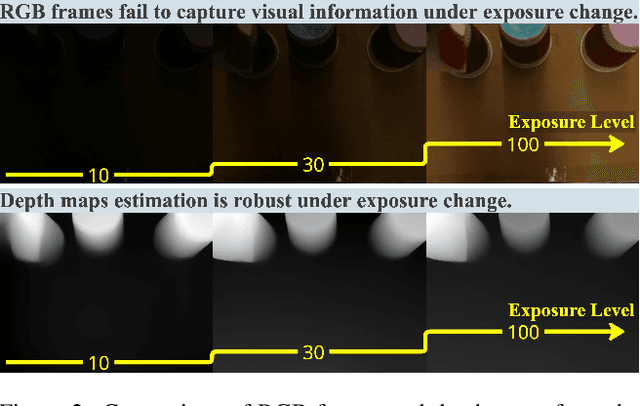
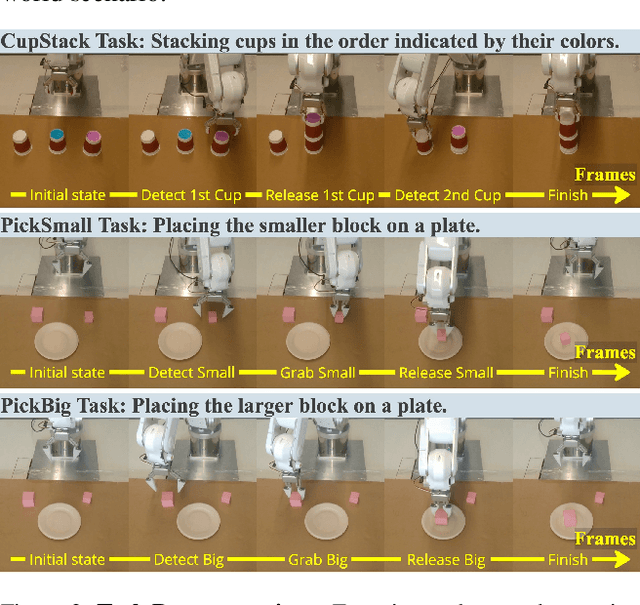
Recent advances in imitation learning have shown significant promise for robotic control and embodied intelligence. However, achieving robust generalization across diverse mounted camera observations remains a critical challenge. In this paper, we introduce a video-based spatial perception framework that leverages 3D spatial representations to address environmental variability, with a focus on handling lighting changes. Our approach integrates a novel image augmentation technique, AugBlender, with a state-of-the-art monocular depth estimation model trained on internet-scale data. Together, these components form a cohesive system designed to enhance robustness and adaptability in dynamic scenarios. Our results demonstrate that our approach significantly boosts the success rate across diverse camera exposures, where previous models experience performance collapse. Our findings highlight the potential of video-based spatial perception models in advancing robustness for end-to-end robotic learning, paving the way for scalable, low-cost solutions in embodied intelligence.
Optimizing Data Delivery: Insights from User Preferences on Visuals, Tables, and Text
Nov 12, 2024In this work, we research user preferences to see a chart, table, or text given a question asked by the user. This enables us to understand when it is best to show a chart, table, or text to the user for the specific question. For this, we conduct a user study where users are shown a question and asked what they would prefer to see and used the data to establish that a user's personal traits does influence the data outputs that they prefer. Understanding how user characteristics impact a user's preferences is critical to creating data tools with a better user experience. Additionally, we investigate to what degree an LLM can be used to replicate a user's preference with and without user preference data. Overall, these findings have significant implications pertaining to the development of data tools and the replication of human preferences using LLMs. Furthermore, this work demonstrates the potential use of LLMs to replicate user preference data which has major implications for future user modeling and personalization research.
CodeLutra: Boosting LLM Code Generation via Preference-Guided Refinement
Nov 07, 2024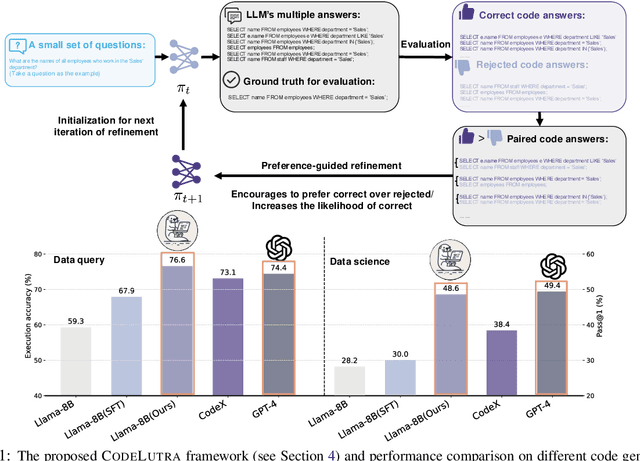


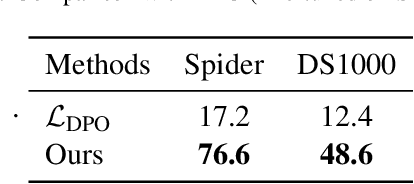
Large Language Models (LLMs) have significantly advanced code generation but often require substantial resources and tend to over-generalize, limiting their efficiency for specific tasks. Fine-tuning smaller, open-source LLMs presents a viable alternative; however, it typically lags behind cutting-edge models due to supervised fine-tuning's reliance solely on correct code examples, which restricts the model's ability to learn from its own mistakes and adapt to diverse programming challenges. To bridge this gap, we introduce CodeLutra, a novel framework that enhances low-performing LLMs by leveraging both successful and failed code generation attempts. Unlike conventional fine-tuning, CodeLutra employs an iterative preference learning mechanism to compare correct and incorrect solutions as well as maximize the likelihood of correct codes. Through continuous iterative refinement, CodeLutra enables smaller LLMs to match or surpass GPT-4's performance in various code generation tasks without relying on vast external datasets or larger auxiliary models. On a challenging data analysis task, using just 500 samples improved Llama-3-8B's accuracy from 28.2% to 48.6%, approaching GPT-4's performance. These results highlight CodeLutra's potential to close the gap between open-source and closed-source models, making it a promising approach in the field of code generation.