 Add to Chrome
 Add to Firefox
 Add to Edge
ReLoop2: Building Self-Adaptive Recommendation Models via Responsive Error Compensation Loop
Jun 22, 2023
Industrial recommender systems face the challenge of operating in non-stationary environments, where data distribution shifts arise from evolving user behaviors over time. To tackle this challenge, a common approach is to periodically re-train or incrementally update deployed deep models with newly observed data, resulting in a continual training process. However, the conventional learning paradigm of neural networks relies on iterative gradient-based updates with a small learning rate, making it slow for large recommendation models to adapt. In this paper, we introduce ReLoop2, a self-correcting learning loop that facilitates fast model adaptation in online recommender systems through responsive error compensation. Inspired by the slow-fast complementary learning system observed in human brains, we propose an error memory module that directly stores error samples from incoming data streams. These stored samples are subsequently leveraged to compensate for model prediction errors during testing, particularly under distribution shifts. The error memory module is designed with fast access capabilities and undergoes continual refreshing with newly observed data samples during the model serving phase to support fast model adaptation. We evaluate the effectiveness of ReLoop2 on three open benchmark datasets as well as a real-world production dataset. The results demonstrate the potential of ReLoop2 in enhancing the responsiveness and adaptiveness of recommender systems operating in non-stationary environments.

MetricPrompt: Prompting Model as a Relevance Metric for Few-shot Text Classification
Jun 15, 2023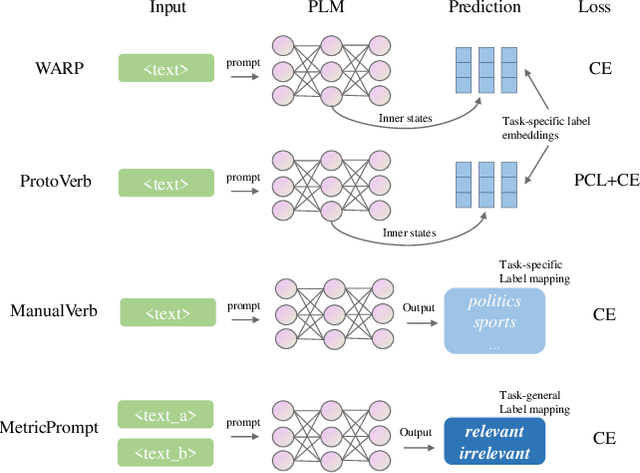
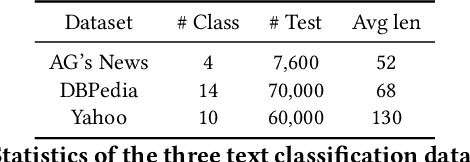
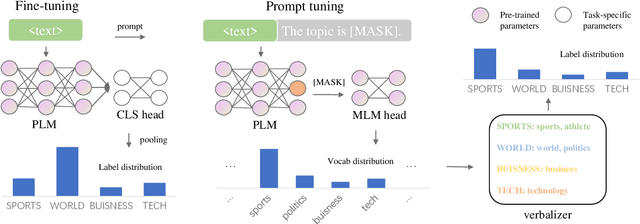
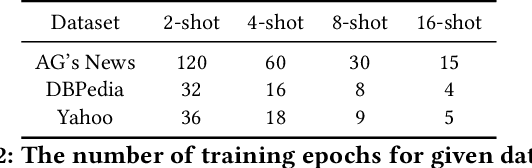
Prompting methods have shown impressive performance in a variety of text mining tasks and applications, especially few-shot ones. Despite the promising prospects, the performance of prompting model largely depends on the design of prompt template and verbalizer. In this work, we propose MetricPrompt, which eases verbalizer design difficulty by reformulating few-shot text classification task into text pair relevance estimation task. MetricPrompt adopts prompting model as the relevance metric, further bridging the gap between Pre-trained Language Model's (PLM) pre-training objective and text classification task, making possible PLM's smooth adaption. Taking a training sample and a query one simultaneously, MetricPrompt captures cross-sample relevance information for accurate relevance estimation. We conduct experiments on three widely used text classification datasets across four few-shot settings. Results show that MetricPrompt outperforms manual verbalizer and other automatic verbalizer design methods across all few-shot settings, achieving new state-of-the-art (SOTA) performance.
I run as fast as a rabbit, can you? A Multilingual Simile Dialogue Dataset
Jun 09, 2023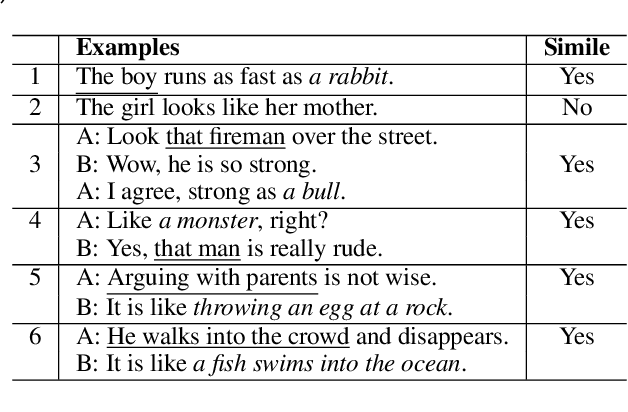
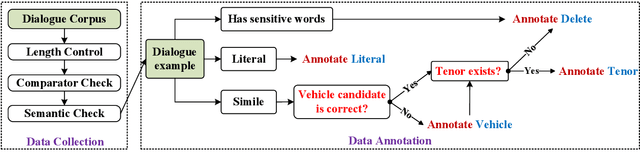
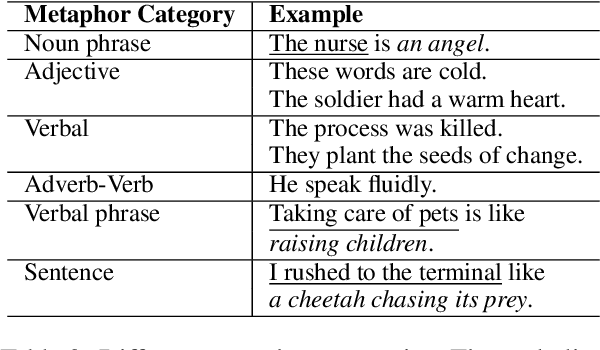
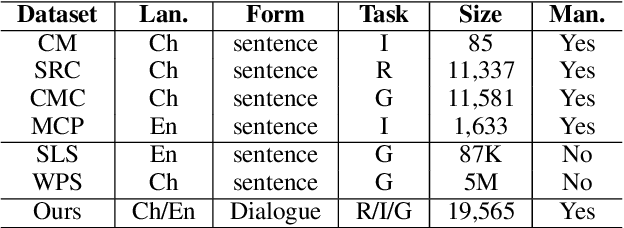
A simile is a figure of speech that compares two different things (called the tenor and the vehicle) via shared properties. The tenor and the vehicle are usually connected with comparator words such as "like" or "as". The simile phenomena are unique and complex in a real-life dialogue scene where the tenor and the vehicle can be verbal phrases or sentences, mentioned by different speakers, exist in different sentences, or occur in reversed order. However, the current simile research usually focuses on similes in a triplet tuple (tenor, property, vehicle) or a single sentence where the tenor and vehicle are usually entities or noun phrases, which could not reflect complex simile phenomena in real scenarios. In this paper, we propose a novel and high-quality multilingual simile dialogue (MSD) dataset to facilitate the study of complex simile phenomena. The MSD is the largest manually annotated simile data ($\sim$20K) and it contains both English and Chinese data. Meanwhile, the MSD data can also be used on dialogue tasks to test the ability of dialogue systems when using similes. We design 3 simile tasks (recognition, interpretation, and generation) and 2 dialogue tasks (retrieval and generation) with MSD. For each task, we provide experimental results from strong pre-trained or state-of-the-art models. The experiments demonstrate the challenge of MSD and we have released the data/code on GitHub.
Learning A Foundation Language Model for Geoscience Knowledge Understanding and Utilization
Jun 08, 2023
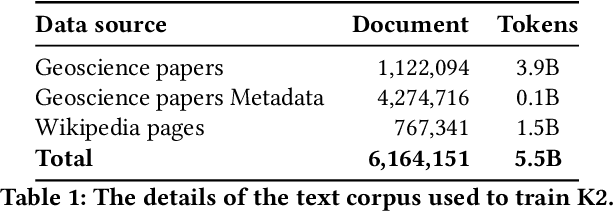

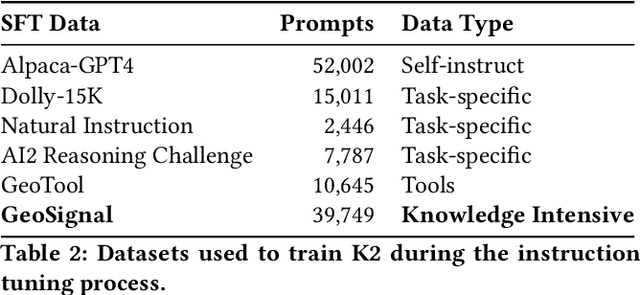
Large language models (LLMs)have achieved great success in general domains of natural language processing. In this paper, we bring LLMs to the realm of geoscience, with the objective of advancing research and applications in this field. To this end, we present the first-ever LLM in geoscience, K2, alongside a suite of resources developed to further promote LLM research within geoscience. For instance, we have curated the first geoscience instruction tuning dataset, GeoSignal, which aims to align LLM responses to geoscience-related user queries. Additionally, we have established the first geoscience benchmark, GeoBenchmark, to evaluate LLMs in the context of geoscience. In this work, we experiment with a complete recipe to adapt a pretrained general-domain LLM to the geoscience domain. Specifically, we further train the LLaMA-7B model on over 1 million pieces of geoscience literature and utilize GeoSignal's supervised data to fine-tune the model. Moreover, we share a protocol that can efficiently gather domain-specific data and construct domain-supervised data, even in situations where manpower is scarce. Experiments conducted on the GeoBenchmark demonstrate the the effectiveness of our approach and datasets.
Set-to-Sequence Ranking-based Concept-aware Learning Path Recommendation
Jun 07, 2023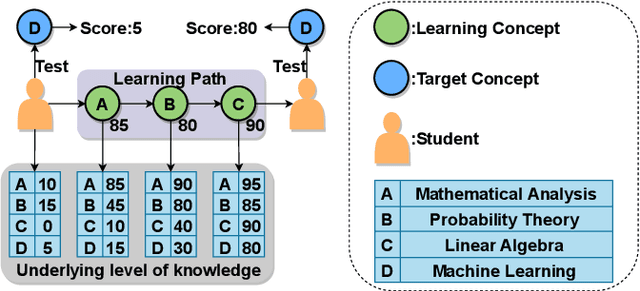
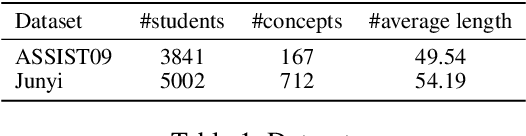
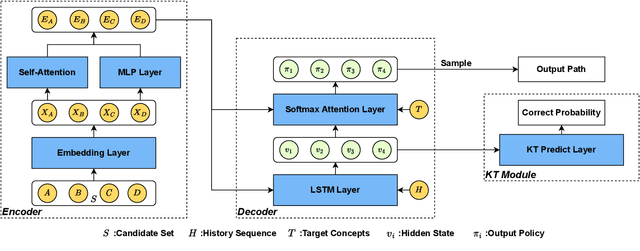
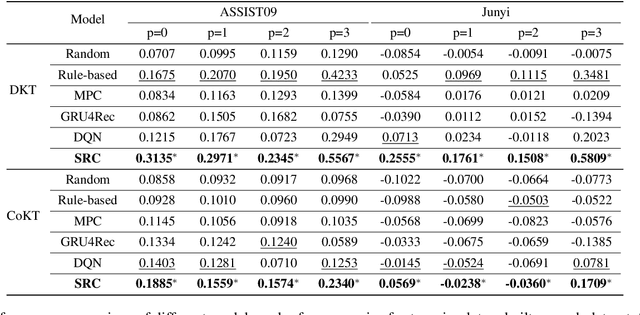
With the development of the online education system, personalized education recommendation has played an essential role. In this paper, we focus on developing path recommendation systems that aim to generating and recommending an entire learning path to the given user in each session. Noticing that existing approaches fail to consider the correlations of concepts in the path, we propose a novel framework named Set-to-Sequence Ranking-based Concept-aware Learning Path Recommendation (SRC), which formulates the recommendation task under a set-to-sequence paradigm. Specifically, we first design a concept-aware encoder module which can capture the correlations among the input learning concepts. The outputs are then fed into a decoder module that sequentially generates a path through an attention mechanism that handles correlations between the learning and target concepts. Our recommendation policy is optimized by policy gradient. In addition, we also introduce an auxiliary module based on knowledge tracing to enhance the model's stability by evaluating students' learning effects on learning concepts. We conduct extensive experiments on two real-world public datasets and one industrial dataset, and the experimental results demonstrate the superiority and effectiveness of SRC. Code will be available at https://gitee.com/mindspore/models/tree/master/research/recommend/SRC.
Privileged Knowledge Distillation for Sim-to-Real Policy Generalization
May 29, 2023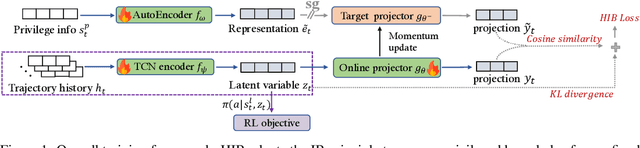
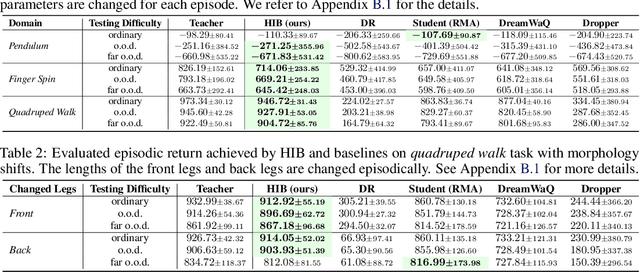
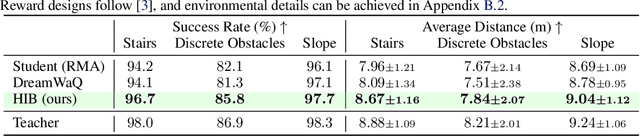
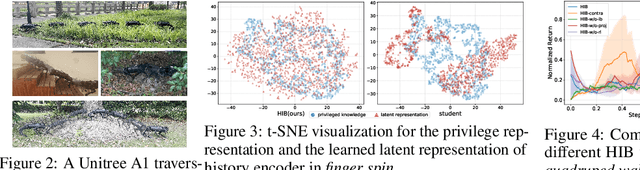
Reinforcement Learning (RL) has recently achieved remarkable success in robotic control. However, most RL methods operate in simulated environments where privileged knowledge (e.g., dynamics, surroundings, terrains) is readily available. Conversely, in real-world scenarios, robot agents usually rely solely on local states (e.g., proprioceptive feedback of robot joints) to select actions, leading to a significant sim-to-real gap. Existing methods address this gap by either gradually reducing the reliance on privileged knowledge or performing a two-stage policy imitation. However, we argue that these methods are limited in their ability to fully leverage the privileged knowledge, resulting in suboptimal performance. In this paper, we propose a novel single-stage privileged knowledge distillation method called the Historical Information Bottleneck (HIB) to narrow the sim-to-real gap. In particular, HIB learns a privileged knowledge representation from historical trajectories by capturing the underlying changeable dynamic information. Theoretical analysis shows that the learned privileged knowledge representation helps reduce the value discrepancy between the oracle and learned policies. Empirical experiments on both simulated and real-world tasks demonstrate that HIB yields improved generalizability compared to previous methods.
Diffusion Model is an Effective Planner and Data Synthesizer for Multi-Task Reinforcement Learning
May 29, 2023Diffusion models have demonstrated highly-expressive generative capabilities in vision and NLP. Recent studies in reinforcement learning (RL) have shown that diffusion models are also powerful in modeling complex policies or trajectories in offline datasets. However, these works have been limited to single-task settings where a generalist agent capable of addressing multi-task predicaments is absent. In this paper, we aim to investigate the effectiveness of a single diffusion model in modeling large-scale multi-task offline data, which can be challenging due to diverse and multimodal data distribution. Specifically, we propose Multi-Task Diffusion Model (\textsc{MTDiff}), a diffusion-based method that incorporates Transformer backbones and prompt learning for generative planning and data synthesis in multi-task offline settings. \textsc{MTDiff} leverages vast amounts of knowledge available in multi-task data and performs implicit knowledge sharing among tasks. For generative planning, we find \textsc{MTDiff} outperforms state-of-the-art algorithms across 50 tasks on Meta-World and 8 maps on Maze2D. For data synthesis, \textsc{MTDiff} generates high-quality data for testing tasks given a single demonstration as a prompt, which enhances the low-quality datasets for even unseen tasks.
MADiff: Offline Multi-agent Learning with Diffusion Models
May 27, 2023Diffusion model (DM), as a powerful generative model, recently achieved huge success in various scenarios including offline reinforcement learning, where the policy learns to conduct planning by generating trajectory in the online evaluation. However, despite the effectiveness shown for single-agent learning, it remains unclear how DMs can operate in multi-agent problems, where agents can hardly complete teamwork without good coordination by independently modeling each agent's trajectories. In this paper, we propose MADiff, a novel generative multi-agent learning framework to tackle this problem. MADiff is realized with an attention-based diffusion model to model the complex coordination among behaviors of multiple diffusion agents. To the best of our knowledge, MADiff is the first diffusion-based multi-agent offline RL framework, which behaves as both a decentralized policy and a centralized controller, which includes opponent modeling and can be used for multi-agent trajectory prediction. MADiff takes advantage of the powerful generative ability of diffusion while well-suited in modeling complex multi-agent interactions. Our experiments show the superior performance of MADiff compared to baseline algorithms in a range of multi-agent learning tasks.
An Empirical Study on Google Research Football Multi-agent Scenarios
May 16, 2023Few multi-agent reinforcement learning (MARL) research on Google Research Football (GRF) focus on the 11v11 multi-agent full-game scenario and to the best of our knowledge, no open benchmark on this scenario has been released to the public. In this work, we fill the gap by providing a population-based MARL training pipeline and hyperparameter settings on multi-agent football scenario that outperforms the bot with difficulty 1.0 from scratch within 2 million steps. Our experiments serve as a reference for the expected performance of Independent Proximal Policy Optimization (IPPO), a state-of-the-art multi-agent reinforcement learning algorithm where each agent tries to maximize its own policy independently across various training configurations. Meanwhile, we open-source our training framework Light-MALib which extends the MALib codebase by distributed and asynchronized implementation with additional analytical tools for football games. Finally, we provide guidance for building strong football AI with population-based training and release diverse pretrained policies for benchmarking. The goal is to provide the community with a head start for whoever experiment their works on GRF and a simple-to-use population-based training framework for further improving their agents through self-play. The implementation is available at https://github.com/Shanghai-Digital-Brain-Laboratory/DB-Football.
U-NEED: A Fine-grained Dataset for User Needs-Centric E-commerce Conversational Recommendation
May 05, 2023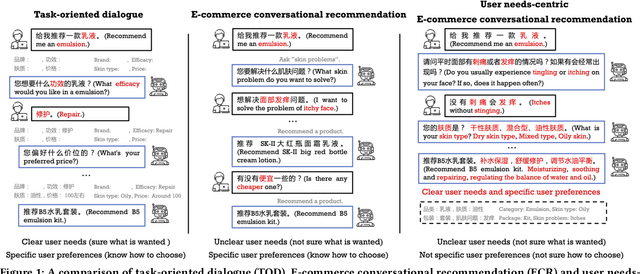
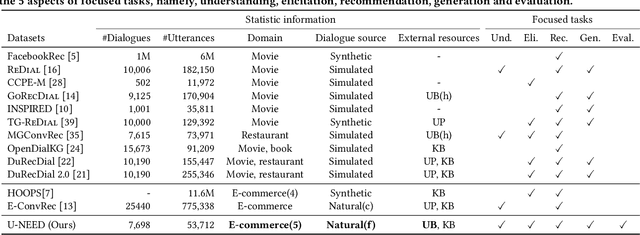
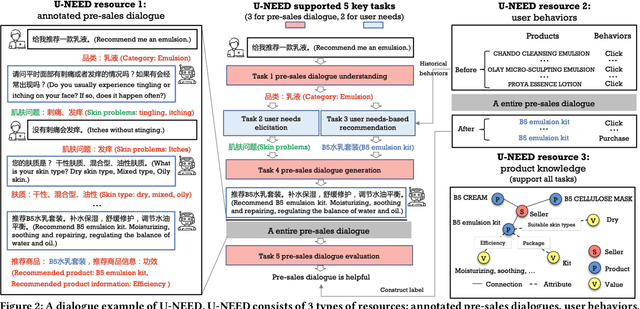
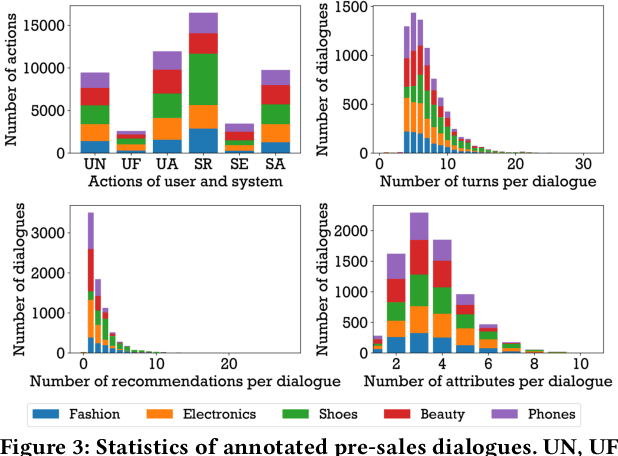
Conversational recommender systems (CRSs) aim to understand the information needs and preferences expressed in a dialogue to recommend suitable items to the user. Most of the existing conversational recommendation datasets are synthesized or simulated with crowdsourcing, which has a large gap with real-world scenarios. To bridge the gap, previous work contributes a dataset E-ConvRec, based on pre-sales dialogues between users and customer service staff in E-commerce scenarios. However, E-ConvRec only supplies coarse-grained annotations and general tasks for making recommendations in pre-sales dialogues. Different from that, we use real user needs as a clue to explore the E-commerce conversational recommendation in complex pre-sales dialogues, namely user needs-centric E-commerce conversational recommendation (UNECR). In this paper, we construct a user needs-centric E-commerce conversational recommendation dataset (U-NEED) from real-world E-commerce scenarios. U-NEED consists of 3 types of resources: (i) 7,698 fine-grained annotated pre-sales dialogues in 5 top categories (ii) 333,879 user behaviors and (iii) 332,148 product knowledge tuples. To facilitate the research of UNECR, we propose 5 critical tasks: (i) pre-sales dialogue understanding (ii) user needs elicitation (iii) user needs-based recommendation (iv) pre-sales dialogue generation and (v) pre-sales dialogue evaluation. We establish baseline methods and evaluation metrics for each task. We report experimental results of 5 tasks on U-NEED. We also report results in 3 typical categories. Experimental results indicate that the challenges of UNECR in various categories are different.