 Add to Chrome
 Add to Firefox
 Add to Edge
Co-RL: Unsupervised Reasoning Emerges from Diverse Cohort in Multi-agent RL
Aug 18, 2026
Reinforcement learning (RL) has emerged as a powerful approach for improving reasoning in language and vision-language models, yet its strongest successes still depend heavily on ground-truth supervision (e.g., verifiable reward). Such annotations are costly to obtain and become increasingly scarce as reasoning capabilities advance beyond what humans can reliably evaluate. Self-rewarding RL reduces this dependence by enabling models to derive reward signals from their own completions. However, training solely on self-generated feedback can reinforce existing biases and suboptimal behaviors, reduce response diversity, and ultimately lead to homogenized responses and training collapse. In this work, we show that unsupervised reasoning can emerge through cooperative multi-agent training. We introduce Co-RL, a framework in which multiple decoupled models, sharing no parameters, are simultaneously optimized through RL using rewards derived from their peers. We further show that increasing cohort diversity, through heterogeneous model families, sizes, and rephrased training samples, reduces the correlated errors that drive self-reinforcing feedback loops. This diversity consistently improves reasoning performance, maintains behavioral diversity, and mitigates training collapse. Across text-only and multimodal domains, Co-RL consistently outperforms the base models and prior label-free approaches, while matching or surpassing supervised methods, without access to any ground-truth labels. Concretely, Co-RL yields average gains of 3.0-8.6% across seven text-only benchmarks for LLMs and 2.3-7.2% across four multimodal benchmarks for VLMs. Code is available at https://github.com/DrStranded/Co-RL.

LLMs and Agentic AI Systems for Smart Grids: A Tutorial on Architectures and Applications
Jul 20, 2026Large language models (LLMs) and agentic AI systems have evolved from natural language tasks to using external tools to plan, retrieve, and act in technical domains. In smart grids, recent work applies agentic schemes to forecasting, optimization, and control, wrapping trusted solvers behind language interfaces and orchestrating multi-step workflows. The literature lacks a unified approach to designing and evaluating such systems. LLMs can produce numerically plausible yet physically infeasible outputs, evaluation protocols vary across tasks, and the boundary between what the model should and should not compute is implicit. This paper presents a solver-grounded design principle: a numerical result is reported only when it originates from a trusted tool and passes explicit verification. We review the building blocks of LLM and agentic AI systems for power systems: prompting strategies and agentic architectures. We instantiate the principle in four case studies: wind power forecasting, EV charging scheduling, power flow analysis, and contingency diagnosis, each comparing an LLM-only baseline against its solver-grounded counterpart on identical data and metrics. EVAgent reproduces the CVXPY optimum while reducing LLM-only unmet energy by 7.5-9.5x, and GridDebugAgent repairs 17/39 contingency cases while reducing total violations by 52.3%. We propose a four-group evaluation framework spanning task utility, solver-grounded correctness, faithfulness and safe failure, and cost and latency. A consistent division of labor emerges: the agentic system reliably orchestrates, retrieves, and explains, while trusted tools compute and a verification gate decides what is reported.
Low-Rank Adaptation for Critic Learning in Off-Policy Reinforcement Learning
Apr 21, 2026Scaling critic capacity is a promising direction for enhancing off-policy reinforcement learning (RL). However, larger critics are prone to overfitting and unstable in replay-buffer-based bootstrap training. This paper leverages Low-Rank Adaptation (LoRA) as a structural-sparsity regularizer for off-policy critics. Our approach freezes randomly initialized base matrices and solely optimizes low-rank adapters, thereby constraining critic updates to a low-dimensional subspace. Built on top of SimbaV2, we further develop a LoRA formulation, compatible with SimbaV2, that preserves its hyperspherical normalization geometry under frozen-backbone training. We evaluate our method with SAC and FastTD3 on DeepMind Control locomotion and IsaacLab robotics benchmarks. LoRA consistently achieves lower critic loss during training and stronger policy performance. Extensive experiments demonstrate that adaptive low-rank updates provide a simple, scalable, and effective structural regularization for critic learning in off-policy RL.
Sampling-Horizon Neural Operator Predictors for Nonlinear Control under Delayed Inputs
Mar 31, 2026Modern control systems frequently operate under input delays and sampled state measurements. A common delay-compensation strategy is predictor feedback; however, practical implementations require solving an implicit ODE online, resulting in intractable computational cost. Moreover, predictor formulations typically assume continuously available state measurements, whereas in practice measurements may be sampled, irregular, or temporarily missing due to hardware faults. In this work, we develop two neural-operator predictor-feedback designs for nonlinear systems with delayed inputs and sampled measurements. In the first design, we introduce a sampling-horizon prediction operator that maps the current measurement and input history to the predicted state trajectory over the next sampling interval. In the second design, the neural operator approximates only the delay-compensating predictor, which is then composed with the closed-loop flow between measurements. The first approach requires uniform sampling but yields residual bounds that scale directly with the operator approximation error. In contrast, the second accommodates non-uniform, but bounded sampling schedules at the cost of amplified approximation error, revealing a practical tradeoff between sampling flexibility and approximation sensitivity for the control engineer. For both schemes, we establish semi-global practical stability with explicit neural operator error-dependent bounds. Numerical experiments on a 6-link nonlinear robotic manipulator demonstrate accurate tracking and substantial computational speedup of 25$\times$ over a baseline approach.
Predictor-Based Output-Feedback Control of Linear Systems with Time-Varying Input and Measurement Delays via Neural-Approximated Prediction Horizons
Mar 31, 2026Due to simplicity and strong stability guarantees, predictor feedback methods have stood as a popular approach for time delay systems since the 1950s. For time-varying delays, however, implementation requires computing a prediction horizon defined by the inverse of the delay function, which is rarely available in closed form and must be approximated. In this work, we formulate the inverse delay mapping as an operator learning problem and study predictor feedback under approximation of the prediction horizon. We propose two approaches: (i) a numerical method based on time integration of an equivalent ODE, and (ii) a data-driven method using neural operators to learn the inverse mapping. We show that both approaches achieve arbitrary approximation accuracy over compact sets, with complementary trade-offs in computational cost and scalability. Building on these approximations, we then develop an output-feedback predictor design for systems with delays in both the input and the measurement. We prove that the resulting closed-loop system is globally exponentially stable when the prediction horizon is approximated with sufficiently small error. Lastly, numerical experiments validate the proposed methods and illustrate their trade-offs between accuracy and computational efficiency.
Benchmarking State Space Models, Transformers, and Recurrent Networks for US Grid Forecasting
Feb 24, 2026Selecting the right deep learning model for power grid forecasting is challenging, as performance heavily depends on the data available to the operator. This paper presents a comprehensive benchmark of five modern neural architectures: two state space models (PowerMamba, S-Mamba), two Transformers (iTransformer, PatchTST), and a traditional LSTM. We evaluate these models on hourly electricity demand across six diverse US power grids for forecast windows between 24 and 168 hours. To ensure a fair comparison, we adapt each model with specialized temporal processing and a modular layer that cleanly integrates weather covariates. Our results reveal that there is no single best model for all situations. When forecasting using only historical load, PatchTST and the state space models provide the highest accuracy. However, when explicit weather data is added to the inputs, the rankings reverse: iTransformer improves its accuracy three times more efficiently than PatchTST. By controlling for model size, we confirm that this advantage stems from the architecture's inherent ability to mix information across different variables. Extending our evaluation to solar generation, wind power, and wholesale prices further demonstrates that model rankings depend on the forecast task: PatchTST excels on highly rhythmic signals like solar, while state space models are better suited for the chaotic fluctuations of wind and price. Ultimately, this benchmark provides grid operators with actionable guidelines for selecting the optimal forecasting architecture based on their specific data environments.
RN-D: Discretized Categorical Actors with Regularized Networks for On-Policy Reinforcement Learning
Jan 30, 2026On-policy deep reinforcement learning remains a dominant paradigm for continuous control, yet standard implementations rely on Gaussian actors and relatively shallow MLP policies, often leading to brittle optimization when gradients are noisy and policy updates must be conservative. In this paper, we revisit policy representation as a first-class design choice for on-policy optimization. We study discretized categorical actors that represent each action dimension with a distribution over bins, yielding a policy objective that resembles a cross-entropy loss. Building on architectural advances from supervised learning, we further propose regularized actor networks, while keeping critic design fixed. Our results show that simply replacing the standard actor network with our discretized regularized actor yields consistent gains and achieve the state-of-the-art performance across diverse continuous-control benchmarks.
Anatomical Region-Guided Contrastive Decoding: A Plug-and-Play Strategy for Mitigating Hallucinations in Medical VLMs
Dec 19, 2025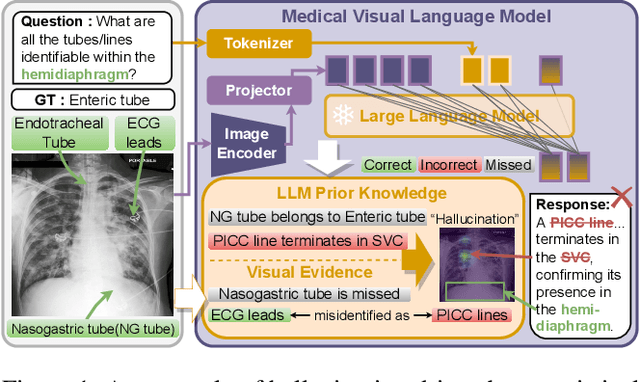
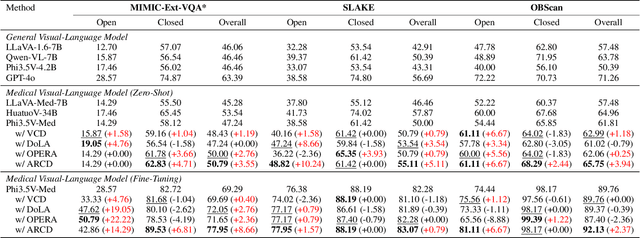
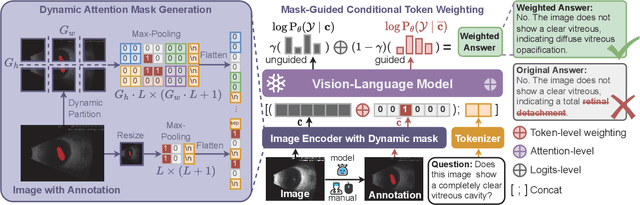
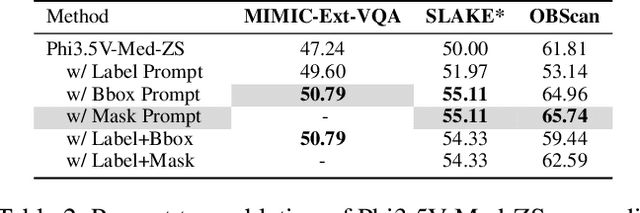
Medical Vision-Language Models (MedVLMs) show immense promise in clinical applicability. However, their reliability is hindered by hallucinations, where models often fail to derive answers from visual evidence, instead relying on learned textual priors. Existing mitigation strategies for MedVLMs have distinct limitations: training-based methods rely on costly expert annotations, limiting scalability, while training-free interventions like contrastive decoding, though data-efficient, apply a global, untargeted correction whose effects in complex real-world clinical settings can be unreliable. To address these challenges, we introduce Anatomical Region-Guided Contrastive Decoding (ARCD), a plug-and-play strategy that mitigates hallucinations by providing targeted, region-specific guidance. Our module leverages an anatomical mask to direct a three-tiered contrastive decoding process. By dynamically re-weighting at the token, attention, and logits levels, it verifiably steers the model's focus onto specified regions, reinforcing anatomical understanding and suppressing factually incorrect outputs. Extensive experiments across diverse datasets, including chest X-ray, CT, brain MRI, and ocular ultrasound, demonstrate our method's effectiveness in improving regional understanding, reducing hallucinations, and enhancing overall diagnostic accuracy.
Stabilization of nonlinear systems with unknown delays via delay-adaptive neural operator approximate predictors
Sep 30, 2025This work establishes the first rigorous stability guarantees for approximate predictors in delay-adaptive control of nonlinear systems, addressing a key challenge in practical implementations where exact predictors are unavailable. We analyze two scenarios: (i) when the actuated input is directly measurable, and (ii) when it is estimated online. For the measurable input case, we prove semi-global practical asymptotic stability with an explicit bound proportional to the approximation error $\epsilon$. For the unmeasured input case, we demonstrate local practical asymptotic stability, with the region of attraction explicitly dependent on both the initial delay estimate and the predictor approximation error. To bridge theory and practice, we show that neural operators-a flexible class of neural network-based approximators-can achieve arbitrarily small approximation errors, thus satisfying the conditions of our stability theorems. Numerical experiments on two nonlinear benchmark systems-a biological protein activator/repressor model and a micro-organism growth Chemostat model-validate our theoretical results. In particular, our numerical simulations confirm stability under approximate predictors, highlight the strong generalization capabilities of neural operators, and demonstrate a substantial computational speedup of up to 15x compared to a baseline fixed-point method.
Uncovering the Bigger Picture: Comprehensive Event Understanding Via Diverse News Retrieval
Aug 27, 2025Access to diverse perspectives is essential for understanding real-world events, yet most news retrieval systems prioritize textual relevance, leading to redundant results and limited viewpoint exposure. We propose NEWSCOPE, a two-stage framework for diverse news retrieval that enhances event coverage by explicitly modeling semantic variation at the sentence level. The first stage retrieves topically relevant content using dense retrieval, while the second stage applies sentence-level clustering and diversity-aware re-ranking to surface complementary information. To evaluate retrieval diversity, we introduce three interpretable metrics, namely Average Pairwise Distance, Positive Cluster Coverage, and Information Density Ratio, and construct two paragraph-level benchmarks: LocalNews and DSGlobal. Experiments show that NEWSCOPE consistently outperforms strong baselines, achieving significantly higher diversity without compromising relevance. Our results demonstrate the effectiveness of fine-grained, interpretable modeling in mitigating redundancy and promoting comprehensive event understanding. The data and code are available at https://github.com/tangyixuan/NEWSCOPE.