 Add to Chrome
 Add to Firefox
 Add to Edge
Geometric Gradient Rectification for Safe Open-Set Semi-Supervised Learning
Jun 25, 2026
Open-set semi-supervised learning aims to leverage unlabeled data that may contain out-of-distribution outliers while maintaining performance on in-distribution classes. Existing methods mainly follow two paradigms: filtering suspicious samples or incorporating unlabeled objectives with soft weighting. We argue that both face a common trade-off: aggressive filtering can discard informative but hard ID samples, whereas utilization can introduce auxiliary gradients that conflict with supervised learning when pseudo labels are wrong. We therefore shift the focus from sample selection to gradient-level control. We propose \textit{Geometric Gradient Rectification} (GGR), a plug-in framework that uses the supervised gradient as an anchor and projects conflicting auxiliary gradients onto an admissible region in gradient space. This makes the applied auxiliary update first-order non-opposing within the rectified coordinate block while preserving orthogonal components that may still carry useful representation signals. We further extend GGR with subspace-aware rectification to stabilize the anchor under noisy mini-batch gradients. Experiments on CIFAR and ImageNet benchmarks show that GGR improves representative OSSL baselines in most settings and yields gains in both closed-set generalization and open-set robustness. Code will be available at https://github.com/JiaheChen2002/GGR.

Language-Induced Priors for Domain Adaptation
May 14, 2026Domain adaptation faces a fundamental paradox in the cold-start regime. When target data is scarce, statistical methods fail to distinguish relevant source domains from irrelevant ones, which often leads to negative transfer. In this paper, we address this challenge by leveraging expert textual descriptions of the target domain, a resource that is often available but overlooked. We propose a probabilistic framework that translates these semantic descriptions into a choice model, namely a Language-Induced Prior (LIP), that learns the preferences from a pretrained Large Language Model (LLM). The LIP is then integrated into an Expectation-Maximization algorithm to identify source relevance. Methodologically, this framework is compatible with any parametric model where a likelihood is available. It allows the LIP to guide the selection of sources when target signals are weak, while gradually refining these choices as samples accumulate. Theoretically, we prove that the estimator roughly matches an oracle cold-start MSE under a correct prior, while remaining asymptotically consistent regardless of the quality of the LIP. Empirically, we validated the framework on a descriptive (Gaussian estimation), a predictive (C-MAPSS dataset), and a prescriptive task (MuJoCo hopper).
Collaborative Contextual Bayesian Optimization
Apr 20, 2026Discovering optimal designs through sequential data collection is essential in many real-world applications. While Bayesian Optimization (BO) has achieved remarkable success in this setting, growing attention has recently turned to context-specific optimal design, formalized as Contextual Bayesian Optimization (CBO). Unlike BO, CBO is inherently more challenging as it must approximate an entire mapping from the context space to its corresponding optimal design, requiring simultaneous exploration across contexts and exploitation within each. In many modern applications, such tasks arise across multiple potentially heterogeneous but related clients, where collaboration can significantly improve learning efficiency. We propose CCBO, Collaborative Contextual Bayesian Optimization, a unified framework enabling multiple clients to jointly perform CBO with controllable contexts, supporting both online collaboration and offline initialization from peers' historical beliefs, with an optional privacy-preserving communication mechanism. We establish sublinear regret guarantees and demonstrate, through extensive simulations and a real-world hot rolling application, that CCBO achieves substantial improvements over existing approaches even under client heterogeneity. The code to reproduce the results can be found at https://github.com/cchihyu/Collaborative-Contextual-Bayesian-Optimization
Learning What Matters: Dynamic Dimension Selection and Aggregation for Interpretable Vision-Language Reward Modeling
Apr 07, 2026Vision-language reward modeling faces a dilemma: generative approaches are interpretable but slow, while discriminative ones are efficient but act as opaque "black boxes." To bridge this gap, we propose VL-MDR (Vision-Language Multi-Dimensional Reward), a framework that dynamically decomposes evaluation into granular, interpretable dimensions. Instead of outputting a monolithic scalar, VL-MDR employs a visual-aware gating mechanism to identify relevant dimensions and adaptively weight them (e.g., Hallucination, Reasoning) for each specific input. To support this, we curate a dataset of 321k vision-language preference pairs annotated across 21 fine-grained dimensions. Extensive experiments show that VL-MDR consistently outperforms existing open-source reward models on benchmarks like VL-RewardBench. Furthermore, we show that VL-MDR-constructed preference pairs effectively enable DPO alignment to mitigate visual hallucinations and improve reliability, providing a scalable solution for VLM alignment.
HO-SFL: Hybrid-Order Split Federated Learning with Backprop-Free Clients and Dimension-Free Aggregation
Mar 16, 2026Fine-tuning large models on edge devices is severely hindered by the memory-intensive backpropagation (BP) in standard frameworks like federated learning and split learning. While substituting BP with zeroth-order optimization can significantly reduce memory footprints, it typically suffers from prohibitively degraded convergence speed. To resolve this dilemma, we propose Hybrid-Order Split Federated Learning (HO-SFL). By reformulating the split learning process within a Lagrangian framework, HO-SFL decouples the optimization landscape: The server performs precise first-order updates (i.e., BP), whereas clients conduct memory-efficient zeroth-order optimization. This hybrid design not only eliminates the need for client-side BP but also enables dimension-free model aggregation, drastically lowering communication costs. Crucially, we provide a theoretical convergence analysis, demonstrating that HO-SFL mitigates the dimension-dependent convergence slowdown of zeroth-order optimization, achieving a convergence rate comparable to first-order methods. Extensive experiments on tasks across vision and language modalities validate that HO-SFL achieves convergence speeds comparable to first-order baselines while significantly reducing communication costs and client memory footprints.
Online Learning of Optimal Sequential Testing Policies
Sep 03, 2025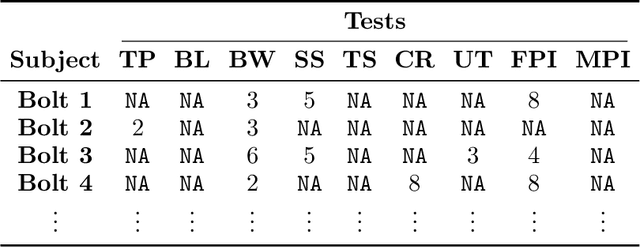
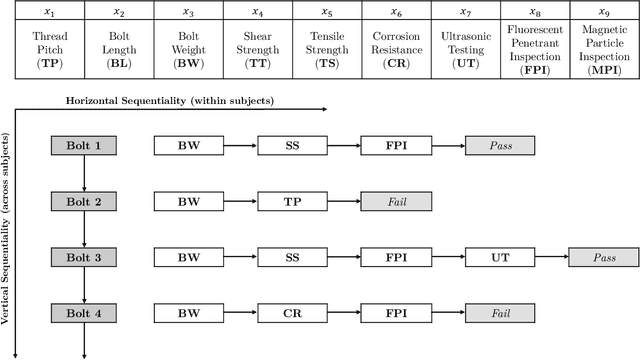
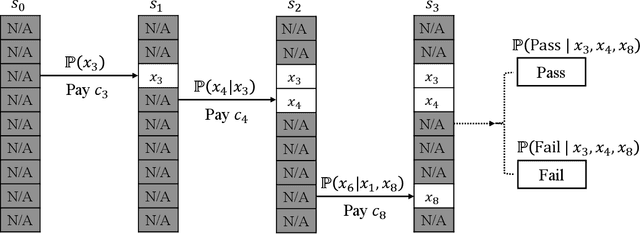
This paper studies an online learning problem that seeks optimal testing policies for a stream of subjects, each of whom can be evaluated through a sequence of candidate tests drawn from a common pool. We refer to this problem as the Online Testing Problem (OTP). Although conducting every candidate test for a subject provides more information, it is often preferable to select only a subset when tests are correlated and costly, and make decisions with partial information. If the joint distribution of test outcomes were known, the problem could be cast as a Markov Decision Process (MDP) and solved exactly. In practice, this distribution is unknown and must be learned online as subjects are tested. When a subject is not fully tested, the resulting missing data can bias estimates, making the problem fundamentally harder than standard episodic MDPs. We prove that the minimax regret must scale at least as $\Omega(T^{\frac{2}{3}})$, in contrast to the $\Theta(\sqrt{T})$ rate in episodic MDPs, revealing the difficulty introduced by missingness. This elevated lower bound is then matched by an Explore-Then-Commit algorithm whose cumulative regret is $\tilde{O}(T^{\frac{2}{3}})$ for both discrete and Gaussian distributions. To highlight the consequence of missingness-dependent rewards in OTP, we study a variant called the Online Cost-sensitive Maximum Entropy Sampling Problem, where rewards are independent of missing data. This structure enables an iterative-elimination algorithm that achieves $\tilde{O}(\sqrt{T})$ regret, breaking the $\Omega(T^{\frac{2}{3}})$ lower bound for OTP. Numerical results confirm our theory in both settings. Overall, this work deepens the understanding of the exploration--exploitation trade-off under missing data and guides the design of efficient sequential testing policies.
Mitigating Hallucination of Large Vision-Language Models via Dynamic Logits Calibration
Jun 26, 2025Large Vision-Language Models (LVLMs) have demonstrated significant advancements in multimodal understanding, yet they are frequently hampered by hallucination-the generation of text that contradicts visual input. Existing training-free decoding strategies exhibit critical limitations, including the use of static constraints that do not adapt to semantic drift during generation, inefficiency stemming from the need for multiple forward passes, and degradation of detail due to overly rigid intervention rules. To overcome these challenges, this paper introduces Dynamic Logits Calibration (DLC), a novel training-free decoding framework designed to dynamically align text generation with visual evidence at inference time. At the decoding phase, DLC step-wise employs CLIP to assess the semantic alignment between the input image and the generated text sequence. Then, the Relative Visual Advantage (RVA) of candidate tokens is evaluated against a dynamically updated contextual baseline, adaptively adjusting output logits to favor tokens that are visually grounded. Furthermore, an adaptive weighting mechanism, informed by a real-time context alignment score, carefully balances the visual guidance while ensuring the overall quality of the textual output. Extensive experiments conducted across diverse benchmarks and various LVLM architectures (such as LLaVA, InstructBLIP, and MiniGPT-4) demonstrate that DLC significantly reduces hallucinations, outperforming current methods while maintaining high inference efficiency by avoiding multiple forward passes. Overall, we present an effective and efficient decoding-time solution to mitigate hallucinations, thereby enhancing the reliability of LVLMs for more practices. Code will be released on Github.
ASMA-Tune: Unlocking LLMs' Assembly Code Comprehension via Structural-Semantic Instruction Tuning
Mar 14, 2025Analysis and comprehension of assembly code are crucial in various applications, such as reverse engineering. However, the low information density and lack of explicit syntactic structures in assembly code pose significant challenges. Pioneering approaches with masked language modeling (MLM)-based methods have been limited by facilitating natural language interaction. While recent methods based on decoder-focused large language models (LLMs) have significantly enhanced semantic representation, they still struggle to capture the nuanced and sparse semantics in assembly code. In this paper, we propose Assembly Augmented Tuning (ASMA-Tune), an end-to-end structural-semantic instruction-tuning framework. Our approach synergizes encoder architectures with decoder-based LLMs through projector modules to enable comprehensive code understanding. Experiments show that ASMA-Tune outperforms existing benchmarks, significantly enhancing assembly code comprehension and instruction-following abilities. Our model and dataset are public at https://github.com/wxy3596/ASMA-Tune.
Generation of Drug-Induced Cardiac Reactions towards Virtual Clinical Trials
Feb 11, 2025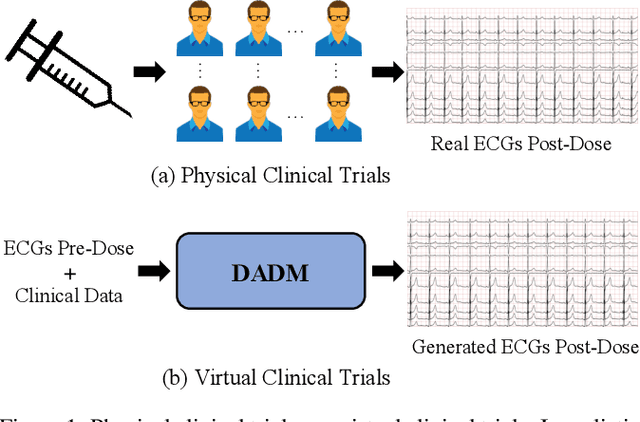
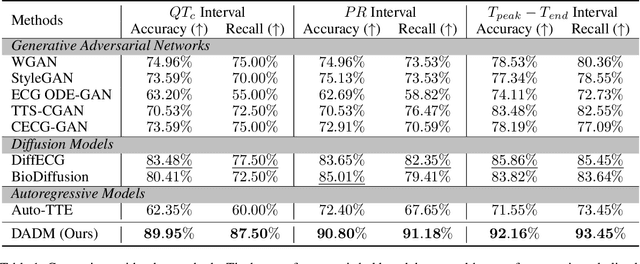
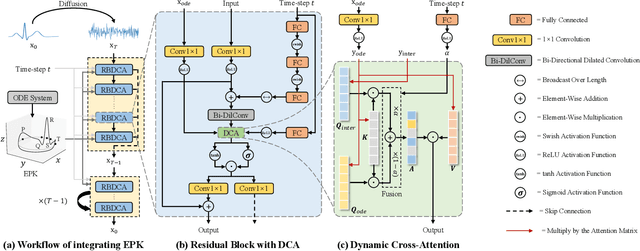
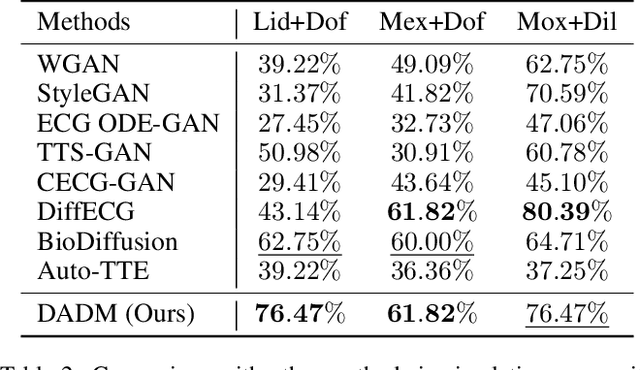
Clinical trials are pivotal in cardiac drug development, yet they often fail due to inadequate efficacy and unexpected safety issues, leading to significant financial losses. Using in-silico trials to replace a part of physical clinical trials, e.g., leveraging advanced generative models to generate drug-influenced electrocardiograms (ECGs), seems an effective method to reduce financial risk and potential harm to trial participants. While existing generative models have demonstrated progress in ECG generation, they fall short in modeling drug reactions due to limited fidelity and inability to capture individualized drug response patterns. In this paper, we propose a Drug-Aware Diffusion Model (DADM), which could simulate individualized drug reactions while ensuring fidelity. To ensure fidelity, we construct a set of ordinary differential equations to provide external physical knowledge (EPK) of the realistic ECG morphology. The EPK is used to adaptively constrain the morphology of the generated ECGs through a dynamic cross-attention (DCA) mechanism. Furthermore, we propose an extension of ControlNet to incorporate demographic and drug data, simulating individual drug reactions. We compare DADM with the other eight state-of-the-art ECG generative models on two real-world databases covering 8 types of drug regimens. The results demonstrate that DADM can more accurately simulate drug-induced changes in ECGs, improving the accuracy by at least 5.79% and recall by 8%.
Take Your Steps: Hierarchically Efficient Pulmonary Disease Screening via CT Volume Compression
Dec 03, 2024Deep learning models are widely used to process Computed Tomography (CT) data in the automated screening of pulmonary diseases, significantly reducing the workload of physicians. However, the three-dimensional nature of CT volumes involves an excessive number of voxels, which significantly increases the complexity of model processing. Previous screening approaches often overlook this issue, which undoubtedly reduces screening efficiency. Towards efficient and effective screening, we design a hierarchical approach to reduce the computational cost of pulmonary disease screening. The new approach re-organizes the screening workflows into three steps. First, we propose a Computed Tomography Volume Compression (CTVC) method to select a small slice subset that comprehensively represents the whole CT volume. Second, the selected CT slices are used to detect pulmonary diseases coarsely via a lightweight classification model. Third, an uncertainty measurement strategy is applied to identify samples with low diagnostic confidence, which are re-detected by radiologists. Experiments on two public pulmonary disease datasets demonstrate that our approach achieves comparable accuracy and recall while reducing the time by 50%-70% compared with the counterparts using full CT volumes. Besides, we also found that our approach outperforms previous cutting-edge CTVC methods in retaining important indications after compression.