 Add to Chrome
 Add to Firefox
 Add to Edge
Uplink Assisted Joint Channel Estimation and CSI Feedback: An Approach Based on Deep Joint Source-Channel Coding
Apr 15, 2025
In frequency division duplex (FDD) multiple-input multiple-output (MIMO) wireless communication systems, the acquisition of downlink channel state information (CSI) is essential for maximizing spatial resource utilization and improving system spectral efficiency. The separate design of modules in AI-based CSI feedback architectures under traditional modular communication frameworks, including channel estimation (CE), CSI compression and feedback, leads to sub-optimal performance. In this paper, we propose an uplink assisted joint CE and and CSI feedback approach via deep learning for downlink CSI acquisition, which mitigates performance degradation caused by distribution bias across separately trained modules in traditional modular communication frameworks. The proposed network adopts a deep joint source-channel coding (DJSCC) architecture to mitigate the cliff effect encountered in the conventional separate source-channel coding. Furthermore, we exploit the uplink CSI as auxiliary information to enhance CSI reconstruction accuracy by leveraging the partial reciprocity between the uplink and downlink channels in FDD systems, without introducing additional overhead. The effectiveness of uplink CSI as assisted information and the necessity of an end-toend multi-module joint training architecture is validated through comprehensive ablation and scalability experiments.

AutoStyle-TTS: Retrieval-Augmented Generation based Automatic Style Matching Text-to-Speech Synthesis
Apr 14, 2025With the advancement of speech synthesis technology, users have higher expectations for the naturalness and expressiveness of synthesized speech. But previous research ignores the importance of prompt selection. This study proposes a text-to-speech (TTS) framework based on Retrieval-Augmented Generation (RAG) technology, which can dynamically adjust the speech style according to the text content to achieve more natural and vivid communication effects. We have constructed a speech style knowledge database containing high-quality speech samples in various contexts and developed a style matching scheme. This scheme uses embeddings, extracted by Llama, PER-LLM-Embedder,and Moka, to match with samples in the knowledge database, selecting the most appropriate speech style for synthesis. Furthermore, our empirical research validates the effectiveness of the proposed method. Our demo can be viewed at: https://thuhcsi.github.io/icme2025-AutoStyle-TTS
MiMu: Mitigating Multiple Shortcut Learning Behavior of Transformers
Apr 14, 2025Empirical Risk Minimization (ERM) models often rely on spurious correlations between features and labels during the learning process, leading to shortcut learning behavior that undermines robustness generalization performance. Current research mainly targets identifying or mitigating a single shortcut; however, in real-world scenarios, cues within the data are diverse and unknown. In empirical studies, we reveal that the models rely to varying extents on different shortcuts. Compared to weak shortcuts, models depend more heavily on strong shortcuts, resulting in their poor generalization ability. To address these challenges, we propose MiMu, a novel method integrated with Transformer-based ERMs designed to Mitigate Multiple shortcut learning behavior, which incorporates self-calibration strategy and self-improvement strategy. In the source model, we preliminarily propose the self-calibration strategy to prevent the model from relying on shortcuts and make overconfident predictions. Then, we further design self-improvement strategy in target model to reduce the reliance on multiple shortcuts. The random mask strategy involves randomly masking partial attention positions to diversify the focus of target model other than concentrating on a fixed region. Meanwhile, the adaptive attention alignment module facilitates the alignment of attention weights to the calibrated source model, without the need for post-hoc attention maps or supervision. Finally, extensive experiments conducted on Natural Language Processing (NLP) and Computer Vision (CV) demonstrate the effectiveness of MiMu in improving robustness generalization abilities.
Decoupling Contrastive Decoding: Robust Hallucination Mitigation in Multimodal Large Language Models
Apr 09, 2025
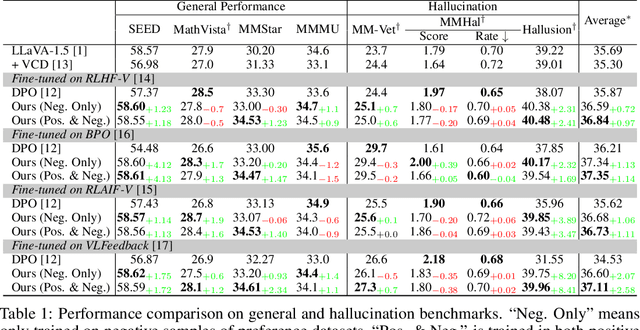
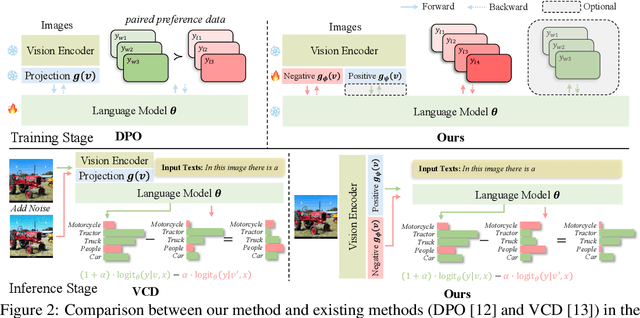
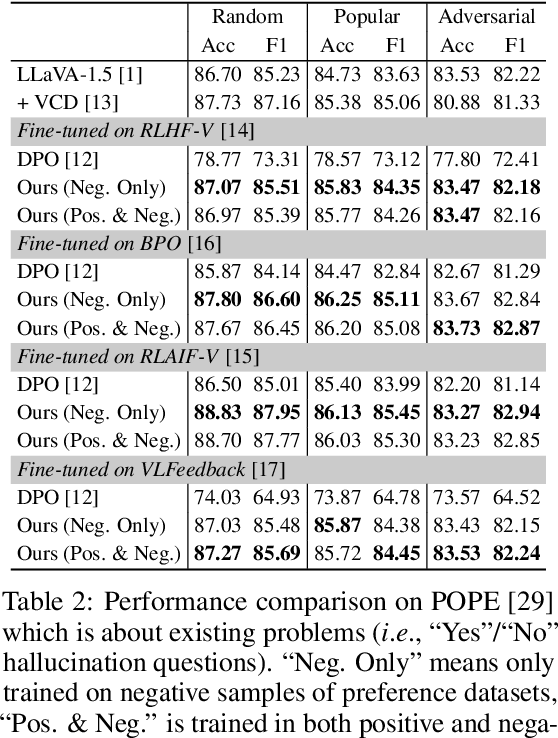
Although multimodal large language models (MLLMs) exhibit remarkable reasoning capabilities on complex multimodal understanding tasks, they still suffer from the notorious hallucination issue: generating outputs misaligned with obvious visual or factual evidence. Currently, training-based solutions, like direct preference optimization (DPO), leverage paired preference data to suppress hallucinations. However, they risk sacrificing general reasoning capabilities due to the likelihood displacement. Meanwhile, training-free solutions, like contrastive decoding, achieve this goal by subtracting the estimated hallucination pattern from a distorted input. Yet, these handcrafted perturbations (e.g., add noise to images) may poorly capture authentic hallucination patterns. To avoid these weaknesses of existing methods, and realize robust hallucination mitigation (i.e., maintaining general reasoning performance), we propose a novel framework: Decoupling Contrastive Decoding (DCD). Specifically, DCD decouples the learning of positive and negative samples in preference datasets, and trains separate positive and negative image projections within the MLLM. The negative projection implicitly models real hallucination patterns, which enables vision-aware negative images in the contrastive decoding inference stage. Our DCD alleviates likelihood displacement by avoiding pairwise optimization and generalizes robustly without handcrafted degradation. Extensive ablations across hallucination benchmarks and general reasoning tasks demonstrate the effectiveness of DCD, i.e., it matches DPO's hallucination suppression while preserving general capabilities and outperforms the handcrafted contrastive decoding methods.
Hyperbolic Diffusion Recommender Model
Apr 02, 2025Diffusion models (DMs) have emerged as the new state-of-the-art family of deep generative models. To gain deeper insights into the limitations of diffusion models in recommender systems, we investigate the fundamental structural disparities between images and items. Consequently, items often exhibit distinct anisotropic and directional structures that are less prevalent in images. However, the traditional forward diffusion process continuously adds isotropic Gaussian noise, causing anisotropic signals to degrade into noise, which impairs the semantically meaningful representations in recommender systems. Inspired by the advancements in hyperbolic spaces, we propose a novel \textit{\textbf{H}yperbolic} \textit{\textbf{D}iffusion} \textit{\textbf{R}ecommender} \textit{\textbf{M}odel} (named HDRM). Unlike existing directional diffusion methods based on Euclidean space, the intrinsic non-Euclidean structure of hyperbolic space makes it particularly well-adapted for handling anisotropic diffusion processes. In particular, we begin by formulating concepts to characterize latent directed diffusion processes within a geometrically grounded hyperbolic space. Subsequently, we propose a novel hyperbolic latent diffusion process specifically tailored for users and items. Drawing upon the natural geometric attributes of hyperbolic spaces, we impose structural restrictions on the space to enhance hyperbolic diffusion propagation, thereby ensuring the preservation of the intrinsic topology of user-item graphs. Extensive experiments on three benchmark datasets demonstrate the effectiveness of HDRM.
Extended Hybrid Zero Dynamics for Bipedal Walking of the Knee-less Robot SLIDER
Apr 01, 2025
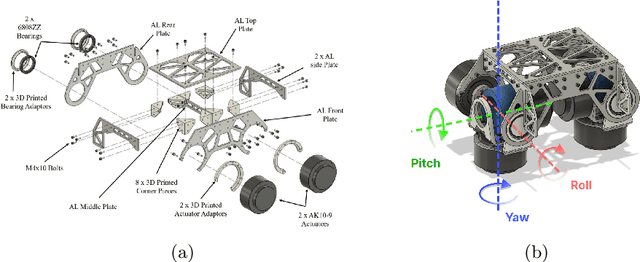
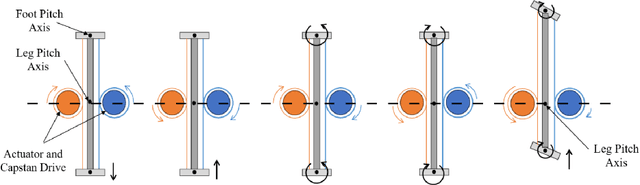
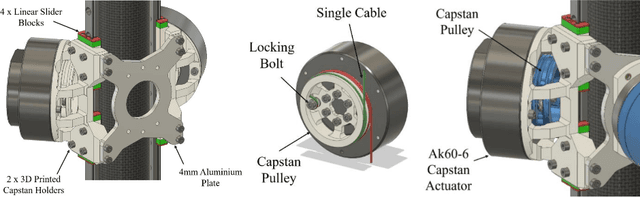
Knee-less bipedal robots like SLIDER have the advantage of ultra-lightweight legs and improved walking energy efficiency compared to traditional humanoid robots. In this paper, we firstly introduce an improved hardware design of the bipedal robot SLIDER with new line-feet and more optimized mass distribution which enables higher locomotion speeds. Secondly, we propose an extended Hybrid Zero Dynamics (eHZD) method, which can be applied to prismatic joint robots like SLIDER. The eHZD method is then used to generate a library of gaits with varying reference velocities in an offline way. Thirdly, a Guided Deep Reinforcement Learning (DRL) algorithm is proposed to use the pre-generated library to create walking control policies in real-time. This approach allows us to combine the advantages of both HZD (for generating stable gaits with a full-dynamics model) and DRL (for real-time adaptive gait generation). The experimental results show that this approach achieves 150% higher walking velocity than the previous MPC-based approach.
Bridging Social Psychology and LLM Reasoning: Conflict-Aware Meta-Review Generation via Cognitive Alignment
Mar 21, 2025The rapid growth of scholarly submissions has overwhelmed traditional peer review systems, driving the need for intelligent automation to preserve scientific rigor. While large language models (LLMs) show promise in automating manuscript critiques, their ability to synthesize high-stakes meta-reviews, which require conflict-aware reasoning and consensus derivation, remains underdeveloped. Existing methods fail to effectively handle conflicting viewpoints within differing opinions, and often introduce additional cognitive biases, such as anchoring effects and conformity bias.To overcome these limitations, we propose the Cognitive Alignment Framework (CAF), a dual-process architecture that transforms LLMs into adaptive scientific arbitrators. By operationalizing Kahneman's dual-process theory, CAF introduces a three-step cognitive pipeline: review initialization, incremental integration, and cognitive alignment.Empirical validation shows that CAF outperforms existing LLM-based methods, with sentiment consistency gains reaching up to 19.47\% and content consistency improving by as much as 12.95\%.
Scalable Trajectory-User Linking with Dual-Stream Representation Networks
Mar 19, 2025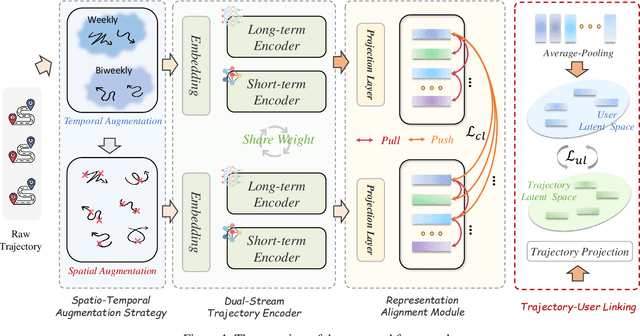
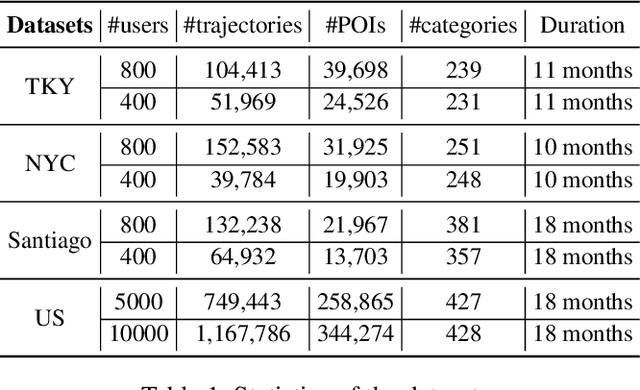
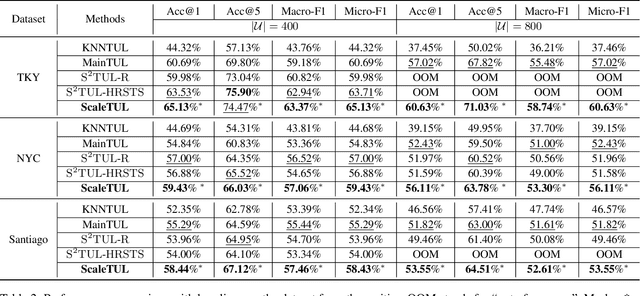
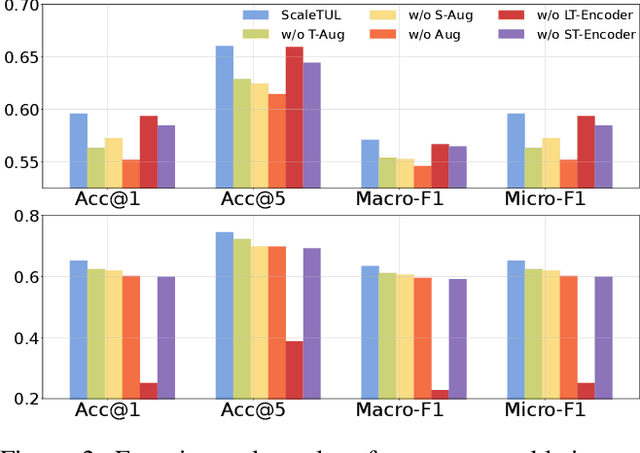
Trajectory-user linking (TUL) aims to match anonymous trajectories to the most likely users who generated them, offering benefits for a wide range of real-world spatio-temporal applications. However, existing TUL methods are limited by high model complexity and poor learning of the effective representations of trajectories, rendering them ineffective in handling large-scale user trajectory data. In this work, we propose a novel $\underline{Scal}$abl$\underline{e}$ Trajectory-User Linking with dual-stream representation networks for large-scale $\underline{TUL}$ problem, named ScaleTUL. Specifically, ScaleTUL generates two views using temporal and spatial augmentations to exploit supervised contrastive learning framework to effectively capture the irregularities of trajectories. In each view, a dual-stream trajectory encoder, consisting of a long-term encoder and a short-term encoder, is designed to learn unified trajectory representations that fuse different temporal-spatial dependencies. Then, a TUL layer is used to associate the trajectories with the corresponding users in the representation space using a two-stage training model. Experimental results on check-in mobility datasets from three real-world cities and the nationwide U.S. demonstrate the superiority of ScaleTUL over state-of-the-art baselines for large-scale TUL tasks.
Growing a Twig to Accelerate Large Vision-Language Models
Mar 18, 2025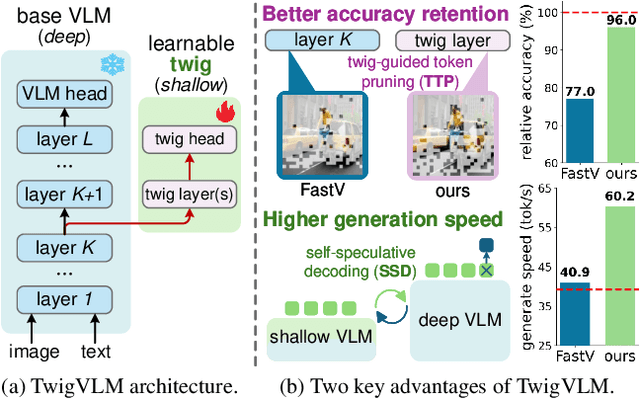
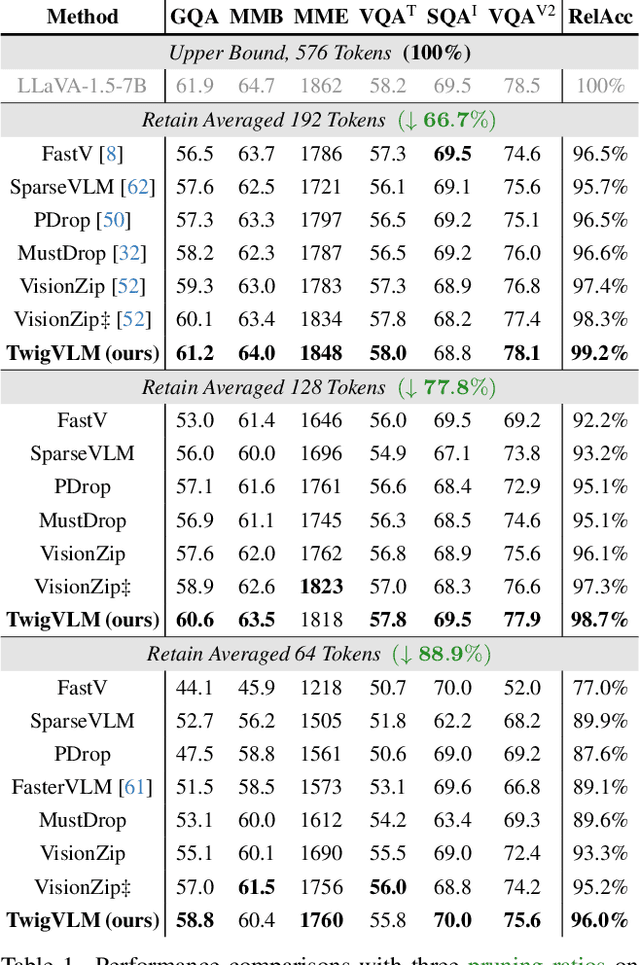
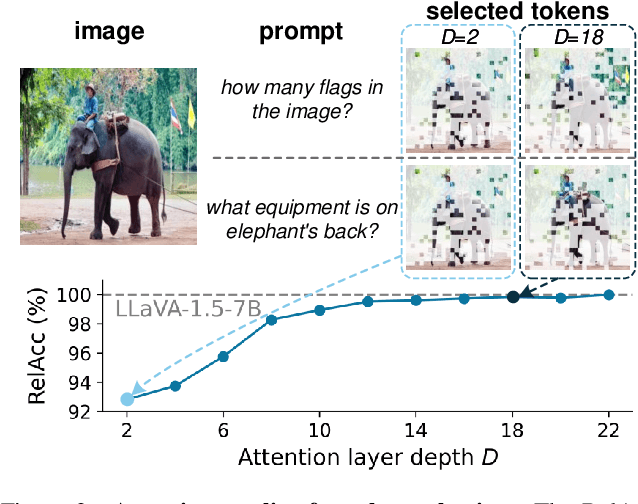
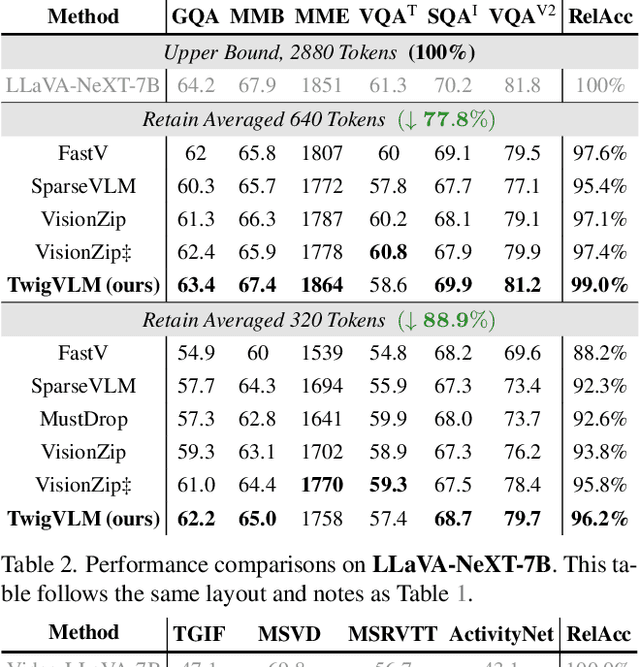
Large vision-language models (VLMs) have demonstrated remarkable capabilities in open-world multimodal understanding, yet their high computational overheads pose great challenges for practical deployment. Some recent works have proposed methods to accelerate VLMs by pruning redundant visual tokens guided by the attention maps of VLM's early layers. Despite the success of these token pruning methods, they still suffer from two major shortcomings: (i) considerable accuracy drop due to insensitive attention signals in early layers, and (ii) limited speedup when generating long responses (e.g., 30 tokens). To address the limitations above, we present TwigVLM -- a simple and general architecture by growing a lightweight twig upon an early layer of the base VLM. Compared with most existing VLM acceleration methods purely based on visual token pruning, our TwigVLM not only achieves better accuracy retention by employing a twig-guided token pruning (TTP) strategy, but also yields higher generation speed by utilizing a self-speculative decoding (SSD) strategy. Taking LLaVA-1.5-7B as the base VLM, experimental results show that TwigVLM preserves 96% of the original performance after pruning 88.9% of visual tokens and achieves 154% speedup in generating long responses, delivering significantly better performance in terms of both accuracy and speed over the state-of-the-art VLM acceleration methods. Code will be made publicly available.
Adams Bashforth Moulton Solver for Inversion and Editing in Rectified Flow
Mar 17, 2025Rectified flow models have achieved remarkable performance in image and video generation tasks. However, existing numerical solvers face a trade-off between fast sampling and high-accuracy solutions, limiting their effectiveness in downstream applications such as reconstruction and editing. To address this challenge, we propose leveraging the Adams-Bashforth-Moulton (ABM) predictor-corrector method to enhance the accuracy of ODE solving in rectified flow models. Specifically, we introduce ABM-Solver, which integrates a multi step predictor corrector approach to reduce local truncation errors and employs Adaptive Step Size Adjustment to improve sampling speed. Furthermore, to effectively preserve non edited regions while facilitating semantic modifications, we introduce a Mask Guided Feature Injection module. We estimate self-similarity to generate a spatial mask that differentiates preserved regions from those available for editing. Extensive experiments on multiple high-resolution image datasets validate that ABM-Solver significantly improves inversion precision and editing quality, outperforming existing solvers without requiring additional training or optimization.