 Add to Chrome
 Add to Firefox
 Add to Edge
DepthMaster: Unified Monocular Depth Estimation for Perspective and Panoramic Images
Jun 11, 2026
While monocular depth estimation has achieved significant progress, achieving generalized metric depth estimation for both narrow field-of-view (FoV) perspectives and $360^\circ$ panoramas remains an unsolved challenge. Existing methods are often tailored to specific camera types and struggle to produce accurate metric depth that generalizes across diverse settings. This limitation stems from two key challenges: the inherent geometric discrepancy between perspective and panoramic cameras, and the scarcity of panoramic training data with metric annotations. In this work, we introduce DepthMaster, a unified metric depth estimation framework. Rather than employing specialized networks to learn spherical distortions, we reformulate the problem by decomposing panoramic images into overlapping perspective patches. Crucially, distinct from prior projection-based methods that rely on ad-hoc architectural modifications to handle boundaries, we introduce a novel Correspondence Consistency Loss (CCL) and inject virtual projection cameras as geometric priors, allowing us to seamlessly stitch the patches while avoiding specialized operators and keeping the backbone largely compatible with standard Transformer designs. This strategy also resolves the geometric differences by unifying all inputs into a canonical perspective representation, and effectively circumvents data scarcity by directly unlocking powerful metric priors from vast perspective datasets. Trained on a mixed dataset that contains only one panorama dataset, DepthMaster achieves state-of-the-art zero-shot performance on 13 diverse datasets, outperforming not only universal methods but also leading specialist models in both perspective and panoramic domains.

OmniCamera: A Unified Framework for Multi-task Video Generation with Arbitrary Camera Control
Apr 07, 2026Video fundamentally intertwines two crucial axes: the dynamic content of a scene and the camera motion through which it is observed. However, existing generation models often entangle these factors, limiting independent control. In this work, we introduce OmniCamera, a unified framework designed to explicitly disentangle and command these two dimensions. This compositional approach enables flexible video generation by allowing arbitrary pairings of camera and content conditions, unlocking unprecedented creative control. To overcome the fundamental challenges of modality conflict and data scarcity inherent in such a system, we present two key innovations. First, we construct OmniCAM, a novel hybrid dataset combining curated real-world videos with synthetic data that provides diverse paired examples for robust multi-task learning. Second, we propose a Dual-level Curriculum Co-Training strategy that mitigates modality interference and synergistically learns from diverse data sources. This strategy operates on two levels: first, it progressively introduces control modalities by difficulties (condition-level), and second, trains for precise control on synthetic data before adapting to real data for photorealism (data-level). As a result, OmniCamera achieves state-of-the-art performance, enabling flexible control for complex camera movements while maintaining superior visual quality.
Aligning Large Language Models with Searcher Preferences
Mar 11, 2026The paradigm shift from item-centric ranking to answer-centric synthesis is redefining the role of search engines. While recent industrial progress has applied generative techniques to closed-set item ranking in e-commerce, research and deployment of open-ended generative search on large content platforms remain limited. This setting introduces challenges, including robustness to noisy retrieval, non-negotiable safety guarantees, and alignment with diverse user needs. In this work, we introduce SearchLLM, the first large language model (LLM) for open-ended generative search. We design a hierarchical, multi-dimensional reward system that separates bottom-line constraints, including factual grounding, basic answer quality and format compliance, from behavior optimization objectives that promote robustness to noisy retrieval and alignment with user needs. Concretely, our reward model evaluates responses conditioned on the user query, session history, and retrieved evidence set, combining rule-based checks with human-calibrated LLM judges to produce an interpretable score vector over these dimensions. We introduce a Gated Aggregation Strategy to derive the training reward for optimizing SearchLLM with Group Relative Policy Optimization (GRPO). We deploy SearchLLM in the AI search entry of RedNote. Offline evaluations and online A/B tests show improved generation quality and user engagement, increasing Valid Consumption Rate by 1.03% and reducing Re-search Rate by 2.81%, while upholding strict safety and reliability standards.
One2Scene: Geometric Consistent Explorable 3D Scene Generation from a Single Image
Feb 23, 2026Generating explorable 3D scenes from a single image is a highly challenging problem in 3D vision. Existing methods struggle to support free exploration, often producing severe geometric distortions and noisy artifacts when the viewpoint moves far from the original perspective. We introduce \textbf{One2Scene}, an effective framework that decomposes this ill-posed problem into three tractable sub-tasks to enable immersive explorable scene generation. We first use a panorama generator to produce anchor views from a single input image as initialization. Then, we lift these 2D anchors into an explicit 3D geometric scaffold via a generalizable, feed-forward Gaussian Splatting network. Instead of treating the panorama as a single image for reconstruction, we project it into multiple sparse anchor views and reformulate the reconstruction task as multi-view stereo matching, which allows us to leverage robust geometric priors learned from large-scale multi-view datasets. A bidirectional feature fusion module is used to enforce cross-view consistency, yielding an efficient and geometrically reliable scaffold. Finally, the scaffold serves as a strong prior for a novel view generator to produce photorealistic and geometrically accurate views at arbitrary cameras. By explicitly conditioning on a 3D-consistent scaffold to perform reconstruction, One2Scene works stably under large camera motions, supporting immersive scene exploration. Extensive experiments show that One2Scene substantially outperforms state-of-the-art methods in panorama depth estimation, feed-forward 360° reconstruction, and explorable 3D scene generation. Code and models will be released.
CoCoEdit: Content-Consistent Image Editing via Region Regularized Reinforcement Learning
Feb 15, 2026Image editing has achieved impressive results with the development of large-scale generative models. However, existing models mainly focus on the editing effects of intended objects and regions, often leading to unwanted changes in unintended regions. We present a post-training framework for Content-Consistent Editing (CoCoEdit) via region regularized reinforcement learning. We first augment existing editing datasets with refined instructions and masks, from which 40K diverse and high quality samples are curated as training set. We then introduce a pixel-level similarity reward to complement MLLM-based rewards, enabling models to ensure both editing quality and content consistency during the editing process. To overcome the spatial-agnostic nature of the rewards, we propose a region-based regularizer, aiming to preserve non-edited regions for high-reward samples while encouraging editing effects for low-reward samples. For evaluation, we annotate editing masks for GEdit-Bench and ImgEdit-Bench, introducing pixel-level similarity metrics to measure content consistency and editing quality. Applying CoCoEdit to Qwen-Image-Edit and FLUX-Kontext, we achieve not only competitive editing scores with state-of-the-art models, but also significantly better content consistency, measured by PSNR/SSIM metrics and human subjective ratings.
Anti-Length Shift: Dynamic Outlier Truncation for Training Efficient Reasoning Models
Jan 07, 2026Large reasoning models enhanced by reinforcement learning with verifiable rewards have achieved significant performance gains by extending their chain-of-thought. However, this paradigm incurs substantial deployment costs as models often exhibit excessive verbosity on simple queries. Existing efficient reasoning methods relying on explicit length penalties often introduce optimization conflicts and leave the generative mechanisms driving overthinking largely unexamined. In this paper, we identify a phenomenon termed length shift where models increasingly generate unnecessary reasoning on trivial inputs during training. To address this, we introduce Dynamic Outlier Truncation (DOT), a training-time intervention that selectively suppresses redundant tokens. This method targets only the extreme tail of response lengths within fully correct rollout groups while preserving long-horizon reasoning capabilities for complex problems. To complement this intervention and ensure stable convergence, we further incorporate auxiliary KL regularization and predictive dynamic sampling. Experimental results across multiple model scales demonstrate that our approach significantly pushes the efficiency-performance Pareto frontier outward. Notably, on the AIME-24, our method reduces inference token usage by 78% while simultaneously increasing accuracy compared to the initial policy and surpassing state-of-the-art efficient reasoning methods.
MiMu: Mitigating Multiple Shortcut Learning Behavior of Transformers
Apr 14, 2025Empirical Risk Minimization (ERM) models often rely on spurious correlations between features and labels during the learning process, leading to shortcut learning behavior that undermines robustness generalization performance. Current research mainly targets identifying or mitigating a single shortcut; however, in real-world scenarios, cues within the data are diverse and unknown. In empirical studies, we reveal that the models rely to varying extents on different shortcuts. Compared to weak shortcuts, models depend more heavily on strong shortcuts, resulting in their poor generalization ability. To address these challenges, we propose MiMu, a novel method integrated with Transformer-based ERMs designed to Mitigate Multiple shortcut learning behavior, which incorporates self-calibration strategy and self-improvement strategy. In the source model, we preliminarily propose the self-calibration strategy to prevent the model from relying on shortcuts and make overconfident predictions. Then, we further design self-improvement strategy in target model to reduce the reliance on multiple shortcuts. The random mask strategy involves randomly masking partial attention positions to diversify the focus of target model other than concentrating on a fixed region. Meanwhile, the adaptive attention alignment module facilitates the alignment of attention weights to the calibrated source model, without the need for post-hoc attention maps or supervision. Finally, extensive experiments conducted on Natural Language Processing (NLP) and Computer Vision (CV) demonstrate the effectiveness of MiMu in improving robustness generalization abilities.
InsViE-1M: Effective Instruction-based Video Editing with Elaborate Dataset Construction
Mar 26, 2025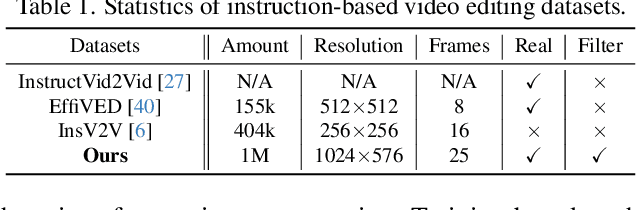
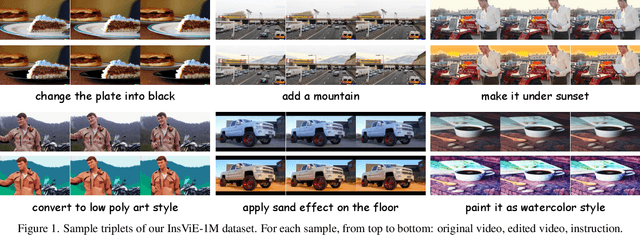
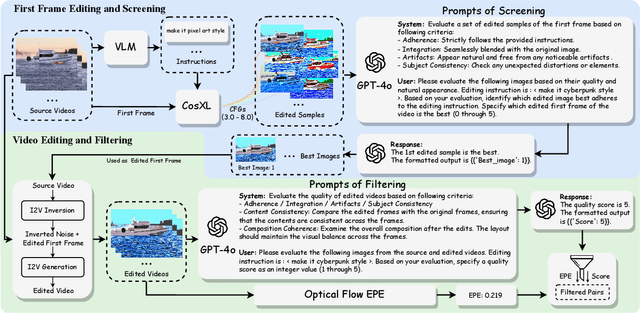
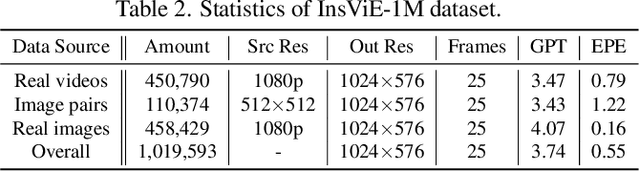
Instruction-based video editing allows effective and interactive editing of videos using only instructions without extra inputs such as masks or attributes. However, collecting high-quality training triplets (source video, edited video, instruction) is a challenging task. Existing datasets mostly consist of low-resolution, short duration, and limited amount of source videos with unsatisfactory editing quality, limiting the performance of trained editing models. In this work, we present a high-quality Instruction-based Video Editing dataset with 1M triplets, namely InsViE-1M. We first curate high-resolution and high-quality source videos and images, then design an effective editing-filtering pipeline to construct high-quality editing triplets for model training. For a source video, we generate multiple edited samples of its first frame with different intensities of classifier-free guidance, which are automatically filtered by GPT-4o with carefully crafted guidelines. The edited first frame is propagated to subsequent frames to produce the edited video, followed by another round of filtering for frame quality and motion evaluation. We also generate and filter a variety of video editing triplets from high-quality images. With the InsViE-1M dataset, we propose a multi-stage learning strategy to train our InsViE model, progressively enhancing its instruction following and editing ability. Extensive experiments demonstrate the advantages of our InsViE-1M dataset and the trained model over state-of-the-art works. Codes are available at InsViE.
Hierarchical Time-Aware Mixture of Experts for Multi-Modal Sequential Recommendation
Jan 24, 2025Multi-modal sequential recommendation (SR) leverages multi-modal data to learn more comprehensive item features and user preferences than traditional SR methods, which has become a critical topic in both academia and industry. Existing methods typically focus on enhancing multi-modal information utility through adaptive modality fusion to capture the evolving of user preference from user-item interaction sequences. However, most of them overlook the interference caused by redundant interest-irrelevant information contained in rich multi-modal data. Additionally, they primarily rely on implicit temporal information based solely on chronological ordering, neglecting explicit temporal signals that could more effectively represent dynamic user interest over time. To address these limitations, we propose a Hierarchical time-aware Mixture of experts for multi-modal Sequential Recommendation (HM4SR) with a two-level Mixture of Experts (MoE) and a multi-task learning strategy. Specifically, the first MoE, named Interactive MoE, extracts essential user interest-related information from the multi-modal data of each item. Then, the second MoE, termed Temporal MoE, captures user dynamic interests by introducing explicit temporal embeddings from timestamps in modality encoding. To further address data sparsity, we propose three auxiliary supervision tasks: sequence-level category prediction (CP) for item feature understanding, contrastive learning on ID (IDCL) to align sequence context with user interests, and placeholder contrastive learning (PCL) to integrate temporal information with modalities for dynamic interest modeling. Extensive experiments on four public datasets verify the effectiveness of HM4SR compared to several state-of-the-art approaches.
Generalized and Efficient 2D Gaussian Splatting for Arbitrary-scale Super-Resolution
Jan 14, 2025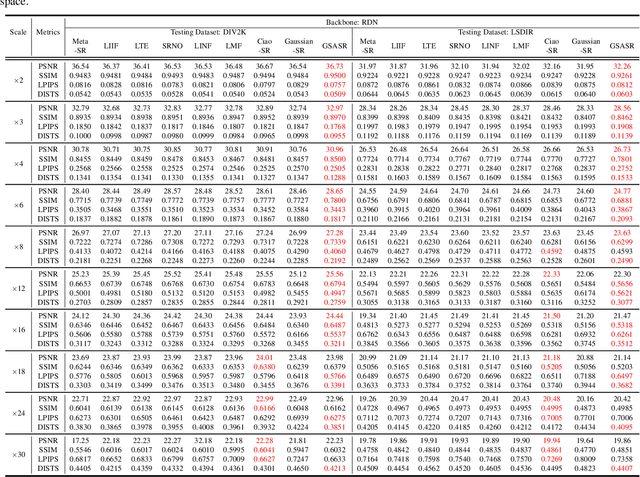
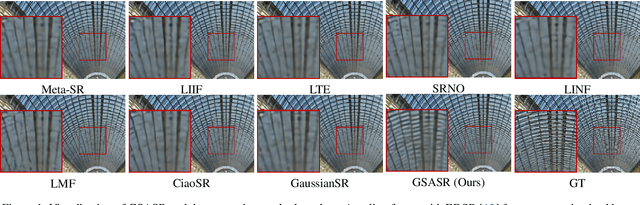
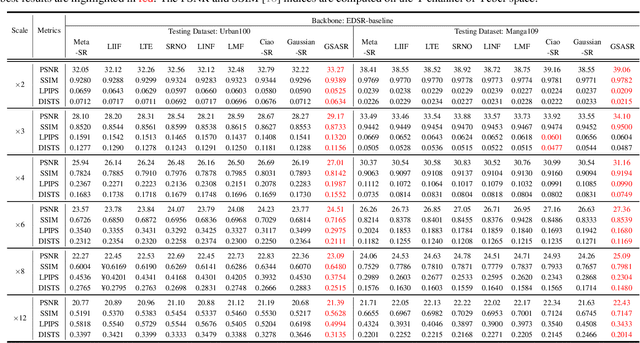
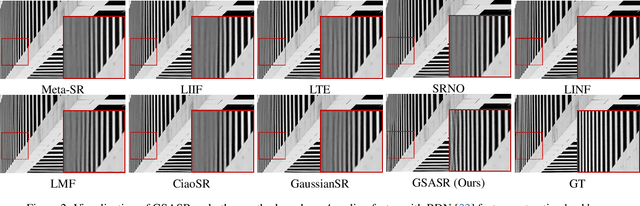
Equipped with the continuous representation capability of Multi-Layer Perceptron (MLP), Implicit Neural Representation (INR) has been successfully employed for Arbitrary-scale Super-Resolution (ASR). However, the limited receptive field of the linear layers in MLP restricts the representation capability of INR, while it is computationally expensive to query the MLP numerous times to render each pixel. Recently, Gaussian Splatting (GS) has shown its advantages over INR in both visual quality and rendering speed in 3D tasks, which motivates us to explore whether GS can be employed for the ASR task. However, directly applying GS to ASR is exceptionally challenging because the original GS is an optimization-based method through overfitting each single scene, while in ASR we aim to learn a single model that can generalize to different images and scaling factors. We overcome these challenges by developing two novel techniques. Firstly, to generalize GS for ASR, we elaborately design an architecture to predict the corresponding image-conditioned Gaussians of the input low-resolution image in a feed-forward manner. Secondly, we implement an efficient differentiable 2D GPU/CUDA-based scale-aware rasterization to render super-resolved images by sampling discrete RGB values from the predicted contiguous Gaussians. Via end-to-end training, our optimized network, namely GSASR, can perform ASR for any image and unseen scaling factors. Extensive experiments validate the effectiveness of our proposed method. The project page can be found at \url{https://mt-cly.github.io/GSASR.github.io/}.