 Add to Chrome
 Add to Firefox
 Add to Edge
ProCeedRL: Process Critic with Exploratory Demonstration Reinforcement Learning for LLM Agentic Reasoning
Apr 02, 2026
Reinforcement Learning (RL) significantly enhances the reasoning abilities of large language models (LLMs), yet applying it to multi-turn agentic tasks remains challenging due to the long-horizon nature of interactions and the stochasticity of environmental feedback. We identify a structural failure mode in agentic exploration: suboptimal actions elicit noisy observations into misleading contexts, which further weaken subsequent decision-making, making recovery increasingly difficult. This cumulative feedback loop of errors renders standard exploration strategies ineffective and susceptible to the model's reasoning and the environment's randomness. To mitigate this issue, we propose ProCeedRL: Process Critic with Explorative Demonstration RL, shifting exploration from passive selection to active intervention. ProCeedRL employs a process-level critic to monitor interactions in real time, incorporating reflection-based demonstrations to guide agents in stopping the accumulation of errors. We find that this approach significantly exceeds the model's saturated exploration performance, demonstrating substantial exploratory benefits. By learning from exploratory demonstrations and on-policy samples, ProCeedRL significantly improves exploration efficiency and achieves superior performance on complex deep search and embodied tasks.

Learning Bimanual Cloth Manipulation with Vision-based Tactile Sensing via Single Robotic Arm
Mar 11, 2026Robotic cloth manipulation remains challenging due to the high-dimensional state space of fabrics, their deformable nature, and frequent occlusions that limit vision-based sensing. Although dual-arm systems can mitigate some of these issues, they increase hardware and control complexity. This paper presents Touch G.O.G., a compact vision-based tactile gripper and perception/control framework for single-arm bimanual cloth manipulation. The proposed framework combines three key components: (1) a novel gripper design and control strategy for in-gripper cloth sliding with a single robot arm, (2) a Vision Foundation Model-backboned Vision Transformer pipeline for cloth part classification (PC-Net) and edge pose estimation (PE-Net) using real and synthetic tactile images, and (3) an encoder-decoder synthetic data generator (SD-Net) that reduces manual annotation by producing high-fidelity tactile images. Experiments show 96% accuracy in distinguishing edges, corners, interior regions, and grasp failures, together with sub-millimeter edge localization and 4.5° orientation error. Real-world results demonstrate reliable cloth unfolding, even for crumpled fabrics, using only a single robotic arm. These results highlight Touch G.O.G. as a compact and cost-effective solution for deformable object manipulation.
Extended Hybrid Zero Dynamics for Bipedal Walking of the Knee-less Robot SLIDER
Apr 01, 2025
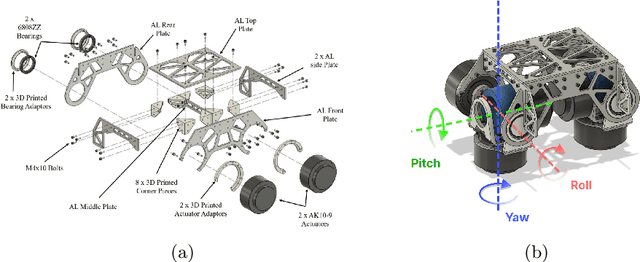
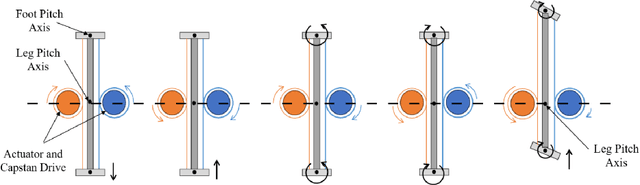
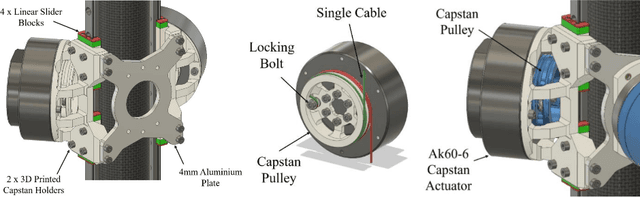
Knee-less bipedal robots like SLIDER have the advantage of ultra-lightweight legs and improved walking energy efficiency compared to traditional humanoid robots. In this paper, we firstly introduce an improved hardware design of the bipedal robot SLIDER with new line-feet and more optimized mass distribution which enables higher locomotion speeds. Secondly, we propose an extended Hybrid Zero Dynamics (eHZD) method, which can be applied to prismatic joint robots like SLIDER. The eHZD method is then used to generate a library of gaits with varying reference velocities in an offline way. Thirdly, a Guided Deep Reinforcement Learning (DRL) algorithm is proposed to use the pre-generated library to create walking control policies in real-time. This approach allows us to combine the advantages of both HZD (for generating stable gaits with a full-dynamics model) and DRL (for real-time adaptive gait generation). The experimental results show that this approach achieves 150% higher walking velocity than the previous MPC-based approach.
A Backbone for Long-Horizon Robot Task Understanding
Aug 07, 2024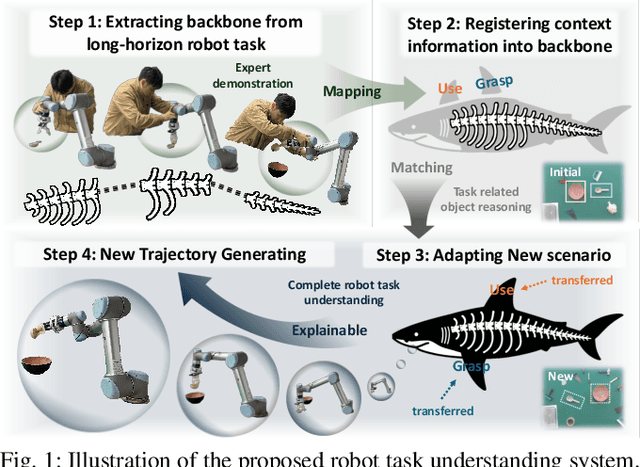
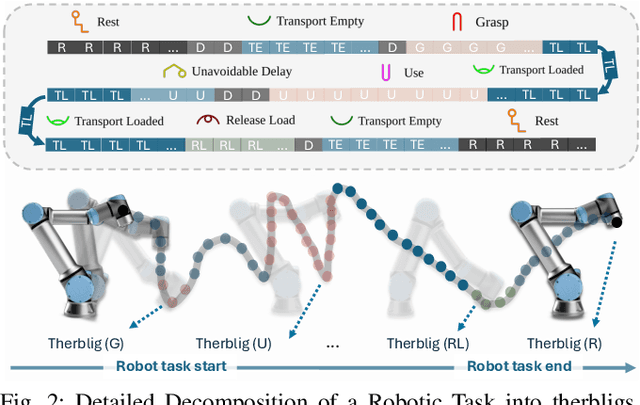
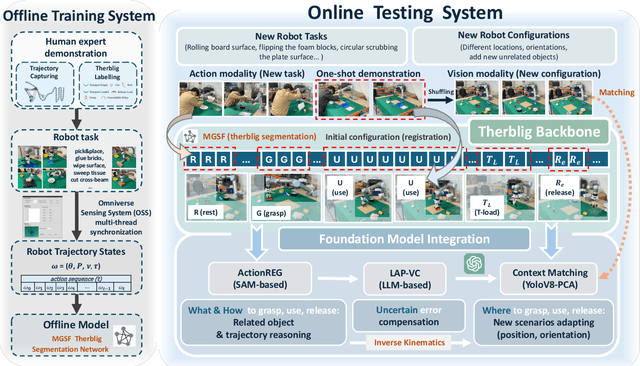
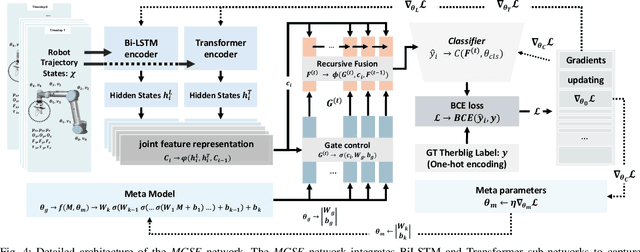
End-to-end robot learning, particularly for long-horizon tasks, often results in unpredictable outcomes and poor generalization. To address these challenges, we propose a novel Therblig-based Backbone Framework (TBBF) to enhance robot task understanding and transferability. This framework uses therbligs (basic action elements) as the backbone to decompose high-level robot tasks into elemental robot configurations, which are then integrated with current foundation models to improve task understanding. The approach consists of two stages: offline training and online testing. During the offline training stage, we developed the Meta-RGate SynerFusion (MGSF) network for accurate therblig segmentation across various tasks. In the online testing stage, after a one-shot demonstration of a new task is collected, our MGSF network extracts high-level knowledge, which is then encoded into the image using Action Registration (ActionREG). Additionally, the Large Language Model (LLM)-Alignment Policy for Visual Correction (LAP-VC) is employed to ensure precise action execution, facilitating trajectory transfer in novel robot scenarios. Experimental results validate these methods, achieving 94.37% recall in therblig segmentation and success rates of 94.4% and 80% in real-world online robot testing for simple and complex scenarios, respectively. Supplementary material is available at: https://sites.google.com/view/therbligsbasedbackbone/home
G.O.G: A Versatile Gripper-On-Gripper Design for Bimanual Cloth Manipulation with a Single Robotic Arm
Jan 19, 2024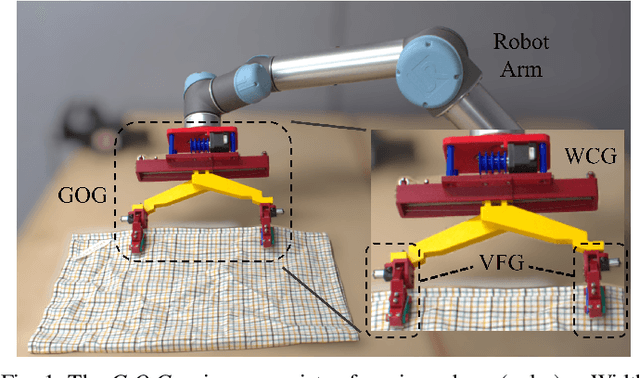
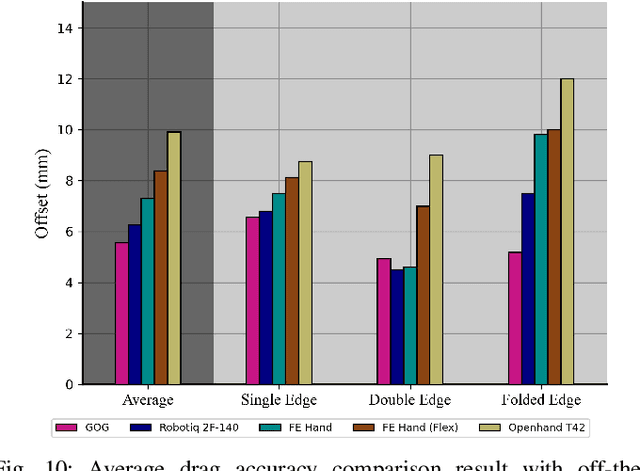
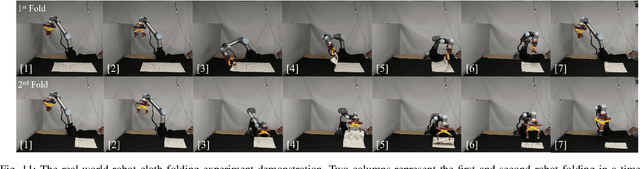
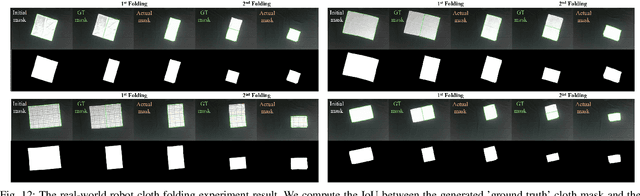
The manipulation of garments poses research challenges due to their deformable nature and the extensive variability in shapes and sizes. Despite numerous attempts by researchers to address these via approaches involving robot perception and control, there has been a relatively limited interest in resolving it through the co-development of robot hardware. Consequently, the majority of studies employ off-the-shelf grippers in conjunction with dual robot arms to enable bimanual manipulation and high dexterity. However, this dual-arm system increases the overall cost of the robotic system as well as its control complexity in order to tackle robot collisions and other robot coordination issues. As an alternative approach, we propose to enable bimanual cloth manipulation using a single robot arm via novel end effector design -- sharing dexterity skills between manipulator and gripper rather than relying entirely on robot arm coordination. To this end, we introduce a new gripper, called G.O.G., based on a gripper-on-gripper structure where the first gripper independently regulates the span, up to 500mm, between its fingers which are in turn also grippers. These finger grippers consist of a variable friction module that enables two grasping modes: firm and sliding grasps. Household item and cloth object benchmarks are employed to evaluate the performance of the proposed design, encompassing both experiments on the gripper design itself and on cloth manipulation. Experimental results demonstrate the potential of the introduced ideas to undertake a range of bimanual cloth manipulation tasks with a single robot arm. Supplementary material is available at https://sites.google.com/view/gripperongripper.
* Accepted for IEEE Robotics and Automation Letters in January 2024. Dongmyoung Lee and Wei Chen contributed equally to this research
TencentPretrain: A Scalable and Flexible Toolkit for Pre-training Models of Different Modalities
Dec 13, 2022
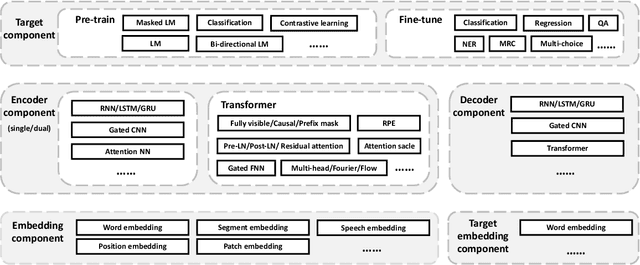

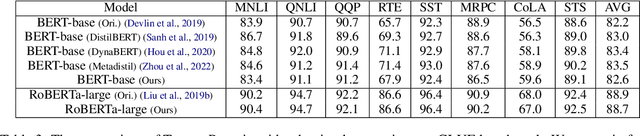
Recently, the success of pre-training in text domain has been fully extended to vision, audio, and cross-modal scenarios. The proposed pre-training models of different modalities are showing a rising trend of homogeneity in their model structures, which brings the opportunity to implement different pre-training models within a uniform framework. In this paper, we present TencentPretrain, a toolkit supporting pre-training models of different modalities. The core feature of TencentPretrain is the modular design. The toolkit uniformly divides pre-training models into 5 components: embedding, encoder, target embedding, decoder, and target. As almost all of common modules are provided in each component, users can choose the desired modules from different components to build a complete pre-training model. The modular design enables users to efficiently reproduce existing pre-training models or build brand-new one. We test the toolkit on text, vision, and audio benchmarks and show that it can match the performance of the original implementations.