 Add to Chrome
 Add to Firefox
 Add to Edge
T-GINEE: A Tensor-Based Multilayer Graph Representation Learning
May 27, 2026
Traditional network analysis focuses on single-layer networks, real-world systems often form multilayer networks with multiple relationship types. However, existing methods typically fail to capture complex inter-layer dependencies by treating layers independently or aggregating them. To address this, we propose T-GINEE (Tensor-Based Generalized Multilayer-graph Estimating Equation), a statistical regularization framework combining tensor-based generalized estimating equations with task-specific loss to model cross-network correlations explicitly. Key innovations include: (1) CP tensor decomposition capturing structural dependencies via shared latent factors; (2) a generalized estimating equation framework modeling inter-layer correlations through working covariance matrices; and (3) a flexible link function accommodating characteristics like sparsity. Our theoretical analysis establishes consistency and asymptotic normality under mild conditions. Extensive experiments on synthetic and real-world datasets validate T-GINEE's effectiveness for multilayer network analysis.

Hyperbolic Diffusion Recommender Model
Apr 02, 2025Diffusion models (DMs) have emerged as the new state-of-the-art family of deep generative models. To gain deeper insights into the limitations of diffusion models in recommender systems, we investigate the fundamental structural disparities between images and items. Consequently, items often exhibit distinct anisotropic and directional structures that are less prevalent in images. However, the traditional forward diffusion process continuously adds isotropic Gaussian noise, causing anisotropic signals to degrade into noise, which impairs the semantically meaningful representations in recommender systems. Inspired by the advancements in hyperbolic spaces, we propose a novel \textit{\textbf{H}yperbolic} \textit{\textbf{D}iffusion} \textit{\textbf{R}ecommender} \textit{\textbf{M}odel} (named HDRM). Unlike existing directional diffusion methods based on Euclidean space, the intrinsic non-Euclidean structure of hyperbolic space makes it particularly well-adapted for handling anisotropic diffusion processes. In particular, we begin by formulating concepts to characterize latent directed diffusion processes within a geometrically grounded hyperbolic space. Subsequently, we propose a novel hyperbolic latent diffusion process specifically tailored for users and items. Drawing upon the natural geometric attributes of hyperbolic spaces, we impose structural restrictions on the space to enhance hyperbolic diffusion propagation, thereby ensuring the preservation of the intrinsic topology of user-item graphs. Extensive experiments on three benchmark datasets demonstrate the effectiveness of HDRM.
Multimodal Recommender Systems: A Survey
Feb 08, 2023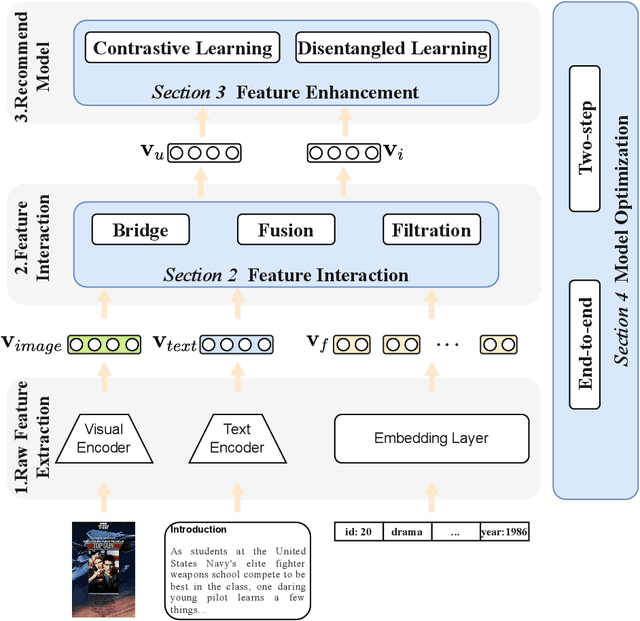
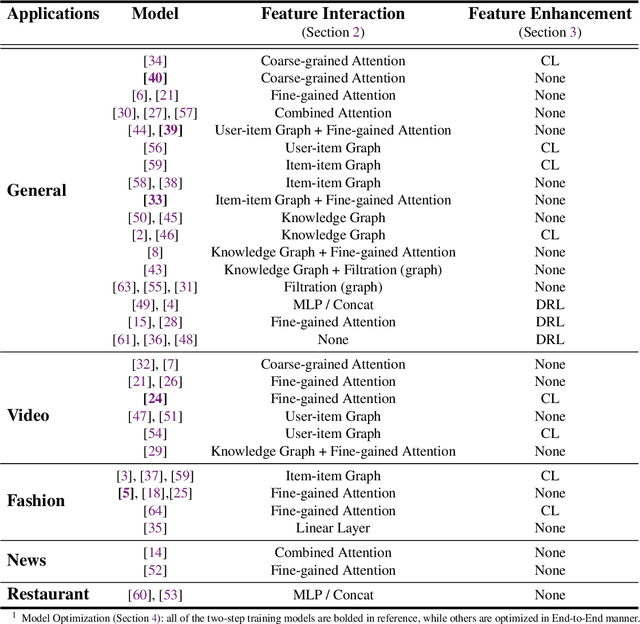
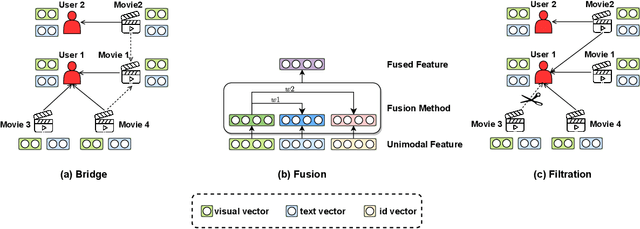
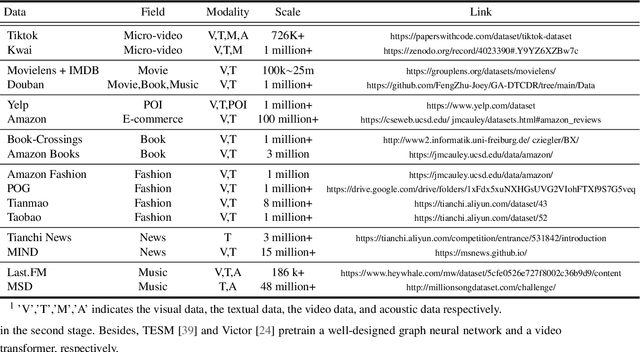
The recommender system (RS) has been an integral toolkit of online services. They are equipped with various deep learning techniques to model user preference based on identifier and attribute information. With the emergence of multimedia services, such as short video, news and etc., understanding these contents while recommending becomes critical. Besides, multimodal features are also helpful in alleviating the problem of data sparsity in RS. Thus, Multimodal Recommender System (MRS) has attracted much attention from both academia and industry recently. In this paper, we will give a comprehensive survey of the MRS models, mainly from technical views. First, we conclude the general procedures and major challenges for MRS. Then, we introduce the existing MRS models according to three categories, i.e., Feature Interaction, Feature Enhancement and Model Optimization. To make it convenient for those who want to research this field, we also summarize the dataset and code resources. Finally, we discuss some promising future directions of MRS and conclude this paper.