 Add to Chrome
 Add to Firefox
 Add to Edge
STaR-Quant: State-Time Consistent Post-Training Quantization for Diffusion Large Language Models
Jun 03, 2026
Diffusion large language models (DLLMs) have recently emerged as a promising alternative to autoregressive LLMs by generating text through iterative masked denoising with bidirectional context. However, their large model sizes and iterative denoising process introduce substantial memory and computational overhead, motivating post-training quantization for efficient deployment. In this paper, we identify two key challenges for low-bit DLLM quantization: state-dependent activation disparity and temporal error accumulation. Masked and unmasked tokens exhibit different activation distributions within each denoising step, while quantization errors can accumulate across steps during iterative decoding. To address these challenges, we propose STaR-Quant, a state-time consistent PTQ framework for DLLMs. STaR-Quant introduces State-Guided Activation Transformation (SGAT) to assign masked and unmasked tokens to different activation transformation spaces with a unified static weight-side transformation. It further introduces Temporal Attention Compensation (TAC) to correct the quantized attention representation via a lightweight block-diagonal affine mapping. Experiments on representative DLLMs demonstrate that STaR-Quant consistently improves low-bit weight-activation quantization over strong PTQ baselines, while delivering up to 1.69x speedup and 3.14x memory saving over FP16 deployment.

R3-VAE: Reference Vector-Guided Rating Residual Quantization VAE for Generative Recommendation
Apr 14, 2026Generative Recommendation (GR) has gained traction for its merits of superior performance and cold-start capability. As the vital role in GR, Semantic Identifiers (SIDs) represent item semantics through discrete tokens. However, current techniques for SID generation based on vector quantization face two main challenges: (i) training instability, stemming from insufficient gradient propagation through the straight-through estimator and sensitivity to initialization; and (ii) inefficient SID quality assessment, where industrial practice still depends on costly GR training and A/B testing. To address these challenges, we propose Reference Vector-Guided Rating Residual Quantization VAE (R3-VAE). This framework incorporates three key innovations: (i) a reference vector that functions as a semantic anchor for the initial features, thereby mitigating sensitivity to initialization; (ii) a dot product-based rating mechanism designed to stabilize the training process and prevent codebook collapse; and (iii) two SID evaluation metrics, Semantic Cohesion and Preference Discrimination, serving as regularization terms during training. Empirical results on six benchmarks demonstrate that R3-VAE outperforms state-of-the-art methods, achieving an average improvement of 14.2% in Recall@10 and 15.5% in NDCG@10 across three Amazon datasets. Furthermore, we perform GR training and online A/B tests on Toutiao. Our method achieves a 1.62% improvement in MRR and a 0.83% gain in StayTime/U versus baselines. Additionally, we employ R3-VAE to replace the item ID of CTR model, resulting in significant improvements in content cold start by 15.36%, corroborating the strong applicability and business value in industry-scale recommendation scenarios.
AutoMS: Multi-Agent Evolutionary Search for Cross-Physics Inverse Microstructure Design
Mar 28, 2026Designing microstructures that satisfy coupled cross-physics objectives is a fundamental challenge in material science. This inverse design problem involves a vast, discontinuous search space where traditional topology optimization is computationally prohibitive, and deep generative models often suffer from "physical hallucinations," lacking the capability to ensure rigorous validity. To address this limitation, we introduce AutoMS, a multi-agent neuro-symbolic framework that reformulates inverse design as an LLM-driven evolutionary search. Unlike methods that treat LLMs merely as interfaces, AutoMS integrates them as "semantic navigators" to initialize search spaces and break local optima, while our novel Simulation-Aware Evolutionary Search (SAES) addresses the "blindness" of traditional evolutionary strategies. Specifically, SAES utilizes simulation feedback to perform local gradient approximation and directed parameter updates, effectively guiding the search toward physically valid Pareto frontiers. Orchestrating specialized agents (Manager, Parser, Generator, and Simulator), AutoMS achieves a state-of-the-art 83.8\% success rate on 17 diverse cross-physics tasks, nearly doubling the performance of traditional NSGA-II (43.7\%) and significantly outperforming ReAct-based LLM baselines (53.3\%). Furthermore, our hierarchical architecture reduces total execution time by 23.3\%. AutoMS demonstrates that autonomous agent systems can effectively navigate complex physical landscapes, bridging the gap between semantic design intent and rigorous physical validity.
HBVLA: Pushing 1-Bit Post-Training Quantization for Vision-Language-Action Models
Feb 14, 2026Vision-Language-Action (VLA) models enable instruction-following embodied control, but their large compute and memory footprints hinder deployment on resource-constrained robots and edge platforms. While reducing weights to 1-bit precision through binarization can greatly improve efficiency, existing methods fail to narrow the distribution gap between binarized and full-precision weights, causing quantization errors to accumulate under long-horizon closed-loop execution and severely degrade actions. To fill this gap, we propose HBVLA, a VLA-tailored binarization framework. First, we use a policy-aware enhanced Hessian to identify weights that are truly critical for action generation. Then, we employ a sparse orthogonal transform for non-salient weights to induce a low-entropy intermediate state. Finally, we quantize both salient and non-salient weights in the Harr domain with group-wise 1-bit quantization. We have evaluated our approach on different VLAs: on LIBERO, quantized OpenVLA-OFT retains 92.2% of full-precision performance; on SimplerEnv, quantized CogAct retains 93.6%, significantly outperforming state-of-the-art binarization methods. We further validate our method on real-world evaluation suite and the results show that HBVLA incurs only marginal success-rate degradation compared to the full-precision model, demonstrating robust deployability under tight hardware constraints. Our work provides a practical foundation for ultra-low-bit quantization of VLAs, enabling more reliable deployment on hardware-limited robotic platforms.
MindChat: A Privacy-preserving Large Language Model for Mental Health Support
Jan 05, 2026Large language models (LLMs) have shown promise for mental health support, yet training such models is constrained by the scarcity and sensitivity of real counseling dialogues. In this article, we present MindChat, a privacy-preserving LLM for mental health support, together with MindCorpus, a synthetic multi-turn counseling dataset constructed via a multi-agent role-playing framework. To synthesize high-quality counseling data, the developed dialogue-construction framework employs a dual closed-loop feedback design to integrate psychological expertise and counseling techniques through role-playing: (i) turn-level critique-and-revision to improve coherence and counseling appropriateness within a session, and (ii) session-level strategy refinement to progressively enrich counselor behaviors across sessions. To mitigate privacy risks under decentralized data ownership, we fine-tune the base model using federated learning with parameter-efficient LoRA adapters and incorporate differentially private optimization to reduce membership and memorization risks. Experiments on synthetic-data quality assessment and counseling capability evaluation show that MindCorpus improves training effectiveness and that MindChat is competitive with existing general and counseling-oriented LLM baselines under both automatic LLM-judge and human evaluation protocols, while exhibiting reduced privacy leakage under membership inference attacks.
ReMA: A Training-Free Plug-and-Play Mixing Augmentation for Video Behavior Recognition
Jan 01, 2026Video behavior recognition demands stable and discriminative representations under complex spatiotemporal variations. However, prevailing data augmentation strategies for videos remain largely perturbation-driven, often introducing uncontrolled variations that amplify non-discriminative factors, which finally weaken intra-class distributional structure and representation drift with inconsistent gains across temporal scales. To address these problems, we propose Representation-aware Mixing Augmentation (ReMA), a plug-and-play augmentation strategy that formulates mixing as a controlled replacement process to expand representations while preserving class-conditional stability. ReMA integrates two complementary mechanisms. Firstly, the Representation Alignment Mechanism (RAM) performs structured intra-class mixing under distributional alignment constraints, suppressing irrelevant intra-class drift while enhancing statistical reliability. Then, the Dynamic Selection Mechanism (DSM) generates motion-aware spatiotemporal masks to localize perturbations, guiding them away from discrimination-sensitive regions and promoting temporal coherence. By jointly controlling how and where mixing is applied, ReMA improves representation robustness without additional supervision or trainable parameters. Extensive experiments on diverse video behavior benchmarks demonstrate that ReMA consistently enhances generalization and robustness across different spatiotemporal granularities.
Disentangling Emotional Bases and Transient Fluctuations: A Low-Rank Sparse Decomposition Approach for Video Affective Analysis
Nov 14, 2025Video-based Affective Computing (VAC), vital for emotion analysis and human-computer interaction, suffers from model instability and representational degradation due to complex emotional dynamics. Since the meaning of different emotional fluctuations may differ under different emotional contexts, the core limitation is the lack of a hierarchical structural mechanism to disentangle distinct affective components, i.e., emotional bases (the long-term emotional tone), and transient fluctuations (the short-term emotional fluctuations). To address this, we propose the Low-Rank Sparse Emotion Understanding Framework (LSEF), a unified model grounded in the Low-Rank Sparse Principle, which theoretically reframes affective dynamics as a hierarchical low-rank sparse compositional process. LSEF employs three plug-and-play modules, i.e., the Stability Encoding Module (SEM) captures low-rank emotional bases; the Dynamic Decoupling Module (DDM) isolates sparse transient signals; and the Consistency Integration Module (CIM) reconstructs multi-scale stability and reactivity coherence. This framework is optimized by a Rank Aware Optimization (RAO) strategy that adaptively balances gradient smoothness and sensitivity. Extensive experiments across multiple datasets confirm that LSEF significantly enhances robustness and dynamic discrimination, which further validates the effectiveness and generality of hierarchical low-rank sparse modeling for understanding affective dynamics.
Decoupling Contrastive Decoding: Robust Hallucination Mitigation in Multimodal Large Language Models
Apr 09, 2025
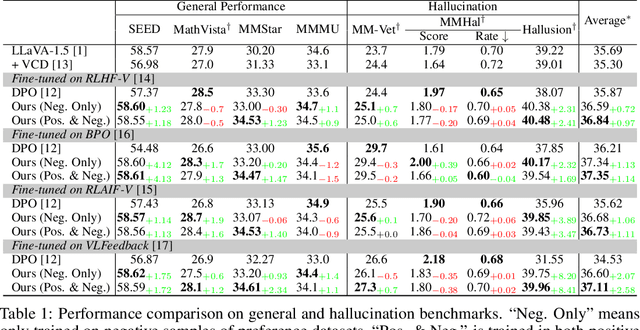
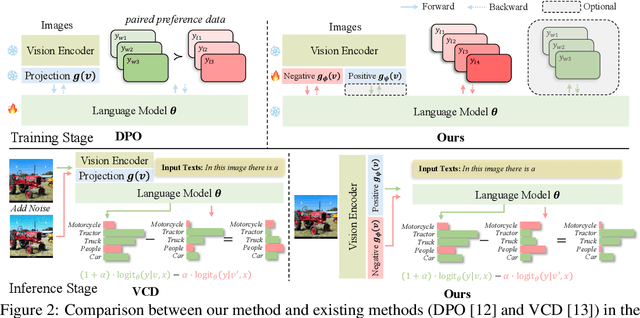
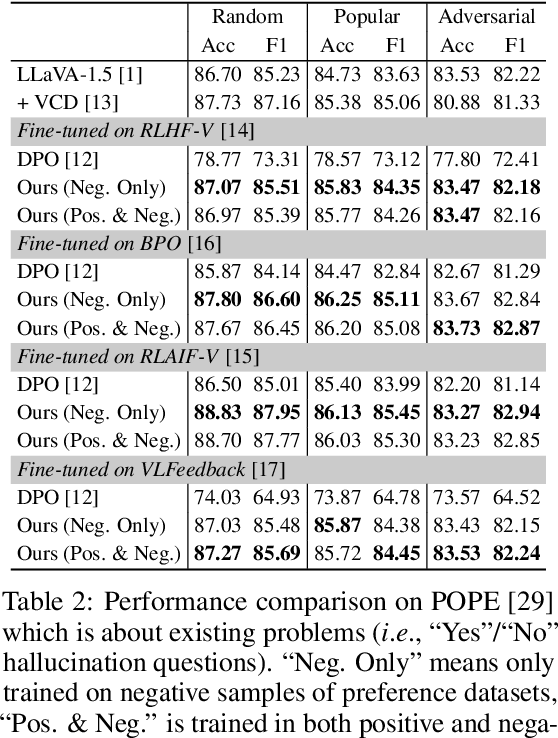
Although multimodal large language models (MLLMs) exhibit remarkable reasoning capabilities on complex multimodal understanding tasks, they still suffer from the notorious hallucination issue: generating outputs misaligned with obvious visual or factual evidence. Currently, training-based solutions, like direct preference optimization (DPO), leverage paired preference data to suppress hallucinations. However, they risk sacrificing general reasoning capabilities due to the likelihood displacement. Meanwhile, training-free solutions, like contrastive decoding, achieve this goal by subtracting the estimated hallucination pattern from a distorted input. Yet, these handcrafted perturbations (e.g., add noise to images) may poorly capture authentic hallucination patterns. To avoid these weaknesses of existing methods, and realize robust hallucination mitigation (i.e., maintaining general reasoning performance), we propose a novel framework: Decoupling Contrastive Decoding (DCD). Specifically, DCD decouples the learning of positive and negative samples in preference datasets, and trains separate positive and negative image projections within the MLLM. The negative projection implicitly models real hallucination patterns, which enables vision-aware negative images in the contrastive decoding inference stage. Our DCD alleviates likelihood displacement by avoiding pairwise optimization and generalizes robustly without handcrafted degradation. Extensive ablations across hallucination benchmarks and general reasoning tasks demonstrate the effectiveness of DCD, i.e., it matches DPO's hallucination suppression while preserving general capabilities and outperforms the handcrafted contrastive decoding methods.
Long Video Diffusion Generation with Segmented Cross-Attention and Content-Rich Video Data Curation
Dec 02, 2024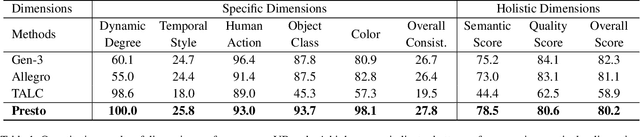
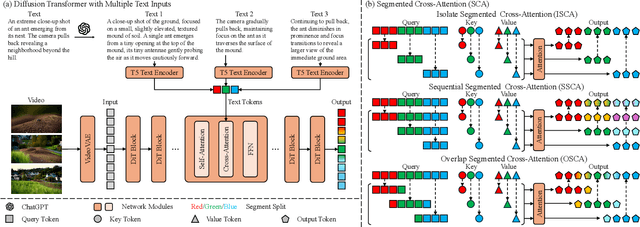

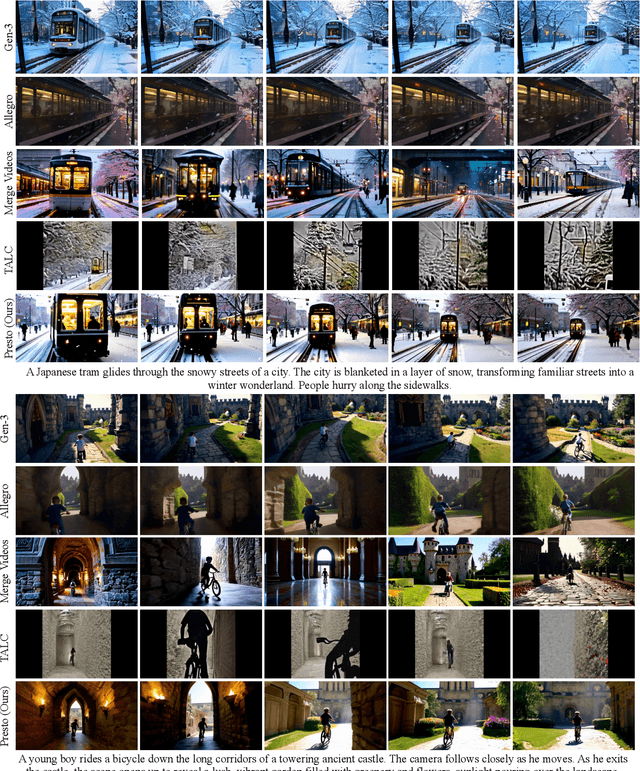
We introduce Presto, a novel video diffusion model designed to generate 15-second videos with long-range coherence and rich content. Extending video generation methods to maintain scenario diversity over long durations presents significant challenges. To address this, we propose a Segmented Cross-Attention (SCA) strategy, which splits hidden states into segments along the temporal dimension, allowing each segment to cross-attend to a corresponding sub-caption. SCA requires no additional parameters, enabling seamless incorporation into current DiT-based architectures. To facilitate high-quality long video generation, we build the LongTake-HD dataset, consisting of 261k content-rich videos with scenario coherence, annotated with an overall video caption and five progressive sub-captions. Experiments show that our Presto achieves 78.5% on the VBench Semantic Score and 100% on the Dynamic Degree, outperforming existing state-of-the-art video generation methods. This demonstrates that our proposed Presto significantly enhances content richness, maintains long-range coherence, and captures intricate textual details. More details are displayed on our project page: https://presto-video.github.io/.
RapVerse: Coherent Vocals and Whole-Body Motions Generations from Text
May 30, 2024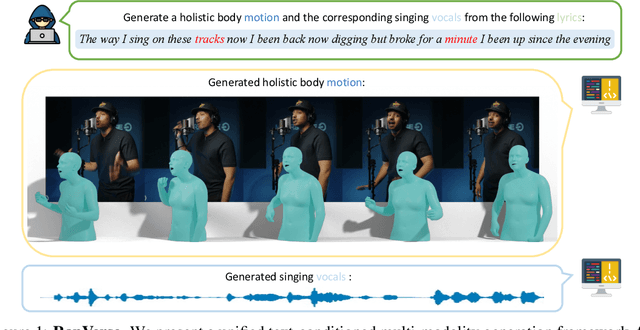
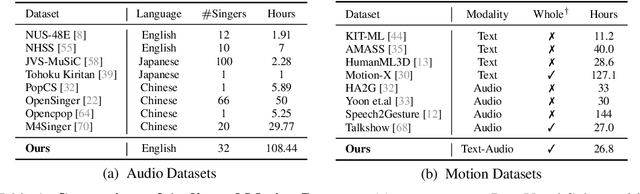

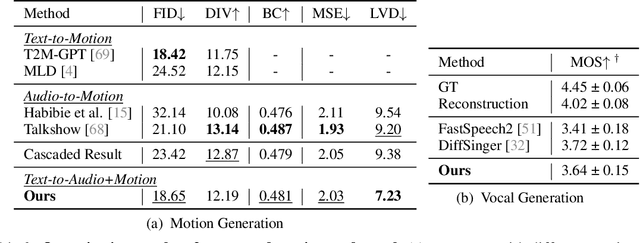
In this work, we introduce a challenging task for simultaneously generating 3D holistic body motions and singing vocals directly from textual lyrics inputs, advancing beyond existing works that typically address these two modalities in isolation. To facilitate this, we first collect the RapVerse dataset, a large dataset containing synchronous rapping vocals, lyrics, and high-quality 3D holistic body meshes. With the RapVerse dataset, we investigate the extent to which scaling autoregressive multimodal transformers across language, audio, and motion can enhance the coherent and realistic generation of vocals and whole-body human motions. For modality unification, a vector-quantized variational autoencoder is employed to encode whole-body motion sequences into discrete motion tokens, while a vocal-to-unit model is leveraged to obtain quantized audio tokens preserving content, prosodic information, and singer identity. By jointly performing transformer modeling on these three modalities in a unified way, our framework ensures a seamless and realistic blend of vocals and human motions. Extensive experiments demonstrate that our unified generation framework not only produces coherent and realistic singing vocals alongside human motions directly from textual inputs but also rivals the performance of specialized single-modality generation systems, establishing new benchmarks for joint vocal-motion generation. The project page is available for research purposes at https://vis-www.cs.umass.edu/RapVerse.