 Add to Chrome
 Add to Firefox
 Add to Edge
Learning Bimanual Cloth Manipulation with Vision-based Tactile Sensing via Single Robotic Arm
Mar 11, 2026
Robotic cloth manipulation remains challenging due to the high-dimensional state space of fabrics, their deformable nature, and frequent occlusions that limit vision-based sensing. Although dual-arm systems can mitigate some of these issues, they increase hardware and control complexity. This paper presents Touch G.O.G., a compact vision-based tactile gripper and perception/control framework for single-arm bimanual cloth manipulation. The proposed framework combines three key components: (1) a novel gripper design and control strategy for in-gripper cloth sliding with a single robot arm, (2) a Vision Foundation Model-backboned Vision Transformer pipeline for cloth part classification (PC-Net) and edge pose estimation (PE-Net) using real and synthetic tactile images, and (3) an encoder-decoder synthetic data generator (SD-Net) that reduces manual annotation by producing high-fidelity tactile images. Experiments show 96% accuracy in distinguishing edges, corners, interior regions, and grasp failures, together with sub-millimeter edge localization and 4.5° orientation error. Real-world results demonstrate reliable cloth unfolding, even for crumpled fabrics, using only a single robotic arm. These results highlight Touch G.O.G. as a compact and cost-effective solution for deformable object manipulation.

Data-driven Interpretable Hybrid Robot Dynamics
Dec 10, 2025We study data-driven identification of interpretable hybrid robot dynamics, where an analytical rigid-body dynamics model is complemented by a learned residual torque term. Using symbolic regression and sparse identification of nonlinear dynamics (SINDy), we recover compact closed-form expressions for this residual from joint-space data. In simulation on a 7-DoF Franka arm with known dynamics, these interpretable models accurately recover inertial, Coriolis, gravity, and viscous effects with very small relative error and outperform neural-network baselines in both accuracy and generalization. On real data from a 7-DoF WAM arm, symbolic-regression residuals generalize substantially better than SINDy and neural networks, which tend to overfit, and suggest candidate new closed-form formulations that extend the nominal dynamics model for this robot. Overall, the results indicate that interpretable residual dynamics models provide compact, accurate, and physically meaningful alternatives to black-box function approximators for torque prediction.
Extended Hybrid Zero Dynamics for Bipedal Walking of the Knee-less Robot SLIDER
Apr 01, 2025
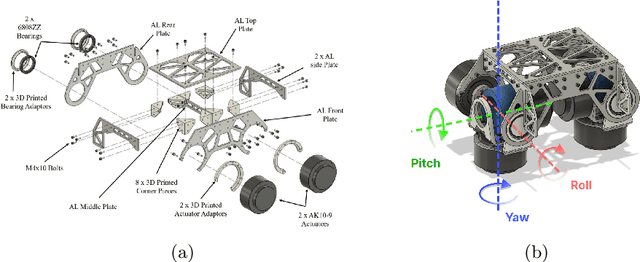
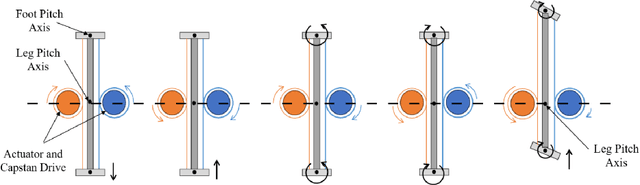
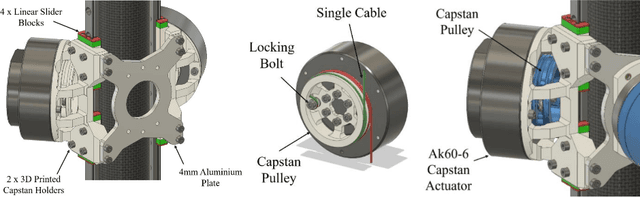
Knee-less bipedal robots like SLIDER have the advantage of ultra-lightweight legs and improved walking energy efficiency compared to traditional humanoid robots. In this paper, we firstly introduce an improved hardware design of the bipedal robot SLIDER with new line-feet and more optimized mass distribution which enables higher locomotion speeds. Secondly, we propose an extended Hybrid Zero Dynamics (eHZD) method, which can be applied to prismatic joint robots like SLIDER. The eHZD method is then used to generate a library of gaits with varying reference velocities in an offline way. Thirdly, a Guided Deep Reinforcement Learning (DRL) algorithm is proposed to use the pre-generated library to create walking control policies in real-time. This approach allows us to combine the advantages of both HZD (for generating stable gaits with a full-dynamics model) and DRL (for real-time adaptive gait generation). The experimental results show that this approach achieves 150% higher walking velocity than the previous MPC-based approach.