 Add to Chrome
 Add to Firefox
 Add to Edge
Unlocking air traffic flow prediction through microscopic aircraft-state modeling
May 11, 2026
Short-term air traffic flow prediction in terminal airspace is essential for proactive air traffic management. Existing approaches predominantly model traffic flow as aggregated time series, despite traffic dynamics being governed by aircraft states and interactions in continuous airspace. Such aggregation obscures fine-grained information including aircraft kinematics, boundary interactions, and control intent. Here we present AeroSense, a state-to-flow modeling framework that predicts future traffic flow directly from instantaneous airspace situations represented as dynamic sets of aircraft states derived from ADS-B trajectories. By establishing an end-to-end mapping from microscopic aircraft states to future regional traffic flow, AeroSense preserves aircraft-level dynamics while naturally accommodating varying traffic density without relying on historical look-back windows. Experiments on a large-scale real-world dataset show that AeroSense consistently improves predictive accuracy over aggregation-based forecasting approaches, particularly during high-density traffic periods. These findings suggest that instantaneous airspace situations provide an effective alternative to conventional time-series-based traffic forecasting paradigms.

From Time Series to State: Situation-Aware Modeling for Air Traffic Flow Prediction
Apr 16, 2026Accurate air traffic prediction in the terminal airspace (TA) is pivotal for proactive air traffic management (ATM). However, existing data-driven approaches predominantly rely on time series-based forecasting paradigms, which inherently overlook critical aircraft state information, such as real-time kinematics and proximity to airspace boundaries. To address this limitation, we propose \textit{AeroSense}, a direct state-to-flow modeling framework for air traffic prediction. Unlike classical time series-based methods that first aggregate aircraft trajectories into macroscopic flow sequences before modeling, AeroSense explicitly represents the real-time airspace situation as \textit{a dynamic set of aircraft states}, enabling the direct processing of a variable number of aircraft instead of time series as inputs. Specifically, we introduce a situation-aware state representation that enables AeroSense to sense the instantaneous terminal airspace situation directly from microscopic aircraft states. Furthermore, we design a model architecture that incorporates masked self-attention to capture inter-aircraft interactions, together with two decoupled prediction heads to model heterogeneous flow dynamics across two key functional areas of the TA. Extensive experiments on a large-scale real-world airport dataset demonstrate that AeroSense consistently achieves state-of-the-art performance, validating that direct modeling of microscopic aircraft states yields substantially higher predictive fidelity than time series-based baselines. Moreover, the proposed framework exhibits superior robustness during peak traffic periods, achieves Pareto-optimal performance under dayparting multi-object evaluation, and provides meaningful interpretability through attention-based visualizations.
Towards Situation-aware State Modeling for Air Traffic Flow Prediction
Apr 14, 2026Accurate air traffic prediction in the terminal airspace (TA) is pivotal for proactive air traffic management (ATM). However, existing data-driven approaches predominantly rely on time series-based forecasting paradigms, which inherently overlook critical aircraft state information, such as real-time kinematics and proximity to airspace boundaries. To address this limitation, we propose \textit{AeroSense}, a direct state-to-flow modeling framework for air traffic prediction. Unlike classical time series-based methods that first aggregate aircraft trajectories into macroscopic flow sequences before modeling, AeroSense explicitly represents the real-time airspace situation as \textit{a dynamic set of aircraft states}, enabling the direct processing of a variable number of aircraft instead of time series as inputs. Specifically, we introduce a situation-aware state representation that enables AeroSense to sense the instantaneous terminal airspace situation directly from microscopic aircraft states. Furthermore, we design a model architecture that incorporates masked self-attention to capture inter-aircraft interactions, together with two decoupled prediction heads to model heterogeneous flow dynamics across two key functional areas of the TA. Extensive experiments on a large-scale real-world airport dataset demonstrate that AeroSense consistently achieves state-of-the-art performance, validating that direct modeling of microscopic aircraft states yields substantially higher predictive fidelity than time series-based baselines. Moreover, the proposed framework exhibits superior robustness during peak traffic periods, achieves Pareto-optimal performance under dayparting multi-object evaluation, and provides meaningful interpretability through attention-based visualizations.
Scalable Trajectory-User Linking with Dual-Stream Representation Networks
Mar 19, 2025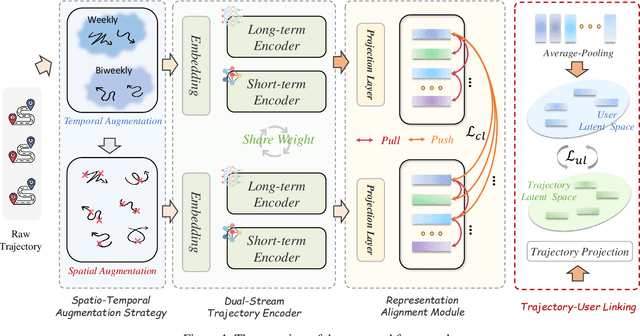
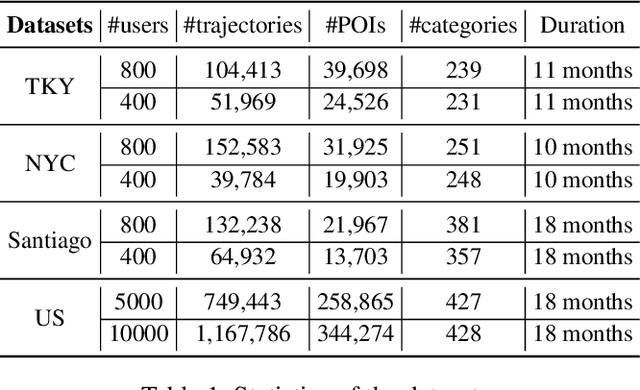
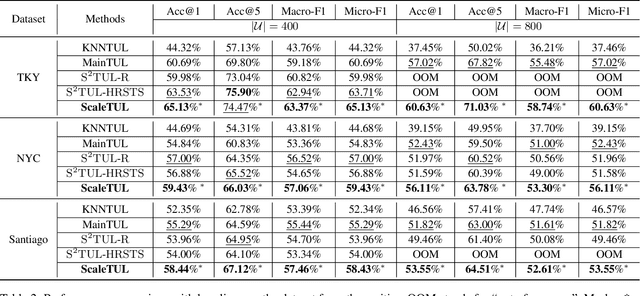
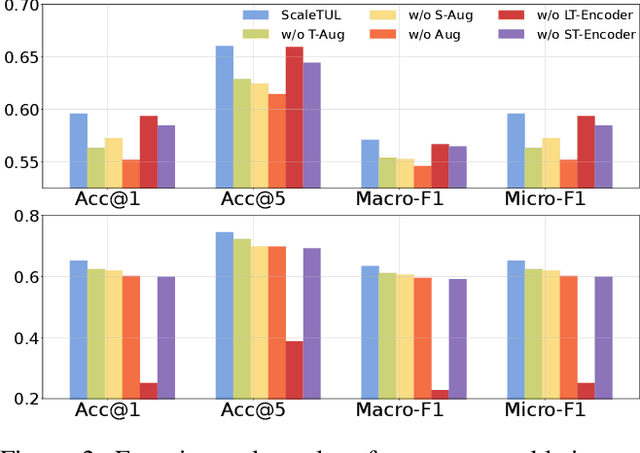
Trajectory-user linking (TUL) aims to match anonymous trajectories to the most likely users who generated them, offering benefits for a wide range of real-world spatio-temporal applications. However, existing TUL methods are limited by high model complexity and poor learning of the effective representations of trajectories, rendering them ineffective in handling large-scale user trajectory data. In this work, we propose a novel $\underline{Scal}$abl$\underline{e}$ Trajectory-User Linking with dual-stream representation networks for large-scale $\underline{TUL}$ problem, named ScaleTUL. Specifically, ScaleTUL generates two views using temporal and spatial augmentations to exploit supervised contrastive learning framework to effectively capture the irregularities of trajectories. In each view, a dual-stream trajectory encoder, consisting of a long-term encoder and a short-term encoder, is designed to learn unified trajectory representations that fuse different temporal-spatial dependencies. Then, a TUL layer is used to associate the trajectories with the corresponding users in the representation space using a two-stage training model. Experimental results on check-in mobility datasets from three real-world cities and the nationwide U.S. demonstrate the superiority of ScaleTUL over state-of-the-art baselines for large-scale TUL tasks.
Spatiotemporal-aware Trend-Seasonality Decomposition Network for Traffic Flow Forecasting
Feb 17, 2025Traffic prediction is critical for optimizing travel scheduling and enhancing public safety, yet the complex spatial and temporal dynamics within traffic data present significant challenges for accurate forecasting. In this paper, we introduce a novel model, the Spatiotemporal-aware Trend-Seasonality Decomposition Network (STDN). This model begins by constructing a dynamic graph structure to represent traffic flow and incorporates novel spatio-temporal embeddings to jointly capture global traffic dynamics. The representations learned are further refined by a specially designed trend-seasonality decomposition module, which disentangles the trend-cyclical component and seasonal component for each traffic node at different times within the graph. These components are subsequently processed through an encoder-decoder network to generate the final predictions. Extensive experiments conducted on real-world traffic datasets demonstrate that STDN achieves superior performance with remarkable computation cost. Furthermore, we have released a new traffic dataset named JiNan, which features unique inner-city dynamics, thereby enriching the scenario comprehensiveness in traffic prediction evaluation.
Multi-fold Correlation Attention Network for Predicting Traffic Speeds with Heterogeneous Frequency
Apr 19, 2021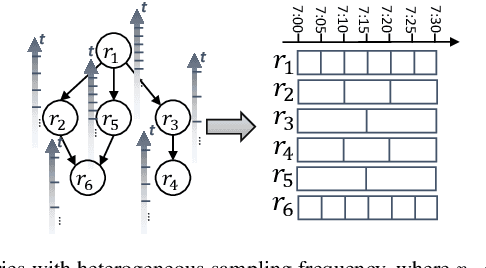
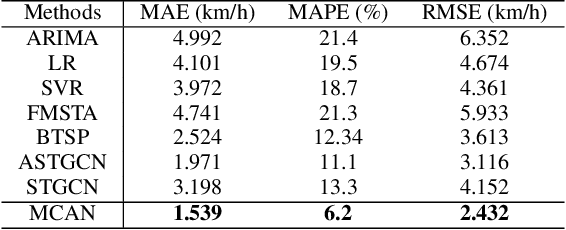
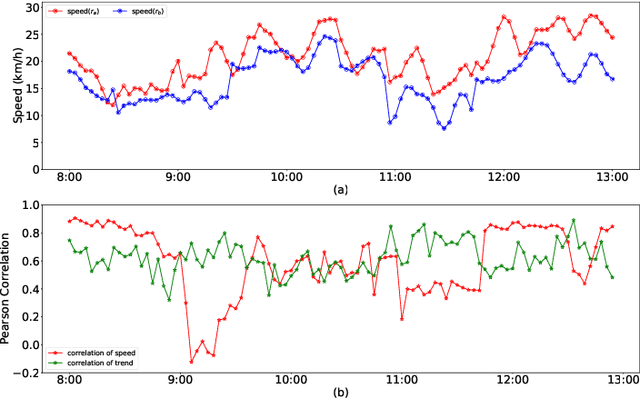
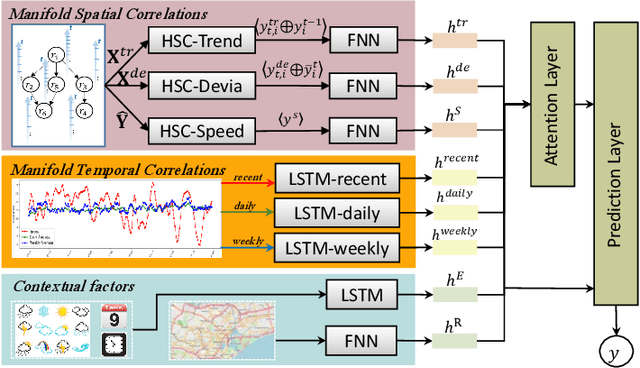
Substantial efforts have been devoted to the investigation of spatiotemporal correlations for improving traffic speed prediction accuracy. However, existing works typically model the correlations based solely on the observed traffic state (e.g. traffic speed) without due consideration that different correlation measurements of the traffic data could exhibit a diverse set of patterns under different traffic situations. In addition, the existing works assume that all road segments can employ the same sampling frequency of traffic states, which is impractical. In this paper, we propose new measurements to model the spatial correlations among traffic data and show that the resulting correlation patterns vary significantly under various traffic situations. We propose a Heterogeneous Spatial Correlation (HSC) model to capture the spatial correlation based on a specific measurement, where the traffic data of varying road segments can be heterogeneous (i.e. obtained with different sampling frequency). We propose a Multi-fold Correlation Attention Network (MCAN), which relies on the HSC model to explore multi-fold spatial correlations and leverage LSTM networks to capture multi-fold temporal correlations to provide discriminating features in order to achieve accurate traffic prediction. The learned multi-fold spatiotemporal correlations together with contextual factors are fused with attention mechanism to make the final predictions. Experiments on real-world datasets demonstrate that the proposed MCAN model outperforms the state-of-the-art baselines.