 Add to Chrome
 Add to Firefox
 Add to Edge
ClinRAG-GRAPH: Clinical-prior Retrieval-Augmented Graph Model with Domain Adversarial Learning for Breast pCR Prediction
Jul 01, 2026
Neoadjuvant chemotherapy (NAC) response prediction is clinically important for treatment stratification in breast cancer. However, robust pre-treatment pathological complete response (pCR) prediction remains challenging due to insufficient cross-modal modeling, multicenter imaging heterogeneity, and weak evidence-grounded interpretability. We propose ClinRAG-GRAPH, a Clinically informed Retrieval-Augmented Generation Graph framework, for pre-treatment pCR prediction from DCE-MRI, structured clinical variables, and biopsy-derived pathological biomarkers. ClinRAG-GRAPH constructs an intra-patient clinical-prior graph and applies a prior-guided relation-aware graph convolutional network for structured multimodal representation learning. To improve cross-center robustness, we introduce a dual-branch domain-adversarial learning strategy to suppress protocol-related MRI bias while preserving pCR-relevant features. To enhance interpretability, we further incorporate large language model (LLM)-driven subgraph RAG module that retrieves clinically analogous historical cases and integrates retrieved evidence for pCR inference. We assemble a large-scale multicenter NAC breast cancer cohort for extensive validation, drawing from two public sources and three in-house centers.Results show that ClinRAG-GRAPH achieves AUCs of 0.815 on the internal test set and 0.774/0.712 on two external test sets, demonstrating robust pre-treatment pCR prediction across centers. The code is available at the anonymized https://github.com/miccai26-1181/ClinRAG-GRAPH.

LiAuto-GeoX: Efficient Grounded Driving Transformer
Jun 04, 2026Dense 3D reconstruction has demonstrated immense potential for spatial understanding, yet its viability as a real-time, onboard representation for autonomous driving remains an open challenge. Existing large-scale visual geometry models typically require substantial computational resources and lack the long-range geometric fidelity, surround-view consistency, and real-time efficiency demanded by dynamic driving environments. To bridge this gap, we present \textbf{LiAuto-GeoX}, an efficient grounded driving transformer designed for deployable, ego-centric 3D scene understanding. Our approach begins by learning a high-capacity driving geometry model from large-scale surround-view data, utilizing sparse LiDAR priors to provide robust geometric grounding in distant, ambiguous, or structure-sparse regions. We then instantiate this capability into a highly compact 155M-parameter onboard model through a novel geometry-preserving distillation framework. This framework employs mask-guided depth-aware distillation to retain fine-grained metric structures by emphasizing geometrically informative regions, and relative-pose relational distillation to enforce cross-view spatial consistency through pose-induced geometric relations. Extensive evaluations reveal that \textbf{LiAuto-GeoX} runs at 220 FPS on KITTI while maintaining high-fidelity dense reconstruction, enabling real-time deployment. The learned geometry transfers seamlessly to downstream autonomy tasks, achieving 90.6 PDMS in trajectory prediction, 24.63 mIoU in occupancy prediction, and 47.67 IoU in future-frame prediction. These all demonstrate that efficient dense 3D reconstruction can transcend its traditional role as a perception target to serve as a scalable, foundational geometric representation for next-generation autonomous driving.
Switch-KD: Visual-Switch Knowledge Distillation for Vision-Language Models
Apr 16, 2026Vision-Language Models (VLMs) have shown remarkable capabilities in joint vision-language understanding, but their large scale poses significant challenges for deployment in resource-constrained scenarios. Knowledge Distillation (KD) offers a viable way to improve model capabilities without increasing model size or data requirements, making deployment more efficient. However, applying KD to VLMs is challenged by modality-specific supervision: although multimodal knowledge in VLMs is fused within the language space, current methods supervise each modality separately without explicitly addressing multimodal alignment, leading to inconsistent multimodal knowledge transfer. To address this, we propose Switch-KD, a visual-switch distillation framework that unifies vision-language knowledge transfer within a shared text-probability space. Switch-KD comprises two key components: (1) Visual-Switch Distillation, which switches the student's visual outputs into the teacher's language pathway to construct cross-modal probabilistic references for implicit visual knowledge transfer; and (2) Dynamic Bi-directional Logits Difference (DBiLD) loss, which adaptively aligns informative probability regions while preserving the distributional structures of teacher and student through bidirectional supervision. Guided by Switch-KD, a 0.5B TinyLLaVA effectively distills rich multimodal knowledge from its 3B teacher, yielding an average improvement of 3.6 points across 10 multimodal benchmarks without any architectural modification.
* 11 pages, 3 figures
Interpretation of Crystal Energy Landscapes with Kolmogorov-Arnold Networks
Apr 06, 2026Characterizing crystalline energy landscapes is essential to predicting thermodynamic stability, electronic structure, and functional behavior. While machine learning (ML) enables rapid property predictions, the "black-box" nature of most models limits their utility for generating new scientific insights. Here, we introduce Kolmogorov-Arnold Networks (KANs) as an interpretable framework to bridge this gap. Unlike conventional neural networks with fixed activation functions, KANs employ learnable functions that reveal underlying physical relationships. We developed the Element-Weighted KAN, a composition-only model that achieves state-of-the-art accuracy in predicting formation energy, band gap, and work function across large-scale datasets. Crucially, without any explicit physical constraints, KANs uncover interpretable chemical trends aligned with the periodic table and quantum mechanical principles through embedding analysis, correlation studies, and principal component analysis. These results demonstrate that KANs provide a powerful framework with high predictive performance and scientific interpretability, establishing a new paradigm for transparent, chemistry-based materials informatics.
AD-CARE: A Guideline-grounded, Modality-agnostic LLM Agent for Real-world Alzheimer's Disease Diagnosis with Multi-cohort Assessment, Fairness Analysis, and Reader Study
Mar 26, 2026Alzheimer's disease (AD) is a growing global health challenge as populations age, and timely, accurate diagnosis is essential to reduce individual and societal burden. However, real-world AD assessment is hampered by incomplete, heterogeneous multimodal data and variability across sites and patient demographics. Although large language models (LLMs) have shown promise in biomedicine, their use in AD has largely been confined to answering narrow, disease-specific questions rather than generating comprehensive diagnostic reports that support clinical decision-making. Here we expand LLM capabilities for clinical decision support by introducing AD-CARE, a modality-agnostic agent that performs guideline-grounded diagnostic assessment from incomplete, heterogeneous inputs without imputing missing modalities. By dynamically orchestrating specialized diagnostic tools and embedding clinical guidelines into LLM-driven reasoning, AD-CARE generates transparent, report-style outputs aligned with real-world clinical workflows. Across six cohorts comprising 10,303 cases, AD-CARE achieved 84.9% diagnostic accuracy, delivering 4.2%-13.7% relative improvements over baseline methods. Despite cohort-level differences, dataset-specific accuracies remain robust (80.4%-98.8%), and the agent consistently outperforms all baselines. AD-CARE reduced performance disparities across racial and age subgroups, decreasing the average dispersion of four metrics by 21%-68% and 28%-51%, respectively. In a controlled reader study, the agent improved neurologist and radiologist accuracy by 6%-11% and more than halved decision time. The framework yielded 2.29%-10.66% absolute gains over eight backbone LLMs and converges their performance. These results show that AD-CARE is a scalable, practically deployable framework that can be integrated into routine clinical workflows for multimodal decision support in AD.
Evaluating the Search Agent in a Parallel World
Mar 05, 2026Integrating web search tools has significantly extended the capability of LLMs to address open-world, real-time, and long-tail problems. However, evaluating these Search Agents presents formidable challenges. First, constructing high-quality deep search benchmarks is prohibitively expensive, while unverified synthetic data often suffers from unreliable sources. Second, static benchmarks face dynamic obsolescence: as internet information evolves, complex queries requiring deep research often degrade into simple retrieval tasks due to increased popularity, and ground truths become outdated due to temporal shifts. Third, attribution ambiguity confounds evaluation, as an agent's performance is often dominated by its parametric memory rather than its actual search and reasoning capabilities. Finally, reliance on specific commercial search engines introduces variability that hampers reproducibility. To address these issues, we propose a novel framework, Mind-ParaWorld, for evaluating Search Agents in a Parallel World. Specifically, MPW samples real-world entity names to synthesize future scenarios and questions situated beyond the model's knowledge cutoff. A ParaWorld Law Model then constructs a set of indivisible Atomic Facts and a unique ground-truth for each question. During evaluation, instead of retrieving real-world results, the agent interacts with a ParaWorld Engine Model that dynamically generates SERPs grounded in these inviolable Atomic Facts. We release MPW-Bench, an interactive benchmark spanning 19 domains with 1,608 instances. Experiments across three evaluation settings show that, while search agents are strong at evidence synthesis given complete information, their performance is limited not only by evidence collection and coverage in unfamiliar search environments, but also by unreliable evidence sufficiency judgment and when-to-stop decisions-bottlenecks.
BRIGHT: A Collaborative Generalist-Specialist Foundation Model for Breast Pathology
Mar 03, 2026Generalist pathology foundation models (PFMs), pretrained on large-scale multi-organ datasets, have demonstrated remarkable predictive capabilities across diverse clinical applications. However, their proficiency on the full spectrum of clinically essential tasks within a specific organ system remains an open question due to the lack of large-scale validation cohorts for a single organ as well as the absence of a tailored training paradigm that can effectively translate broad histomorphological knowledge into the organ-specific expertise required for specialist-level interpretation. In this study, we propose BRIGHT, the first PFM specifically designed for breast pathology, trained on approximately 210 million histopathology tiles from over 51,000 breast whole-slide images derived from a cohort of over 40,000 patients across 19 hospitals. BRIGHT employs a collaborative generalist-specialist framework to capture both universal and organ-specific features. To comprehensively evaluate the performance of PFMs on breast oncology, we curate the largest multi-institutional cohorts to date for downstream task development and evaluation, comprising over 25,000 WSIs across 10 hospitals. The validation cohorts cover the full spectrum of breast pathology across 24 distinct clinical tasks spanning diagnosis, biomarker prediction, treatment response and survival prediction. Extensive experiments demonstrate that BRIGHT outperforms three leading generalist PFMs, achieving state-of-the-art (SOTA) performance in 21 of 24 internal validation tasks and in 5 of 10 external validation tasks with excellent heatmap interpretability. By evaluating on large-scale validation cohorts, this study not only demonstrates BRIGHT's clinical utility in breast oncology but also validates a collaborative generalist-specialist paradigm, providing a scalable template for developing PFMs on a specific organ system.
MindWatcher: Toward Smarter Multimodal Tool-Integrated Reasoning
Dec 29, 2025Traditional workflow-based agents exhibit limited intelligence when addressing real-world problems requiring tool invocation. Tool-integrated reasoning (TIR) agents capable of autonomous reasoning and tool invocation are rapidly emerging as a powerful approach for complex decision-making tasks involving multi-step interactions with external environments. In this work, we introduce MindWatcher, a TIR agent integrating interleaved thinking and multimodal chain-of-thought (CoT) reasoning. MindWatcher can autonomously decide whether and how to invoke diverse tools and coordinate their use, without relying on human prompts or workflows. The interleaved thinking paradigm enables the model to switch between thinking and tool calling at any intermediate stage, while its multimodal CoT capability allows manipulation of images during reasoning to yield more precise search results. We implement automated data auditing and evaluation pipelines, complemented by manually curated high-quality datasets for training, and we construct a benchmark, called MindWatcher-Evaluate Bench (MWE-Bench), to evaluate its performance. MindWatcher is equipped with a comprehensive suite of auxiliary reasoning tools, enabling it to address broad-domain multimodal problems. A large-scale, high-quality local image retrieval database, covering eight categories including cars, animals, and plants, endows model with robust object recognition despite its small size. Finally, we design a more efficient training infrastructure for MindWatcher, enhancing training speed and hardware utilization. Experiments not only demonstrate that MindWatcher matches or exceeds the performance of larger or more recent models through superior tool invocation, but also uncover critical insights for agent training, such as the genetic inheritance phenomenon in agentic RL.
Growing a Twig to Accelerate Large Vision-Language Models
Mar 18, 2025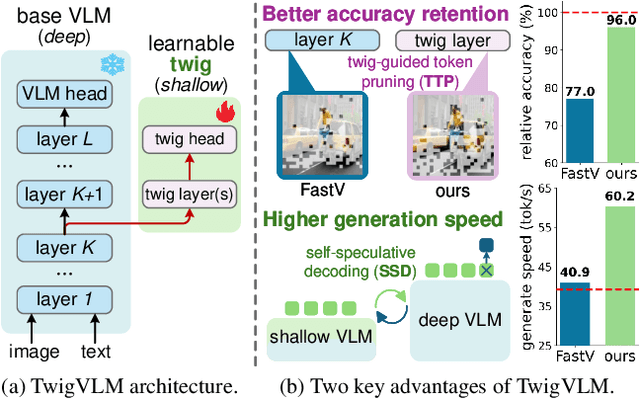
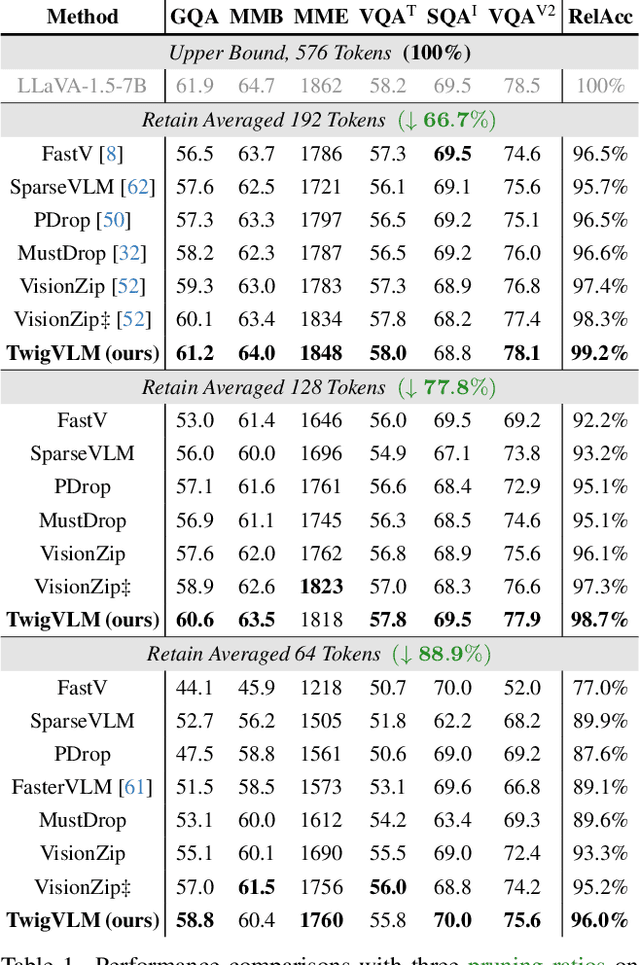
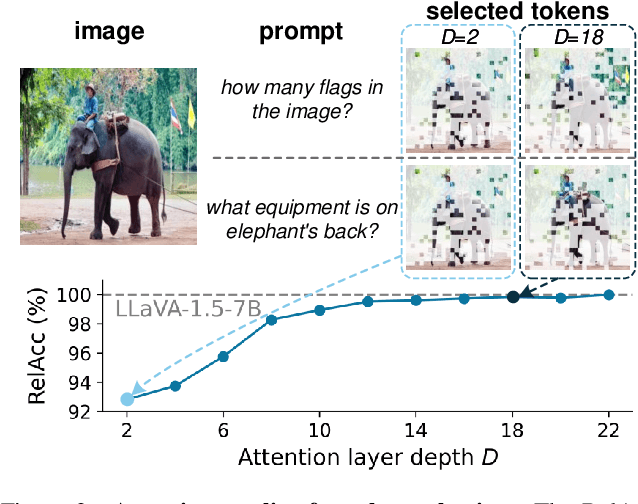
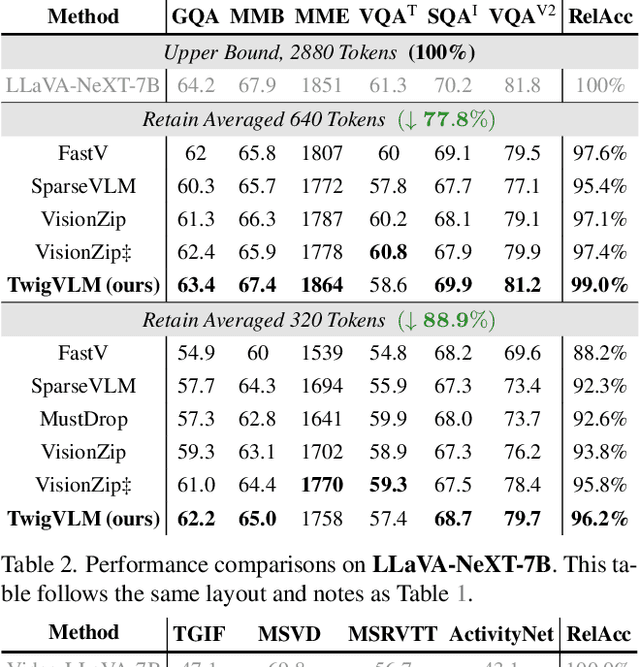
Large vision-language models (VLMs) have demonstrated remarkable capabilities in open-world multimodal understanding, yet their high computational overheads pose great challenges for practical deployment. Some recent works have proposed methods to accelerate VLMs by pruning redundant visual tokens guided by the attention maps of VLM's early layers. Despite the success of these token pruning methods, they still suffer from two major shortcomings: (i) considerable accuracy drop due to insensitive attention signals in early layers, and (ii) limited speedup when generating long responses (e.g., 30 tokens). To address the limitations above, we present TwigVLM -- a simple and general architecture by growing a lightweight twig upon an early layer of the base VLM. Compared with most existing VLM acceleration methods purely based on visual token pruning, our TwigVLM not only achieves better accuracy retention by employing a twig-guided token pruning (TTP) strategy, but also yields higher generation speed by utilizing a self-speculative decoding (SSD) strategy. Taking LLaVA-1.5-7B as the base VLM, experimental results show that TwigVLM preserves 96% of the original performance after pruning 88.9% of visual tokens and achieves 154% speedup in generating long responses, delivering significantly better performance in terms of both accuracy and speed over the state-of-the-art VLM acceleration methods. Code will be made publicly available.