 Add to Chrome
 Add to Firefox
 Add to Edge
Efficient Adaptation in Mixed-Motive Environments via Hierarchical Opponent Modeling and Planning
Jun 12, 2024
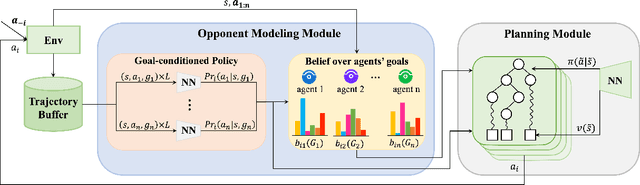
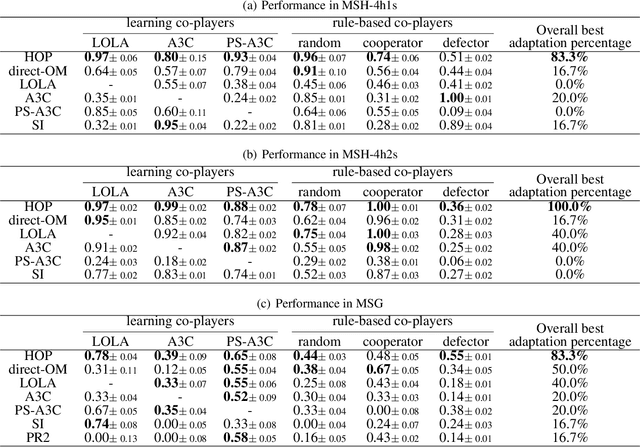
Despite the recent successes of multi-agent reinforcement learning (MARL) algorithms, efficiently adapting to co-players in mixed-motive environments remains a significant challenge. One feasible approach is to hierarchically model co-players' behavior based on inferring their characteristics. However, these methods often encounter difficulties in efficient reasoning and utilization of inferred information. To address these issues, we propose Hierarchical Opponent modeling and Planning (HOP), a novel multi-agent decision-making algorithm that enables few-shot adaptation to unseen policies in mixed-motive environments. HOP is hierarchically composed of two modules: an opponent modeling module that infers others' goals and learns corresponding goal-conditioned policies, and a planning module that employs Monte Carlo Tree Search (MCTS) to identify the best response. Our approach improves efficiency by updating beliefs about others' goals both across and within episodes and by using information from the opponent modeling module to guide planning. Experimental results demonstrate that in mixed-motive environments, HOP exhibits superior few-shot adaptation capabilities when interacting with various unseen agents, and excels in self-play scenarios. Furthermore, the emergence of social intelligence during our experiments underscores the potential of our approach in complex multi-agent environments.

InterPreT: Interactive Predicate Learning from Language Feedback for Generalizable Task Planning
May 30, 2024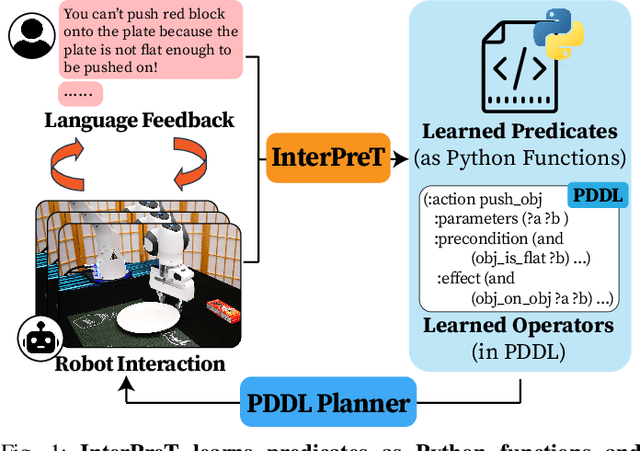
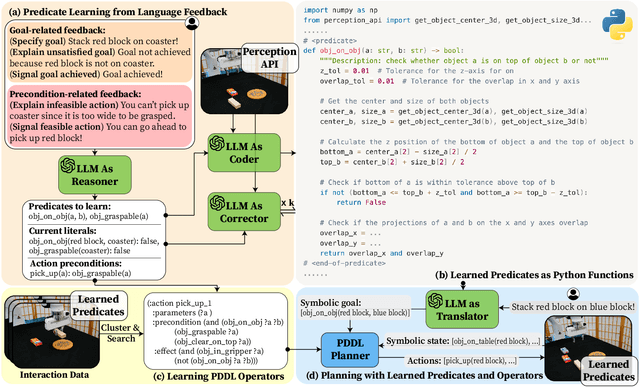
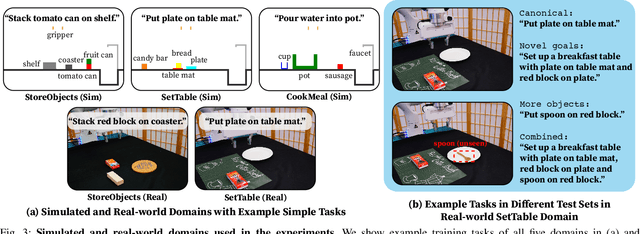
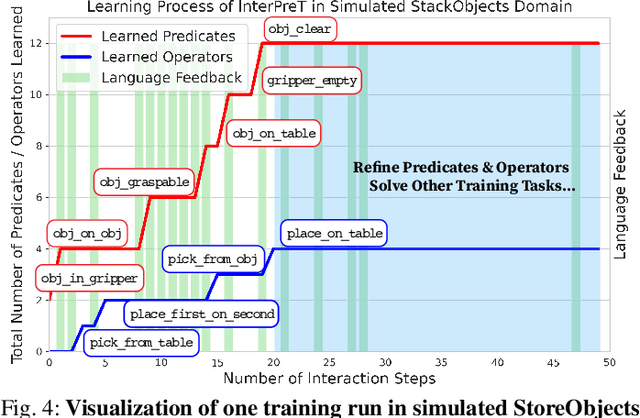
Learning abstract state representations and knowledge is crucial for long-horizon robot planning. We present InterPreT, an LLM-powered framework for robots to learn symbolic predicates from language feedback of human non-experts during embodied interaction. The learned predicates provide relational abstractions of the environment state, facilitating the learning of symbolic operators that capture action preconditions and effects. By compiling the learned predicates and operators into a PDDL domain on-the-fly, InterPreT allows effective planning toward arbitrary in-domain goals using a PDDL planner. In both simulated and real-world robot manipulation domains, we demonstrate that InterPreT reliably uncovers the key predicates and operators governing the environment dynamics. Although learned from simple training tasks, these predicates and operators exhibit strong generalization to novel tasks with significantly higher complexity. In the most challenging generalization setting, InterPreT attains success rates of 73% in simulation and 40% in the real world, substantially outperforming baseline methods.
SocialGFs: Learning Social Gradient Fields for Multi-Agent Reinforcement Learning
May 03, 2024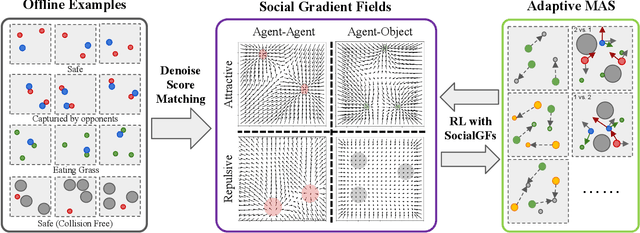
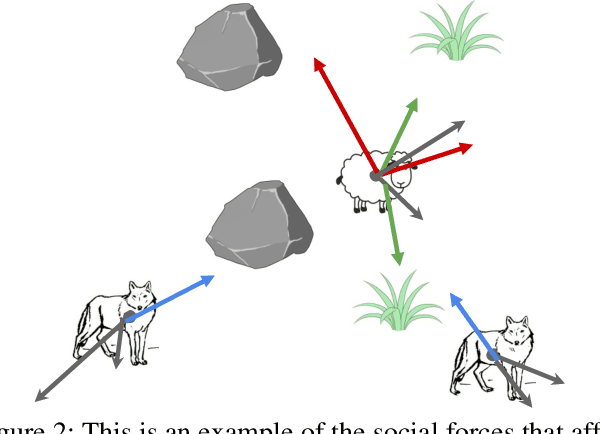

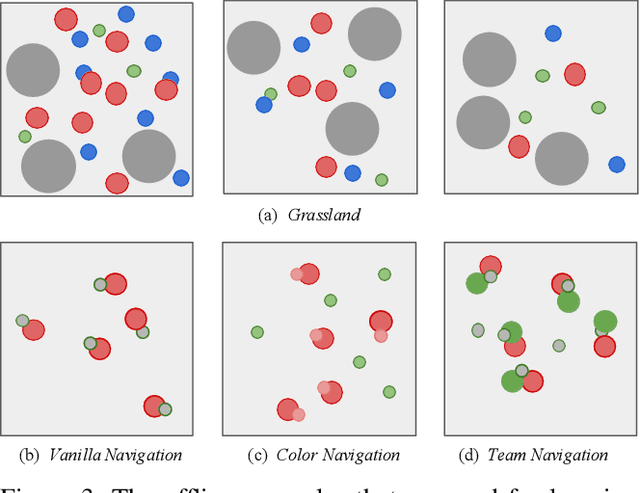
Multi-agent systems (MAS) need to adaptively cope with dynamic environments, changing agent populations, and diverse tasks. However, most of the multi-agent systems cannot easily handle them, due to the complexity of the state and task space. The social impact theory regards the complex influencing factors as forces acting on an agent, emanating from the environment, other agents, and the agent's intrinsic motivation, referring to the social force. Inspired by this concept, we propose a novel gradient-based state representation for multi-agent reinforcement learning. To non-trivially model the social forces, we further introduce a data-driven method, where we employ denoising score matching to learn the social gradient fields (SocialGFs) from offline samples, e.g., the attractive or repulsive outcomes of each force. During interactions, the agents take actions based on the multi-dimensional gradients to maximize their own rewards. In practice, we integrate SocialGFs into the widely used multi-agent reinforcement learning algorithms, e.g., MAPPO. The empirical results reveal that SocialGFs offer four advantages for multi-agent systems: 1) they can be learned without requiring online interaction, 2) they demonstrate transferability across diverse tasks, 3) they facilitate credit assignment in challenging reward settings, and 4) they are scalable with the increasing number of agents.
PhyRecon: Physically Plausible Neural Scene Reconstruction
Apr 28, 2024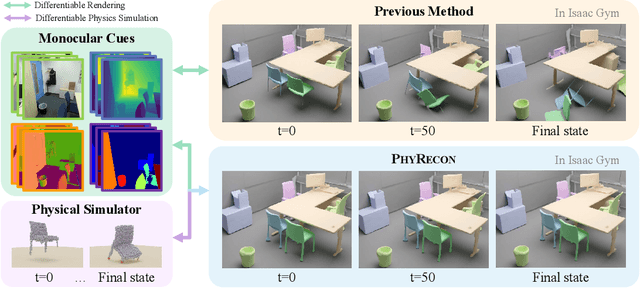
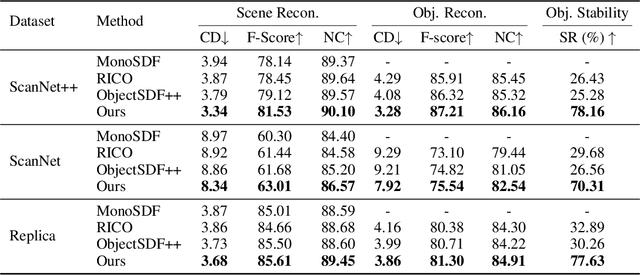
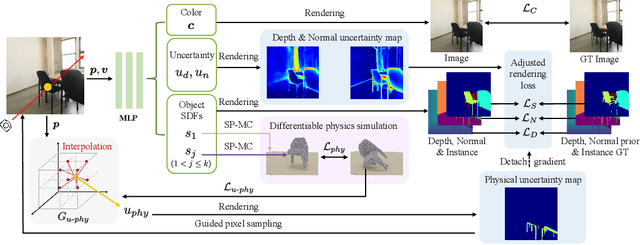
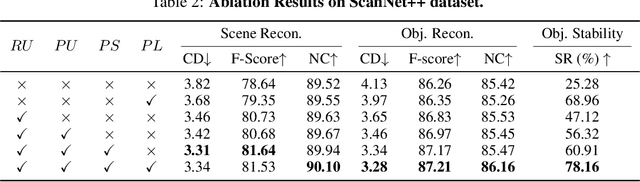
While neural implicit representations have gained popularity in multi-view 3D reconstruction, previous work struggles to yield physically plausible results, thereby limiting their applications in physics-demanding domains like embodied AI and robotics. The lack of plausibility originates from both the absence of physics modeling in the existing pipeline and their inability to recover intricate geometrical structures. In this paper, we introduce PhyRecon, which stands as the first approach to harness both differentiable rendering and differentiable physics simulation to learn implicit surface representations. Our framework proposes a novel differentiable particle-based physical simulator seamlessly integrated with the neural implicit representation. At its core is an efficient transformation between SDF-based implicit representation and explicit surface points by our proposed algorithm, Surface Points Marching Cubes (SP-MC), enabling differentiable learning with both rendering and physical losses. Moreover, we model both rendering and physical uncertainty to identify and compensate for the inconsistent and inaccurate monocular geometric priors. The physical uncertainty additionally enables a physics-guided pixel sampling to enhance the learning of slender structures. By amalgamating these techniques, our model facilitates efficient joint modeling with appearance, geometry, and physics. Extensive experiments demonstrate that PhyRecon significantly outperforms all state-of-the-art methods in terms of reconstruction quality. Our reconstruction results also yield superior physical stability, verified by Isaac Gym, with at least a 40% improvement across all datasets, opening broader avenues for future physics-based applications.
Ag2Manip: Learning Novel Manipulation Skills with Agent-Agnostic Visual and Action Representations
Apr 26, 2024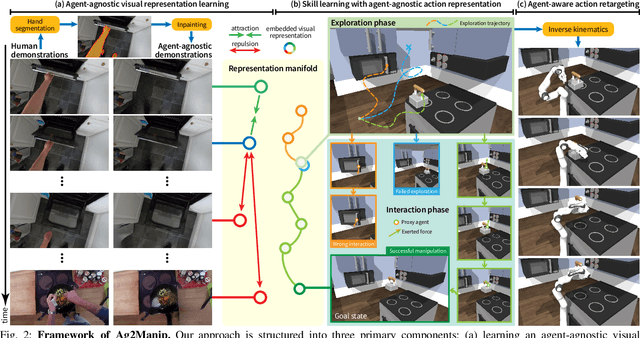
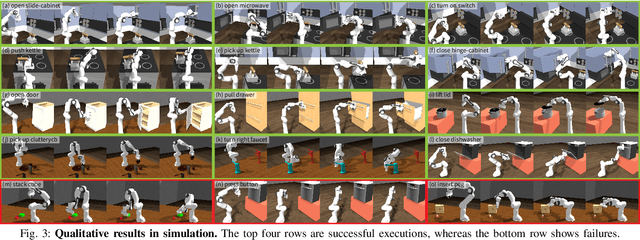
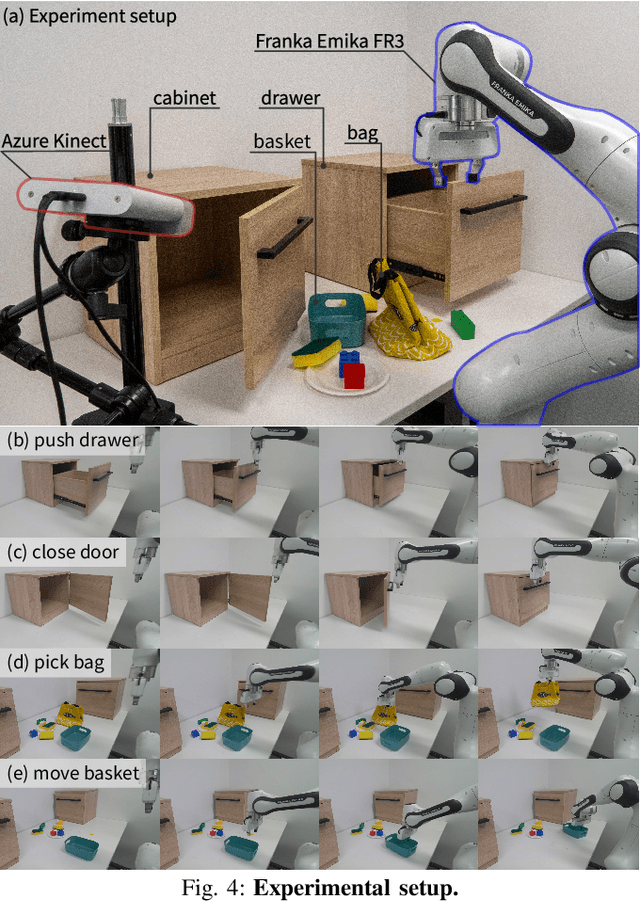
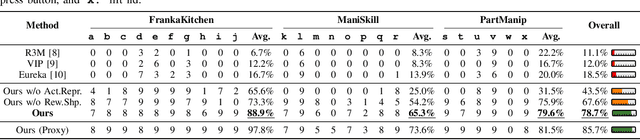
Autonomous robotic systems capable of learning novel manipulation tasks are poised to transform industries from manufacturing to service automation. However, modern methods (e.g., VIP and R3M) still face significant hurdles, notably the domain gap among robotic embodiments and the sparsity of successful task executions within specific action spaces, resulting in misaligned and ambiguous task representations. We introduce Ag2Manip (Agent-Agnostic representations for Manipulation), a framework aimed at surmounting these challenges through two key innovations: a novel agent-agnostic visual representation derived from human manipulation videos, with the specifics of embodiments obscured to enhance generalizability; and an agent-agnostic action representation abstracting a robot's kinematics to a universal agent proxy, emphasizing crucial interactions between end-effector and object. Ag2Manip's empirical validation across simulated benchmarks like FrankaKitchen, ManiSkill, and PartManip shows a 325% increase in performance, achieved without domain-specific demonstrations. Ablation studies underline the essential contributions of the visual and action representations to this success. Extending our evaluations to the real world, Ag2Manip significantly improves imitation learning success rates from 50% to 77.5%, demonstrating its effectiveness and generalizability across both simulated and physical environments.
LLM3:Large Language Model-based Task and Motion Planning with Motion Failure Reasoning
Mar 20, 2024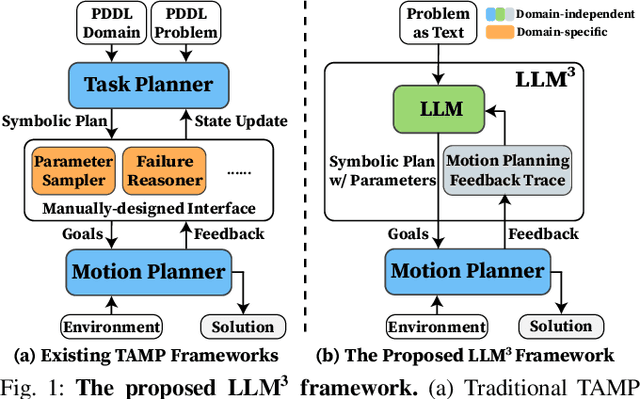
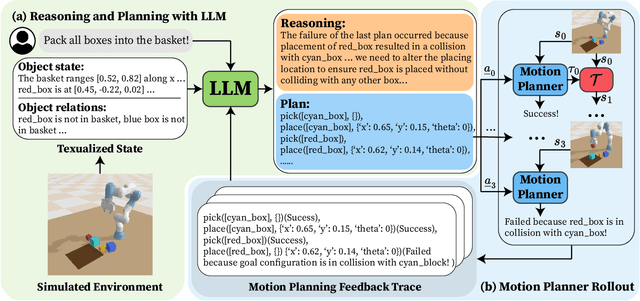
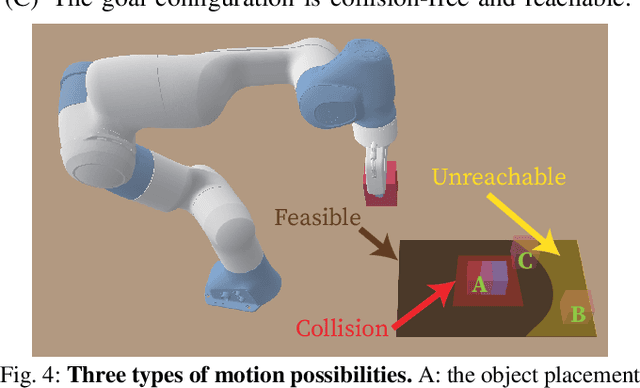
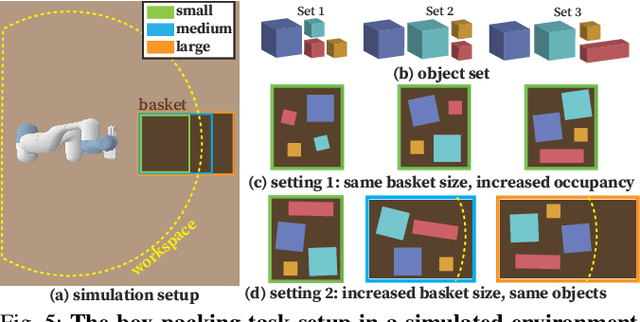
Conventional Task and Motion Planning (TAMP) approaches rely on manually crafted interfaces connecting symbolic task planning with continuous motion generation. These domain-specific and labor-intensive modules are limited in addressing emerging tasks in real-world settings. Here, we present LLM^3, a novel Large Language Model (LLM)-based TAMP framework featuring a domain-independent interface. Specifically, we leverage the powerful reasoning and planning capabilities of pre-trained LLMs to propose symbolic action sequences and select continuous action parameters for motion planning. Crucially, LLM^3 incorporates motion planning feedback through prompting, allowing the LLM to iteratively refine its proposals by reasoning about motion failure. Consequently, LLM^3 interfaces between task planning and motion planning, alleviating the intricate design process of handling domain-specific messages between them. Through a series of simulations in a box-packing domain, we quantitatively demonstrate the effectiveness of LLM^3 in solving TAMP problems and the efficiency in selecting action parameters. Ablation studies underscore the significant contribution of motion failure reasoning to the success of LLM^3. Furthermore, we conduct qualitative experiments on a physical manipulator, demonstrating the practical applicability of our approach in real-world settings.
Fast Peer Adaptation with Context-aware Exploration
Feb 04, 2024


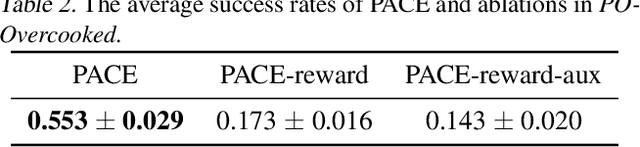
Fast adapting to unknown peers (partners or opponents) with different strategies is a key challenge in multi-agent games. To do so, it is crucial for the agent to efficiently probe and identify the peer's strategy, as this is the prerequisite for carrying out the best response in adaptation. However, it is difficult to explore the strategies of unknown peers, especially when the games are partially observable and have a long horizon. In this paper, we propose a peer identification reward, which rewards the learning agent based on how well it can identify the behavior pattern of the peer over the historical context, such as the observation over multiple episodes. This reward motivates the agent to learn a context-aware policy for effective exploration and fast adaptation, i.e., to actively seek and collect informative feedback from peers when uncertain about their policies and to exploit the context to perform the best response when confident. We evaluate our method on diverse testbeds that involve competitive (Kuhn Poker), cooperative (PO-Overcooked), or mixed (Predator-Prey-W) games with peer agents. We demonstrate that our method induces more active exploration behavior, achieving faster adaptation and better outcomes than existing methods.
On the Emergence of Symmetrical Reality
Jan 26, 2024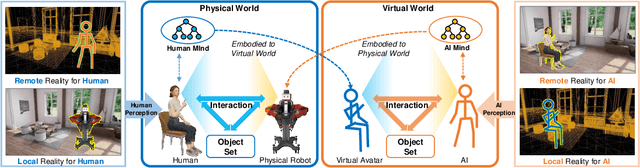
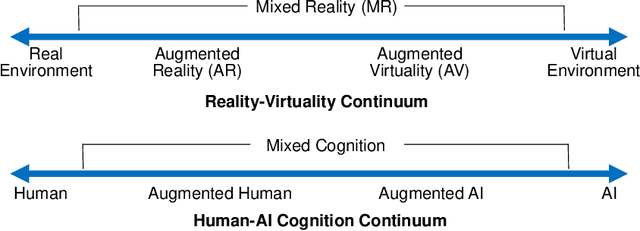
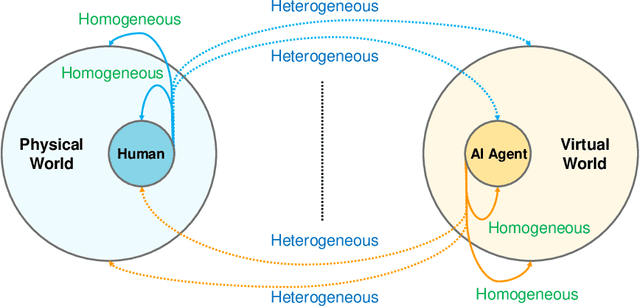
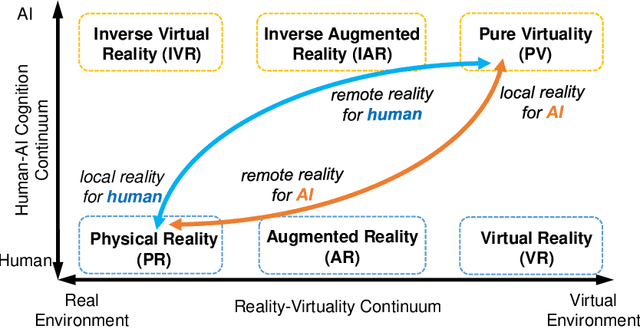
Artificial intelligence (AI) has revolutionized human cognitive abilities and facilitated the development of new AI entities capable of interacting with humans in both physical and virtual environments. Despite the existence of virtual reality, mixed reality, and augmented reality for several years, integrating these technical fields remains a formidable challenge due to their disparate application directions. The advent of AI agents, capable of autonomous perception and action, further compounds this issue by exposing the limitations of traditional human-centered research approaches. It is imperative to establish a comprehensive framework that accommodates the dual perceptual centers of humans and AI agents in both physical and virtual worlds. In this paper, we introduce the symmetrical reality framework, which offers a unified representation encompassing various forms of physical-virtual amalgamations. This framework enables researchers to better comprehend how AI agents can collaborate with humans and how distinct technical pathways of physical-virtual integration can be consolidated from a broader perspective. We then delve into the coexistence of humans and AI, demonstrating a prototype system that exemplifies the operation of symmetrical reality systems for specific tasks, such as pouring water. Subsequently, we propose an instance of an AI-driven active assistance service that illustrates the potential applications of symmetrical reality. This paper aims to offer beneficial perspectives and guidance for researchers and practitioners in different fields, thus contributing to the ongoing research about human-AI coexistence in both physical and virtual environments.
CivRealm: A Learning and Reasoning Odyssey in Civilization for Decision-Making Agents
Jan 19, 2024


The generalization of decision-making agents encompasses two fundamental elements: learning from past experiences and reasoning in novel contexts. However, the predominant emphasis in most interactive environments is on learning, often at the expense of complexity in reasoning. In this paper, we introduce CivRealm, an environment inspired by the Civilization game. Civilization's profound alignment with human history and society necessitates sophisticated learning, while its ever-changing situations demand strong reasoning to generalize. Particularly, CivRealm sets up an imperfect-information general-sum game with a changing number of players; it presents a plethora of complex features, challenging the agent to deal with open-ended stochastic environments that require diplomacy and negotiation skills. Within CivRealm, we provide interfaces for two typical agent types: tensor-based agents that focus on learning, and language-based agents that emphasize reasoning. To catalyze further research, we present initial results for both paradigms. The canonical RL-based agents exhibit reasonable performance in mini-games, whereas both RL- and LLM-based agents struggle to make substantial progress in the full game. Overall, CivRealm stands as a unique learning and reasoning challenge for decision-making agents. The code is available at https://github.com/bigai-ai/civrealm.
MusicAOG: an Energy-Based Model for Learning and Sampling a Hierarchical Representation of Symbolic Music
Jan 05, 2024In addressing the challenge of interpretability and generalizability of artificial music intelligence, this paper introduces a novel symbolic representation that amalgamates both explicit and implicit musical information across diverse traditions and granularities. Utilizing a hierarchical and-or graph representation, the model employs nodes and edges to encapsulate a broad spectrum of musical elements, including structures, textures, rhythms, and harmonies. This hierarchical approach expands the representability across various scales of music. This representation serves as the foundation for an energy-based model, uniquely tailored to learn musical concepts through a flexible algorithm framework relying on the minimax entropy principle. Utilizing an adapted Metropolis-Hastings sampling technique, the model enables fine-grained control over music generation. A comprehensive empirical evaluation, contrasting this novel approach with existing methodologies, manifests considerable advancements in interpretability and controllability. This study marks a substantial contribution to the fields of music analysis, composition, and computational musicology.