 Add to Chrome
 Add to Firefox
 Add to Edge
Can Current Agents Close the Discovery-to-Application Gap? A Case Study in Minecraft
Apr 27, 2026
Discovering causal regularities and applying them to build functional systems--the discovery-to-application loop--is a hallmark of general intelligence, yet evaluating this capacity has been hindered by the vast complexity gap between scientific discovery and real-world engineering. We introduce SciCrafter, a Minecraft-based benchmark that operationalizes this loop through parameterized redstone circuit tasks. Agents must ignite lamps in specified patterns (e.g., simultaneously or in timed sequences); scaling target parameters substantially increases construction complexity and required knowledge, forcing genuine discovery rather than reliance on memorized solutions. Evaluating frontier models including GPT-5.2, Gemini-3-Pro, and Claude-Opus-4.5 under a general-purpose code agent scaffold, we find that all plateau at approximately 26% success rate. To diagnose these failures, we decompose the loop into four capacities--knowledge gap identification, experimental discovery, knowledge consolidation, and knowledge application--and design targeted interventions whose marginal contributions serve as proxies for corresponding gaps. Our analysis reveals that although the general knowledge application capability still remains as the biggest gap across all models, for frontier models the knowledge gap identification starts to become a major hurdle--indicating the bottleneck is shifting from solving problems right to raising the right problems for current AI. We release SciCrafter as a diagnostic probe for future research on AI systems that navigate the full discovery-to-application loop.

In-Context Editing: Learning Knowledge from Self-Induced Distributions
Jun 17, 2024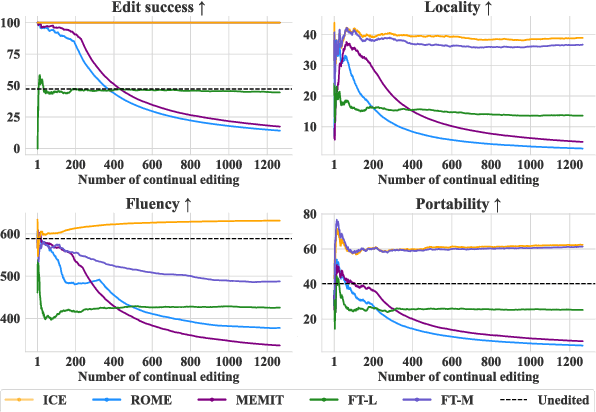
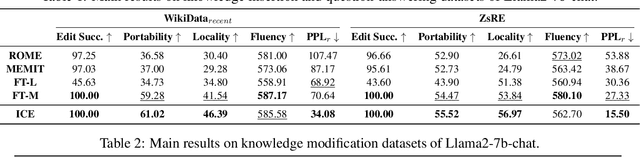
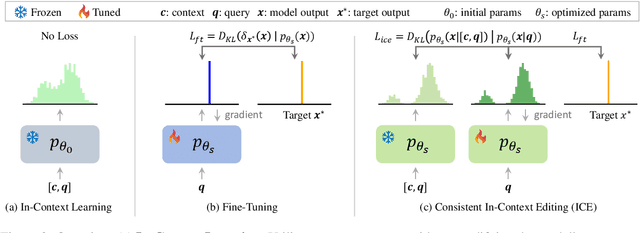
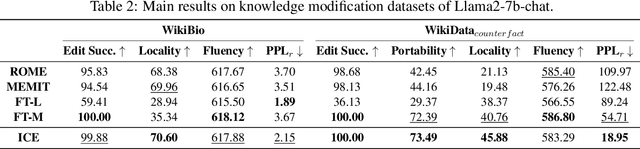
The existing fine-tuning paradigm for language models is brittle in knowledge editing scenarios, where the model must incorporate new information without extensive retraining. This brittleness often results in overfitting, reduced performance, and unnatural language generation. To address this, we propose Consistent In-Context Editing (ICE), a novel approach that leverages the model's in-context learning capability to tune toward a contextual distribution rather than a one-hot target. ICE introduces a straightforward optimization framework that includes both a target and a procedure, enhancing the robustness and effectiveness of gradient-based tuning methods. We provide analytical insights into ICE across four critical aspects of knowledge editing: accuracy, locality, generalization, and linguistic quality, showing its advantages. Experimental results across four datasets confirm the effectiveness of ICE and demonstrate its potential for continual editing, ensuring that updated information is incorporated while preserving the integrity of the model.
CivRealm: A Learning and Reasoning Odyssey in Civilization for Decision-Making Agents
Jan 19, 2024


The generalization of decision-making agents encompasses two fundamental elements: learning from past experiences and reasoning in novel contexts. However, the predominant emphasis in most interactive environments is on learning, often at the expense of complexity in reasoning. In this paper, we introduce CivRealm, an environment inspired by the Civilization game. Civilization's profound alignment with human history and society necessitates sophisticated learning, while its ever-changing situations demand strong reasoning to generalize. Particularly, CivRealm sets up an imperfect-information general-sum game with a changing number of players; it presents a plethora of complex features, challenging the agent to deal with open-ended stochastic environments that require diplomacy and negotiation skills. Within CivRealm, we provide interfaces for two typical agent types: tensor-based agents that focus on learning, and language-based agents that emphasize reasoning. To catalyze further research, we present initial results for both paradigms. The canonical RL-based agents exhibit reasonable performance in mini-games, whereas both RL- and LLM-based agents struggle to make substantial progress in the full game. Overall, CivRealm stands as a unique learning and reasoning challenge for decision-making agents. The code is available at https://github.com/bigai-ai/civrealm.