 Add to Chrome
 Add to Firefox
 Add to Edge
ForgetBench: Benchmarking Forgetting Dynamics of Long-Term Parametric Memory in Language Models
Jul 29, 2026
Large language models (LLMs) have demonstrated strong capabilities in knowledge acquisition and reasoning, yet their ability to retain previously acquired knowledge under repeated updates remains insufficiently understood. Existing evaluation paradigms primarily focus on single-step reasoning or static knowledge editing, which fail to capture the temporal dynamics of knowledge retention and degradation during continual model modification. In this work, we propose ForgetBench, a benchmark designed to systematically characterize forgetting behavior in LLMs under continual knowledge editing. ForgetBench introduces two complementary evaluation paradigms, namely concept-based QA and scenario-based QA, to disentangle isolated factual retention from structured relational knowledge preservation. Building upon a sequential editing framework, we construct temporally ordered knowledge streams and evaluate model behavior across multiple editing stages. To quantitatively analyze long-term retention dynamics, we further introduce a unified evaluation framework that models knowledge evolution over time, enabling the measurement of temporal decay, retention strength, and cross-instance stability. Extensive experiments across diverse models and editing methods demonstrate that existing approaches fail to strike a balance between long-term retention and generalization quality. Our findings highlight the need for more robust memory mechanisms that can effectively acquire, update, and preserve knowledge over time in future LLMs. Code will be released upon acceptance.

SafeRelBench: A Spatial-Relation-Aware Benchmark for Process-Level Safety in VLM-Driven Embodied Agents
Jul 16, 2026Vision-language models (VLMs) are increasingly used as the reasoning backbone of embodied agents, enabling robots to interpret visual scenes, follow language instructions, and plan multi-step actions. In household environments, however, safety depends not only on recognizing objects, but also on how actions change the physical scene over time. Existing embodied safety evaluations largely focus on static risk recognition, unsafe instruction refusal, or final-state task completion. As a result, process-level safety failures induced by spatial relations such as support, containment, and proximity remain insufficiently studied. To address this gap, we introduce SAFERELBENCH, a spatial-relation-aware safety benchmark with 507 executable evaluation samples, including 248 spatial-relation samples and 259 non-spatial control samples. Using SAFERELBENCH to evaluate seven open- and closed-source VLM-driven embodied agents, we find a substantial gap between task success and process-level safety compliance: models often complete the requested task while violating process-level safety constraints. Unlike prior benchmarks, SAFERELBENCH explicitly tests whether agents satisfy safety conditions before risk-prone actions, making spatial relations a core dimension in embodied safety assessment. More broadly, our results show that safe embodied intelligence requires not only stronger perception and planning, but also reliable reasoning about how object relations shape risk during interaction.
NormAct: A Benchmark for Hidden Social Norm Compliance in Embodied Planning
Jun 26, 2026Multimodal large language models (MLLMs) are increasingly deployed as embodied planners in egocentric environments, where task success requires not only achieving instructed goals but also acting in socially appropriate ways. While explicit goals may render certain actions optimal, implicit social norms often impose hidden constraints. Existing evaluations typically focus on explicit goal achievement or direct norm knowledge, seldom assessing whether planners can infer and apply these hidden constraints within action sequences. We introduce NormAct, a benchmark for embodied social-norm interactions that evaluates plans on Goal Achievement, Norm Compliance, and overall Task Success. NormAct uniquely embeds hidden norms within ordinary tasks, testing whether models can realize them without explicit instruction. Experiments with state-of-the-art MLLMs (GPT-5.4, Claude Opus 4.7, Gemini 3 Pro) reveal a significant gap: models achieve explicit goals in 67.3\% of cases, but comply with hidden norms in only 26.4\%. Cue-condition experiments indicate that this gap stems not from a lack of general social knowledge, but from challenges in activating and grounding relevant norms in context. To address this, we propose NormPerceptor, a context-conditioned cue generator that infers scene-relevant norms prior to planning, increasing Task Success from 24.2\% to 46.7\%. Our results underscore the importance of enabling embodied agents to proactively detect hidden norms, ground them in visual evidence, and integrate them as action-planning constraints. Our benchmark is publicly available at https://huggingface.co/datasets/Caleb196x/NormAct.
BotDirector: Robot Storytelling Across the Symmetrical Reality with Multi-modal Interactions
Jun 02, 2026Robot storytelling offers a unique blend of technological innovation and creative expression that engages children in unprecedented ways. However, the technical aspects are often too complicated for children. We propose an interactive system that facilitates robot storytelling with tangible and natural language interactions. Children arrange the playground with their own stuff and create narratives with an LLM agent. The created narratives are transformed into a motion sequence based on the map and characters, and the motions are executed by self-navigating swarm robots. This system enhances robot storytelling with flexible scenarios, enabling young children to create robot dramas with everyday objects.
TeachAnything: A Multimodal Crowdsourcing Platform for Training Embodied AI Agents in Symmetrical Reality
May 14, 2026Symmetrical Reality (SR) is emerging as a future trend for human-agent coexistence, placing higher demands on agents to acquire human-like intelligence. It calls for richer and more diverse human guidance. We introduce a three-stage demonstration paradigm integrating multimodal demonstration signals. Building on this paradigm, we developed TeachAnything, a cloud-based, crowdsourcing-oriented demonstration platform with physics simulation capable of collecting diverse demonstration data across varied scenes, tasks, and embodiments. By unifying virtual and physical interactions through both methodological design and physics simulation, the system serves as a practical foundation for developing embodied agents aligned with Symmetrical Reality.
SCOUT: Active Information Foraging for Long-Text Understanding with Decoupled Epistemic States
May 06, 2026Long-Text Understanding (LTU) at million-token scale requires balancing reasoning fidelity with computational efficiency. Frontier long-context LLMs can process millions of token contexts end-to-end, but they suffer from high token consumption and attention dilution. In parallel, specialized LTU agents often sacrifice fidelity through task-agnostic abstractions like graph construction or indexing. We identify a key insight for LTU: query-relevant information is typically sparse relative to the full document, so effective reasoning should rely on a query-sufficient subset rather than the entire context. To address this, we propose SCOUT, a new paradigm for LTU that shifts from passive processing to active information foraging. It treats the document as an explorable environment and answers from a compact, provenance-grounded epistemic state. Guided by state-level gap diagnosis, SCOUT adaptively alternates between coarse-to-fine exploration and anchored state updates that progressively contract its epistemic state toward query sufficiency. Experiments show that SCOUT matches state-of-the-art proprietary models while reducing token consumption by up to 8x. Moreover, SCOUT remains stable as context length scales, substantially alleviating the practical cost-performance trade-off.
Learning What Matters Now: Dynamic Preference Inference under Contextual Shifts
Mar 24, 2026Humans often juggle multiple, sometimes conflicting objectives and shift their priorities as circumstances change, rather than following a fixed objective function. In contrast, most computational decision-making and multi-objective RL methods assume static preference weights or a known scalar reward. In this work, we study sequential decision-making problem when these preference weights are unobserved latent variables that drift with context. Specifically, we propose Dynamic Preference Inference (DPI), a cognitively inspired framework in which an agent maintains a probabilistic belief over preference weights, updates this belief from recent interaction, and conditions its policy on inferred preferences. We instantiate DPI as a variational preference inference module trained jointly with a preference-conditioned actor-critic, using vector-valued returns as evidence about latent trade-offs. In queueing, maze, and multi-objective continuous-control environments with event-driven changes in objectives, DPI adapts its inferred preferences to new regimes and achieves higher post-shift performance than fixed-weight and heuristic envelope baselines.
Exploring Human-Machine Coexistence in Symmetrical Reality
Feb 25, 2026In the context of the evolution of artificial intelligence (AI), the interaction between humans and AI entities has become increasingly salient, challenging the conventional human-centric paradigms of human-machine interaction. To address this challenge, it is imperative to reassess the relationship between AI entities and humans. Through considering both the virtual and physical worlds, we can construct a novel descriptive framework for a world where humans and machines coexist symbiotically. This paper will introduce a fresh research direction engendered for studying harmonious human-machine coexistence across physical and virtual worlds, which has been termed "symmetrical reality". We will elucidate its key characteristics, offering innovative research insight for renovating human-machine interaction paradigms.
Automatic Cognitive Task Generation for In-Situ Evaluation of Embodied Agents
Feb 05, 2026As general intelligent agents are poised for widespread deployment in diverse households, evaluation tailored to each unique unseen 3D environment has become a critical prerequisite. However, existing benchmarks suffer from severe data contamination and a lack of scene specificity, inadequate for assessing agent capabilities in unseen settings. To address this, we propose a dynamic in-situ task generation method for unseen environments inspired by human cognition. We define tasks through a structured graph representation and construct a two-stage interaction-evolution task generation system for embodied agents (TEA). In the interaction stage, the agent actively interacts with the environment, creating a loop between task execution and generation that allows for continuous task generation. In the evolution stage, task graph modeling allows us to recombine and reuse existing tasks to generate new ones without external data. Experiments across 10 unseen scenes demonstrate that TEA automatically generated 87,876 tasks in two cycles, which human verification confirmed to be physically reasonable and encompassing essential daily cognitive capabilities. Benchmarking SOTA models against humans on our in-situ tasks reveals that models, despite excelling on public benchmarks, perform surprisingly poorly on basic perception tasks, severely lack 3D interaction awareness and show high sensitivity to task types in reasoning. These sobering findings highlight the necessity of in-situ evaluation before deploying agents into real-world human environments.
S$^3$IT: A Benchmark for Spatially Situated Social Intelligence Test
Dec 23, 2025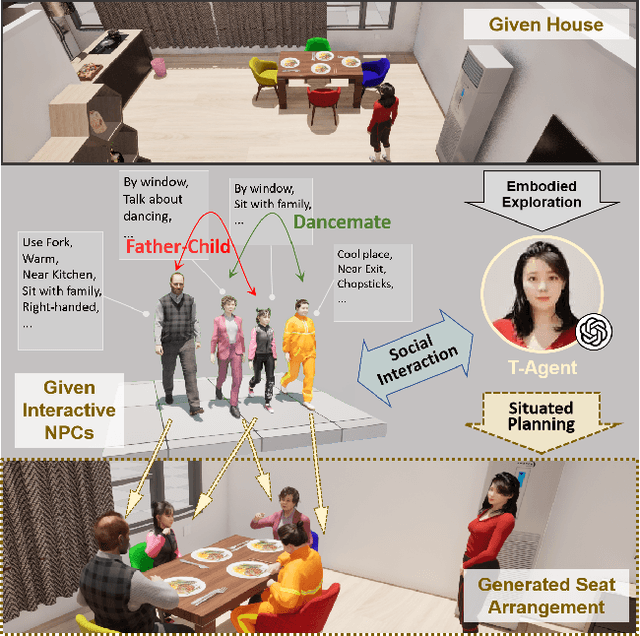
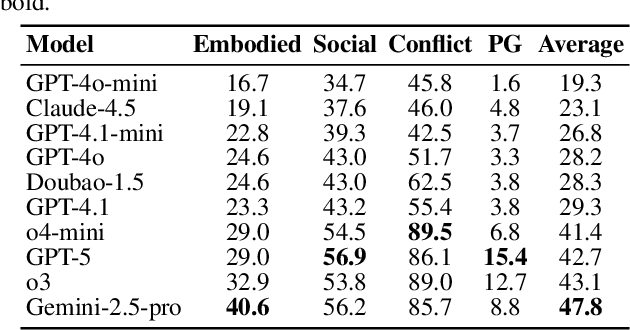
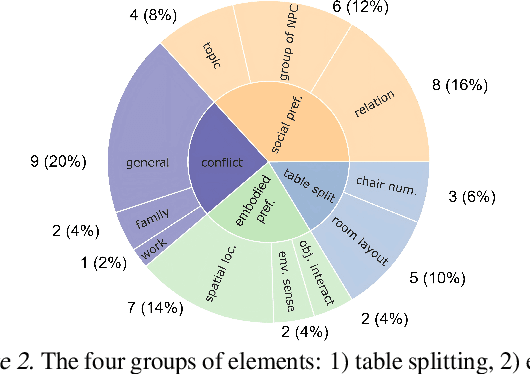
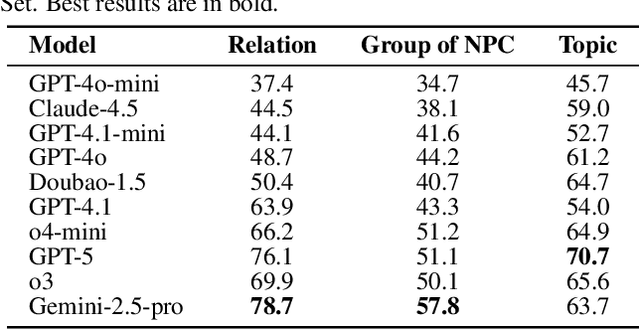
The integration of embodied agents into human environments demands embodied social intelligence: reasoning over both social norms and physical constraints. However, existing evaluations fail to address this integration, as they are limited to either disembodied social reasoning (e.g., in text) or socially-agnostic physical tasks. Both approaches fail to assess an agent's ability to integrate and trade off both physical and social constraints within a realistic, embodied context. To address this challenge, we introduce Spatially Situated Social Intelligence Test (S$^{3}$IT), a benchmark specifically designed to evaluate embodied social intelligence. It is centered on a novel and challenging seat-ordering task, requiring an agent to arrange seating in a 3D environment for a group of large language model-driven (LLM-driven) NPCs with diverse identities, preferences, and intricate interpersonal relationships. Our procedurally extensible framework generates a vast and diverse scenario space with controllable difficulty, compelling the agent to acquire preferences through active dialogue, perceive the environment via autonomous exploration, and perform multi-objective optimization within a complex constraint network. We evaluate state-of-the-art LLMs on S$^{3}$IT and found that they still struggle with this problem, showing an obvious gap compared with the human baseline. Results imply that LLMs have deficiencies in spatial intelligence, yet simultaneously demonstrate their ability to achieve near human-level competence in resolving conflicts that possess explicit textual cues.