 Add to Chrome
 Add to Firefox
 Add to Edge
A Monolithic Hand with Asymmetric Origami Bending and Dual-chamber Actuators
Jul 24, 2026
The passive adaptability inherent in soft robotic hands affords them advantages in applications that require safe and compliant interaction. However, existing soft robotic hands often struggle to simultaneously achieve adequate output performance and easy manufacturing due to their complicated structures. In this paper, we introduce the asymmetric origami bending (AOB) pattern for generating bending motion and the asymmetric dual-chamber (ADC) design for obtaining multifunction capability. The AOB single (AOB-S) chamber and AOB dual-chamber (AOB-D) units are designed and constitute the finger and palm actuators of the proposed Origami-inspired SOft Robotic (OSOR) hand. The OSOR hand achieves bio-inspired fingers-palm motions and adequate output performance within a monolithic structure that significantly simplifies the manufacturing process. By defining the asymmetric ratio to characterize the geometric asymmetry of the unit, the analytical models of the AOB and ADC structures are proposed. The Finite Element Analysis tool for the design of AOB actuators is obtained by geometric analysis. The asymmetric origami design grants the integrated manufacturing of the OSOR hand through a Selective Laser Sintering printing process with a single thermoplastic polyurethane material. The model and simulations are validated by experimental results. Experiments show the finger and palm maximum bending motion range of 203° and 40°, respectively, with output forces of 6.3 N and 16 N. The OSOR hand is capable of pinching a piece of tissue, stably grasping water bottles with two fingers, palm-only grasping, and completing the power grasps in the taxonomy of manufacturing grasps. The compactness, performance, and easy manufacturing of the proposed hand benefit the development of the soft robotic hand with new possibilities.

ReA-OVCD: Reliability-Aware Open-Vocabulary Change Detection via Semantic and Spatial Refinement
Jun 18, 2026Unlike traditional remote sensing change detection that relies on predefined categories, Open-Vocabulary Change Detection (OVCD) identifies land cover changes flexibly using arbitrary text prompts. However, existing methods suffer from an inherent trade-off when modeling changes: instance-level comparison overlooks fine-grained semantic variations (e.g., partial building extensions), while direct pixel comparison proves unreliable, yielding unstable responses and boundary artifacts due to semantic ambiguity and spatial inconsistency. To this end, we propose an efficient training-free Reliability-Aware Open-Vocabulary Change Detection (ReA-OVCD) framework. It first derives candidate change regions from pixel-wise semantic discrepancies to ensure flexible and detailed localization. To ensure reliability, it subsequently introduces a collaborative refinement strategy to explicitly model change validity from both semantic and spatial perspectives. Specifically, we develop a Semantic Change Reasoning (SCR) module that reassesses changes by jointly analyzing distributional divergence and response variation, enabling the suppression of incidental inconsistencies while preserving reliable semantic shifts. In addition, a Boundary-aware Change Refinement (BCR) module is designed to mitigate artifacts stemming from boundary misalignment and uncertainty through validating whether candidate regions are supported by reliable interior pixels. Extensive experiments across multiple datasets (LEVIR-CD, WHU-CD, DSIFN, and SECOND) demonstrate that our method consistently outperforms state-of-the-art approaches, achieving $\mathrm{F}_{1}^{C}$ improvements of 2.13\% to 9.75\% with higher computational efficiency. The code is publicly available at \https://github.com/Funny0101/ReA-OVCD
R-DMesh: Video-Guided 3D Animation via Rectified Dynamic Mesh Flow
May 14, 2026Video-guided 3D animation holds immense potential for content creation, offering intuitive and precise control over dynamic assets. However, practical deployment faces a critical yet frequently overlooked hurdle: the pose misalignment dilemma. In real-world scenarios, the initial pose of a user-provided static mesh rarely aligns with the starting frame of a reference video. Naively forcing a mesh to follow a mismatched trajectory inevitably leads to severe geometric distortion or animation failure. To address this, we present Rectified Dynamic Mesh (R-DMesh), a unified framework designed to generate high-fidelity 4D meshes that are ``rectified'' to align with video context. Unlike standard motion transfer approaches, our method introduces a novel VAE that explicitly disentangles the input into a conditional base mesh, relative motion trajectories, and a crucial rectification jump offset. This offset is learned to automatically transform the arbitrary pose of the input mesh to match the video's initial state before animation begins. We process these components via a Triflow Attention mechanism, which leverages vertex-wise geometric features to modulate the three orthogonal flows, ensuring physical consistency and local rigidity during the rectification and animation process. For generation, we employ a Rectified Flow-based Diffusion Transformer conditioned on pre-trained video latents, effectively transferring rich spatio-temporal priors to the 3D domain. To support this task, we construct Video-RDMesh, a large-scale dataset of over 500k dynamic mesh sequences specifically curated to simulate pose misalignment. Extensive experiments demonstrate that R-DMesh not only solves the alignment problem but also enables robust downstream applications, including pose retargeting and holistic 4D generation.
HY-World 2.0: A Multi-Modal World Model for Reconstructing, Generating, and Simulating 3D Worlds
Apr 15, 2026We introduce HY-World 2.0, a multi-modal world model framework that advances our prior project HY-World 1.0. HY-World 2.0 accommodates diverse input modalities, including text prompts, single-view images, multi-view images, and videos, and produces 3D world representations. With text or single-view image inputs, the model performs world generation, synthesizing high-fidelity, navigable 3D Gaussian Splatting (3DGS) scenes. This is achieved through a four-stage method: a) Panorama Generation with HY-Pano 2.0, b) Trajectory Planning with WorldNav, c) World Expansion with WorldStereo 2.0, and d) World Composition with WorldMirror 2.0. Specifically, we introduce key innovations to enhance panorama fidelity, enable 3D scene understanding and planning, and upgrade WorldStereo, our keyframe-based view generation model with consistent memory. We also upgrade WorldMirror, a feed-forward model for universal 3D prediction, by refining model architecture and learning strategy, enabling world reconstruction from multi-view images or videos. Also, we introduce WorldLens, a high-performance 3DGS rendering platform featuring a flexible engine-agnostic architecture, automatic IBL lighting, efficient collision detection, and training-rendering co-design, enabling interactive exploration of 3D worlds with character support. Extensive experiments demonstrate that HY-World 2.0 achieves state-of-the-art performance on several benchmarks among open-source approaches, delivering results comparable to the closed-source model Marble. We release all model weights, code, and technical details to facilitate reproducibility and support further research on 3D world models.
ShortCoder: Knowledge-Augmented Syntax Optimization for Token-Efficient Code Generation
Jan 14, 2026Code generation tasks aim to automate the conversion of user requirements into executable code, significantly reducing manual development efforts and enhancing software productivity. The emergence of large language models (LLMs) has significantly advanced code generation, though their efficiency is still impacted by certain inherent architectural constraints. Each token generation necessitates a complete inference pass, requiring persistent retention of contextual information in memory and escalating resource consumption. While existing research prioritizes inference-phase optimizations such as prompt compression and model quantization, the generation phase remains underexplored. To tackle these challenges, we propose a knowledge-infused framework named ShortCoder, which optimizes code generation efficiency while preserving semantic equivalence and readability. In particular, we introduce: (1) ten syntax-level simplification rules for Python, derived from AST-preserving transformations, achieving 18.1% token reduction without functional compromise; (2) a hybrid data synthesis pipeline integrating rule-based rewriting with LLM-guided refinement, producing ShorterCodeBench, a corpus of validated tuples of original code and simplified code with semantic consistency; (3) a fine-tuning strategy that injects conciseness awareness into the base LLMs. Extensive experimental results demonstrate that ShortCoder consistently outperforms state-of-the-art methods on HumanEval, achieving an improvement of 18.1%-37.8% in generation efficiency over previous methods while ensuring the performance of code generation.
Hunyuan3D Studio: End-to-End AI Pipeline for Game-Ready 3D Asset Generation
Sep 16, 2025
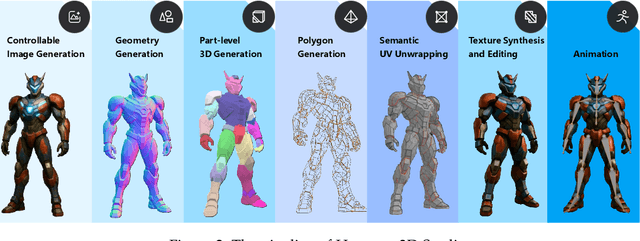

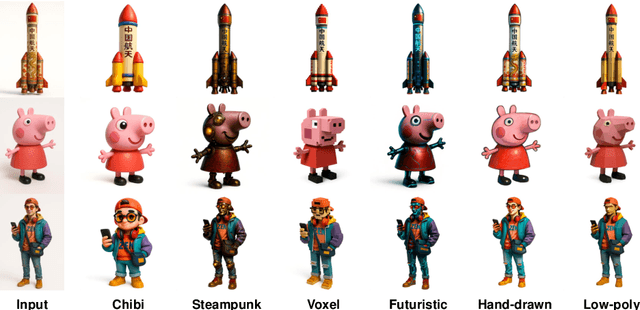
The creation of high-quality 3D assets, a cornerstone of modern game development, has long been characterized by labor-intensive and specialized workflows. This paper presents Hunyuan3D Studio, an end-to-end AI-powered content creation platform designed to revolutionize the game production pipeline by automating and streamlining the generation of game-ready 3D assets. At its core, Hunyuan3D Studio integrates a suite of advanced neural modules (such as Part-level 3D Generation, Polygon Generation, Semantic UV, etc.) into a cohesive and user-friendly system. This unified framework allows for the rapid transformation of a single concept image or textual description into a fully-realized, production-quality 3D model complete with optimized geometry and high-fidelity PBR textures. We demonstrate that assets generated by Hunyuan3D Studio are not only visually compelling but also adhere to the stringent technical requirements of contemporary game engines, significantly reducing iteration time and lowering the barrier to entry for 3D content creation. By providing a seamless bridge from creative intent to technical asset, Hunyuan3D Studio represents a significant leap forward for AI-assisted workflows in game development and interactive media.
HunyuanWorld 1.0: Generating Immersive, Explorable, and Interactive 3D Worlds from Words or Pixels
Jul 29, 2025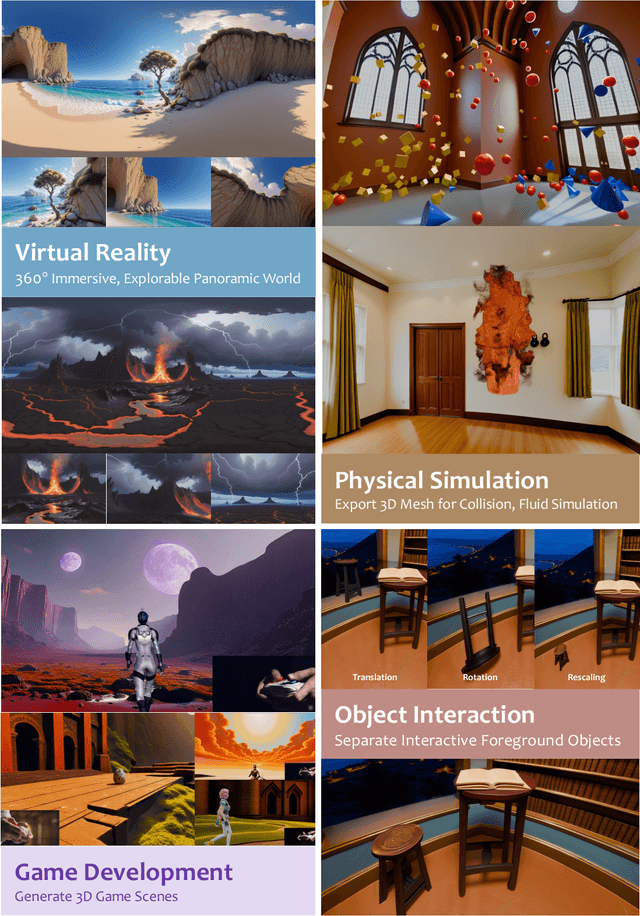

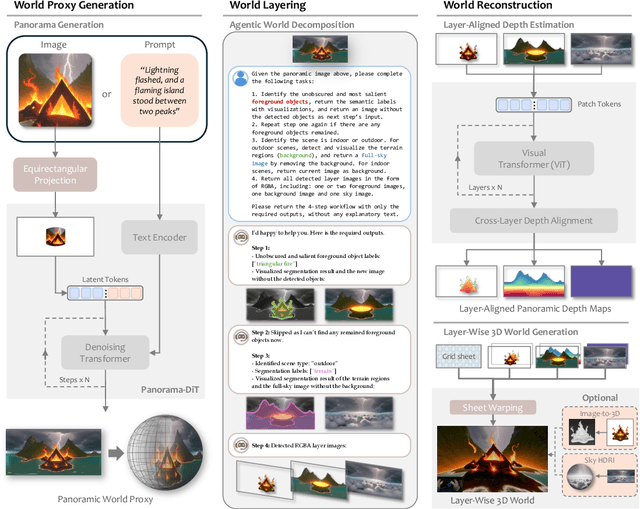
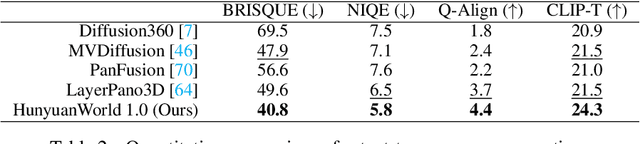
Creating immersive and playable 3D worlds from texts or images remains a fundamental challenge in computer vision and graphics. Existing world generation approaches typically fall into two categories: video-based methods that offer rich diversity but lack 3D consistency and rendering efficiency, and 3D-based methods that provide geometric consistency but struggle with limited training data and memory-inefficient representations. To address these limitations, we present HunyuanWorld 1.0, a novel framework that combines the best of both worlds for generating immersive, explorable, and interactive 3D scenes from text and image conditions. Our approach features three key advantages: 1) 360{\deg} immersive experiences via panoramic world proxies; 2) mesh export capabilities for seamless compatibility with existing computer graphics pipelines; 3) disentangled object representations for augmented interactivity. The core of our framework is a semantically layered 3D mesh representation that leverages panoramic images as 360{\deg} world proxies for semantic-aware world decomposition and reconstruction, enabling the generation of diverse 3D worlds. Extensive experiments demonstrate that our method achieves state-of-the-art performance in generating coherent, explorable, and interactive 3D worlds while enabling versatile applications in virtual reality, physical simulation, game development, and interactive content creation.
Hunyuan3D 2.1: From Images to High-Fidelity 3D Assets with Production-Ready PBR Material
Jun 18, 20253D AI-generated content (AIGC) is a passionate field that has significantly accelerated the creation of 3D models in gaming, film, and design. Despite the development of several groundbreaking models that have revolutionized 3D generation, the field remains largely accessible only to researchers, developers, and designers due to the complexities involved in collecting, processing, and training 3D models. To address these challenges, we introduce Hunyuan3D 2.1 as a case study in this tutorial. This tutorial offers a comprehensive, step-by-step guide on processing 3D data, training a 3D generative model, and evaluating its performance using Hunyuan3D 2.1, an advanced system for producing high-resolution, textured 3D assets. The system comprises two core components: the Hunyuan3D-DiT for shape generation and the Hunyuan3D-Paint for texture synthesis. We will explore the entire workflow, including data preparation, model architecture, training strategies, evaluation metrics, and deployment. By the conclusion of this tutorial, you will have the knowledge to finetune or develop a robust 3D generative model suitable for applications in gaming, virtual reality, and industrial design.
Learning Generalizable Skills from Offline Multi-Task Data for Multi-Agent Cooperation
Mar 27, 2025Learning cooperative multi-agent policy from offline multi-task data that can generalize to unseen tasks with varying numbers of agents and targets is an attractive problem in many scenarios. Although aggregating general behavior patterns among multiple tasks as skills to improve policy transfer is a promising approach, two primary challenges hinder the further advancement of skill learning in offline multi-task MARL. Firstly, extracting general cooperative behaviors from various action sequences as common skills lacks bringing cooperative temporal knowledge into them. Secondly, existing works only involve common skills and can not adaptively choose independent knowledge as task-specific skills in each task for fine-grained action execution. To tackle these challenges, we propose Hierarchical and Separate Skill Discovery (HiSSD), a novel approach for generalizable offline multi-task MARL through skill learning. HiSSD leverages a hierarchical framework that jointly learns common and task-specific skills. The common skills learn cooperative temporal knowledge and enable in-sample exploitation for offline multi-task MARL. The task-specific skills represent the priors of each task and achieve a task-guided fine-grained action execution. To verify the advancement of our method, we conduct experiments on multi-agent MuJoCo and SMAC benchmarks. After training the policy using HiSSD on offline multi-task data, the empirical results show that HiSSD assigns effective cooperative behaviors and obtains superior performance in unseen tasks.
SURGEON: Memory-Adaptive Fully Test-Time Adaptation via Dynamic Activation Sparsity
Mar 26, 2025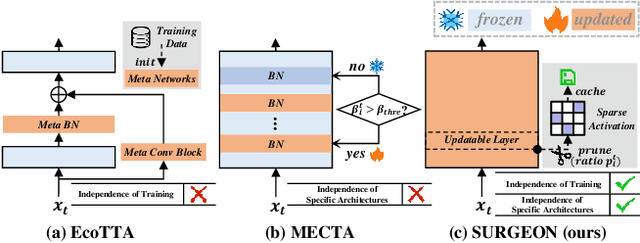
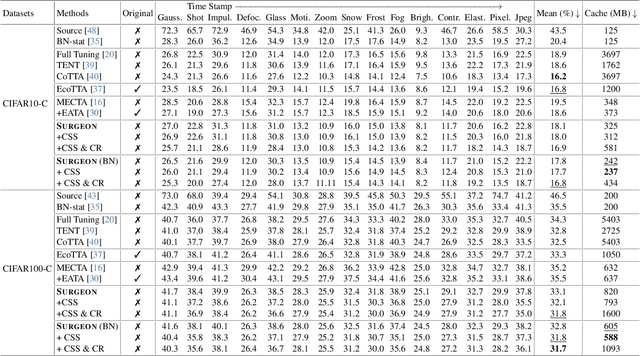
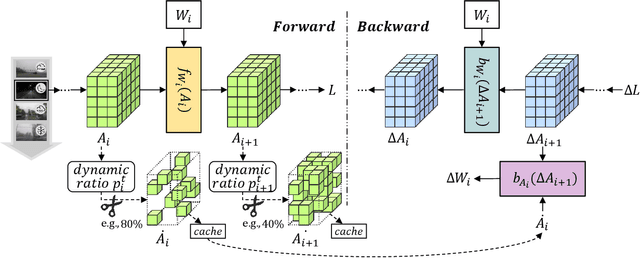
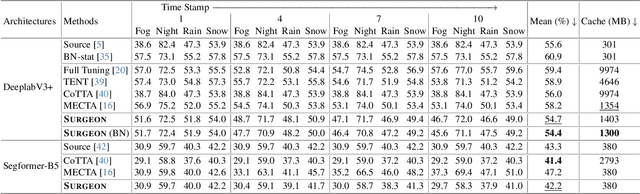
Despite the growing integration of deep models into mobile terminals, the accuracy of these models declines significantly due to various deployment interferences. Test-time adaptation (TTA) has emerged to improve the performance of deep models by adapting them to unlabeled target data online. Yet, the significant memory cost, particularly in resource-constrained terminals, impedes the effective deployment of most backward-propagation-based TTA methods. To tackle memory constraints, we introduce SURGEON, a method that substantially reduces memory cost while preserving comparable accuracy improvements during fully test-time adaptation (FTTA) without relying on specific network architectures or modifications to the original training procedure. Specifically, we propose a novel dynamic activation sparsity strategy that directly prunes activations at layer-specific dynamic ratios during adaptation, allowing for flexible control of learning ability and memory cost in a data-sensitive manner. Among this, two metrics, Gradient Importance and Layer Activation Memory, are considered to determine the layer-wise pruning ratios, reflecting accuracy contribution and memory efficiency, respectively. Experimentally, our method surpasses the baselines by not only reducing memory usage but also achieving superior accuracy, delivering SOTA performance across diverse datasets, architectures, and tasks.