 Add to Chrome
 Add to Firefox
 Add to Edge
ShortCoder: Knowledge-Augmented Syntax Optimization for Token-Efficient Code Generation
Jan 14, 2026
Code generation tasks aim to automate the conversion of user requirements into executable code, significantly reducing manual development efforts and enhancing software productivity. The emergence of large language models (LLMs) has significantly advanced code generation, though their efficiency is still impacted by certain inherent architectural constraints. Each token generation necessitates a complete inference pass, requiring persistent retention of contextual information in memory and escalating resource consumption. While existing research prioritizes inference-phase optimizations such as prompt compression and model quantization, the generation phase remains underexplored. To tackle these challenges, we propose a knowledge-infused framework named ShortCoder, which optimizes code generation efficiency while preserving semantic equivalence and readability. In particular, we introduce: (1) ten syntax-level simplification rules for Python, derived from AST-preserving transformations, achieving 18.1% token reduction without functional compromise; (2) a hybrid data synthesis pipeline integrating rule-based rewriting with LLM-guided refinement, producing ShorterCodeBench, a corpus of validated tuples of original code and simplified code with semantic consistency; (3) a fine-tuning strategy that injects conciseness awareness into the base LLMs. Extensive experimental results demonstrate that ShortCoder consistently outperforms state-of-the-art methods on HumanEval, achieving an improvement of 18.1%-37.8% in generation efficiency over previous methods while ensuring the performance of code generation.

Agents in Software Engineering: Survey, Landscape, and Vision
Sep 13, 2024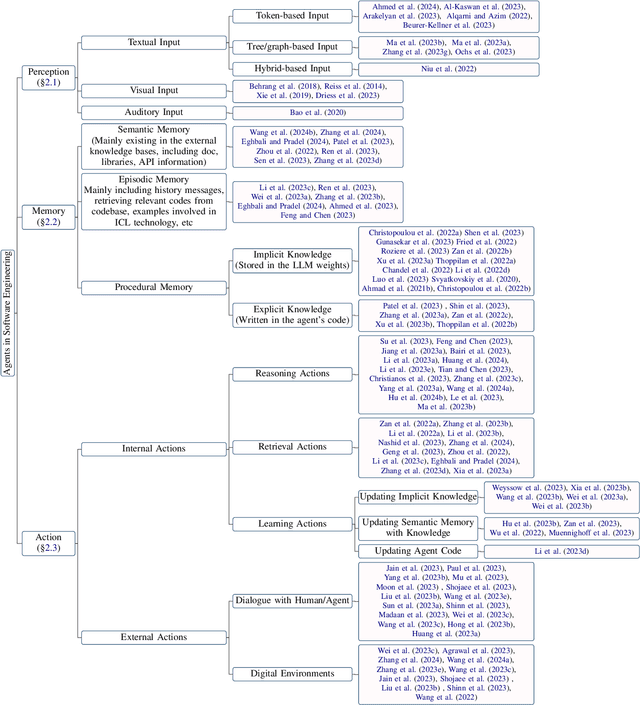
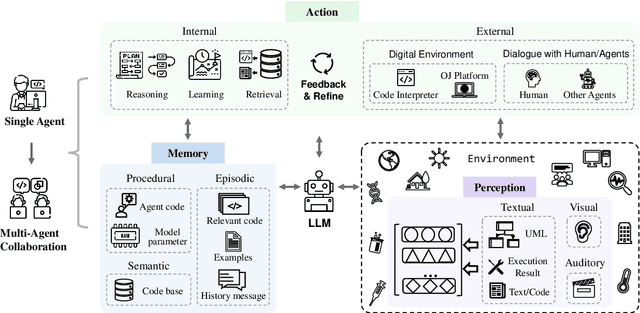
In recent years, Large Language Models (LLMs) have achieved remarkable success and have been widely used in various downstream tasks, especially in the tasks of the software engineering (SE) field. We find that many studies combining LLMs with SE have employed the concept of agents either explicitly or implicitly. However, there is a lack of an in-depth survey to sort out the development context of existing works, analyze how existing works combine the LLM-based agent technologies to optimize various tasks, and clarify the framework of LLM-based agents in SE. In this paper, we conduct the first survey of the studies on combining LLM-based agents with SE and present a framework of LLM-based agents in SE which includes three key modules: perception, memory, and action. We also summarize the current challenges in combining the two fields and propose future opportunities in response to existing challenges. We maintain a GitHub repository of the related papers at: https://github.com/DeepSoftwareAnalytics/Awesome-Agent4SE.