 Add to Chrome
 Add to Firefox
 Add to Edge
Tactile-based Object Retrieval From Granular Media
Feb 21, 2024


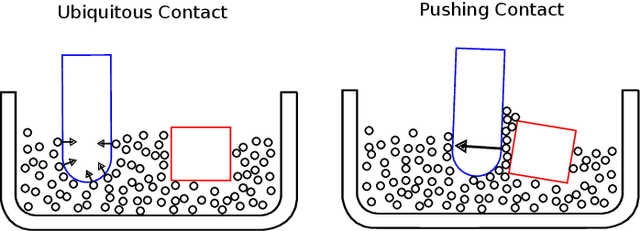
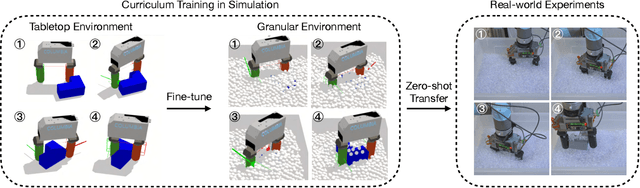
We introduce GEOTACT, a robotic manipulation method capable of retrieving objects buried in granular media. This is a challenging task due to the need to interact with granular media, and doing so based exclusively on tactile feedback, since a buried object can be completely hidden from vision. Tactile feedback is in itself challenging in this context, due to ubiquitous contact with the surrounding media, and the inherent noise level induced by the tactile readings. To address these challenges, we use a learning method trained end-to-end with simulated sensor noise. We show that our problem formulation leads to the natural emergence of learned pushing behaviors that the manipulator uses to reduce uncertainty and funnel the object to a stable grasp despite spurious and noisy tactile readings. We also introduce a training curriculum that enables learning these behaviors in simulation, followed by zero-shot transfer to real hardware. To the best of our knowledge, GEOTACT is the first method to reliably retrieve a number of different objects from a granular environment, doing so on real hardware and with integrated tactile sensing. Videos and additional information can be found at https://jxu.ai/geotact.

Universal Manipulation Interface: In-The-Wild Robot Teaching Without In-The-Wild Robots
Feb 19, 2024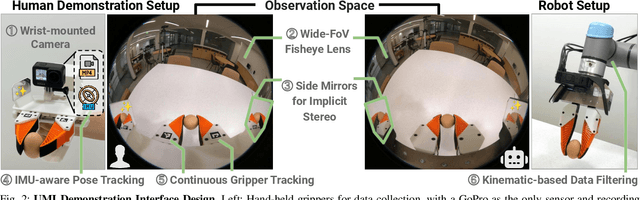
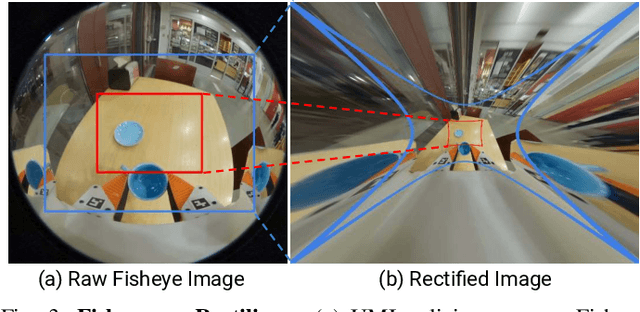
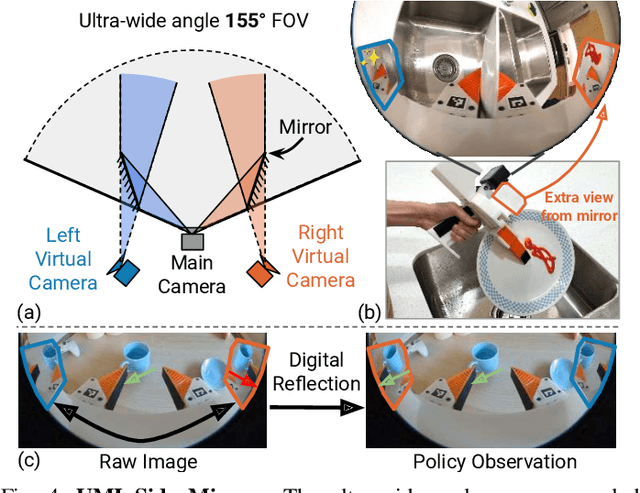

We present Universal Manipulation Interface (UMI) -- a data collection and policy learning framework that allows direct skill transfer from in-the-wild human demonstrations to deployable robot policies. UMI employs hand-held grippers coupled with careful interface design to enable portable, low-cost, and information-rich data collection for challenging bimanual and dynamic manipulation demonstrations. To facilitate deployable policy learning, UMI incorporates a carefully designed policy interface with inference-time latency matching and a relative-trajectory action representation. The resulting learned policies are hardware-agnostic and deployable across multiple robot platforms. Equipped with these features, UMI framework unlocks new robot manipulation capabilities, allowing zero-shot generalizable dynamic, bimanual, precise, and long-horizon behaviors, by only changing the training data for each task. We demonstrate UMI's versatility and efficacy with comprehensive real-world experiments, where policies learned via UMI zero-shot generalize to novel environments and objects when trained on diverse human demonstrations. UMI's hardware and software system is open-sourced at https://umi-gripper.github.io.
Foundation Models in Robotics: Applications, Challenges, and the Future
Dec 13, 2023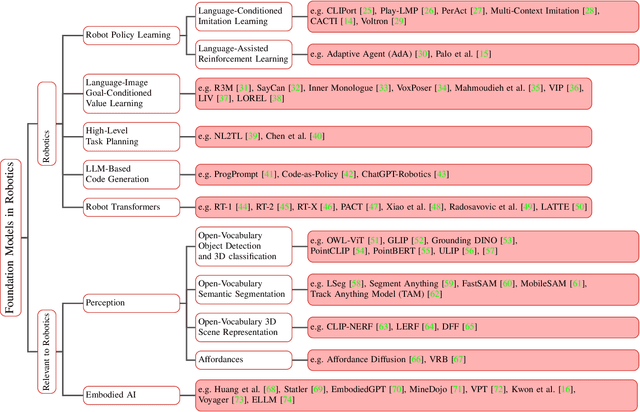


We survey applications of pretrained foundation models in robotics. Traditional deep learning models in robotics are trained on small datasets tailored for specific tasks, which limits their adaptability across diverse applications. In contrast, foundation models pretrained on internet-scale data appear to have superior generalization capabilities, and in some instances display an emergent ability to find zero-shot solutions to problems that are not present in the training data. Foundation models may hold the potential to enhance various components of the robot autonomy stack, from perception to decision-making and control. For example, large language models can generate code or provide common sense reasoning, while vision-language models enable open-vocabulary visual recognition. However, significant open research challenges remain, particularly around the scarcity of robot-relevant training data, safety guarantees and uncertainty quantification, and real-time execution. In this survey, we study recent papers that have used or built foundation models to solve robotics problems. We explore how foundation models contribute to improving robot capabilities in the domains of perception, decision-making, and control. We discuss the challenges hindering the adoption of foundation models in robot autonomy and provide opportunities and potential pathways for future advancements. The GitHub project corresponding to this paper (Preliminary release. We are committed to further enhancing and updating this work to ensure its quality and relevance) can be found here: https://github.com/robotics-survey/Awesome-Robotics-Foundation-Models
MD-Splatting: Learning Metric Deformation from 4D Gaussians in Highly Deformable Scenes
Nov 30, 2023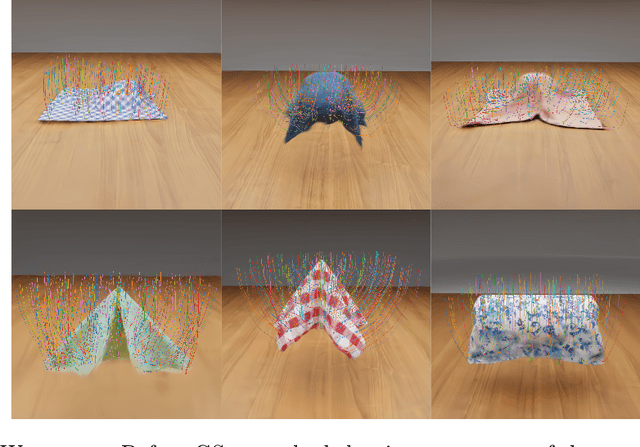

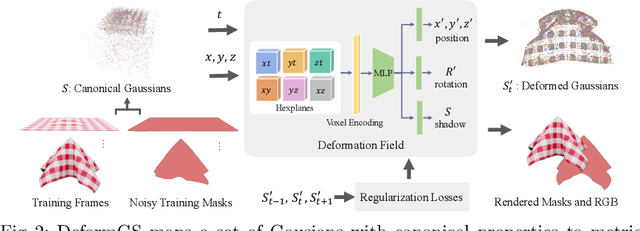
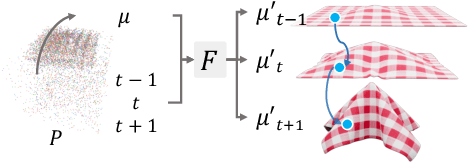
Accurate 3D tracking in highly deformable scenes with occlusions and shadows can facilitate new applications in robotics, augmented reality, and generative AI. However, tracking under these conditions is extremely challenging due to the ambiguity that arises with large deformations, shadows, and occlusions. We introduce MD-Splatting, an approach for simultaneous 3D tracking and novel view synthesis, using video captures of a dynamic scene from various camera poses. MD-Splatting builds on recent advances in Gaussian splatting, a method that learns the properties of a large number of Gaussians for state-of-the-art and fast novel view synthesis. MD-Splatting learns a deformation function to project a set of Gaussians with non-metric, thus canonical, properties into metric space. The deformation function uses a neural-voxel encoding and a multilayer perceptron (MLP) to infer Gaussian position, rotation, and a shadow scalar. We enforce physics-inspired regularization terms based on local rigidity, conservation of momentum, and isometry, which leads to trajectories with smaller trajectory errors. MD-Splatting achieves high-quality 3D tracking on highly deformable scenes with shadows and occlusions. Compared to state-of-the-art, we improve 3D tracking by an average of 23.9 %, while simultaneously achieving high-quality novel view synthesis. With sufficient texture such as in scene 6, MD-Splatting achieves a median tracking error of 3.39 mm on a cloth of 1 x 1 meters in size. Project website: https://md-splatting.github.io/.
Open X-Embodiment: Robotic Learning Datasets and RT-X Models
Oct 17, 2023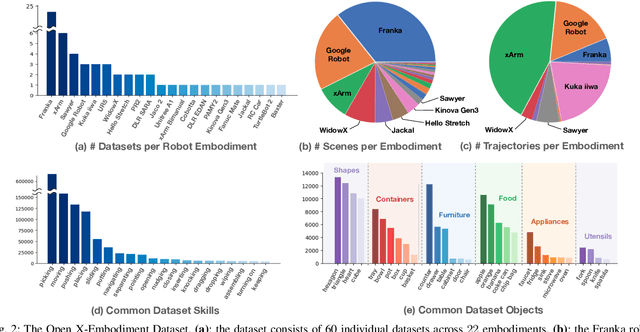
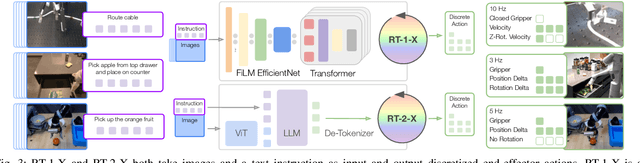


Large, high-capacity models trained on diverse datasets have shown remarkable successes on efficiently tackling downstream applications. In domains from NLP to Computer Vision, this has led to a consolidation of pretrained models, with general pretrained backbones serving as a starting point for many applications. Can such a consolidation happen in robotics? Conventionally, robotic learning methods train a separate model for every application, every robot, and even every environment. Can we instead train generalist X-robot policy that can be adapted efficiently to new robots, tasks, and environments? In this paper, we provide datasets in standardized data formats and models to make it possible to explore this possibility in the context of robotic manipulation, alongside experimental results that provide an example of effective X-robot policies. We assemble a dataset from 22 different robots collected through a collaboration between 21 institutions, demonstrating 527 skills (160266 tasks). We show that a high-capacity model trained on this data, which we call RT-X, exhibits positive transfer and improves the capabilities of multiple robots by leveraging experience from other platforms. More details can be found on the project website $\href{https://robotics-transformer-x.github.io}{\text{robotics-transformer-x.github.io}}$.
Scaling Up and Distilling Down: Language-Guided Robot Skill Acquisition
Jul 26, 2023We present a framework for robot skill acquisition, which 1) efficiently scale up data generation of language-labelled robot data and 2) effectively distills this data down into a robust multi-task language-conditioned visuo-motor policy. For (1), we use a large language model (LLM) to guide high-level planning, and sampling-based robot planners (e.g. motion or grasp samplers) for generating diverse and rich manipulation trajectories. To robustify this data-collection process, the LLM also infers a code-snippet for the success condition of each task, simultaneously enabling the data-collection process to detect failure and retry as well as the automatic labeling of trajectories with success/failure. For (2), we extend the diffusion policy single-task behavior-cloning approach to multi-task settings with language conditioning. Finally, we propose a new multi-task benchmark with 18 tasks across five domains to test long-horizon behavior, common-sense reasoning, tool-use, and intuitive physics. We find that our distilled policy successfully learned the robust retrying behavior in its data collection policy, while improving absolute success rates by 34.8% on average across five domains. The benchmark, code, and qualitative results are on our website https://www.cs.columbia.edu/~huy/scalingup/
RICo: Rotate-Inpaint-Complete for Generalizable Scene Reconstruction
Jul 21, 2023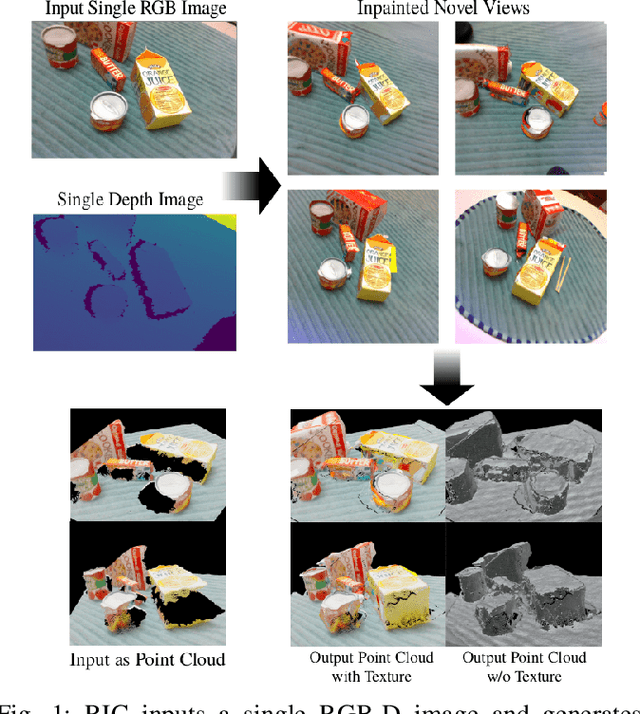
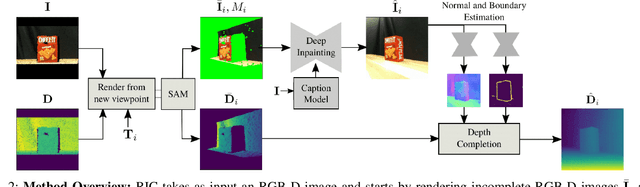
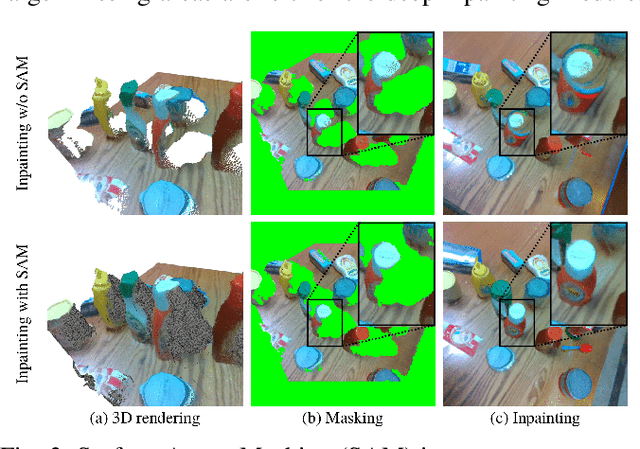
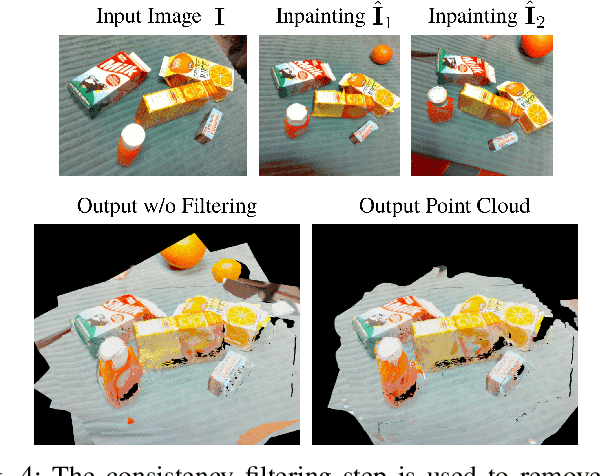
General scene reconstruction refers to the task of estimating the full 3D geometry and texture of a scene containing previously unseen objects. In many practical applications such as AR/VR, autonomous navigation, and robotics, only a single view of the scene may be available, making the scene reconstruction a very challenging task. In this paper, we present a method for scene reconstruction by structurally breaking the problem into two steps: rendering novel views via inpainting and 2D to 3D scene lifting. Specifically, we leverage the generalization capability of large language models to inpaint the missing areas of scene color images rendered from different views. Next, we lift these inpainted images to 3D by predicting normals of the inpainted image and solving for the missing depth values. By predicting for normals instead of depth directly, our method allows for robustness to changes in depth distributions and scale. With rigorous quantitative evaluation, we show that our method outperforms multiple baselines while providing generalization to novel objects and scenes.
XSkill: Cross Embodiment Skill Discovery
Jul 19, 2023Human demonstration videos are a widely available data source for robot learning and an intuitive user interface for expressing desired behavior. However, directly extracting reusable robot manipulation skills from unstructured human videos is challenging due to the big embodiment difference and unobserved action parameters. To bridge this embodiment gap, this paper introduces XSkill, an imitation learning framework that 1) discovers a cross-embodiment representation called skill prototypes purely from unlabeled human and robot manipulation videos, 2) transfers the skill representation to robot actions using conditional diffusion policy, and finally, 3) composes the learned skill to accomplish unseen tasks specified by a human prompt video. Our experiments in simulation and real-world environments show that the discovered skill prototypes facilitate both skill transfer and composition for unseen tasks, resulting in a more general and scalable imitation learning framework. The performance of XSkill is best understood from the anonymous website: https://xskillcorl.github.io.
REFLECT: Summarizing Robot Experiences for Failure Explanation and Correction
Jul 12, 2023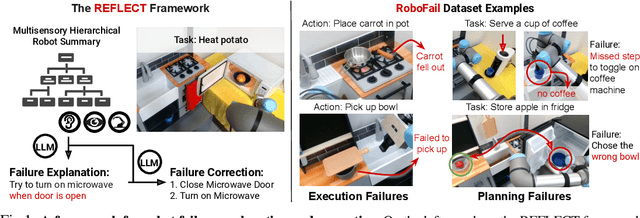
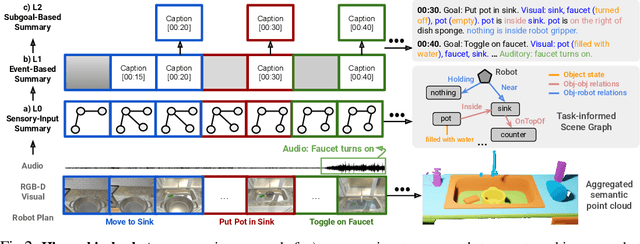
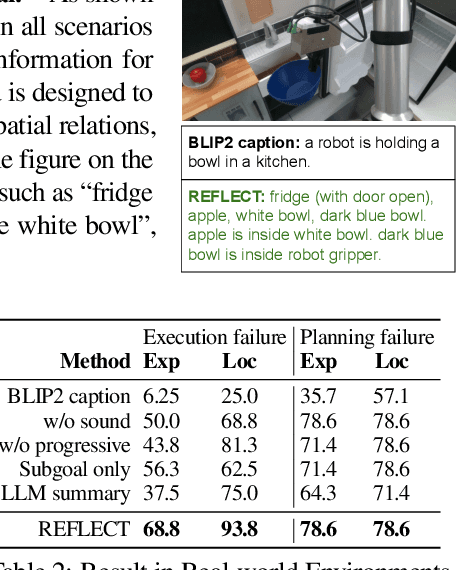

The ability to detect and analyze failed executions automatically is crucial for an explainable and robust robotic system. Recently, Large Language Models (LLMs) have demonstrated strong reasoning abilities on textual inputs. To leverage the power of LLM for robot failure explanation, we introduce a framework REFLECT, which queries LLM to identify and explain robot failures given a hierarchical summary of robot past experiences generated from multi-sensory data. Conditioned on the explanation, a task planner will generate an executable plan for the robot to correct the failure and complete the task. To systematically evaluate the framework, we create the RoboFail dataset with a variety of tasks and failure scenarios. We demonstrate that the LLM-based framework is able to generate informative failure explanations that assist successful correction planning. Videos and code available at: https://roboreflect.github.io/.
RoCo: Dialectic Multi-Robot Collaboration with Large Language Models
Jul 10, 2023We propose a novel approach to multi-robot collaboration that harnesses the power of pre-trained large language models (LLMs) for both high-level communication and low-level path planning. Robots are equipped with LLMs to discuss and collectively reason task strategies. They then generate sub-task plans and task space waypoint paths, which are used by a multi-arm motion planner to accelerate trajectory planning. We also provide feedback from the environment, such as collision checking, and prompt the LLM agents to improve their plan and waypoints in-context. For evaluation, we introduce RoCoBench, a 6-task benchmark covering a wide range of multi-robot collaboration scenarios, accompanied by a text-only dataset for agent representation and reasoning. We experimentally demonstrate the effectiveness of our approach -- it achieves high success rates across all tasks in RoCoBench and adapts to variations in task semantics. Our dialog setup offers high interpretability and flexibility -- in real world experiments, we show RoCo easily incorporates human-in-the-loop, where a user can communicate and collaborate with a robot agent to complete tasks together. See project website https://project-roco.github.io for videos and code.