 Add to Chrome
 Add to Firefox
 Add to Edge
State and Trajectory Estimation of Tensegrity Robots via Factor Graphs and Chebyshev Polynomials
Apr 09, 2026
Tensegrity robots offer compliance and adaptability, but their nonlinear, and underconstrained dynamics make state estimation challenging. Reliable continuous-time estimation of all rigid links is crucial for closed-loop control, system identification, and machine learning; however, conventional methods often fall short. This paper proposes a two-stage approach for robust state or trajectory estimation (i.e., filtering or smoothing) of a cable-driven tensegrity robot. For online state estimation, this work introduces a factor-graph-based method, which fuses measurements from an RGB-D camera with on-board cable length sensors. To the best of the authors' knowledge, this is the first application of factor graphs in this domain. Factor graphs are a natural choice, as they exploit the robot's structural properties and provide effective sensor fusion solutions capable of handling nonlinearities in practice. Both the Mahalanobis distance-based clustering algorithm, used to handle noise, and the Chebyshev polynomial method, used to estimate the most probable velocities and intermediate states, are shown to perform well on simulated and real-world data, compared to an ICP-based algorithm. Results show that the approach provides high fidelity, continuous-time state and trajectory estimates for complex tensegrity robot motions.

An Open-Source, Reproducible Tensegrity Robot that can Navigate Among Obstacles
Nov 08, 2025Tensegrity robots, composed of rigid struts and elastic tendons, provide impact resistance, low mass, and adaptability to unstructured terrain. Their compliance and complex, coupled dynamics, however, present modeling and control challenges, hindering path planning and obstacle avoidance. This paper presents a complete, open-source, and reproducible system that enables navigation for a 3-bar tensegrity robot. The system comprises: (i) an inexpensive, open-source hardware design, and (ii) an integrated, open-source software stack for physics-based modeling, system identification, state estimation, path planning, and control. All hardware and software are publicly available at https://sites.google.com/view/tensegrity-navigation/. The proposed system tracks the robot's pose and executes collision-free paths to a specified goal among known obstacle locations. System robustness is demonstrated through experiments involving unmodeled environmental challenges, including a vertical drop, an incline, and granular media, culminating in an outdoor field demonstration. To validate reproducibility, experiments were conducted using robot instances at two different laboratories. This work provides the robotics community with a complete navigation system for a compliant, impact-resistant, and shape-morphing robot. This system is intended to serve as a springboard for advancing the navigation capabilities of other unconventional robotic platforms.
The State of Robot Motion Generation
Oct 16, 2024This paper reviews the large spectrum of methods for generating robot motion proposed over the 50 years of robotics research culminating in recent developments. It crosses the boundaries of methodologies, typically not surveyed together, from those that operate over explicit models to those that learn implicit ones. The paper discusses the current state-of-the-art as well as properties of varying methodologies, highlighting opportunities for integration.
Tactile-based Object Retrieval From Granular Media
Feb 21, 2024

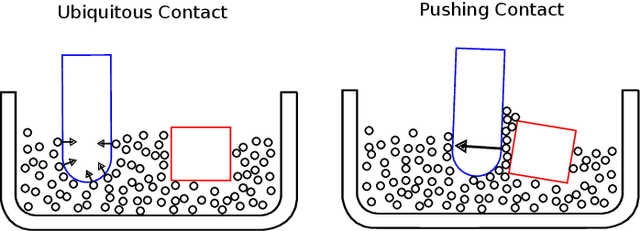
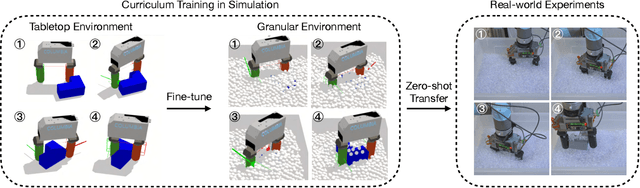
We introduce GEOTACT, a robotic manipulation method capable of retrieving objects buried in granular media. This is a challenging task due to the need to interact with granular media, and doing so based exclusively on tactile feedback, since a buried object can be completely hidden from vision. Tactile feedback is in itself challenging in this context, due to ubiquitous contact with the surrounding media, and the inherent noise level induced by the tactile readings. To address these challenges, we use a learning method trained end-to-end with simulated sensor noise. We show that our problem formulation leads to the natural emergence of learned pushing behaviors that the manipulator uses to reduce uncertainty and funnel the object to a stable grasp despite spurious and noisy tactile readings. We also introduce a training curriculum that enables learning these behaviors in simulation, followed by zero-shot transfer to real hardware. To the best of our knowledge, GEOTACT is the first method to reliably retrieve a number of different objects from a granular environment, doing so on real hardware and with integrated tactile sensing. Videos and additional information can be found at https://jxu.ai/geotact.