 Add to Chrome
 Add to Firefox
 Add to Edge
Handroid: Bridging Dexterous Hand and Humanoid
Jul 17, 2026
Dexterous hands and humanoid robots are typically developed as distinct embodiments: the former enable contact-rich manipulation at the object scale, whereas the latter provide mobility and whole-body interaction in human-centered environments. We introduce \textbf{Handroid}, a desktop-scale dual-embodiment robot that integrates both capabilities within a single reconfigurable platform. Handroid reuses one 27-DoF electromechanical body as either a dexterous hand or a desktop humanoid, measuring 0.33 m in height and 2.05 kg in weight. In the dexterous hand embodiment, 20 DoFs form an anthropomorphic hand closely matching the kinematic structure of the human hand. In the humanoid embodiment, the same articulated modules are reconfigured into a humanoid with a head, arms, and legs, including a 12-DoF lower-limb structure for locomotion and whole-body motion. Handroid further provides a unified control and learning framework supporting hand teleoperation, dexterous grasping, in-hand manipulation, humanoid locomotion, gait generation, and interactive motion authoring. We validate the platform through real-world dexterous manipulation, reinforcement-learning-based locomotion, keyframe motion deployment, and a long-horizon task involving embodiment reconfiguration, locomotion, docking, and dexterous pick-and-place. These results position Handroid as a compact and reproducible platform for advancing morphology-reconfigurable robotics and cross-embodiment robot learning.

DexVerse: A Modular Benchmark for Multi-Task, Multi-Embodiment Dexterous Manipulation
Jul 09, 2026Building general-purpose dexterous manipulation policies requires benchmarks that go beyond isolated tasks to systematically evaluate policies across diverse interaction modes, sensory conditions, and robot embodiments. However, existing benchmarks remain limited in task and data diversity, embodiment coverage, or controllable visual variation, hindering studies of cross-task and cross-embodiment generalization. We present DexVerse, a large-scale and modular benchmark for dexterous manipulation. DexVerse includes 100 tasks spanning a broad range of manipulation skills, including object grasping and relocation, articulated-object interaction, functional tool use, bimanual coordination, non-prehensile control, contact-rich behaviors, multi-goal execution, and long-horizon multi-stage task completion. It supports 3 robot arms and 6 dexterous hands, and is extensible to new tasks, assets, and embodiments. To evaluate visuomotor generalization, DexVerse provides configurable visual variations in textures, background, lighting, and camera viewpoints. We further provide a VR-based teleoperation interface and 3,180 demonstrations with synchronized proprioceptive, RGB, depth, point-cloud, and state observations. We benchmark representative methods, including Diffusion Policy, DP3, OpenVLA, and $π_{0.5}$, across 19 tasks. Results reveal substantial challenges in task generalization and visuomotor robustness, establishing DexVerse as a promising testbed for general-purpose dexterous manipulation. Project page: https://ycyao216.github.io/DexVerse.site
Current as Touch: Proprioceptive Contact Feedback for Compliant Dexterous Manipulation
Jul 03, 2026Compliance is essential for dexterous manipulation, yet existing solutions often rely on external tactile or force sensors that are costly, fragile, and difficult to deploy on low-cost robot hands. We propose a proprioception-driven framework that learns contact-aware compliance cues from motor current and joint states. Since motor current is closely related to actuator torque, it provides an intrinsic signal for perceiving contact force, object resistance, and grasp stability without additional sensing hardware. Rather than estimating external wrenches or commanding torque, our method predicts a compliance reference position: an ideal joint-position target for a standard PD controller whose induced position error generates appropriate grasping force. This position-based formulation is compatible with mainstream teleoperation and policy-learning pipelines, while enabling the robot to adapt interaction forces from real-time proprioceptive feedback. Thus, motor current serves not only as a force proxy but also as a learnable proprioceptive contact signal for compliance reference prediction. Experiments on multiple dexterous hands and contact-rich tasks, including fragile object handling, sustained surface contact, thin-object retrieval, and dynamic load adaptation, show stable compliant grasping, safer and more efficient teleoperation, and improved downstream policy learning without external tactile or force sensors.
DexCompose: Reusing Dexterous Policies for Multi-Task Manipulation with a Single Hand
Jun 26, 2026Dexterous manipulation policies can solve individual skills, but composing them to perform multiple tasks with a single hand remains challenging. Adding a new task on top of an existing manipulation skill often imposes conflicting demands on overlapping fingers and contact modes, causing destructive interference between preserving an existing manipulation outcome and executing a new one. We propose DexCompose, a role-aware residual composition framework that reuses pretrained dexterous policies for multi-task manipulation through explicit finger-level action ownership. Given two pretrained full-hand policies, DexCompose first collects successful post-task states from the first skill and performs release tests over candidate finger masks to identify which fingers are necessary for maintaining the established skill state. It then trains two asymmetric residual modules: a bounded residual stabilizer for task preservation, and a context-aware residual that adapts the frozen downstream policy only within the action subspace assigned to the new task. We evaluate the framework on 16 composite dexterous manipulation tasks spanning four object-retention skills and four downstream interactions. DexCompose achieves a 77.4% average composite success rate, demonstrating that structural action ownership with dual residuals offers a promising direction for composing dexterous skills beyond conventional policy chaining.
CoorDex: Coordinating Body and Hand Priors for Continuous Dexterous Humanoid Loco-Manipulation
Jun 22, 2026Humanoid loco-manipulation is often simplified into a stop-and-go process: walking to an object, stopping to manipulate it, and then resuming locomotion. It also commonly relies on low degree-of-freedom (DoF) end effectors that behave like an open-close grasp primitive. We introduce CoorDex, a learning pipeline that converts high-dimensional body and dexterous hand control into coordinated latent residual control, enabling high-DoF dexterous loco-manipulation on the move. Starting from simulated whole-body and hand demonstrations, CoorDex trains privileged motion tracking teachers for the humanoid body and dexterous hand, distills them into proprioception-conditioned latent priors, and uses the frozen priors as the action space for downstream residual reinforcement learning. A coordinated latent residual policy composes these priors through shared task context and separate body-hand residual heads, preserving natural whole-body motion while improving finger-level contact reliability. CoorDex enables a Unitree G1 humanoid with a 20-DoF WUJI hand to execute dexterous manipulation while in motion, including non-stop bottle grasping and carrying, fridge door opening on the move, and cube pick-and-turn. Ablations on the walk-grasp-carry task show that joint-space PPO, joint-space hand control, and monolithic latent prediction all fail under the same reward budget, while the latent-prior interface and coordinated residual structure make high-dimensional contact-rich loco-manipulation trainable. Project Page: https://skevinci.github.io/coordex/
One Hand to Rule Them All: Canonical Representations for Unified Dexterous Manipulation
Feb 18, 2026Dexterous manipulation policies today largely assume fixed hand designs, severely restricting their generalization to new embodiments with varied kinematic and structural layouts. To overcome this limitation, we introduce a parameterized canonical representation that unifies a broad spectrum of dexterous hand architectures. It comprises a unified parameter space and a canonical URDF format, offering three key advantages. 1) The parameter space captures essential morphological and kinematic variations for effective conditioning in learning algorithms. 2) A structured latent manifold can be learned over our space, where interpolations between embodiments yield smooth and physically meaningful morphology transitions. 3) The canonical URDF standardizes the action space while preserving dynamic and functional properties of the original URDFs, enabling efficient and reliable cross-embodiment policy learning. We validate these advantages through extensive analysis and experiments, including grasp policy replay, VAE latent encoding, and cross-embodiment zero-shot transfer. Specifically, we train a VAE on the unified representation to obtain a compact, semantically rich latent embedding, and develop a grasping policy conditioned on the canonical representation that generalizes across dexterous hands. We demonstrate, through simulation and real-world tasks on unseen morphologies (e.g., 81.9% zero-shot success rate on 3-finger LEAP Hand), that our framework unifies both the representational and action spaces of structurally diverse hands, providing a scalable foundation for cross-hand learning toward universal dexterous manipulation.
Web2Grasp: Learning Functional Grasps from Web Images of Hand-Object Interactions
May 07, 2025Functional grasp is essential for enabling dexterous multi-finger robot hands to manipulate objects effectively. However, most prior work either focuses on power grasping, which simply involves holding an object still, or relies on costly teleoperated robot demonstrations to teach robots how to grasp each object functionally. Instead, we propose extracting human grasp information from web images since they depict natural and functional object interactions, thereby bypassing the need for curated demonstrations. We reconstruct human hand-object interaction (HOI) 3D meshes from RGB images, retarget the human hand to multi-finger robot hands, and align the noisy object mesh with its accurate 3D shape. We show that these relatively low-quality HOI data from inexpensive web sources can effectively train a functional grasping model. To further expand the grasp dataset for seen and unseen objects, we use the initially-trained grasping policy with web data in the IsaacGym simulator to generate physically feasible grasps while preserving functionality. We train the grasping model on 10 object categories and evaluate it on 9 unseen objects, including challenging items such as syringes, pens, spray bottles, and tongs, which are underrepresented in existing datasets. The model trained on the web HOI dataset, achieving a 75.8% success rate on seen objects and 61.8% across all objects in simulation, with a 6.7% improvement in success rate and a 1.8x increase in functionality ratings over baselines. Simulator-augmented data further boosts performance from 61.8% to 83.4%. The sim-to-real transfer to the LEAP Hand achieves a 85% success rate. Project website is at: https://webgrasp.github.io/.
REMAC: Self-Reflective and Self-Evolving Multi-Agent Collaboration for Long-Horizon Robot Manipulation
Mar 28, 2025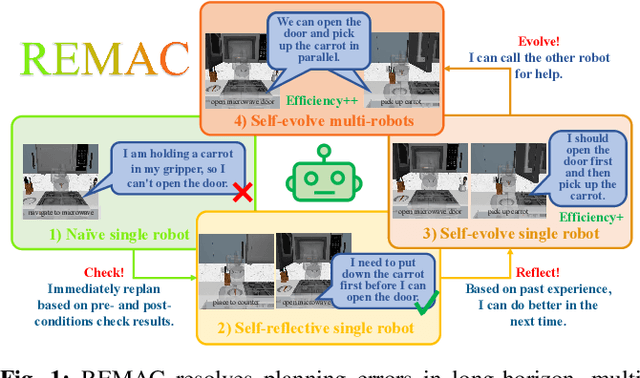
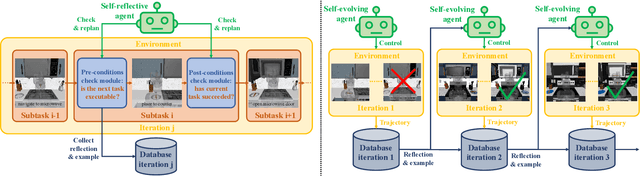
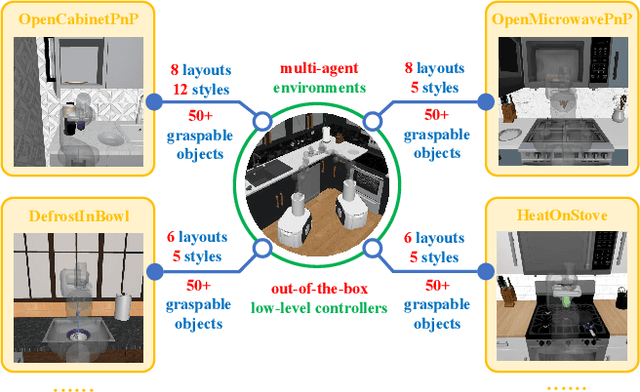
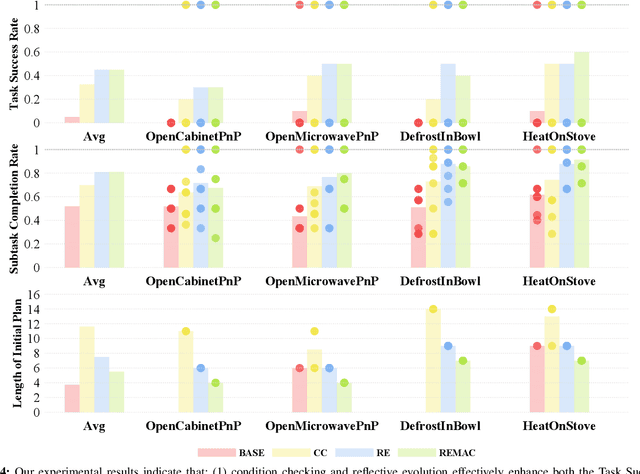
Vision-language models (VLMs) have demonstrated remarkable capabilities in robotic planning, particularly for long-horizon tasks that require a holistic understanding of the environment for task decomposition. Existing methods typically rely on prior environmental knowledge or carefully designed task-specific prompts, making them struggle with dynamic scene changes or unexpected task conditions, e.g., a robot attempting to put a carrot in the microwave but finds the door was closed. Such challenges underscore two critical issues: adaptability and efficiency. To address them, in this work, we propose an adaptive multi-agent planning framework, termed REMAC, that enables efficient, scene-agnostic multi-robot long-horizon task planning and execution through continuous reflection and self-evolution. REMAC incorporates two key modules: a self-reflection module performing pre-condition and post-condition checks in the loop to evaluate progress and refine plans, and a self-evolvement module dynamically adapting plans based on scene-specific reasoning. It offers several appealing benefits: 1) Robots can initially explore and reason about the environment without complex prompt design. 2) Robots can keep reflecting on potential planning errors and adapting the plan based on task-specific insights. 3) After iterations, a robot can call another one to coordinate tasks in parallel, maximizing the task execution efficiency. To validate REMAC's effectiveness, we build a multi-agent environment for long-horizon robot manipulation and navigation based on RoboCasa, featuring 4 task categories with 27 task styles and 50+ different objects. Based on it, we further benchmark state-of-the-art reasoning models, including DeepSeek-R1, o3-mini, QwQ, and Grok3, demonstrating REMAC's superiority by boosting average success rates by 40% and execution efficiency by 52.7% over the single robot baseline.
When Should We Prefer State-to-Visual DAgger Over Visual Reinforcement Learning?
Dec 18, 2024
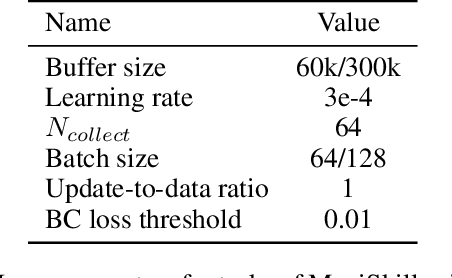


Learning policies from high-dimensional visual inputs, such as pixels and point clouds, is crucial in various applications. Visual reinforcement learning is a promising approach that directly trains policies from visual observations, although it faces challenges in sample efficiency and computational costs. This study conducts an empirical comparison of State-to-Visual DAgger, a two-stage framework that initially trains a state policy before adopting online imitation to learn a visual policy, and Visual RL across a diverse set of tasks. We evaluate both methods across 16 tasks from three benchmarks, focusing on their asymptotic performance, sample efficiency, and computational costs. Surprisingly, our findings reveal that State-to-Visual DAgger does not universally outperform Visual RL but shows significant advantages in challenging tasks, offering more consistent performance. In contrast, its benefits in sample efficiency are less pronounced, although it often reduces the overall wall-clock time required for training. Based on our findings, we provide recommendations for practitioners and hope that our results contribute valuable perspectives for future research in visual policy learning.
Soft Robotic Dynamic In-Hand Pen Spinning
Nov 19, 2024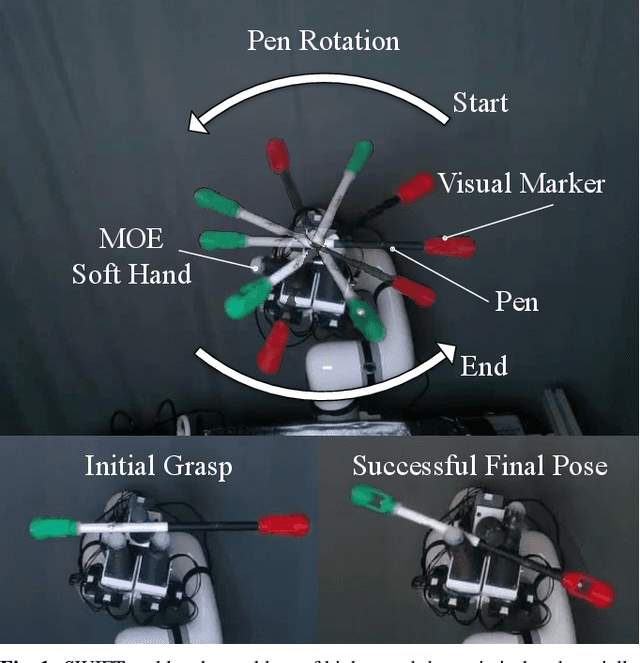
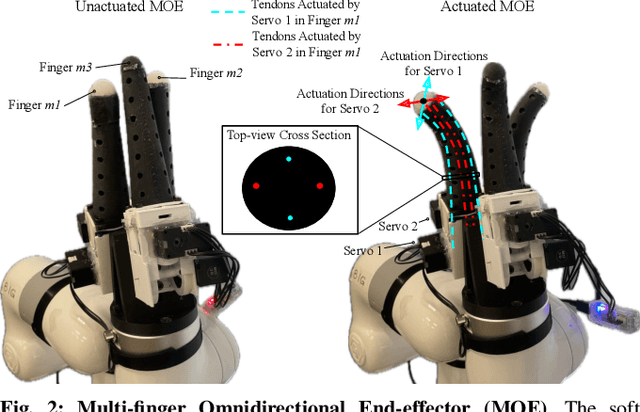
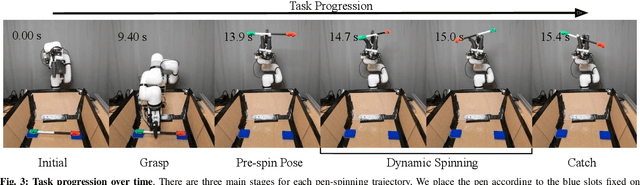
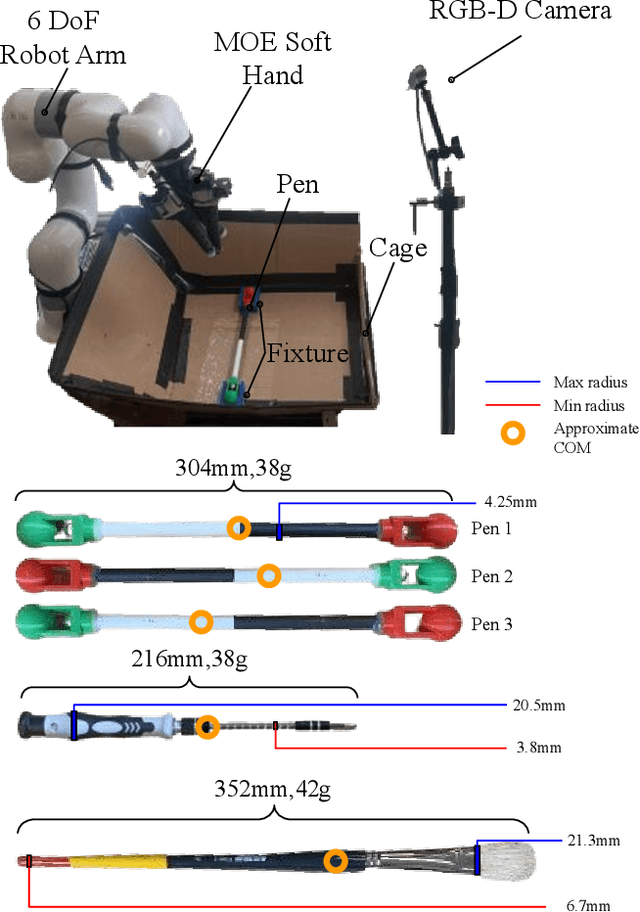
Dynamic in-hand manipulation remains a challenging task for soft robotic systems that have demonstrated advantages in safe compliant interactions but struggle with high-speed dynamic tasks. In this work, we present SWIFT, a system for learning dynamic tasks using a soft and compliant robotic hand. Unlike previous works that rely on simulation, quasi-static actions and precise object models, the proposed system learns to spin a pen through trial-and-error using only real-world data without requiring explicit prior knowledge of the pen's physical attributes. With self-labeled trials sampled from the real world, the system discovers the set of pen grasping and spinning primitive parameters that enables a soft hand to spin a pen robustly and reliably. After 130 sampled actions per object, SWIFT achieves 100% success rate across three pens with different weights and weight distributions, demonstrating the system's generalizability and robustness to changes in object properties. The results highlight the potential for soft robotic end-effectors to perform dynamic tasks including rapid in-hand manipulation. We also demonstrate that SWIFT generalizes to spinning items with different shapes and weights such as a brush and a screwdriver which we spin with 10/10 and 5/10 success rates respectively. Videos, data, and code are available at https://soft-spin.github.io.