 Add to Chrome
 Add to Firefox
 Add to Edge
Stabilizing Contrastive RL: Techniques for Offline Goal Reaching
Jun 06, 2023
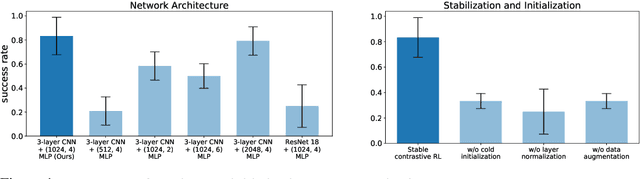
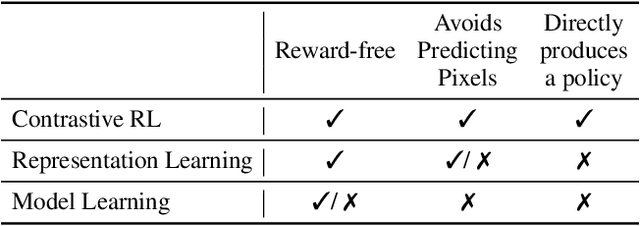
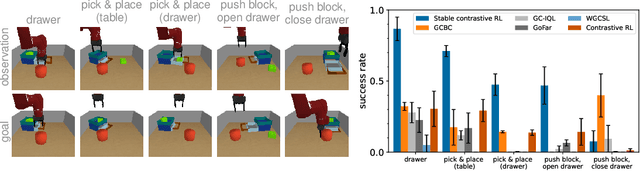
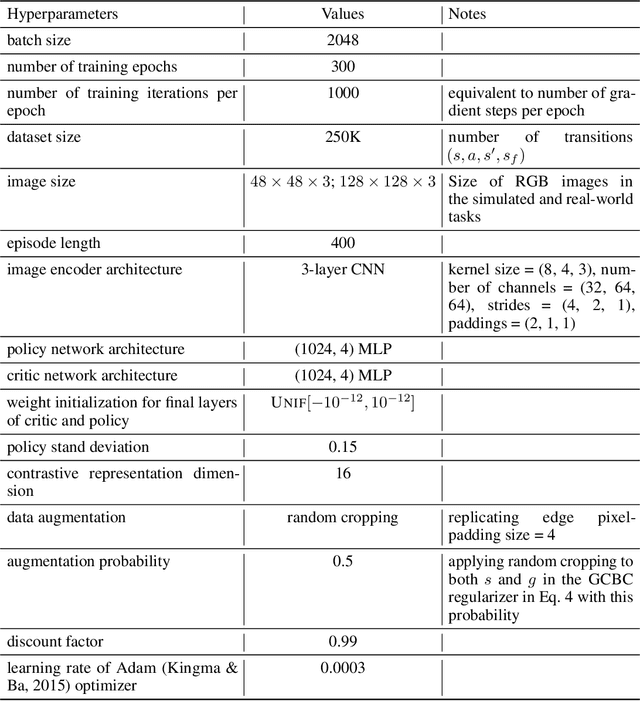
In the same way that the computer vision (CV) and natural language processing (NLP) communities have developed self-supervised methods, reinforcement learning (RL) can be cast as a self-supervised problem: learning to reach any goal, without requiring human-specified rewards or labels. However, actually building a self-supervised foundation for RL faces some important challenges. Building on prior contrastive approaches to this RL problem, we conduct careful ablation experiments and discover that a shallow and wide architecture, combined with careful weight initialization and data augmentation, can significantly boost the performance of these contrastive RL approaches on challenging simulated benchmarks. Additionally, we demonstrate that, with these design decisions, contrastive approaches can solve real-world robotic manipulation tasks, with tasks being specified by a single goal image provided after training.

SACSoN: Scalable Autonomous Data Collection for Social Navigation
Jun 02, 2023Machine learning provides a powerful tool for building socially compliant robotic systems that go beyond simple predictive models of human behavior. By observing and understanding human interactions from past experiences, learning can enable effective social navigation behaviors directly from data. However, collecting navigation data in human-occupied environments may require teleoperation or continuous monitoring, making the process prohibitively expensive to scale. In this paper, we present a scalable data collection system for vision-based navigation, SACSoN, that can autonomously navigate around pedestrians in challenging real-world environments while encouraging rich interactions. SACSoN uses visual observations to observe and react to humans in its vicinity. It couples this visual understanding with continual learning and an autonomous collision recovery system that limits the involvement of a human operator, allowing for better dataset scaling. We use a this system to collect the SACSoN dataset, the largest-of-its-kind visual navigation dataset of autonomous robots operating in human-occupied spaces, spanning over 75 hours and 4000 rich interactions with humans. Our experiments show that collecting data with a novel objective that encourages interactions, leads to significant improvements in downstream tasks such as inferring pedestrian dynamics and learning socially compliant navigation behaviors. We make videos of our autonomous data collection system and the SACSoN dataset publicly available on our project page.
The False Promise of Imitating Proprietary LLMs
May 25, 2023
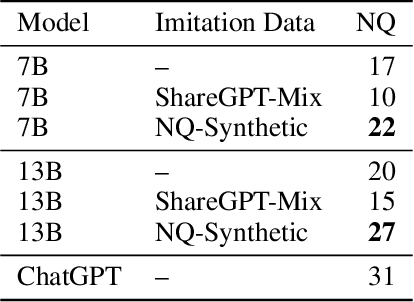

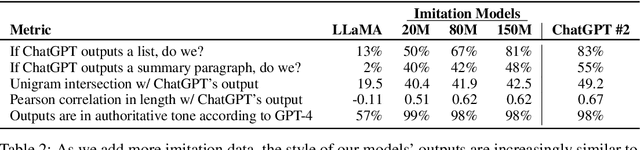
An emerging method to cheaply improve a weaker language model is to finetune it on outputs from a stronger model, such as a proprietary system like ChatGPT (e.g., Alpaca, Self-Instruct, and others). This approach looks to cheaply imitate the proprietary model's capabilities using a weaker open-source model. In this work, we critically analyze this approach. We first finetune a series of LMs that imitate ChatGPT using varying base model sizes (1.5B--13B), data sources, and imitation data amounts (0.3M--150M tokens). We then evaluate the models using crowd raters and canonical NLP benchmarks. Initially, we were surprised by the output quality of our imitation models -- they appear far better at following instructions, and crowd workers rate their outputs as competitive with ChatGPT. However, when conducting more targeted automatic evaluations, we find that imitation models close little to none of the gap from the base LM to ChatGPT on tasks that are not heavily supported in the imitation data. We show that these performance discrepancies may slip past human raters because imitation models are adept at mimicking ChatGPT's style but not its factuality. Overall, we conclude that model imitation is a false promise: there exists a substantial capabilities gap between open and closed LMs that, with current methods, can only be bridged using an unwieldy amount of imitation data or by using more capable base LMs. In turn, we argue that the highest leverage action for improving open-source models is to tackle the difficult challenge of developing better base LMs, rather than taking the shortcut of imitating proprietary systems.
Training Diffusion Models with Reinforcement Learning
May 23, 2023
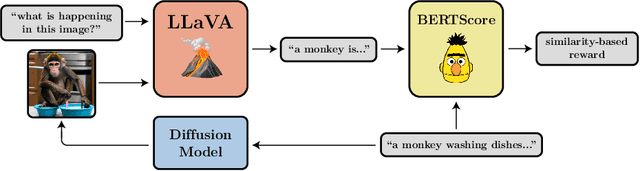
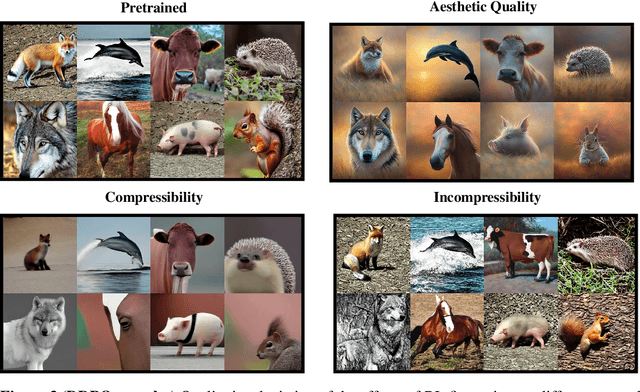
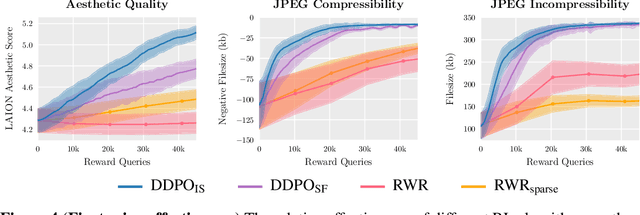
Diffusion models are a class of flexible generative models trained with an approximation to the log-likelihood objective. However, most use cases of diffusion models are not concerned with likelihoods, but instead with downstream objectives such as human-perceived image quality or drug effectiveness. In this paper, we investigate reinforcement learning methods for directly optimizing diffusion models for such objectives. We describe how posing denoising as a multi-step decision-making problem enables a class of policy gradient algorithms, which we refer to as denoising diffusion policy optimization (DDPO), that are more effective than alternative reward-weighted likelihood approaches. Empirically, DDPO is able to adapt text-to-image diffusion models to objectives that are difficult to express via prompting, such as image compressibility, and those derived from human feedback, such as aesthetic quality. Finally, we show that DDPO can improve prompt-image alignment using feedback from a vision-language model without the need for additional data collection or human annotation.
Deep RL at Scale: Sorting Waste in Office Buildings with a Fleet of Mobile Manipulators
May 05, 2023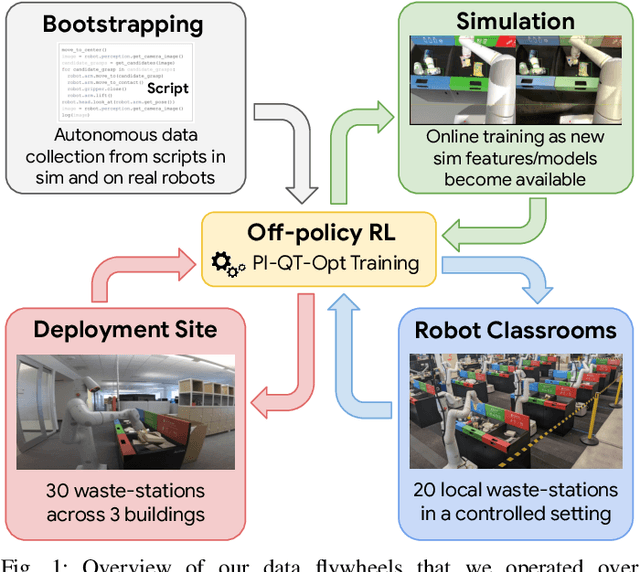


We describe a system for deep reinforcement learning of robotic manipulation skills applied to a large-scale real-world task: sorting recyclables and trash in office buildings. Real-world deployment of deep RL policies requires not only effective training algorithms, but the ability to bootstrap real-world training and enable broad generalization. To this end, our system combines scalable deep RL from real-world data with bootstrapping from training in simulation, and incorporates auxiliary inputs from existing computer vision systems as a way to boost generalization to novel objects, while retaining the benefits of end-to-end training. We analyze the tradeoffs of different design decisions in our system, and present a large-scale empirical validation that includes training on real-world data gathered over the course of 24 months of experimentation, across a fleet of 23 robots in three office buildings, with a total training set of 9527 hours of robotic experience. Our final validation also consists of 4800 evaluation trials across 240 waste station configurations, in order to evaluate in detail the impact of the design decisions in our system, the scaling effects of including more real-world data, and the performance of the method on novel objects. The projects website and videos can be found at \href{http://rl-at-scale.github.io}{rl-at-scale.github.io}.
Learning Fine-Grained Bimanual Manipulation with Low-Cost Hardware
Apr 23, 2023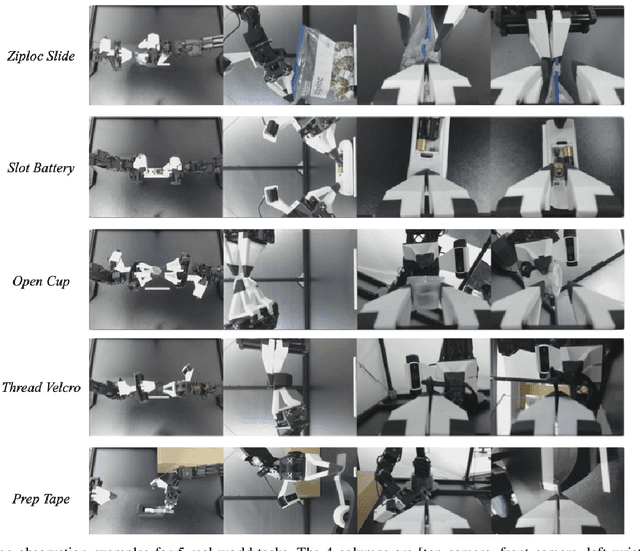
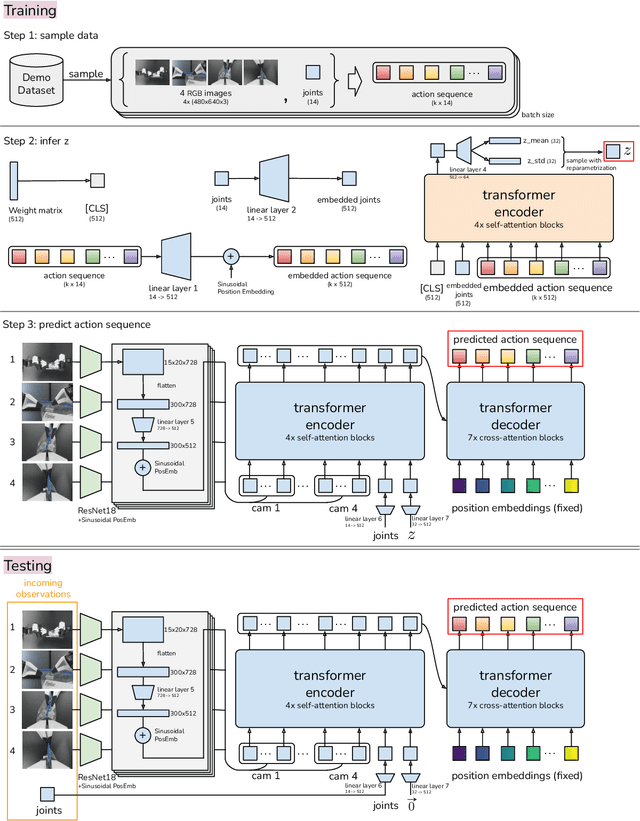

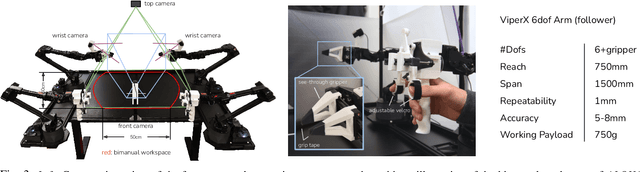
Fine manipulation tasks, such as threading cable ties or slotting a battery, are notoriously difficult for robots because they require precision, careful coordination of contact forces, and closed-loop visual feedback. Performing these tasks typically requires high-end robots, accurate sensors, or careful calibration, which can be expensive and difficult to set up. Can learning enable low-cost and imprecise hardware to perform these fine manipulation tasks? We present a low-cost system that performs end-to-end imitation learning directly from real demonstrations, collected with a custom teleoperation interface. Imitation learning, however, presents its own challenges, particularly in high-precision domains: errors in the policy can compound over time, and human demonstrations can be non-stationary. To address these challenges, we develop a simple yet novel algorithm, Action Chunking with Transformers (ACT), which learns a generative model over action sequences. ACT allows the robot to learn 6 difficult tasks in the real world, such as opening a translucent condiment cup and slotting a battery with 80-90% success, with only 10 minutes worth of demonstrations. Project website: https://tonyzhaozh.github.io/aloha/
IDQL: Implicit Q-Learning as an Actor-Critic Method with Diffusion Policies
Apr 20, 2023



Effective offline RL methods require properly handling out-of-distribution actions. Implicit Q-learning (IQL) addresses this by training a Q-function using only dataset actions through a modified Bellman backup. However, it is unclear which policy actually attains the values represented by this implicitly trained Q-function. In this paper, we reinterpret IQL as an actor-critic method by generalizing the critic objective and connecting it to a behavior-regularized implicit actor. This generalization shows how the induced actor balances reward maximization and divergence from the behavior policy, with the specific loss choice determining the nature of this tradeoff. Notably, this actor can exhibit complex and multimodal characteristics, suggesting issues with the conditional Gaussian actor fit with advantage weighted regression (AWR) used in prior methods. Instead, we propose using samples from a diffusion parameterized behavior policy and weights computed from the critic to then importance sampled our intended policy. We introduce Implicit Diffusion Q-learning (IDQL), combining our general IQL critic with the policy extraction method. IDQL maintains the ease of implementation of IQL while outperforming prior offline RL methods and demonstrating robustness to hyperparameters. Code is available at https://github.com/philippe-eecs/IDQL.
Efficient Deep Reinforcement Learning Requires Regulating Overfitting
Apr 20, 2023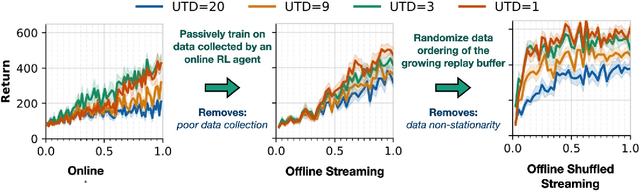

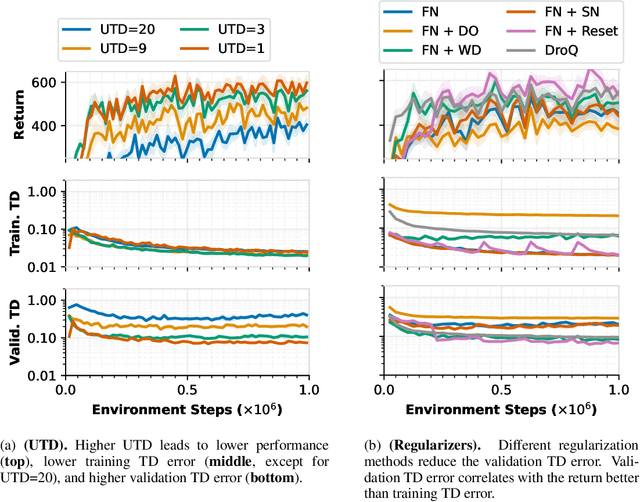

Deep reinforcement learning algorithms that learn policies by trial-and-error must learn from limited amounts of data collected by actively interacting with the environment. While many prior works have shown that proper regularization techniques are crucial for enabling data-efficient RL, a general understanding of the bottlenecks in data-efficient RL has remained unclear. Consequently, it has been difficult to devise a universal technique that works well across all domains. In this paper, we attempt to understand the primary bottleneck in sample-efficient deep RL by examining several potential hypotheses such as non-stationarity, excessive action distribution shift, and overfitting. We perform thorough empirical analysis on state-based DeepMind control suite (DMC) tasks in a controlled and systematic way to show that high temporal-difference (TD) error on the validation set of transitions is the main culprit that severely affects the performance of deep RL algorithms, and prior methods that lead to good performance do in fact, control the validation TD error to be low. This observation gives us a robust principle for making deep RL efficient: we can hill-climb on the validation TD error by utilizing any form of regularization techniques from supervised learning. We show that a simple online model selection method that targets the validation TD error is effective across state-based DMC and Gym tasks.
Learning and Adapting Agile Locomotion Skills by Transferring Experience
Apr 19, 2023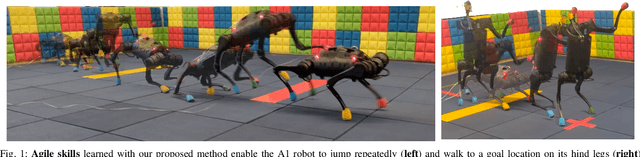
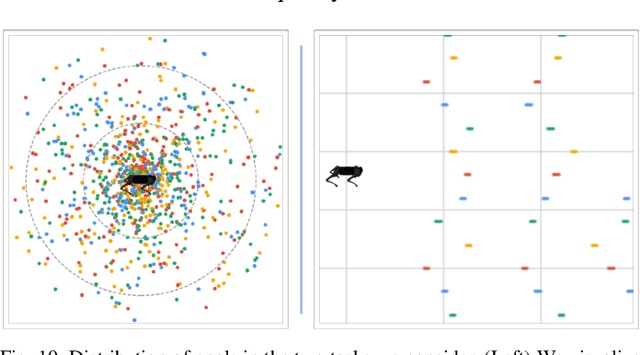
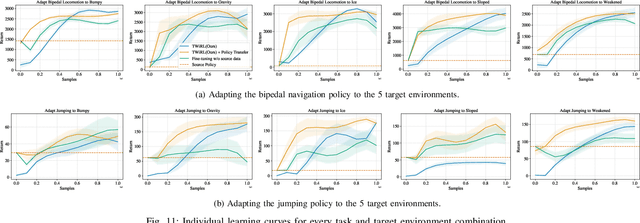
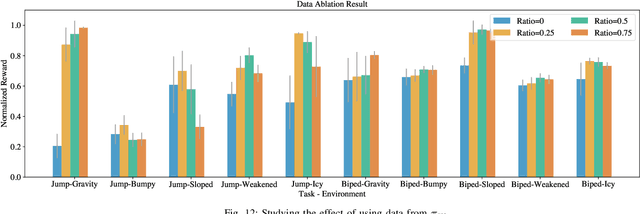
Legged robots have enormous potential in their range of capabilities, from navigating unstructured terrains to high-speed running. However, designing robust controllers for highly agile dynamic motions remains a substantial challenge for roboticists. Reinforcement learning (RL) offers a promising data-driven approach for automatically training such controllers. However, exploration in these high-dimensional, underactuated systems remains a significant hurdle for enabling legged robots to learn performant, naturalistic, and versatile agility skills. We propose a framework for training complex robotic skills by transferring experience from existing controllers to jumpstart learning new tasks. To leverage controllers we can acquire in practice, we design this framework to be flexible in terms of their source -- that is, the controllers may have been optimized for a different objective under different dynamics, or may require different knowledge of the surroundings -- and thus may be highly suboptimal for the target task. We show that our method enables learning complex agile jumping behaviors, navigating to goal locations while walking on hind legs, and adapting to new environments. We also demonstrate that the agile behaviors learned in this way are graceful and safe enough to deploy in the real world.
FastRLAP: A System for Learning High-Speed Driving via Deep RL and Autonomous Practicing
Apr 19, 2023
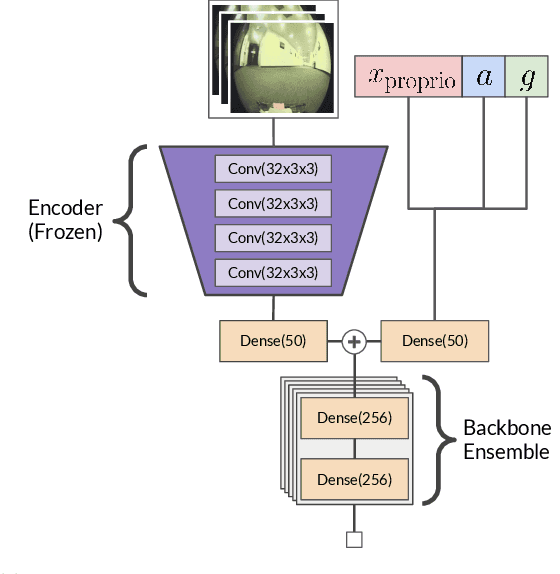


We present a system that enables an autonomous small-scale RC car to drive aggressively from visual observations using reinforcement learning (RL). Our system, FastRLAP (faster lap), trains autonomously in the real world, without human interventions, and without requiring any simulation or expert demonstrations. Our system integrates a number of important components to make this possible: we initialize the representations for the RL policy and value function from a large prior dataset of other robots navigating in other environments (at low speed), which provides a navigation-relevant representation. From here, a sample-efficient online RL method uses a single low-speed user-provided demonstration to determine the desired driving course, extracts a set of navigational checkpoints, and autonomously practices driving through these checkpoints, resetting automatically on collision or failure. Perhaps surprisingly, we find that with appropriate initialization and choice of algorithm, our system can learn to drive over a variety of racing courses with less than 20 minutes of online training. The resulting policies exhibit emergent aggressive driving skills, such as timing braking and acceleration around turns and avoiding areas which impede the robot's motion, approaching the performance of a human driver using a similar first-person interface over the course of training.