 Add to Chrome
 Add to Firefox
 Add to Edge
Hessian Aware Low-Rank Weight Perturbation for Continual Learning
Nov 26, 2023
Continual learning aims to learn a series of tasks sequentially without forgetting the knowledge acquired from the previous ones. In this work, we propose the Hessian Aware Low-Rank Perturbation algorithm for continual learning. By modeling the parameter transitions along the sequential tasks with the weight matrix transformation, we propose to apply the low-rank approximation on the task-adaptive parameters in each layer of the neural networks. Specifically, we theoretically demonstrate the quantitative relationship between the Hessian and the proposed low-rank approximation. The approximation ranks are then globally determined according to the marginal increment of the empirical loss estimated by the layer-specific gradient and low-rank approximation error. Furthermore, we control the model capacity by pruning less important parameters to diminish the parameter growth. We conduct extensive experiments on various benchmarks, including a dataset with large-scale tasks, and compare our method against some recent state-of-the-art methods to demonstrate the effectiveness and scalability of our proposed method. Empirical results show that our method performs better on different benchmarks, especially in achieving task order robustness and handling the forgetting issue. A demo code can be found at https://github.com/lijiaqi/HALRP.

RetroDiff: Retrosynthesis as Multi-stage Distribution Interpolation
Nov 23, 2023Retrosynthesis poses a fundamental challenge in biopharmaceuticals, aiming to aid chemists in finding appropriate reactant molecules and synthetic pathways given determined product molecules. With the reactant and product represented as 2D graphs, retrosynthesis constitutes a conditional graph-to-graph generative task. Inspired by the recent advancements in discrete diffusion models for graph generation, we introduce Retrosynthesis Diffusion (RetroDiff), a novel diffusion-based method designed to address this problem. However, integrating a diffusion-based graph-to-graph framework while retaining essential chemical reaction template information presents a notable challenge. Our key innovation is to develop a multi-stage diffusion process. In this method, we decompose the retrosynthesis procedure to first sample external groups from the dummy distribution given products and then generate the external bonds to connect the products and generated groups. Interestingly, such a generation process is exactly the reverse of the widely adapted semi-template retrosynthesis procedure, i.e. from reaction center identification to synthon completion, which significantly reduces the error accumulation. Experimental results on the benchmark have demonstrated the superiority of our method over all other semi-template methods.
Igniting Language Intelligence: The Hitchhiker's Guide From Chain-of-Thought Reasoning to Language Agents
Nov 20, 2023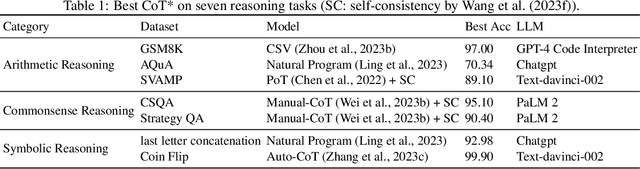
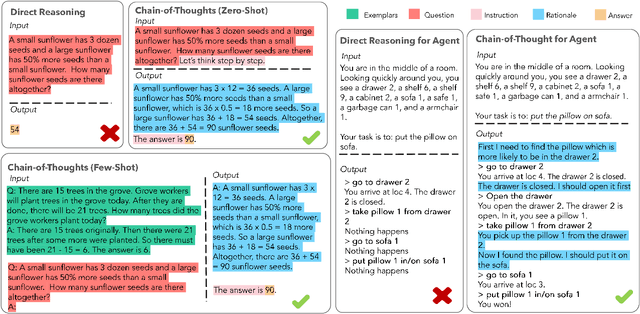
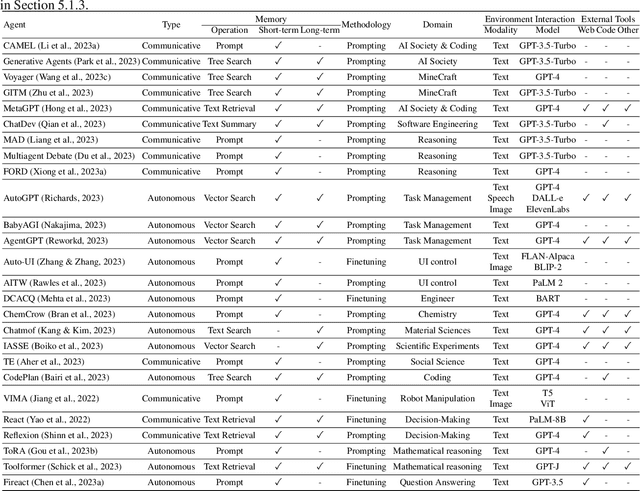
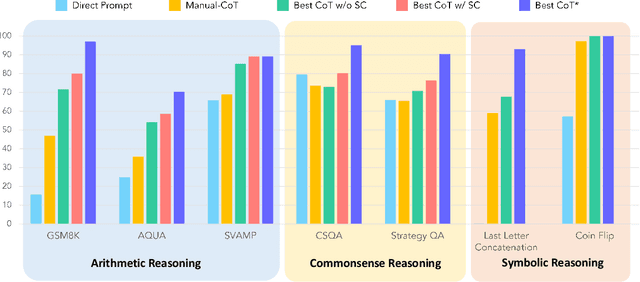
Large language models (LLMs) have dramatically enhanced the field of language intelligence, as demonstrably evidenced by their formidable empirical performance across a spectrum of complex reasoning tasks. Additionally, theoretical proofs have illuminated their emergent reasoning capabilities, providing a compelling showcase of their advanced cognitive abilities in linguistic contexts. Critical to their remarkable efficacy in handling complex reasoning tasks, LLMs leverage the intriguing chain-of-thought (CoT) reasoning techniques, obliging them to formulate intermediate steps en route to deriving an answer. The CoT reasoning approach has not only exhibited proficiency in amplifying reasoning performance but also in enhancing interpretability, controllability, and flexibility. In light of these merits, recent research endeavors have extended CoT reasoning methodologies to nurture the development of autonomous language agents, which adeptly adhere to language instructions and execute actions within varied environments. This survey paper orchestrates a thorough discourse, penetrating vital research dimensions, encompassing: (i) the foundational mechanics of CoT techniques, with a focus on elucidating the circumstances and justification behind its efficacy; (ii) the paradigm shift in CoT; and (iii) the burgeoning of language agents fortified by CoT approaches. Prospective research avenues envelop explorations into generalization, efficiency, customization, scaling, and safety. This paper caters to a wide audience, including beginners seeking comprehensive knowledge of CoT reasoning and language agents, as well as experienced researchers interested in foundational mechanics and engaging in cutting-edge discussions on these topics. A repository for the related papers is available at https://github.com/Zoeyyao27/CoT-Igniting-Agent.
A Survey on Language Models for Code
Nov 19, 2023
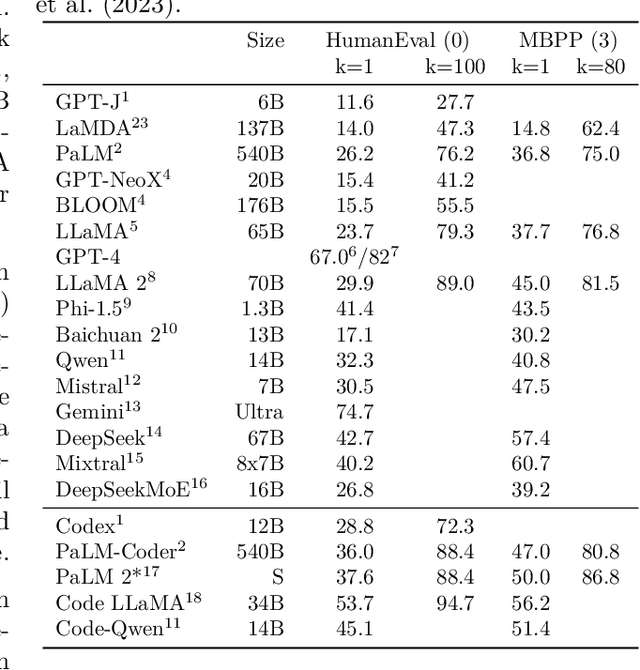
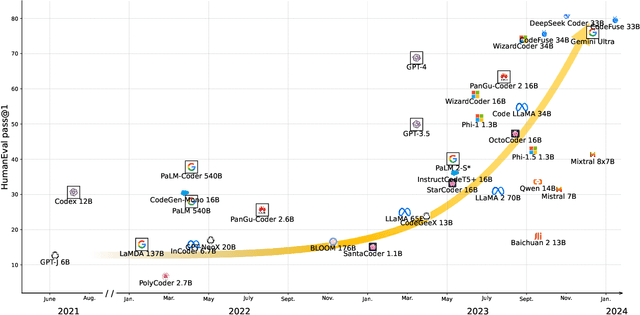
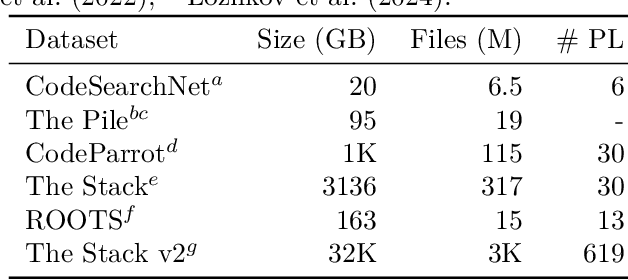
In this work we systematically review the recent advancements in code processing with language models, covering 50+ models, 30+ evaluation tasks, 150+ datasets, and 550 related works. We break down code processing models into general language models represented by the GPT family and specialized models that are specifically pretrained on code, often with tailored objectives. We discuss the relations and differences between these models, and highlight the historical transition of code modeling from statistical models and RNNs to pretrained Transformers and LLMs, which is exactly the same course that had been taken by NLP. We also discuss code-specific features such as AST, CFG, and unit tests, along with their application in training code language models, and identify key challenges and potential future directions in this domain. We keep the survey open and updated on GitHub repository at https://github.com/codefuse-ai/Awesome-Code-LLM.
CLEAN-EVAL: Clean Evaluation on Contaminated Large Language Models
Nov 15, 2023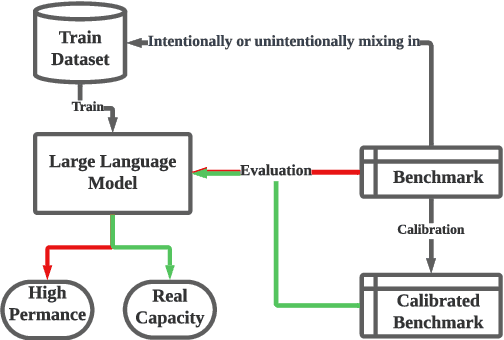
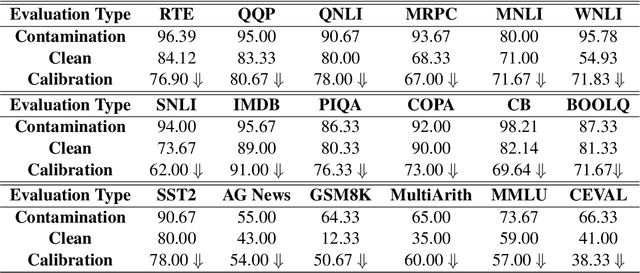
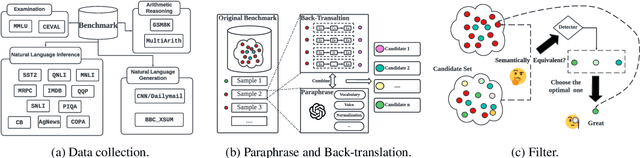
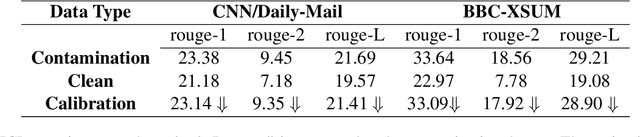
We are currently in an era of fierce competition among various large language models (LLMs) continuously pushing the boundaries of benchmark performance. However, genuinely assessing the capabilities of these LLMs has become a challenging and critical issue due to potential data contamination, and it wastes dozens of time and effort for researchers and engineers to download and try those contaminated models. To save our precious time, we propose a novel and useful method, Clean-Eval, which mitigates the issue of data contamination and evaluates the LLMs in a cleaner manner. Clean-Eval employs an LLM to paraphrase and back-translate the contaminated data into a candidate set, generating expressions with the same meaning but in different surface forms. A semantic detector is then used to filter the generated low-quality samples to narrow down this candidate set. The best candidate is finally selected from this set based on the BLEURT score. According to human assessment, this best candidate is semantically similar to the original contamination data but expressed differently. All candidates can form a new benchmark to evaluate the model. Our experiments illustrate that Clean-Eval substantially restores the actual evaluation results on contaminated LLMs under both few-shot learning and fine-tuning scenarios.
MELA: Multilingual Evaluation of Linguistic Acceptability
Nov 15, 2023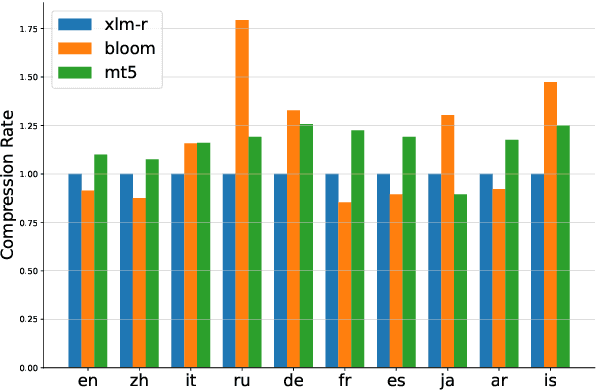
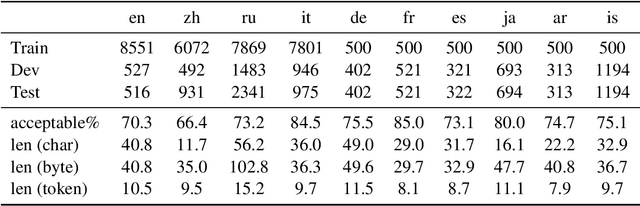
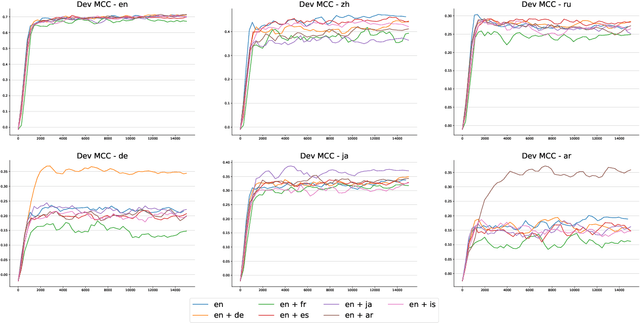
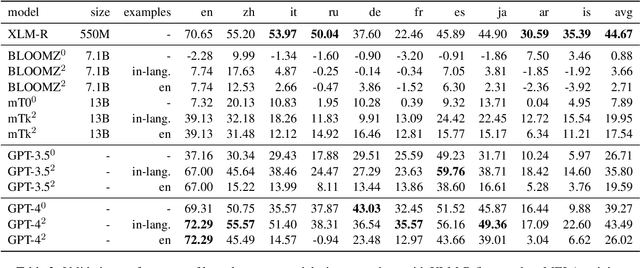
Recent benchmarks for Large Language Models (LLMs) have mostly focused on application-driven tasks such as complex reasoning and code generation, and this has led to a scarcity in purely linguistic evaluation of LLMs. Against this background, we introduce Multilingual Evaluation of Linguistic Acceptability -- MELA, the first multilingual benchmark on linguistic acceptability with 48K samples covering 10 languages from a diverse set of language families. We establish baselines of commonly used LLMs along with supervised models, and conduct cross-lingual transfer and multi-task learning experiments with XLM-R. In pursuit of multilingual interpretability, we analyze the weights of fine-tuned XLM-R to explore the possibility of identifying transfer difficulty between languages. Our results show that ChatGPT benefits much from in-context examples but still lags behind fine-tuned XLM-R, while the performance of GPT-4 is on par with fine-tuned XLM-R even in zero-shot setting. Cross-lingual and multi-task learning experiments show that unlike semantic tasks, in-language training data is crucial in acceptability judgements. Results in layerwise probing indicate that the upper layers of XLM-R become a task-specific but language-agnostic region for multilingual acceptability judgment. We also introduce the concept of conflicting weight, which could be a potential indicator for the difficulty of cross-lingual transfer between languages. Our data will be available at https://github.com/sjtu-compling/MELA.
CASTER: A Computer-Vision-Assisted Wireless Channel Simulator for Gesture Recognition
Nov 13, 2023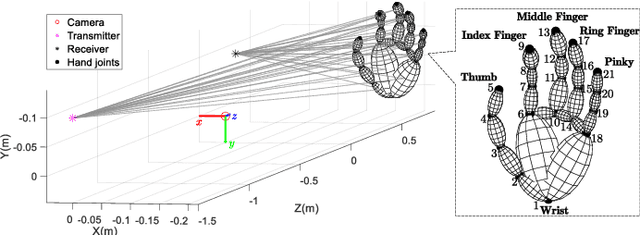
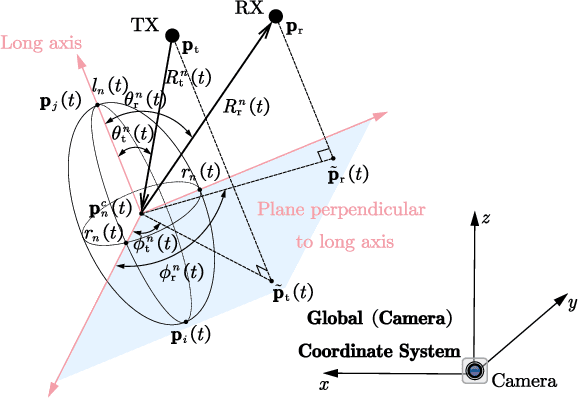
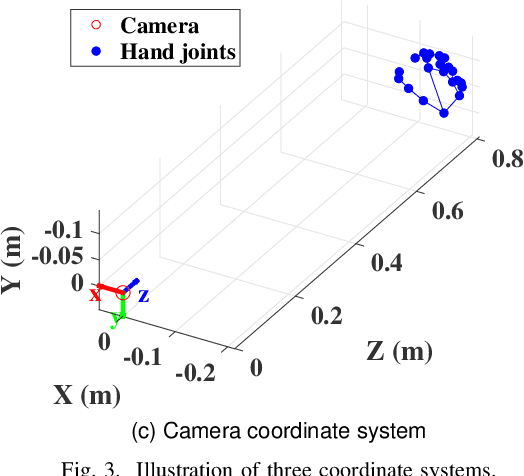
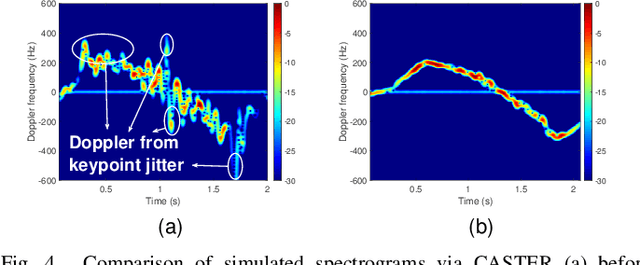
In this paper, a computer-vision-assisted simulation method is proposed to address the issue of training dataset acquisition for wireless hand gesture recognition. In the existing literature, in order to classify gestures via the wireless channel estimation, massive training samples should be measured in a consistent environment, consuming significant efforts. In the proposed CASTER simulator, however, the training dataset can be simulated via existing videos. Particularly, a gesture is represented by a sequence of snapshots, and the channel impulse response of each snapshot is calculated via tracing the rays scattered off a primitive-based hand model. Moreover, CASTER simulator relies on the existing videos to extract the motion data of gestures. Thus, the massive measurements of wireless channel can be eliminated. The experiments demonstrate a 90.8% average classification accuracy of simulation-to-reality inference.
Leveraging Word Guessing Games to Assess the Intelligence of Large Language Models
Nov 06, 2023The automatic evaluation of LLM-based agent intelligence is critical in developing advanced LLM-based agents. Although considerable effort has been devoted to developing human-annotated evaluation datasets, such as AlpacaEval, existing techniques are costly, time-consuming, and lack adaptability. In this paper, inspired by the popular language game ``Who is Spy'', we propose to use the word guessing game to assess the intelligence performance of LLMs. Given a word, the LLM is asked to describe the word and determine its identity (spy or not) based on its and other players' descriptions. Ideally, an advanced agent should possess the ability to accurately describe a given word using an aggressive description while concurrently maximizing confusion in the conservative description, enhancing its participation in the game. To this end, we first develop DEEP to evaluate LLMs' expression and disguising abilities. DEEP requires LLM to describe a word in aggressive and conservative modes. We then introduce SpyGame, an interactive multi-agent framework designed to assess LLMs' intelligence through participation in a competitive language-based board game. Incorporating multi-agent interaction, SpyGame requires the target LLM to possess linguistic skills and strategic thinking, providing a more comprehensive evaluation of LLMs' human-like cognitive abilities and adaptability in complex communication situations. The proposed evaluation framework is very easy to implement. We collected words from multiple sources, domains, and languages and used the proposed evaluation framework to conduct experiments. Extensive experiments demonstrate that the proposed DEEP and SpyGame effectively evaluate the capabilities of various LLMs, capturing their ability to adapt to novel situations and engage in strategic communication.
Rethinking Word-Level Auto-Completion in Computer-Aided Translation
Oct 24, 2023
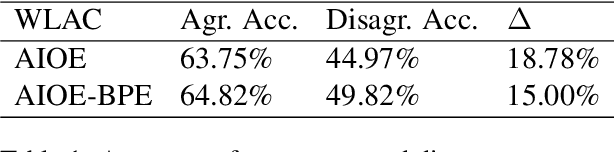
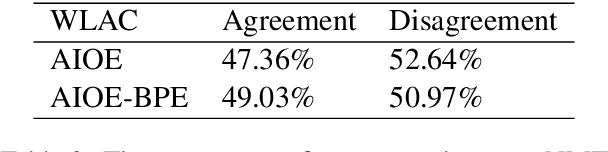
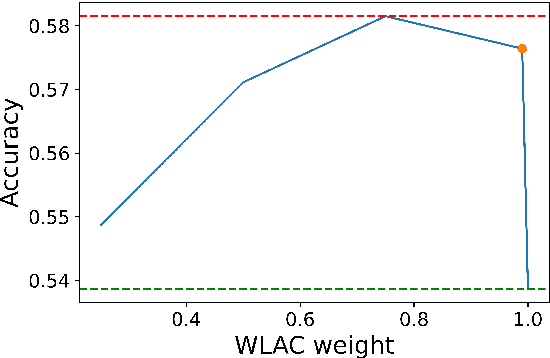
Word-Level Auto-Completion (WLAC) plays a crucial role in Computer-Assisted Translation. It aims at providing word-level auto-completion suggestions for human translators. While previous studies have primarily focused on designing complex model architectures, this paper takes a different perspective by rethinking the fundamental question: what kind of words are good auto-completions? We introduce a measurable criterion to answer this question and discover that existing WLAC models often fail to meet this criterion. Building upon this observation, we propose an effective approach to enhance WLAC performance by promoting adherence to the criterion. Notably, the proposed approach is general and can be applied to various encoder-based architectures. Through extensive experiments, we demonstrate that our approach outperforms the top-performing system submitted to the WLAC shared tasks in WMT2022, while utilizing significantly smaller model sizes.
MCC-KD: Multi-CoT Consistent Knowledge Distillation
Oct 24, 2023Large language models (LLMs) have showcased remarkable capabilities in complex reasoning through chain of thought (CoT) prompting. Recently, there has been a growing interest in transferring these reasoning abilities from LLMs to smaller models. However, achieving both the diversity and consistency in rationales presents a challenge. In this paper, we focus on enhancing these two aspects and propose Multi-CoT Consistent Knowledge Distillation (MCC-KD) to efficiently distill the reasoning capabilities. In MCC-KD, we generate multiple rationales for each question and enforce consistency among the corresponding predictions by minimizing the bidirectional KL-divergence between the answer distributions. We investigate the effectiveness of MCC-KD with different model architectures (LLaMA/FlanT5) and various model scales (3B/7B/11B/13B) on both mathematical reasoning and commonsense reasoning benchmarks. The empirical results not only confirm MCC-KD's superior performance on in-distribution datasets but also highlight its robust generalization ability on out-of-distribution datasets.