 Add to Chrome
 Add to Firefox
 Add to Edge
A Stochastic--Geometric Theory of Scaling Laws in Grokking
Jun 29, 2026
Delayed generalization (\ie~grokking) refers to the phenomenon in which a neural network fits its training data early in training but only begins to generalize after a prolonged delay, often through an abrupt transition. Despite extensive empirical study, its underlying mechanism remains poorly understood. In this work, we first theoretically characterize a shell--core topological configuration of the reachable solution space induced by Adam's optimization dynamics with weight-shrinkage regularization, supported by empirical evidence. This optimization-induced topological configuration gives rise to grokking. In model's parameter space, random initialization solutions concentrate on a thin outer spherical shell, enclosing another spherical shell of memorization solutions, which in turn contains a core corresponding to the generalization solutions. Leveraging stopping-time theory, we then analyze the geometry of this topological configuration and the solution transition time at which optimization trajectories escape the memorization manifold and first reach the boundary of the generalization manifold. Our theoretical analysis derives grokking scaling laws for the learning rate, batch size, and $\ell_2$ regularization coefficient, which are further validated through experiments and shown to recover results from prior literature.

Reliability-Gated Source Anchoring for Continual Test-Time Adaptation
May 13, 2026Continual test-time adaptation (CTTA) updates a pretrained model online on an unlabeled, non-stationary stream while anchoring it to a frozen source checkpoint. This anchor is useful only when the source remains reliable. On CCC-Hard, however, a ResNet-50 source falls to approximately $1.3\%$ top-$1$ accuracy, while existing source-anchored CTTA methods continue applying the same anchor strength. We call this failure mode blind anchoring and propose RMemSafe, a reliability-gated extension of ROID that uses the frozen source's normalized predictive entropy to attenuate all explicit source-coupled uses in the objective. When the source posterior approaches uniformity, the gate closes: the source anchor and agreement filter vanish, and the objective reduces to a source-agnostic fallback comprising ROID's base losses plus marginal calibration. Combined with ASR, RMemSafe achieves the lowest error on $8$ of $9$ matched-split continual-corruption cells and is the best reset-based method on all $9$, improving ROID+ASR by $1.05$~pp on ResNet-50 and $0.48$~pp on ViT-B/16. A controlled source-degradation sweep shows a $1.13{\times}$ shallower harm slope than ROID+ASR, consistent with the graceful-decay prediction. The entropy gate detects high-entropy source collapse, not confidently wrong low-entropy sources; this scope is explicitly evaluated and discussed.
Multi-Modal Learning meets Genetic Programming: Analyzing Alignment in Latent Space Optimization
Apr 09, 2026Symbolic regression (SR) aims to discover mathematical expressions from data, a task traditionally tackled using Genetic Programming (GP) through combinatorial search over symbolic structures. Latent Space Optimization (LSO) methods use neural encoders to map symbolic expressions into continuous spaces, transforming the combinatorial search into continuous optimization. SNIP (Meidani et al., 2024), a contrastive pre-training model inspired by CLIP, advances LSO by introducing a multi-modal approach: aligning symbolic and numeric encoders in a shared latent space to learn the phenotype-genotype mapping, enabling optimization in the numeric space to implicitly guide symbolic search. However, this relies on fine-grained cross-modal alignment, whereas literature on similar models like CLIP reveals that such an alignment is typically coarse-grained. In this paper, we investigate whether SNIP delivers on its promise of effective bi-modal optimization for SR. Our experiments show that: (1) cross-modal alignment does not improve during optimization, even as fitness increases, and (2) the alignment learned by SNIP is too coarse to efficiently conduct principled search in the symbolic space. These findings reveal that while multi-modal LSO holds significant potential for SR, effective alignment-guided optimization remains unrealized in practice, highlighting fine-grained alignment as a critical direction for future work.
Personalized Federated Fine-Tuning of Vision Foundation Models for Healthcare
Oct 14, 2025Foundation models open up new possibilities for the use of AI in healthcare. However, even when pre-trained on health data, they still need to be fine-tuned for specific downstream tasks. Furthermore, although foundation models reduce the amount of training data required to achieve good performance, obtaining sufficient data is still a challenge. This is due, in part, to restrictions on sharing and aggregating data from different sources to protect patients' privacy. One possible solution to this is to fine-tune foundation models via federated learning across multiple participating clients (i.e., hospitals, clinics, etc.). In this work, we propose a new personalized federated fine-tuning method that learns orthogonal LoRA adapters to disentangle general and client-specific knowledge, enabling each client to fully exploit both their own data and the data of others. Our preliminary results on real-world federated medical imaging tasks demonstrate that our approach is competitive against current federated fine-tuning methods.
Adversarial Bounding Boxes Generation (ABBG) Attack against Visual Object Trackers
Nov 26, 2024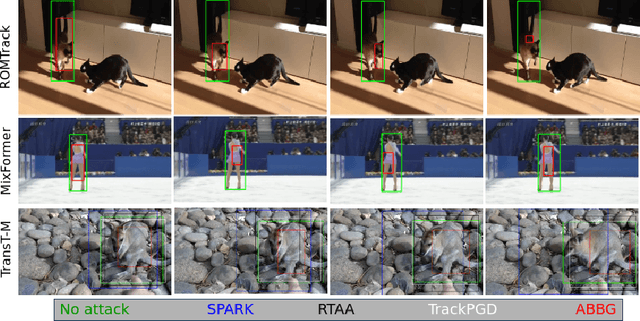
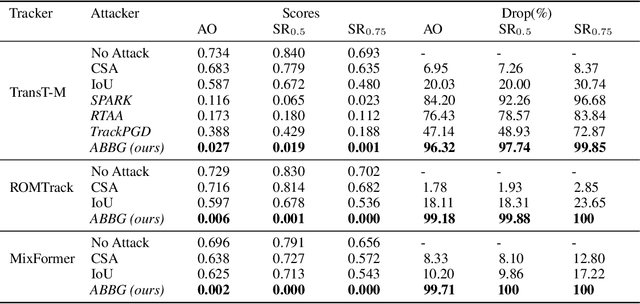
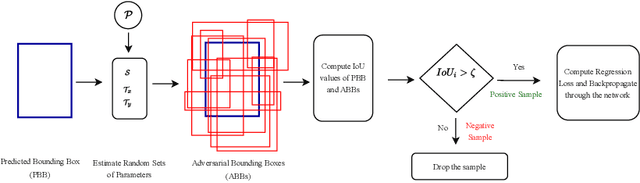
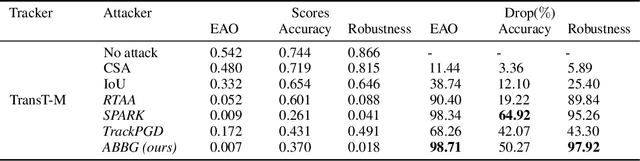
Adversarial perturbations aim to deceive neural networks into predicting inaccurate results. For visual object trackers, adversarial attacks have been developed to generate perturbations by manipulating the outputs. However, transformer trackers predict a specific bounding box instead of an object candidate list, which limits the applicability of many existing attack scenarios. To address this issue, we present a novel white-box approach to attack visual object trackers with transformer backbones using only one bounding box. From the tracker predicted bounding box, we generate a list of adversarial bounding boxes and compute the adversarial loss for those bounding boxes. Experimental results demonstrate that our simple yet effective attack outperforms existing attacks against several robust transformer trackers, including TransT-M, ROMTrack, and MixFormer, on popular benchmark tracking datasets such as GOT-10k, UAV123, and VOT2022STS.
TrackPGD: A White-box Attack using Binary Masks against Robust Transformer Trackers
Jul 04, 2024Object trackers with transformer backbones have achieved robust performance on visual object tracking datasets. However, the adversarial robustness of these trackers has not been well studied in the literature. Due to the backbone differences, the adversarial white-box attacks proposed for object tracking are not transferable to all types of trackers. For instance, transformer trackers such as MixFormerM still function well after black-box attacks, especially in predicting the object binary masks. We are proposing a novel white-box attack named TrackPGD, which relies on the predicted object binary mask to attack the robust transformer trackers. That new attack focuses on annotation masks by adapting the well-known SegPGD segmentation attack, allowing to successfully conduct the white-box attack on trackers relying on transformer backbones. The experimental results indicate that the TrackPGD is able to effectively attack transformer-based trackers such as MixFormerM, OSTrackSTS, and TransT-SEG on several tracking datasets.
Detecting Brittle Decisions for Free: Leveraging Margin Consistency in Deep Robust Classifiers
Jun 26, 2024Despite extensive research on adversarial training strategies to improve robustness, the decisions of even the most robust deep learning models can still be quite sensitive to imperceptible perturbations, creating serious risks when deploying them for high-stakes real-world applications. While detecting such cases may be critical, evaluating a model's vulnerability at a per-instance level using adversarial attacks is computationally too intensive and unsuitable for real-time deployment scenarios. The input space margin is the exact score to detect non-robust samples and is intractable for deep neural networks. This paper introduces the concept of margin consistency -- a property that links the input space margins and the logit margins in robust models -- for efficient detection of vulnerable samples. First, we establish that margin consistency is a necessary and sufficient condition to use a model's logit margin as a score for identifying non-robust samples. Next, through comprehensive empirical analysis of various robustly trained models on CIFAR10 and CIFAR100 datasets, we show that they indicate strong margin consistency with a strong correlation between their input space margins and the logit margins. Then, we show that we can effectively use the logit margin to confidently detect brittle decisions with such models and accurately estimate robust accuracy on an arbitrarily large test set by estimating the input margins only on a small subset. Finally, we address cases where the model is not sufficiently margin-consistent by learning a pseudo-margin from the feature representation. Our findings highlight the potential of leveraging deep representations to efficiently assess adversarial vulnerability in deployment scenarios.
Reproducibility Study on Adversarial Attacks Against Robust Transformer Trackers
Jun 03, 2024New transformer networks have been integrated into object tracking pipelines and have demonstrated strong performance on the latest benchmarks. This paper focuses on understanding how transformer trackers behave under adversarial attacks and how different attacks perform on tracking datasets as their parameters change. We conducted a series of experiments to evaluate the effectiveness of existing adversarial attacks on object trackers with transformer and non-transformer backbones. We experimented on 7 different trackers, including 3 that are transformer-based, and 4 which leverage other architectures. These trackers are tested against 4 recent attack methods to assess their performance and robustness on VOT2022ST, UAV123 and GOT10k datasets. Our empirical study focuses on evaluating adversarial robustness of object trackers based on bounding box versus binary mask predictions, and attack methods at different levels of perturbations. Interestingly, our study found that altering the perturbation level may not significantly affect the overall object tracking results after the attack. Similarly, the sparsity and imperceptibility of the attack perturbations may remain stable against perturbation level shifts. By applying a specific attack on all transformer trackers, we show that new transformer trackers having a stronger cross-attention modeling achieve a greater adversarial robustness on tracking datasets, such as VOT2022ST and GOT10k. Our results also indicate the necessity for new attack methods to effectively tackle the latest types of transformer trackers. The codes necessary to reproduce this study are available at https://github.com/fatemehN/ReproducibilityStudy.
Analyzing Data Augmentation for Medical Images: A Case Study in Ultrasound Images
Mar 14, 2024Data augmentation is one of the most effective techniques to improve the generalization performance of deep neural networks. Yet, despite often facing limited data availability in medical image analysis, it is frequently underutilized. This appears to be due to a gap in our collective understanding of the efficacy of different augmentation techniques across medical imaging tasks and modalities. One domain where this is especially true is breast ultrasound images. This work addresses this issue by analyzing the effectiveness of different augmentation techniques for the classification of breast lesions in ultrasound images. We assess the generalizability of our findings across several datasets, demonstrate that certain augmentations are far more effective than others, and show that their usage leads to significant performance gains.
Improving genetic algorithms performance via deterministic population shrinkage
Jan 22, 2024Despite the intuition that the same population size is not needed throughout the run of an Evolutionary Algorithm (EA), most EAs use a fixed population size. This paper presents an empirical study on the possible benefits of a Simple Variable Population Sizing (SVPS) scheme on the performance of Genetic Algorithms (GAs). It consists in decreasing the population for a GA run following a predetermined schedule, configured by a speed and a severity parameter. The method uses as initial population size an estimation of the minimum size needed to supply enough building blocks, using a fixed-size selectorecombinative GA converging within some confidence interval toward good solutions for a particular problem. Following this methodology, a scalability analysis is conducted on deceptive, quasi-deceptive, and non-deceptive trap functions in order to assess whether SVPS-GA improves performances compared to a fixed-size GA under different problem instances and difficulty levels. Results show several combinations of speed-severity where SVPS-GA preserves the solution quality while improving performances, by reducing the number of evaluations needed for success.