 Add to Chrome
 Add to Firefox
 Add to Edge
Boosting Multimodal Large Language Models with Visual Tokens Withdrawal for Rapid Inference
May 09, 2024
Multimodal large language models (MLLMs) demand considerable computations for inference due to the extensive parameters and the additional input tokens needed for visual information representation. Herein, we introduce Visual Tokens Withdrawal (VTW), a plug-and-play module to boost MLLMs for rapid inference. Our approach is inspired by two intriguing phenomena we have observed: (1) the attention sink phenomenon that is prevalent in LLMs also persists in MLLMs, suggesting that initial tokens and nearest tokens receive the majority of attention, while middle vision tokens garner minimal attention in deep layers; (2) the presence of information migration, which implies that visual information is transferred to subsequent text tokens within the first few layers of MLLMs. As per our findings, we conclude that vision tokens are not necessary in the deep layers of MLLMs. Thus, we strategically withdraw them at a certain layer, enabling only text tokens to engage in subsequent layers. To pinpoint the ideal layer for vision tokens withdrawal, we initially analyze a limited set of tiny datasets and choose the first layer that meets the Kullback-Leibler divergence criterion. Our VTW approach can cut computational overhead by over 40\% across diverse multimodal tasks while maintaining performance. Our code is released at https://github.com/lzhxmu/VTW.

ObjectAdd: Adding Objects into Image via a Training-Free Diffusion Modification Fashion
May 02, 2024
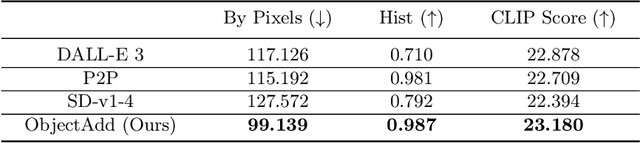
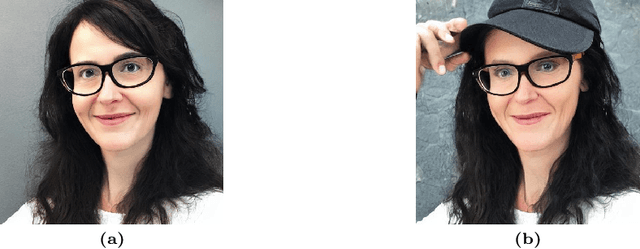

We introduce ObjectAdd, a training-free diffusion modification method to add user-expected objects into user-specified area. The motive of ObjectAdd stems from: first, describing everything in one prompt can be difficult, and second, users often need to add objects into the generated image. To accommodate with real world, our ObjectAdd maintains accurate image consistency after adding objects with technical innovations in: (1) embedding-level concatenation to ensure correct text embedding coalesce; (2) object-driven layout control with latent and attention injection to ensure objects accessing user-specified area; (3) prompted image inpainting in an attention refocusing & object expansion fashion to ensure rest of the image stays the same. With a text-prompted image, our ObjectAdd allows users to specify a box and an object, and achieves: (1) adding object inside the box area; (2) exact content outside the box area; (3) flawless fusion between the two areas
X-Oscar: A Progressive Framework for High-quality Text-guided 3D Animatable Avatar Generation
May 02, 2024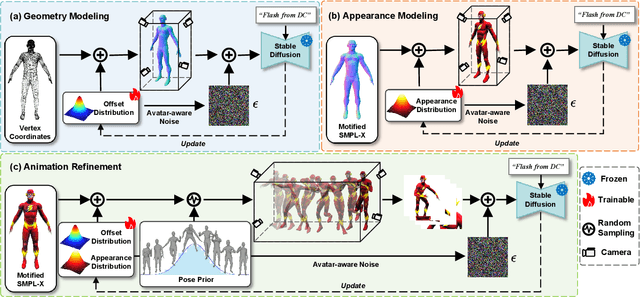
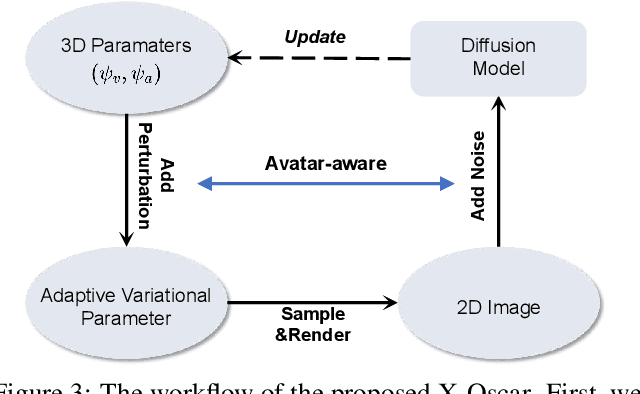
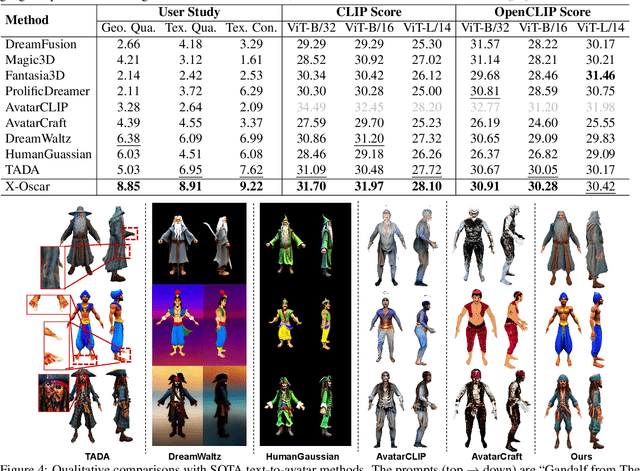
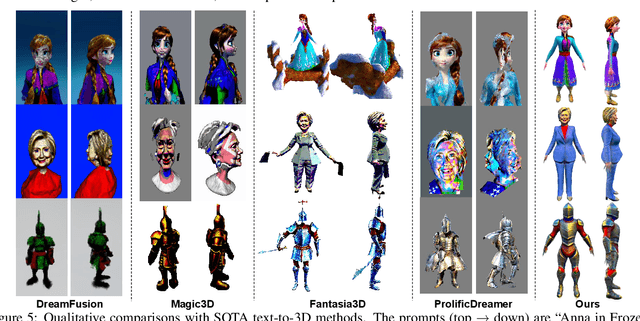
Recent advancements in automatic 3D avatar generation guided by text have made significant progress. However, existing methods have limitations such as oversaturation and low-quality output. To address these challenges, we propose X-Oscar, a progressive framework for generating high-quality animatable avatars from text prompts. It follows a sequential Geometry->Texture->Animation paradigm, simplifying optimization through step-by-step generation. To tackle oversaturation, we introduce Adaptive Variational Parameter (AVP), representing avatars as an adaptive distribution during training. Additionally, we present Avatar-aware Score Distillation Sampling (ASDS), a novel technique that incorporates avatar-aware noise into rendered images for improved generation quality during optimization. Extensive evaluations confirm the superiority of X-Oscar over existing text-to-3D and text-to-avatar approaches. Our anonymous project page: https://xmu-xiaoma666.github.io/Projects/X-Oscar/.
GraCo: Granularity-Controllable Interactive Segmentation
May 01, 2024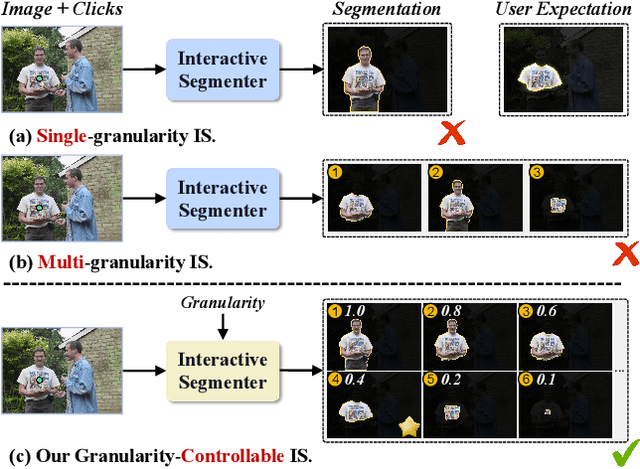
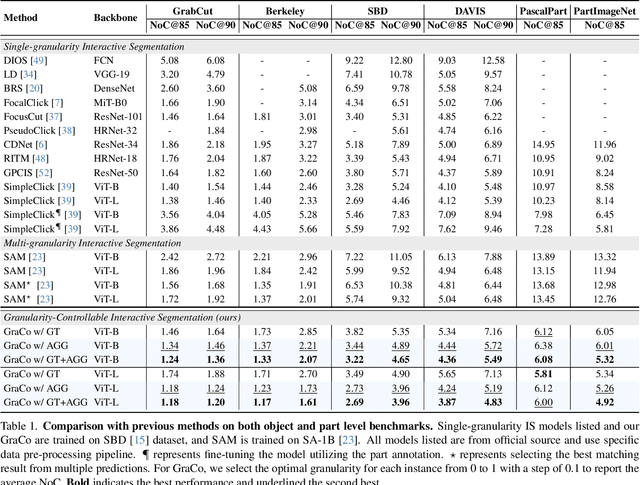
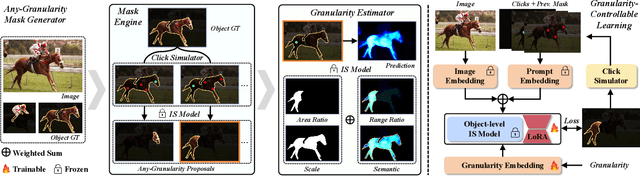
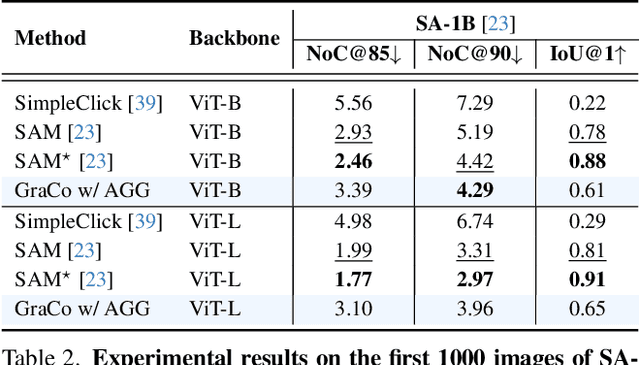
Interactive Segmentation (IS) segments specific objects or parts in the image according to user input. Current IS pipelines fall into two categories: single-granularity output and multi-granularity output. The latter aims to alleviate the spatial ambiguity present in the former. However, the multi-granularity output pipeline suffers from limited interaction flexibility and produces redundant results. In this work, we introduce Granularity-Controllable Interactive Segmentation (GraCo), a novel approach that allows precise control of prediction granularity by introducing additional parameters to input. This enhances the customization of the interactive system and eliminates redundancy while resolving ambiguity. Nevertheless, the exorbitant cost of annotating multi-granularity masks and the lack of available datasets with granularity annotations make it difficult for models to acquire the necessary guidance to control output granularity. To address this problem, we design an any-granularity mask generator that exploits the semantic property of the pre-trained IS model to automatically generate abundant mask-granularity pairs without requiring additional manual annotation. Based on these pairs, we propose a granularity-controllable learning strategy that efficiently imparts the granularity controllability to the IS model. Extensive experiments on intricate scenarios at object and part levels demonstrate that our GraCo has significant advantages over previous methods. This highlights the potential of GraCo to be a flexible annotation tool, capable of adapting to diverse segmentation scenarios. The project page: https://zhao-yian.github.io/GraCo.
Cantor: Inspiring Multimodal Chain-of-Thought of MLLM
Apr 24, 2024With the advent of large language models(LLMs) enhanced by the chain-of-thought(CoT) methodology, visual reasoning problem is usually decomposed into manageable sub-tasks and tackled sequentially with various external tools. However, such a paradigm faces the challenge of the potential "determining hallucinations" in decision-making due to insufficient visual information and the limitation of low-level perception tools that fail to provide abstract summaries necessary for comprehensive reasoning. We argue that converging visual context acquisition and logical reasoning is pivotal for tackling visual reasoning tasks. This paper delves into the realm of multimodal CoT to solve intricate visual reasoning tasks with multimodal large language models(MLLMs) and their cognitive capability. To this end, we propose an innovative multimodal CoT framework, termed Cantor, characterized by a perception-decision architecture. Cantor first acts as a decision generator and integrates visual inputs to analyze the image and problem, ensuring a closer alignment with the actual context. Furthermore, Cantor leverages the advanced cognitive functions of MLLMs to perform as multifaceted experts for deriving higher-level information, enhancing the CoT generation process. Our extensive experiments demonstrate the efficacy of the proposed framework, showing significant improvements in multimodal CoT performance across two complex visual reasoning datasets, without necessitating fine-tuning or ground-truth rationales. Project Page: https://ggg0919.github.io/cantor/ .
Multi-Modal Prompt Learning on Blind Image Quality Assessment
Apr 23, 2024


Image Quality Assessment (IQA) models benefit significantly from semantic information, which allows them to treat different types of objects distinctly. Currently, leveraging semantic information to enhance IQA is a crucial research direction. Traditional methods, hindered by a lack of sufficiently annotated data, have employed the CLIP image-text pretraining model as their backbone to gain semantic awareness. However, the generalist nature of these pre-trained Vision-Language (VL) models often renders them suboptimal for IQA-specific tasks. Recent approaches have attempted to address this mismatch using prompt technology, but these solutions have shortcomings. Existing prompt-based VL models overly focus on incremental semantic information from text, neglecting the rich insights available from visual data analysis. This imbalance limits their performance improvements in IQA tasks. This paper introduces an innovative multi-modal prompt-based methodology for IQA. Our approach employs carefully crafted prompts that synergistically mine incremental semantic information from both visual and linguistic data. Specifically, in the visual branch, we introduce a multi-layer prompt structure to enhance the VL model's adaptability. In the text branch, we deploy a dual-prompt scheme that steers the model to recognize and differentiate between scene category and distortion type, thereby refining the model's capacity to assess image quality. Our experimental findings underscore the effectiveness of our method over existing Blind Image Quality Assessment (BIQA) approaches. Notably, it demonstrates competitive performance across various datasets. Our method achieves Spearman Rank Correlation Coefficient (SRCC) values of 0.961(surpassing 0.946 in CSIQ) and 0.941 (exceeding 0.930 in KADID), illustrating its robustness and accuracy in diverse contexts.
CutDiffusion: A Simple, Fast, Cheap, and Strong Diffusion Extrapolation Method
Apr 23, 2024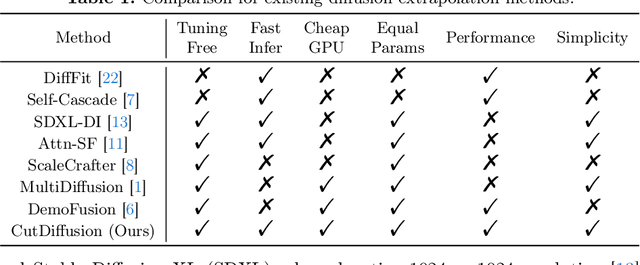
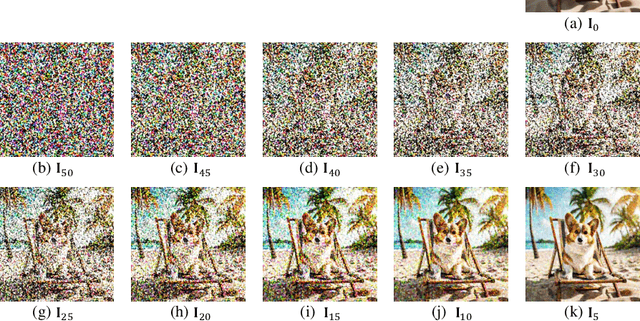
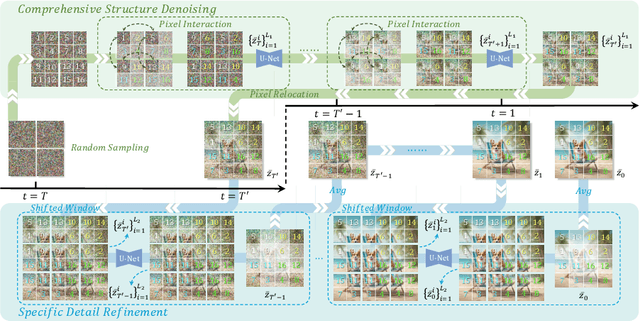

Transforming large pre-trained low-resolution diffusion models to cater to higher-resolution demands, i.e., diffusion extrapolation, significantly improves diffusion adaptability. We propose tuning-free CutDiffusion, aimed at simplifying and accelerating the diffusion extrapolation process, making it more affordable and improving performance. CutDiffusion abides by the existing patch-wise extrapolation but cuts a standard patch diffusion process into an initial phase focused on comprehensive structure denoising and a subsequent phase dedicated to specific detail refinement. Comprehensive experiments highlight the numerous almighty advantages of CutDiffusion: (1) simple method construction that enables a concise higher-resolution diffusion process without third-party engagement; (2) fast inference speed achieved through a single-step higher-resolution diffusion process, and fewer inference patches required; (3) cheap GPU cost resulting from patch-wise inference and fewer patches during the comprehensive structure denoising; (4) strong generation performance, stemming from the emphasis on specific detail refinement.
NeRF-DetS: Enhancing Multi-View 3D Object Detection with Sampling-adaptive Network of Continuous NeRF-based Representation
Apr 22, 2024As a preliminary work, NeRF-Det unifies the tasks of novel view synthesis and 3D perception, demonstrating that perceptual tasks can benefit from novel view synthesis methods like NeRF, significantly improving the performance of indoor multi-view 3D object detection. Using the geometry MLP of NeRF to direct the attention of detection head to crucial parts and incorporating self-supervised loss from novel view rendering contribute to the achieved improvement. To better leverage the notable advantages of the continuous representation through neural rendering in space, we introduce a novel 3D perception network structure, NeRF-DetS. The key component of NeRF-DetS is the Multi-level Sampling-Adaptive Network, making the sampling process adaptively from coarse to fine. Also, we propose a superior multi-view information fusion method, known as Multi-head Weighted Fusion. This fusion approach efficiently addresses the challenge of losing multi-view information when using arithmetic mean, while keeping low computational costs. NeRF-DetS outperforms competitive NeRF-Det on the ScanNetV2 dataset, by achieving +5.02% and +5.92% improvement in mAP@.25 and mAP@.50, respectively.
Rethinking 3D Dense Caption and Visual Grounding in A Unified Framework through Prompt-based Localization
Apr 17, 2024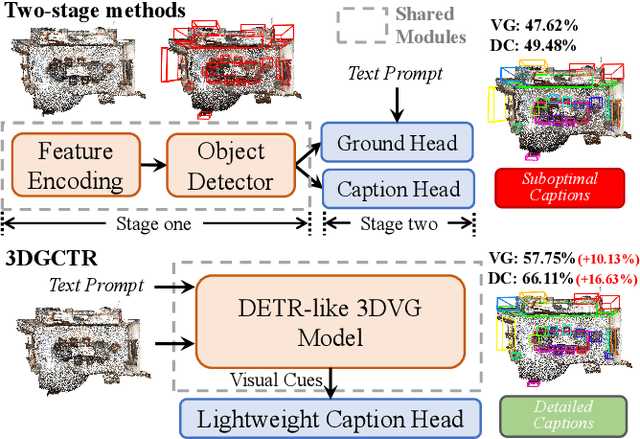
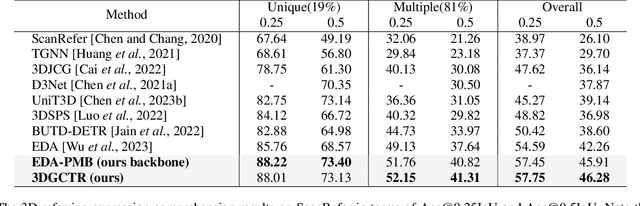
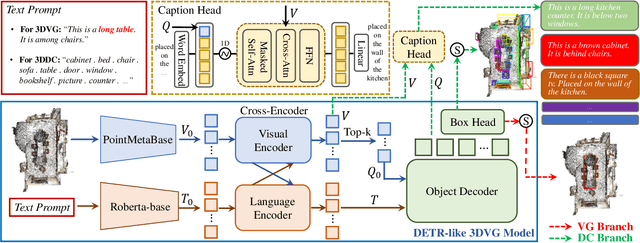
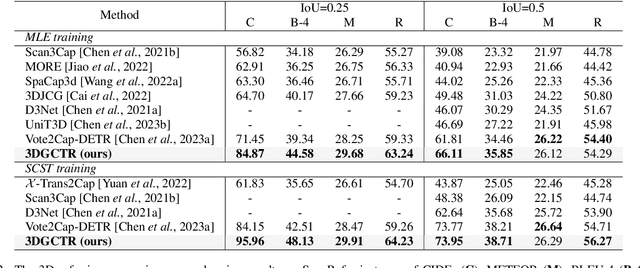
3D Visual Grounding (3DVG) and 3D Dense Captioning (3DDC) are two crucial tasks in various 3D applications, which require both shared and complementary information in localization and visual-language relationships. Therefore, existing approaches adopt the two-stage "detect-then-describe/discriminate" pipeline, which relies heavily on the performance of the detector, resulting in suboptimal performance. Inspired by DETR, we propose a unified framework, 3DGCTR, to jointly solve these two distinct but closely related tasks in an end-to-end fashion. The key idea is to reconsider the prompt-based localization ability of the 3DVG model. In this way, the 3DVG model with a well-designed prompt as input can assist the 3DDC task by extracting localization information from the prompt. In terms of implementation, we integrate a Lightweight Caption Head into the existing 3DVG network with a Caption Text Prompt as a connection, effectively harnessing the existing 3DVG model's inherent localization capacity, thereby boosting 3DDC capability. This integration facilitates simultaneous multi-task training on both tasks, mutually enhancing their performance. Extensive experimental results demonstrate the effectiveness of this approach. Specifically, on the ScanRefer dataset, 3DGCTR surpasses the state-of-the-art 3DDC method by 4.3% in CIDEr@0.5IoU in MLE training and improves upon the SOTA 3DVG method by 3.16% in Acc@0.25IoU.
DiffAgent: Fast and Accurate Text-to-Image API Selection with Large Language Model
Mar 31, 2024
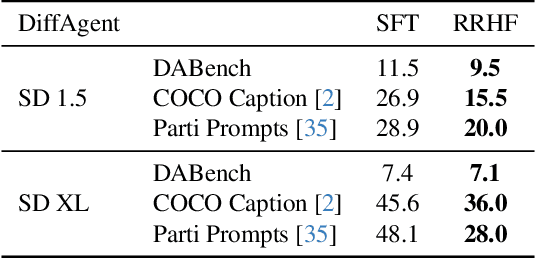
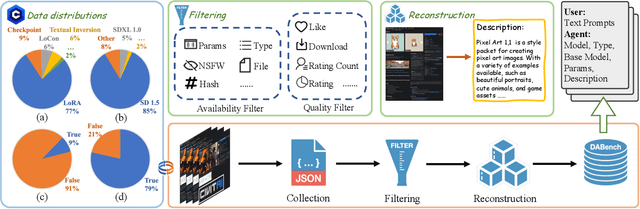
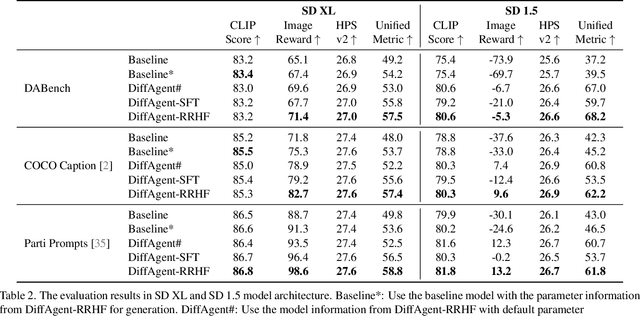
Text-to-image (T2I) generative models have attracted significant attention and found extensive applications within and beyond academic research. For example, the Civitai community, a platform for T2I innovation, currently hosts an impressive array of 74,492 distinct models. However, this diversity presents a formidable challenge in selecting the most appropriate model and parameters, a process that typically requires numerous trials. Drawing inspiration from the tool usage research of large language models (LLMs), we introduce DiffAgent, an LLM agent designed to screen the accurate selection in seconds via API calls. DiffAgent leverages a novel two-stage training framework, SFTA, enabling it to accurately align T2I API responses with user input in accordance with human preferences. To train and evaluate DiffAgent's capabilities, we present DABench, a comprehensive dataset encompassing an extensive range of T2I APIs from the community. Our evaluations reveal that DiffAgent not only excels in identifying the appropriate T2I API but also underscores the effectiveness of the SFTA training framework. Codes are available at https://github.com/OpenGVLab/DiffAgent.