 Add to Chrome
 Add to Firefox
 Add to Edge
ST-WAM: Semantic-Temporal World Action Model for Robust Manipulation under Visual Distribution Shifts
Jul 31, 2026
World Action Models (WAMs) have emerged as a promising paradigm by jointly modeling robot actions and future visual dynamics. However, their reliance on pixel-generative future supervision can entangle action-relevant state transitions with task-irrelevant visual content, limiting robustness under visual distribution shifts. We identify Training-Distribution Hallucination, a recurring phenomenon in which futures conditioned on visually shifted observations hallucinate training-domain content rather than remain faithful to the current scene. A controlled frame-triplet diagnosis further shows that DINOv3 features remain more stable across visual shifts while better preserving task-state distinctions than Wan-VAE latents. Rather than correcting the predicted futures, we propose Semantic-Temporal WAM (ST-WAM) to improve action robustness by using DINOv3 as a shared semantic representation for future prediction and history retrieval while retaining fine-grained VAE dynamics. Its Dual-Space Future Experts (DSFE) jointly predict future VAE latents and DINO features, while Current-Anchored Intent Retrieval (CAIR) retrieves task-relevant evidence from recent DINO history under the current visual-language context. ST-WAM is trained end-to-end without additional embodied pretraining or task-specific annotations, and requires no explicit future generation at inference. It achieves 98.7% on LIBERO and 92.8% on RoboTwin 2.0; more importantly, compared with Fast-WAM, it improves zero-shot LIBERO-Plus performance by 21.3 percentage points and more than doubles real-world success under visual shifts from 25.8% to 61.5%. These results demonstrate that semantic-temporal modeling effectively complements pixel-generative dynamics for robust manipulation.

PRPO: Perception-Reinforced Policy Optimization via Token-Level Dynamic Advantage Reshaping
Jun 07, 2026Reinforcement Learning with Verifiable Rewards (RLVR) has become an effective paradigm for improving the reasoning capability of Large Vision-Language Models (LVLMs). However, existing RLVR methods primarily rely on trajectory-level outcome rewards, which assign identical learning signals across all generated tokens. This coarse-grained credit assignment is fundamentally mismatched to multimodal reasoning, where only a sparse subset of tokens is causally grounded in visual evidence. Consequently, these pivotal perceptual tokens receive weak supervision and are often overwhelmed by language priors or reasoning-template tokens. To address this limitation, we propose Perception-Reinforced Policy Optimization (PRPO), a token-level reinforcement learning framework that explicitly identifies and reinforces pivotal perceptual tokens within long-horizon multimodal reasoning trajectories. PRPO introduces Robust Visual Dependency (RVD), a principled metric that identifies tokens whose predictions are both visually grounded and perturbation-stable, filtering out brittle or noisy visual tokens. Based on RVD, we further propose Perceptual Advantage Reshaping (PAR), a token-level credit assignment technique that amplifies perceptually informative tokens while preserving stable gradients for non-perceptual tokens. Extensive experiments on seven multimodal reasoning benchmarks demonstrate that PRPO consistently outperforms strong LVLM baselines across both 3B and 7B model scales, achieving average gains of 23.3% and 21.1%, respectively. PRPO achieves state-of-the-art performance with improved training efficiency and stronger cross-task generalization. Our findings highlight the importance of fine-grained credit assignment for scalable multimodal reinforcement learning.
ABot-OCR Technical Report
May 27, 2026We introduce ABot-OCR, an end-to-end vision-language model that transcribes a page image directly into clean Markdown in a single forward pass. By doing so, our approach completely eliminates the need for brittle modular orchestration. To maximize parsing fidelity, we develop a dedicated data engine to provide large-scale, structurally consistent supervision. Furthermore, we propose Decoupled Heterogeneous Document Optimization, a structure-constrained reinforcement learning method that sharpens textual accuracy and strictly enforces markup well-formedness beyond supervised fine-tuning alone. Extensive evaluations demonstrate the superior performance of our framework. On the OmniDocBench v1.5 and v1.6 benchmarks, ABot-OCR achieves state-of-the-art scores of 92.81 and 93.30 among all end-to-end systems, substantially narrowing the performance gap relative to strong pipeline baselines. Finally, comprehensive multilingual text recognition across ten diverse languages further confirms the robust generalizability of ABot-OCR.
POINav: Benchmarking and Enhancing Final-Meters Arrival in Real-World Vision-Language Navigation
May 27, 2026Real-world navigation is fundamentally driven by Points of Interest (POIs), yet reaching a precise POI remains a critical "final-meters" challenge. Existing Vision-Language Navigation (VLN) benchmarks of POI-goal navigation often suffer from coarse granularity or significant sim-to-real gaps due to generated scene. To bridge this gap, we present POINav-Bench, the first benchmark designed for closed-loop evaluation of real-world POI-goal navigation. It comprises 11 commercial areas reconstructed from real-world captures using 3D Gaussian Splatting (3DGS), covering 126,398 $m^{2}$ in total and spanning 163 distinct POIs. With traversability-aware annotations and reference trajectories, POINav-Bench enables high-fidelity evaluation of navigation agents in realistic, POI-rich real-world environments. Building on this, we propose the POINav Brain-Action Framework where a Brain module performs POI-grounded reasoning to guide an Action module in predicting continuous waypoints for real-world execution. We further curate the POINav-Dataset, containing 70K real-world signage-entrance pairs. Experiments show that our framework provides a viable path toward refining real-world POI-goal navigation.
Winning solutions and post-challenge analyses of the ChaLearn AutoDL challenge 2019
Jan 11, 2022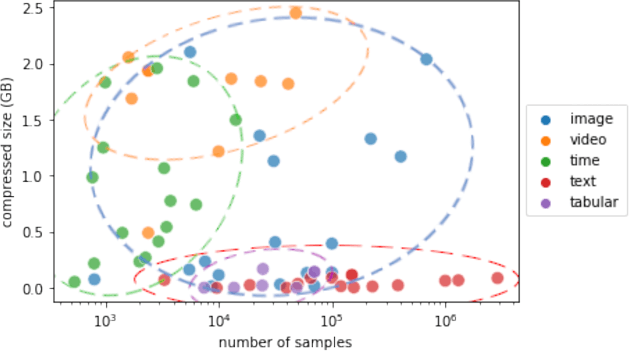
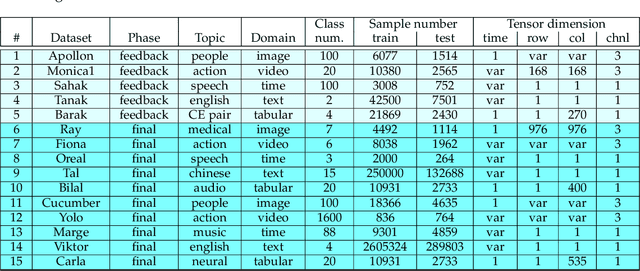
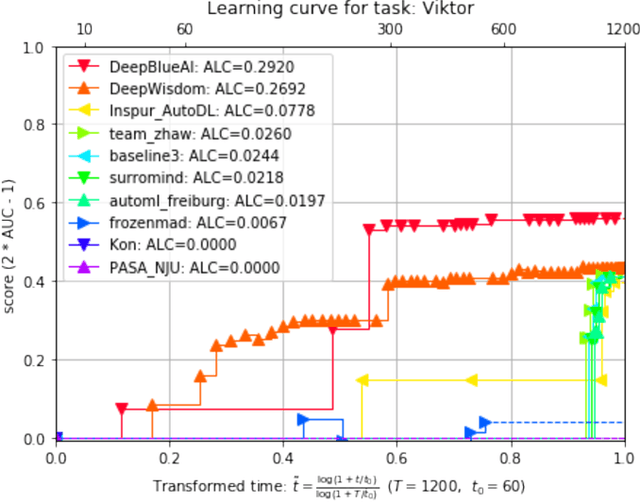
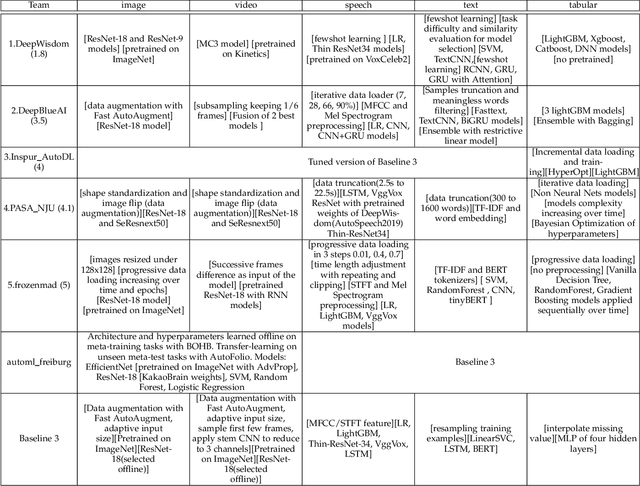
This paper reports the results and post-challenge analyses of ChaLearn's AutoDL challenge series, which helped sorting out a profusion of AutoML solutions for Deep Learning (DL) that had been introduced in a variety of settings, but lacked fair comparisons. All input data modalities (time series, images, videos, text, tabular) were formatted as tensors and all tasks were multi-label classification problems. Code submissions were executed on hidden tasks, with limited time and computational resources, pushing solutions that get results quickly. In this setting, DL methods dominated, though popular Neural Architecture Search (NAS) was impractical. Solutions relied on fine-tuned pre-trained networks, with architectures matching data modality. Post-challenge tests did not reveal improvements beyond the imposed time limit. While no component is particularly original or novel, a high level modular organization emerged featuring a "meta-learner", "data ingestor", "model selector", "model/learner", and "evaluator". This modularity enabled ablation studies, which revealed the importance of (off-platform) meta-learning, ensembling, and efficient data management. Experiments on heterogeneous module combinations further confirm the (local) optimality of the winning solutions. Our challenge legacy includes an ever-lasting benchmark (http://autodl.chalearn.org), the open-sourced code of the winners, and a free "AutoDL self-service".
* The first three authors contributed equally; This is only a draft version