 Add to Chrome
 Add to Firefox
 Add to Edge
Control-Diverse Reinforcement Fine-Tuning: Decoupling the Shared Control Bottleneck of RL Post-Training
Aug 08, 2026
Reinforcement learning post-training unlocks complex reasoning in LLMs. Yet benchmark scores reveal only whether a model improved, not what changed inside it, nor how it splits finite capability across tasks. A representative interpretability line attributes the success of RL fine-tuning to stronger and more diverse circuit activation. We challenge this activation-centered account by separating activation from control: an activated circuit need not control the post-training reward gain. Adapting Metabolic Control Analysis, we define the Post-training Control Coefficient to measure component control over reward gain and arrange these coefficients by task family into a control matrix, paired with an activation-magnitude matrix. We call cross-task control concentration the Shared Control Bottleneck and the difference between activation and control concentration the Activation-Control Gap. This reveals that highly shared activations can coexist with task-specific control, while a small gap indicates that control has collapsed onto a shared direction and lost task specificity. To reduce this collapse, we regularize the post-training loss with the Shared Control Bottleneck and propose Control-Diverse Reinforcement Fine-Tuning (CD-RFT). The exact regularizer gradient requires second-order automatic differentiation incompatible with flash attention, so we derive a first-order proxy with worst-case overhead below eight percent. On Qwen2.5-7B, CD-RFT achieves the largest control decoupling and improves multi-task capability over matched GRPO across mathematics, code, and logic. The no-KL variant leads on pass@1, and the KL-penalized variant leads on large-k pass@k coverage that KL otherwise degrades. Together, these results show that the Shared Control Bottleneck is both a mechanistic diagnostic and a training regularizer, and that control decoupling and capability gains transfer to Llama-3.2-3B.

M$^\text{4}$World: A Multi-view Multimodal Driving World Model for Interactive Object Manipulation and Minute-long Streaming
Jul 15, 2026Driving-world generation has emerged as a core capability for scalable autonomous-driving simulation, yet existing methods remain limited in object-level controllability and long-horizon stability. We present M$^\text{4}$World, a Multi-view and Multimodal generative driving world model that synthesizes future surround-view video streams and synchronized LiDAR scans while supporting interactive object Manipulation and stable Minute-long streaming. Fine-grained object manipulation is realized through a flexible conditioning interface that supports explicit control over both the spatial layout and visual appearance of individual objects. Stable minute-long streaming, on the other hand, is achieved through a multi-stage training framework that enables online causal generation in only four denoising steps while maintaining coherent world dynamics throughout extended rollouts. Building on these components, we introduce an efficient few-clip post-training as well as a suite of visual reference-conditioned generation models, preserving general generation ability while allowing rare-case customization for long-tail controllability. To assess controllability beyond realism, we further introduce an automated VLM-based judging pipeline that evaluates scene-level condition adherence, view-wise object controllability, and cross-view object consistency. Comprehensive experiments show that M$^\text{4}$World consistently delivers high generation quality, precise controllability, and stable minute-long streaming. Together with downstream long-tail augmentation and scene editing, these results demonstrate the potential of M$^\text{4}$World for controllable, scalable driving simulation.
Optimizing Gradient-driven Criteria in Network Sparsity: Gradient is All You Need
Jan 30, 2022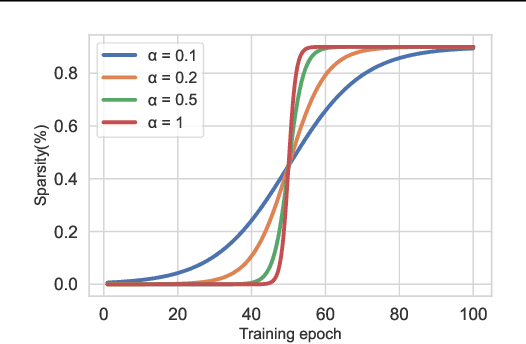
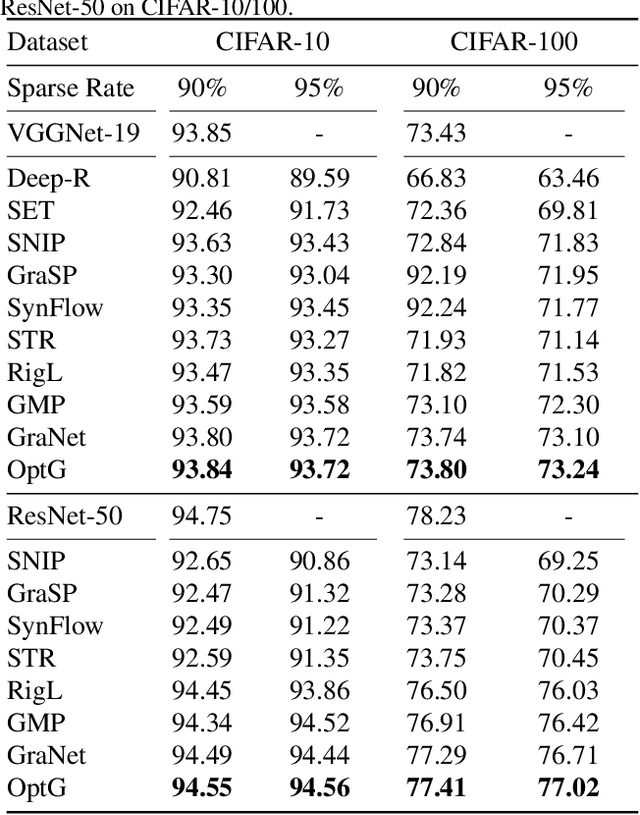
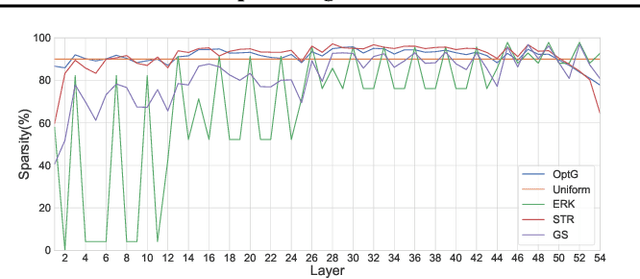
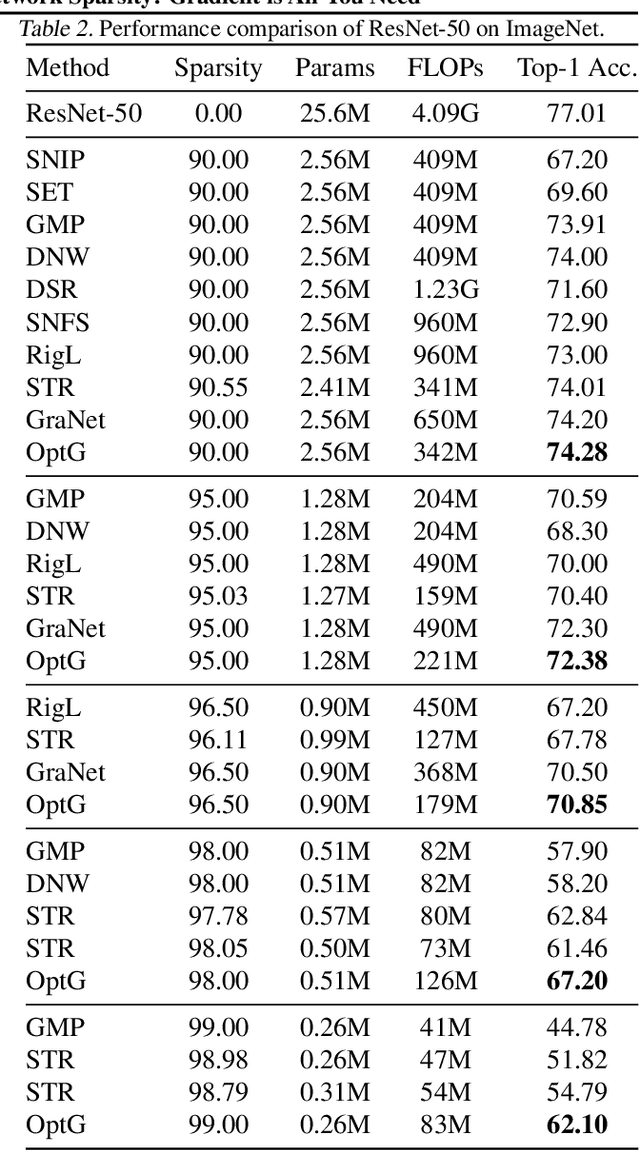
Network sparsity receives popularity mostly due to its capability to reduce the network complexity. Extensive studies excavate gradient-driven sparsity. Typically, these methods are constructed upon premise of weight independence, which however, is contrary to the fact that weights are mutually influenced. Thus, their performance remains to be improved. In this paper, we propose to further optimize gradient-driven sparsity (OptG) by solving this independence paradox. Our motive comes from the recent advances on supermask training which shows that sparse subnetworks can be located in a randomly initialized network by simply updating mask values without modifying any weight. We prove that supermask training is to accumulate the weight gradients and can partly solve the independence paradox. Consequently, OptG integrates supermask training into gradient-driven sparsity, and a specialized mask optimizer is designed to solve the independence paradox. Experiments show that OptG can well surpass many existing state-of-the-art competitors. Our code is available at \url{https://github.com/zyxxmu/OptG}.