 Add to Chrome
 Add to Firefox
 Add to Edge
From Objectives to Applications: Aligning Architectural Biases in Audio Self-Supervised Learning
Jul 01, 2026
This paper examines audio self-supervised learning (SSL) through the alignment between pretraining objectives, architectural inductive biases, and downstream applications. Rather than treating SSL methods as a chronological sequence of pretext tasks or model families, we ask how different supervisory signals shape the representations that models are expected to learn. The discussion is organized around five paradigms: auxiliary tasks, contrastive learning, generative reconstruction, discrete token prediction, and multimodal alignment. These objectives place different demands on the model, from local structural sensitivity and contrastive invariance to contextual inference, discrete semantic abstraction, and multimodal grounding. We relate these demands to the biases of CNNs, recurrent and State Space Models, Transformers, and hybrid architectures, showing how local acoustic compression, sequential state propagation, content-dependent global routing, and local--global integration support different forms of audio SSL. The same view is then used to interpret downstream applications in speech processing, environmental sound analysis, music information retrieval, medical and bioacoustic analysis, and multimodal audio understanding as practical tests of whether learned representations and architectural choices generalize across domains. We also review benchmark protocols and open challenges, including tokenization bottlenecks, long-context efficiency, robustness, and secure multimodal deployment, and discuss how codec-based tokenization and audio-language modeling extend this objective--architecture--application pipeline. The accompanying repository is released at https://github.com/colaudiolab/Awesome-Self-Supervised-Audio-Learning.

AudioDER: A Deduplication-Enhanced Reasoning Dataset for Post-Training Large Audio-Language Models
Jun 12, 2026Large Audio-Language Models (LALMs) have shown strong performance on a wide range of audio understanding tasks, yet they still struggle with complex audio reasoning. A practical way to improve such capabilities is post-training, whose effectiveness critically depends on the quality and diversity of training data. However, existing audio-language datasets often contain substantial redundancy, where many samples are highly similar in acoustic content and thus provide overlapping supervisory signals. Such redundancy not only increases annotation cost, but also limits corpus diversity and reduces the effectiveness of post-training. To address this issue, we propose a redundancy-aware data construction pipeline for building reasoning-oriented supervision for LALMs. Specifically, we first perform acoustic similarity-based deduplication across raw audio datasets to improve corpus diversity. We then integrate existing audio captions and question-answer pairs into a unified multiple-choice format. Based on these unified annotations, we leverage Qwen3-30B to generate chain-of-thought (CoT) rationales for reasoning-oriented supervision. Based on this pipeline, we construct AudioDER, a reasoning-oriented post-training dataset containing approximately 191k samples spanning sound, speech, and music. Each sample consists of an audio clip, a multiple-choice question, four answer candidates, an audio caption, and a CoT rationale. Extensive experiments show that post-training on AudioDER consistently improves the performance of Qwen2-Audio-7B-Instruct on multiple audio reasoning benchmarks, including MMAU-mini, MMSU, and MMAR. We hope AudioDER can serve as a valuable resource for advancing audio reasoning research and the development of more capable LALMs.
The First Challenge on Remote Sensing Infrared Image Super-Resolution at NTIRE 2026: Benchmark Results and Method Overview
Apr 23, 2026This paper presents the NTIRE 2026 Remote Sensing Infrared Image Super-Resolution (x4) Challenge, one of the associated challenges of NTIRE 2026. The challenge aims to recover high-resolution (HR) infrared images from low-resolution (LR) inputs generated through bicubic downsampling with a x4 scaling factor. The objective is to develop effective models or solutions that achieve state-of-the-art performance for infrared image SR in remote sensing scenarios. To reflect the characteristics of infrared data and practical application needs, the challenge adopts a single-track setting. A total of 115 participants registered for the competition, with 13 teams submitting valid entries. This report summarizes the challenge design, dataset, evaluation protocol, main results, and the representative methods of each team. The challenge serves as a benchmark to advance research in infrared image super-resolution and promote the development of effective solutions for real-world remote sensing applications.
NTIRE 2026 The Second Challenge on Day and Night Raindrop Removal for Dual-Focused Images: Methods and Results
Apr 12, 2026This paper presents an overview of the NTIRE 2026 Second Challenge on Day and Night Raindrop Removal for Dual-Focused Images. Building upon the success of the first edition, this challenge attracted a wide range of impressive solutions, all developed and evaluated on our real-world Raindrop Clarity dataset~\cite{jin2024raindrop}. For this edition, we adjust the dataset with 14,139 images for training, 407 images for validation, and 593 images for testing. The primary goal of this challenge is to establish a strong and practical benchmark for the removal of raindrops under various illumination and focus conditions. In total, 168 teams have registered for the competition, and 17 teams submitted valid final solutions and fact sheets for the testing phase. The submitted methods achieved strong performance on the Raindrop Clarity dataset, demonstrating the growing progress in this challenging task.
Silent Speech Interfaces in the Era of Large Language Models: A Comprehensive Taxonomy and Systematic Review
Mar 12, 2026Human-computer interaction has traditionally relied on the acoustic channel, a dependency that introduces systemic vulnerabilities to environmental noise, privacy constraints, and physiological speech impairments. Silent Speech Interfaces (SSIs) emerge as a transformative paradigm that bypasses the acoustic stage by decoding linguistic intent directly from the neuro-muscular-articulatory continuum. This review provides a high-level synthesis of the SSI landscape, transitioning from traditional transducer-centric analysis to a holistic intent-to-execution taxonomy. We systematically evaluate sensing modalities across four critical physiological interception points: neural oscillations, neuromuscular activation, articulatory kinematics (ultrasound/magnetometry), and pervasive active probing via acoustic or radio-frequency sensing. Critically, we analyze the current paradigm shift from heuristic signal processing to Latent Semantic Alignment. In this new era, Large Language Models (LLMs) and deep generative architectures serve as high-level linguistic priors to resolve the ``informational sparsity'' and non-stationarity of biosignals. By mapping fragmented physiological gestures into structured semantic latent spaces, modern SSI frameworks have, for the first time, approached the Word Error Rate usability threshold required for real-world deployment. We further examine the transition of SSIs from bulky laboratory instrumentation to ``invisible interfaces'' integrated into commodity-grade wearables, such as earables and smart glasses. Finally, we outline a strategic roadmap addressing the ``user-dependency paradox'' through self-supervised foundation models and define the ethical boundaries of ``neuro-security'' to protect cognitive liberty in an increasingly interfaced world.
NTIRE 2025 Image Shadow Removal Challenge Report
Jun 18, 2025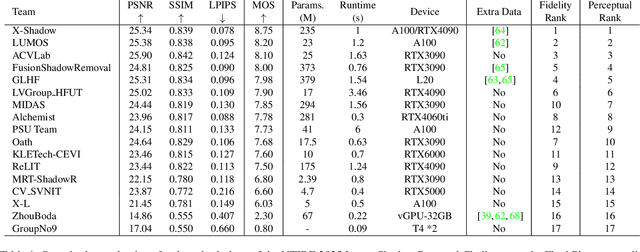

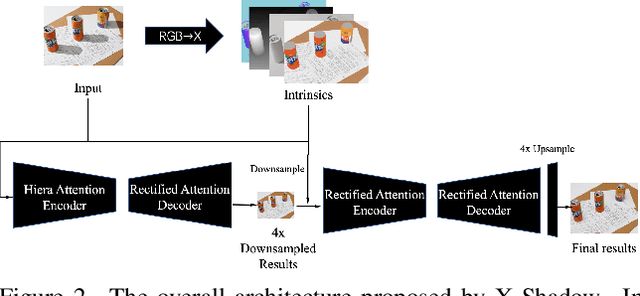

This work examines the findings of the NTIRE 2025 Shadow Removal Challenge. A total of 306 participants have registered, with 17 teams successfully submitting their solutions during the final evaluation phase. Following the last two editions, this challenge had two evaluation tracks: one focusing on reconstruction fidelity and the other on visual perception through a user study. Both tracks were evaluated with images from the WSRD+ dataset, simulating interactions between self- and cast-shadows with a large number of diverse objects, textures, and materials.
NTIRE 2025 Challenge on HR Depth from Images of Specular and Transparent Surfaces
Jun 06, 2025This paper reports on the NTIRE 2025 challenge on HR Depth From images of Specular and Transparent surfaces, held in conjunction with the New Trends in Image Restoration and Enhancement (NTIRE) workshop at CVPR 2025. This challenge aims to advance the research on depth estimation, specifically to address two of the main open issues in the field: high-resolution and non-Lambertian surfaces. The challenge proposes two tracks on stereo and single-image depth estimation, attracting about 177 registered participants. In the final testing stage, 4 and 4 participating teams submitted their models and fact sheets for the two tracks.
NTIRE 2025 challenge on Text to Image Generation Model Quality Assessment
May 22, 2025This paper reports on the NTIRE 2025 challenge on Text to Image (T2I) generation model quality assessment, which will be held in conjunction with the New Trends in Image Restoration and Enhancement Workshop (NTIRE) at CVPR 2025. The aim of this challenge is to address the fine-grained quality assessment of text-to-image generation models. This challenge evaluates text-to-image models from two aspects: image-text alignment and image structural distortion detection, and is divided into the alignment track and the structural track. The alignment track uses the EvalMuse-40K, which contains around 40K AI-Generated Images (AIGIs) generated by 20 popular generative models. The alignment track has a total of 371 registered participants. A total of 1,883 submissions are received in the development phase, and 507 submissions are received in the test phase. Finally, 12 participating teams submitted their models and fact sheets. The structure track uses the EvalMuse-Structure, which contains 10,000 AI-Generated Images (AIGIs) with corresponding structural distortion mask. A total of 211 participants have registered in the structure track. A total of 1155 submissions are received in the development phase, and 487 submissions are received in the test phase. Finally, 8 participating teams submitted their models and fact sheets. Almost all methods have achieved better results than baseline methods, and the winning methods in both tracks have demonstrated superior prediction performance on T2I model quality assessment.
NTIRE 2025 Challenge on Image Super-Resolution ($\times$4): Methods and Results
Apr 20, 2025This paper presents the NTIRE 2025 image super-resolution ($\times$4) challenge, one of the associated competitions of the 10th NTIRE Workshop at CVPR 2025. The challenge aims to recover high-resolution (HR) images from low-resolution (LR) counterparts generated through bicubic downsampling with a $\times$4 scaling factor. The objective is to develop effective network designs or solutions that achieve state-of-the-art SR performance. To reflect the dual objectives of image SR research, the challenge includes two sub-tracks: (1) a restoration track, emphasizes pixel-wise accuracy and ranks submissions based on PSNR; (2) a perceptual track, focuses on visual realism and ranks results by a perceptual score. A total of 286 participants registered for the competition, with 25 teams submitting valid entries. This report summarizes the challenge design, datasets, evaluation protocol, the main results, and methods of each team. The challenge serves as a benchmark to advance the state of the art and foster progress in image SR.
NTIRE 2025 Challenge on Event-Based Image Deblurring: Methods and Results
Apr 16, 2025This paper presents an overview of NTIRE 2025 the First Challenge on Event-Based Image Deblurring, detailing the proposed methodologies and corresponding results. The primary goal of the challenge is to design an event-based method that achieves high-quality image deblurring, with performance quantitatively assessed using Peak Signal-to-Noise Ratio (PSNR). Notably, there are no restrictions on computational complexity or model size. The task focuses on leveraging both events and images as inputs for single-image deblurring. A total of 199 participants registered, among whom 15 teams successfully submitted valid results, offering valuable insights into the current state of event-based image deblurring. We anticipate that this challenge will drive further advancements in event-based vision research.