 Add to Chrome
 Add to Firefox
 Add to Edge
Towards Knowledgeable Deep Research: Framework and Benchmark
Apr 09, 2026
Deep Research (DR) requires LLM agents to autonomously perform multi-step information seeking, processing, and reasoning to generate comprehensive reports. In contrast to existing studies that mainly focus on unstructured web content, a more challenging DR task should additionally utilize structured knowledge to provide a solid data foundation, facilitate quantitative computation, and lead to in-depth analyses. In this paper, we refer to this novel task as Knowledgeable Deep Research (KDR), which requires DR agents to generate reports with both structured and unstructured knowledge. Furthermore, we propose the Hybrid Knowledge Analysis framework (HKA), a multi-agent architecture that reasons over both kinds of knowledge and integrates the texts, figures, and tables into coherent multimodal reports. The key design is the Structured Knowledge Analyzer, which utilizes both coding and vision-language models to produce figures, tables, and corresponding insights. To support systematic evaluation, we construct KDR-Bench, which covers 9 domains, includes 41 expert-level questions, and incorporates a large number of structured knowledge resources (e.g., 1,252 tables). We further annotate the main conclusions and key points for each question and propose three categories of evaluation metrics including general-purpose, knowledge-centric, and vision-enhanced ones. Experimental results demonstrate that HKA consistently outperforms most existing DR agents on general-purpose and knowledge-centric metrics, and even surpasses the Gemini DR agent on vision-enhanced metrics, highlighting its effectiveness in deep, structure-aware knowledge analysis. Finally, we hope this work can serve as a new foundation for structured knowledge analysis in DR agents and facilitate future multimodal DR studies.

Intern-S1-Pro: Scientific Multimodal Foundation Model at Trillion Scale
Mar 26, 2026We introduce Intern-S1-Pro, the first one-trillion-parameter scientific multimodal foundation model. Scaling to this unprecedented size, the model delivers a comprehensive enhancement across both general and scientific domains. Beyond stronger reasoning and image-text understanding capabilities, its intelligence is augmented with advanced agent capabilities. Simultaneously, its scientific expertise has been vastly expanded to master over 100 specialized tasks across critical science fields, including chemistry, materials, life sciences, and earth sciences. Achieving this massive scale is made possible by the robust infrastructure support of XTuner and LMDeploy, which facilitates highly efficient Reinforcement Learning (RL) training at the 1-trillion parameter level while ensuring strict precision consistency between training and inference. By seamlessly integrating these advancements, Intern-S1-Pro further fortifies the fusion of general and specialized intelligence, working as a Specializable Generalist, demonstrating its position in the top tier of open-source models for general capabilities, while outperforming proprietary models in the depth of specialized scientific tasks.
Machine intelligence supports the full chain of 2D dendrite synthesis
Mar 17, 2026Exemplified by the chemical vapor deposition growth of two-dimensional dendrites, which has potential applications in catalysis and presents a parameter-intensive, data-scarce and reaction process-complex model problem, we devise a machine intelligence-empowered framework for the full chain support of material synthesis, encompassing rapid process optimization, accurate customized synthesis, and comprehensive mechanism deciphering.First, active learning is integrated into the experimental workflow, identifying an optimal recipe for the growth of highly-branched, electrocatalytically-active ReSe2 dendrites through 60 experiments (4 iterations), which account for less than 1.3% of the numerous possible parameter combinations.Then, a prediction accuracy-guided data augmentation strategy is developed combined with a tree-based machine learning (ML) algorithm, unveiling a non-linear correlation between 5 process variables and fractal dimension (DF) of ReSe2 dendrites with only 9 experiment additions, which guides the synthesis of various user-defined DF. Finally, we construct a data-knowledge dual-driven mechanism model by integration of cross-scale characterizations, interpretable ML models, and domain knowledge in thermodynamics and kinetics, unraveling synergistic contributions of multiple process parameters to the product morphology. This work demonstrates the ML potential to transform the research paradigm and is adaptable to broader material synthesis.
Rethinking Multiple-Choice Questions for RLVR: Unlocking Potential via Distractor Design
Mar 13, 2026Reinforcement Learning with Verifiable Rewards (RLVR) significantly enhances the reasoning capabilities of Large Language Models. When applied to RLVR, Multiple-Choice Questions (MCQs) offer a scalable source of verifiable data but risk inducing reward hacking, where models shortcut reasoning via random guessing or simple elimination. Current approaches often mitigate this by converting MCQs to open-ended formats, thereby discarding the contrastive signal provided by expert-designed distractors. In this work, we systematically investigate the impact of option design on RLVR. Our analysis highlights two primary insights: (1) Mismatches in option counts between training and testing degrade performance. (2) Strong distractors effectively mitigate random guessing, enabling effective RLVR training even with 2-way questions. Motivated by these findings, we propose Iterative Distractor Curation (IDC), a framework that actively constructs high-quality distractors to block elimination shortcuts and promote deep reasoning. Experiments on various benchmarks demonstrate that our method effectively enhances distractor quality and yields significant gains in RLVR training compared to the original data.
Kimi K2.5: Visual Agentic Intelligence
Feb 02, 2026We introduce Kimi K2.5, an open-source multimodal agentic model designed to advance general agentic intelligence. K2.5 emphasizes the joint optimization of text and vision so that two modalities enhance each other. This includes a series of techniques such as joint text-vision pre-training, zero-vision SFT, and joint text-vision reinforcement learning. Building on this multimodal foundation, K2.5 introduces Agent Swarm, a self-directed parallel agent orchestration framework that dynamically decomposes complex tasks into heterogeneous sub-problems and executes them concurrently. Extensive evaluations show that Kimi K2.5 achieves state-of-the-art results across various domains including coding, vision, reasoning, and agentic tasks. Agent Swarm also reduces latency by up to $4.5\times$ over single-agent baselines. We release the post-trained Kimi K2.5 model checkpoint to facilitate future research and real-world applications of agentic intelligence.
AI-generated data contamination erodes pathological variability and diagnostic reliability
Jan 21, 2026Generative artificial intelligence (AI) is rapidly populating medical records with synthetic content, creating a feedback loop where future models are increasingly at risk of training on uncurated AI-generated data. However, the clinical consequences of this AI-generated data contamination remain unexplored. Here, we show that in the absence of mandatory human verification, this self-referential cycle drives a rapid erosion of pathological variability and diagnostic reliability. By analysing more than 800,000 synthetic data points across clinical text generation, vision-language reporting, and medical image synthesis, we find that models progressively converge toward generic phenotypes regardless of the model architecture. Specifically, rare but critical findings, including pneumothorax and effusions, vanish from the synthetic content generated by AI models, while demographic representations skew heavily toward middle-aged male phenotypes. Crucially, this degradation is masked by false diagnostic confidence; models continue to issue reassuring reports while failing to detect life-threatening pathology, with false reassurance rates tripling to 40%. Blinded physician evaluation confirms that this decoupling of confidence and accuracy renders AI-generated documentation clinically useless after just two generations. We systematically evaluate three mitigation strategies, finding that while synthetic volume scaling fails to prevent collapse, mixing real data with quality-aware filtering effectively preserves diversity. Ultimately, our results suggest that without policy-mandated human oversight, the deployment of generative AI threatens to degrade the very healthcare data ecosystems it relies upon.
VirtualEnv: A Platform for Embodied AI Research
Jan 12, 2026As large language models (LLMs) continue to improve in reasoning and decision-making, there is a growing need for realistic and interactive environments where their abilities can be rigorously evaluated. We present VirtualEnv, a next-generation simulation platform built on Unreal Engine 5 that enables fine-grained benchmarking of LLMs in embodied and interactive scenarios. VirtualEnv supports rich agent-environment interactions, including object manipulation, navigation, and adaptive multi-agent collaboration, as well as game-inspired mechanics like escape rooms and procedurally generated environments. We provide a user-friendly API built on top of Unreal Engine, allowing researchers to deploy and control LLM-driven agents using natural language instructions. We integrate large-scale LLMs and vision-language models (VLMs), such as GPT-based models, to generate novel environments and structured tasks from multimodal inputs. Our experiments benchmark the performance of several popular LLMs across tasks of increasing complexity, analyzing differences in adaptability, planning, and multi-agent coordination. We also describe our methodology for procedural task generation, task validation, and real-time environment control. VirtualEnv is released as an open-source platform, we aim to advance research at the intersection of AI and gaming, enable standardized evaluation of LLMs in embodied AI settings, and pave the way for future developments in immersive simulations and interactive entertainment.
AdaptEval: A Benchmark for Evaluating Large Language Models on Code Snippet Adaptation
Jan 08, 2026Recent advancements in large language models (LLMs) have automated various software engineering tasks, with benchmarks emerging to evaluate their capabilities. However, for adaptation, a critical activity during code reuse, there is no benchmark to assess LLMs' performance, leaving their practical utility in this area unclear. To fill this gap, we propose AdaptEval, a benchmark designed to evaluate LLMs on code snippet adaptation. Unlike existing benchmarks, AdaptEval incorporates the following three distinctive features: First, Practical Context. Tasks in AdaptEval are derived from developers' practices, preserving rich contextual information from Stack Overflow and GitHub communities. Second, Multi-granularity Annotation. Each task is annotated with requirements at both task and adaptation levels, supporting the evaluation of LLMs across diverse adaptation scenarios. Third, Fine-grained Evaluation. AdaptEval includes a two-tier testing framework combining adaptation-level and function-level tests, which enables evaluating LLMs' performance across various individual adaptations. Based on AdaptEval, we conduct the first empirical study to evaluate six instruction-tuned LLMs and especially three reasoning LLMs on code snippet adaptation. Experimental results demonstrate that AdaptEval enables the assessment of LLMs' adaptation capabilities from various perspectives. It also provides critical insights into their current limitations, particularly their struggle to follow explicit instructions. We hope AdaptEval can facilitate further investigation and enhancement of LLMs' capabilities in code snippet adaptation, supporting their real-world applications.
A Single-Loop Bilevel Deep Learning Method for Optimal Control of Obstacle Problems
Jan 07, 2026Optimal control of obstacle problems arises in a wide range of applications and is computationally challenging due to its nonsmoothness, nonlinearity, and bilevel structure. Classical numerical approaches rely on mesh-based discretization and typically require solving a sequence of costly subproblems. In this work, we propose a single-loop bilevel deep learning method, which is mesh-free, scalable to high-dimensional and complex domains, and avoids repeated solution of discretized subproblems. The method employs constraint-embedding neural networks to approximate the state and control and preserves the bilevel structure. To train the neural networks efficiently, we propose a Single-Loop Stochastic First-Order Bilevel Algorithm (S2-FOBA), which eliminates nested optimization and does not rely on restrictive lower-level uniqueness assumptions. We analyze the convergence behavior of S2-FOBA under mild assumptions. Numerical experiments on benchmark examples, including distributed and obstacle control problems with regular and irregular obstacles on complex domains, demonstrate that the proposed method achieves satisfactory accuracy while reducing computational cost compared to classical numerical methods.
Artificial Intelligence-Enabled Holistic Design of Catalysts Tailored for Semiconducting Carbon Nanotube Growth
Dec 18, 2025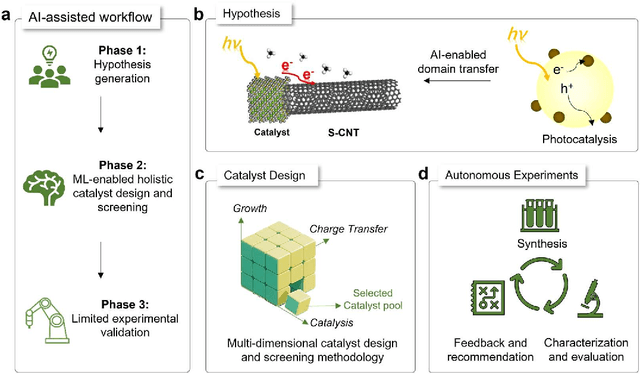
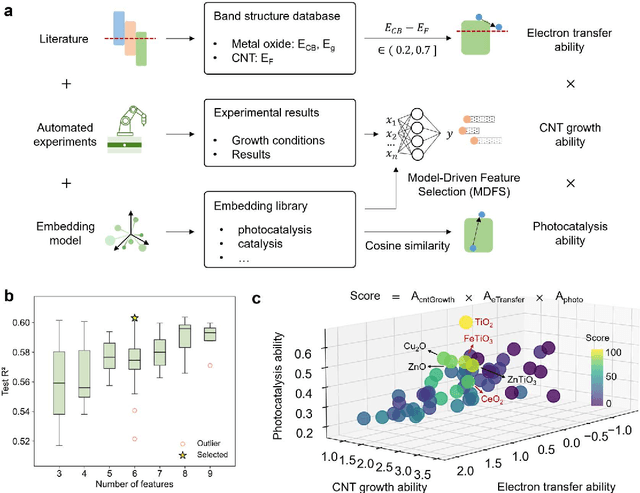
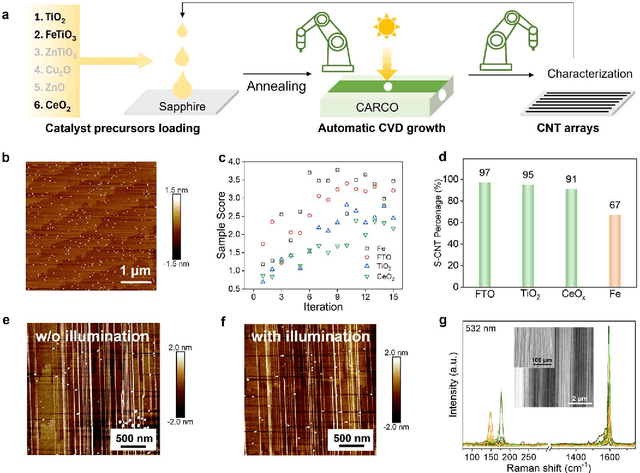
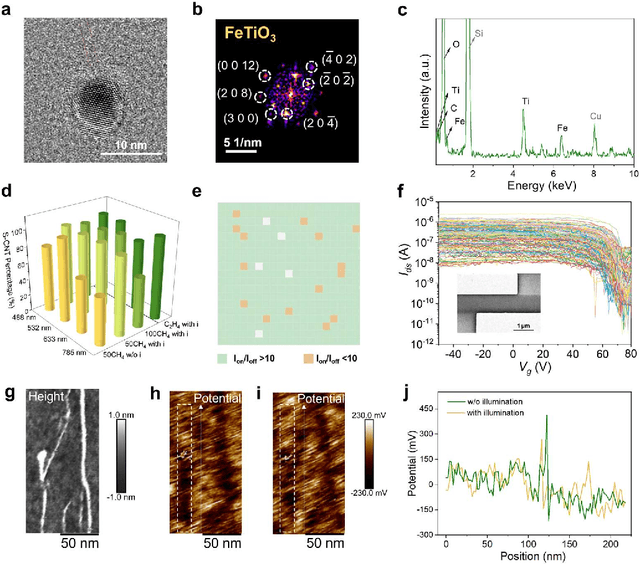
Catalyst design is crucial for materials synthesis, especially for complex reaction networks. Strategies like collaborative catalytic systems and multifunctional catalysts are effective but face challenges at the nanoscale. Carbon nanotube synthesis contains complicated nanoscale catalytic reactions, thus achieving high-density, high-quality semiconducting CNTs demands innovative catalyst design. In this work, we present a holistic framework integrating machine learning into traditional catalyst design for semiconducting CNT synthesis. It combines knowledge-based insights with data-driven techniques. Three key components, including open-access electronic structure databases for precise physicochemical descriptors, pre-trained natural language processing-based embedding model for higher-level abstractions, and physical - driven predictive models based on experiment data, are utilized. Through this framework, a new method for selective semiconducting CNT synthesis via catalyst - mediated electron injection, tuned by light during growth, is proposed. 54 candidate catalysts are screened, and three with high potential are identified. High-throughput experiments validate the predictions, with semiconducting selectivity exceeding 91% and the FeTiO3 catalyst reaching 98.6%. This approach not only addresses semiconducting CNT synthesis but also offers a generalizable methodology for global catalyst design and nanomaterials synthesis, advancing materials science in precise control.