 Add to Chrome
 Add to Firefox
 Add to Edge
From Objectives to Applications: Aligning Architectural Biases in Audio Self-Supervised Learning
Jul 01, 2026
This paper examines audio self-supervised learning (SSL) through the alignment between pretraining objectives, architectural inductive biases, and downstream applications. Rather than treating SSL methods as a chronological sequence of pretext tasks or model families, we ask how different supervisory signals shape the representations that models are expected to learn. The discussion is organized around five paradigms: auxiliary tasks, contrastive learning, generative reconstruction, discrete token prediction, and multimodal alignment. These objectives place different demands on the model, from local structural sensitivity and contrastive invariance to contextual inference, discrete semantic abstraction, and multimodal grounding. We relate these demands to the biases of CNNs, recurrent and State Space Models, Transformers, and hybrid architectures, showing how local acoustic compression, sequential state propagation, content-dependent global routing, and local--global integration support different forms of audio SSL. The same view is then used to interpret downstream applications in speech processing, environmental sound analysis, music information retrieval, medical and bioacoustic analysis, and multimodal audio understanding as practical tests of whether learned representations and architectural choices generalize across domains. We also review benchmark protocols and open challenges, including tokenization bottlenecks, long-context efficiency, robustness, and secure multimodal deployment, and discuss how codec-based tokenization and audio-language modeling extend this objective--architecture--application pipeline. The accompanying repository is released at https://github.com/colaudiolab/Awesome-Self-Supervised-Audio-Learning.

NTIRE 2025 Image Shadow Removal Challenge Report
Jun 18, 2025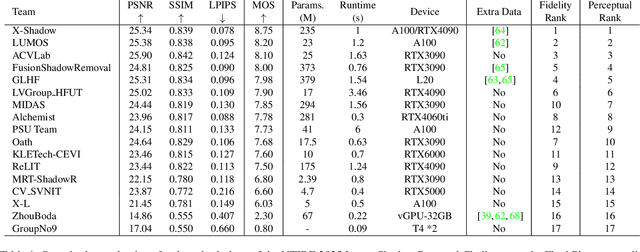

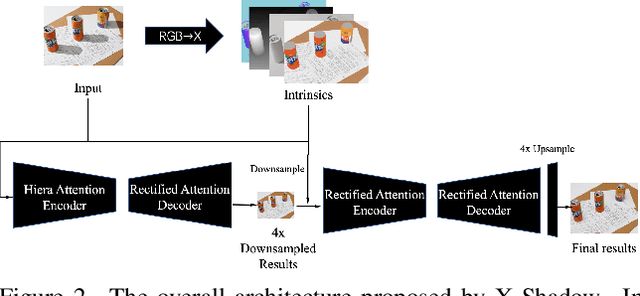

This work examines the findings of the NTIRE 2025 Shadow Removal Challenge. A total of 306 participants have registered, with 17 teams successfully submitting their solutions during the final evaluation phase. Following the last two editions, this challenge had two evaluation tracks: one focusing on reconstruction fidelity and the other on visual perception through a user study. Both tracks were evaluated with images from the WSRD+ dataset, simulating interactions between self- and cast-shadows with a large number of diverse objects, textures, and materials.