 Add to Chrome
 Add to Firefox
 Add to Edge
HRVMamba: High-Resolution Visual State Space Model for Dense Prediction
Oct 04, 2024
Recently, State Space Models (SSMs) with efficient hardware-aware designs, i.e., Mamba, have demonstrated significant potential in computer vision tasks due to their linear computational complexity with respect to token length and their global receptive field. However, Mamba's performance on dense prediction tasks, including human pose estimation and semantic segmentation, has been constrained by three key challenges: insufficient inductive bias, long-range forgetting, and low-resolution output representation. To address these challenges, we introduce the Dynamic Visual State Space (DVSS) block, which utilizes multi-scale convolutional kernels to extract local features across different scales and enhance inductive bias, and employs deformable convolution to mitigate the long-range forgetting problem while enabling adaptive spatial aggregation based on input and task-specific information. By leveraging the multi-resolution parallel design proposed in HRNet, we introduce High-Resolution Visual State Space Model (HRVMamba) based on the DVSS block, which preserves high-resolution representations throughout the entire process while promoting effective multi-scale feature learning. Extensive experiments highlight HRVMamba's impressive performance on dense prediction tasks, achieving competitive results against existing benchmark models without bells and whistles. Code is available at https://github.com/zhanghao5201/HRVMamba.

Articulated Object Manipulation using Online Axis Estimation with SAM2-Based Tracking
Sep 24, 2024Articulated object manipulation requires precise object interaction, where the object's axis must be carefully considered. Previous research employed interactive perception for manipulating articulated objects, but typically, open-loop approaches often suffer from overlooking the interaction dynamics. To address this limitation, we present a closed-loop pipeline integrating interactive perception with online axis estimation from segmented 3D point clouds. Our method leverages any interactive perception technique as a foundation for interactive perception, inducing slight object movement to generate point cloud frames of the evolving dynamic scene. These point clouds are then segmented using Segment Anything Model 2 (SAM2), after which the moving part of the object is masked for accurate motion online axis estimation, guiding subsequent robotic actions. Our approach significantly enhances the precision and efficiency of manipulation tasks involving articulated objects. Experiments in simulated environments demonstrate that our method outperforms baseline approaches, especially in tasks that demand precise axis-based control. Project Page: https://hytidel.github.io/video-tracking-for-axis-estimation/.
Prior Knowledge Distillation Network for Face Super-Resolution
Sep 22, 2024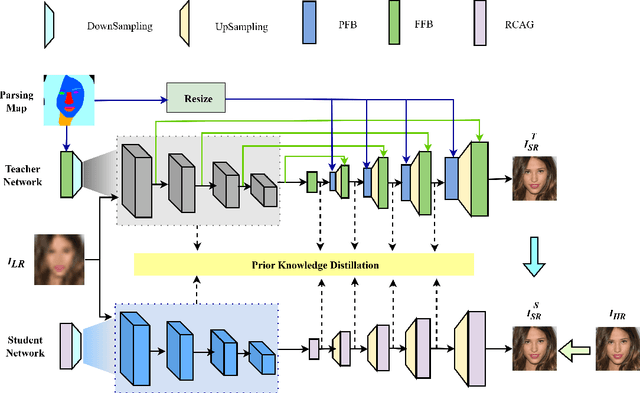
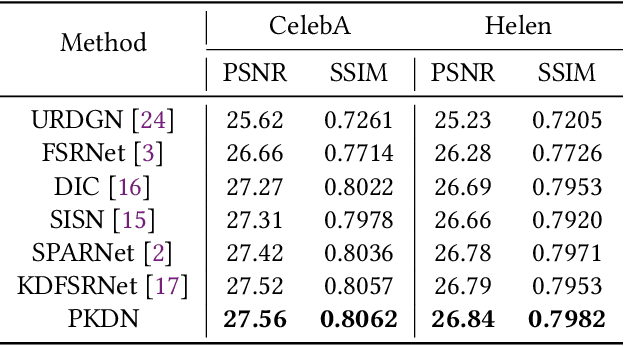
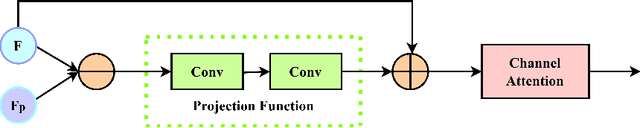
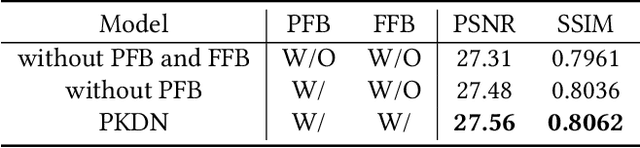
The purpose of face super-resolution (FSR) is to reconstruct high-resolution (HR) face images from low-resolution (LR) inputs. With the continuous advancement of deep learning technologies, contemporary prior-guided FSR methods initially estimate facial priors and then use this information to assist in the super-resolution reconstruction process. However, ensuring the accuracy of prior estimation remains challenging, and straightforward cascading and convolutional operations often fail to fully leverage prior knowledge. Inaccurate or insufficiently utilized prior information inevitably degrades FSR performance. To address this issue, we propose a prior knowledge distillation network (PKDN) for FSR, which involves transferring prior information from the teacher network to the student network. This approach enables the network to learn priors during the training stage while relying solely on low-resolution facial images during the testing stage, thus mitigating the adverse effects of prior estimation inaccuracies. Additionally, we incorporate robust attention mechanisms to design a parsing map fusion block that effectively utilizes prior information. To prevent feature loss, we retain multi-scale features during the feature extraction stage and employ them in the subsequent super-resolution reconstruction process. Experimental results on benchmark datasets demonstrate that our PKDN approach surpasses existing FSR methods in generating high-quality face images.
Closed-Loop Visuomotor Control with Generative Expectation for Robotic Manipulation
Sep 13, 2024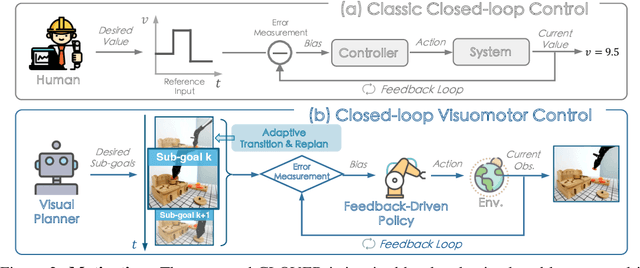
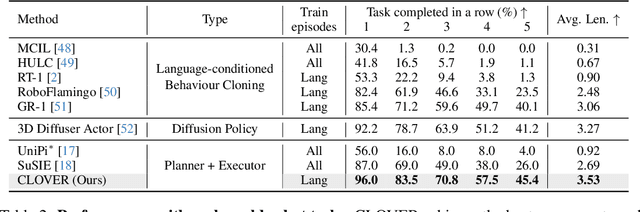
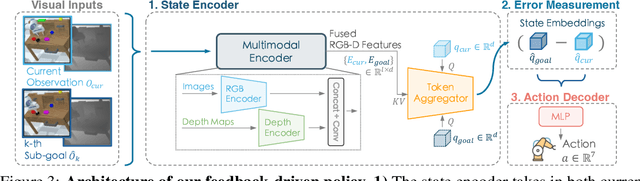
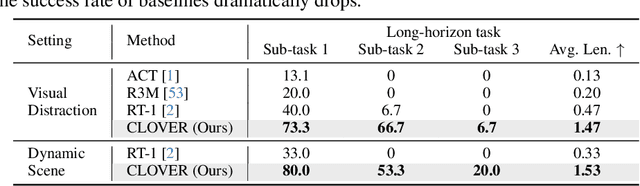
Despite significant progress in robotics and embodied AI in recent years, deploying robots for long-horizon tasks remains a great challenge. Majority of prior arts adhere to an open-loop philosophy and lack real-time feedback, leading to error accumulation and undesirable robustness. A handful of approaches have endeavored to establish feedback mechanisms leveraging pixel-level differences or pre-trained visual representations, yet their efficacy and adaptability have been found to be constrained. Inspired by classic closed-loop control systems, we propose CLOVER, a closed-loop visuomotor control framework that incorporates feedback mechanisms to improve adaptive robotic control. CLOVER consists of a text-conditioned video diffusion model for generating visual plans as reference inputs, a measurable embedding space for accurate error quantification, and a feedback-driven controller that refines actions from feedback and initiates replans as needed. Our framework exhibits notable advancement in real-world robotic tasks and achieves state-of-the-art on CALVIN benchmark, improving by 8% over previous open-loop counterparts. Code and checkpoints are maintained at https://github.com/OpenDriveLab/CLOVER.
RoboTwin: Dual-Arm Robot Benchmark with Generative Digital Twins (early version)
Sep 04, 2024


Effective collaboration of dual-arm robots and their tool use capabilities are increasingly important areas in the advancement of robotics. These skills play a significant role in expanding robots' ability to operate in diverse real-world environments. However, progress is impeded by the scarcity of specialized training data. This paper introduces RoboTwin, a novel benchmark dataset combining real-world teleoperated data with synthetic data from digital twins, designed for dual-arm robotic scenarios. Using the COBOT Magic platform, we have collected diverse data on tool usage and human-robot interaction. We present a innovative approach to creating digital twins using AI-generated content, transforming 2D images into detailed 3D models. Furthermore, we utilize large language models to generate expert-level training data and task-specific pose sequences oriented toward functionality. Our key contributions are: 1) the RoboTwin benchmark dataset, 2) an efficient real-to-simulation pipeline, and 3) the use of language models for automatic expert-level data generation. These advancements are designed to address the shortage of robotic training data, potentially accelerating the development of more capable and versatile robotic systems for a wide range of real-world applications. The project page is available at https://robotwin-benchmark.github.io/early-version/
Federated Prediction-Powered Inference from Decentralized Data
Sep 03, 2024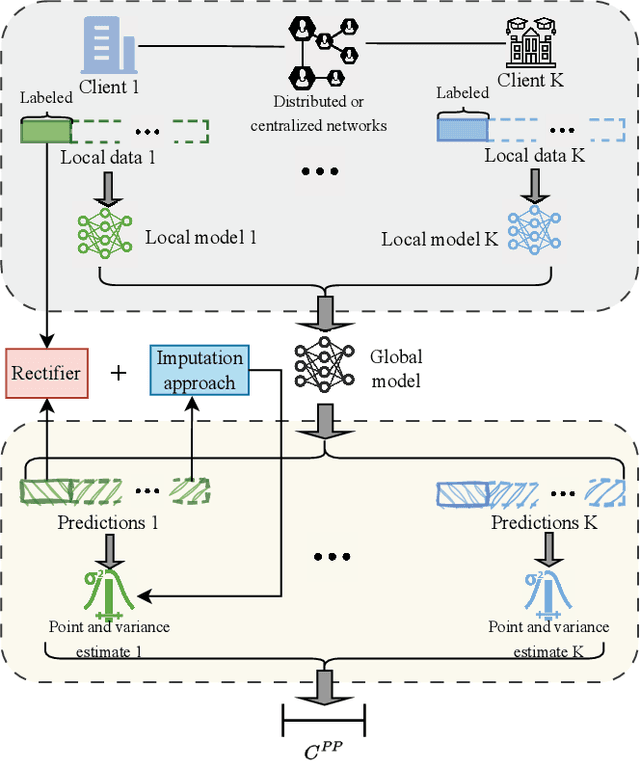
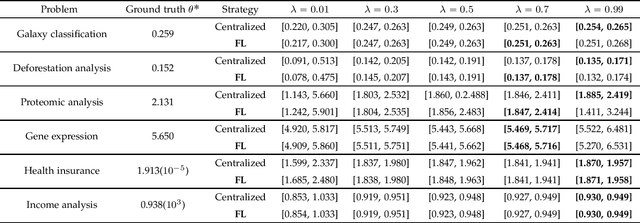
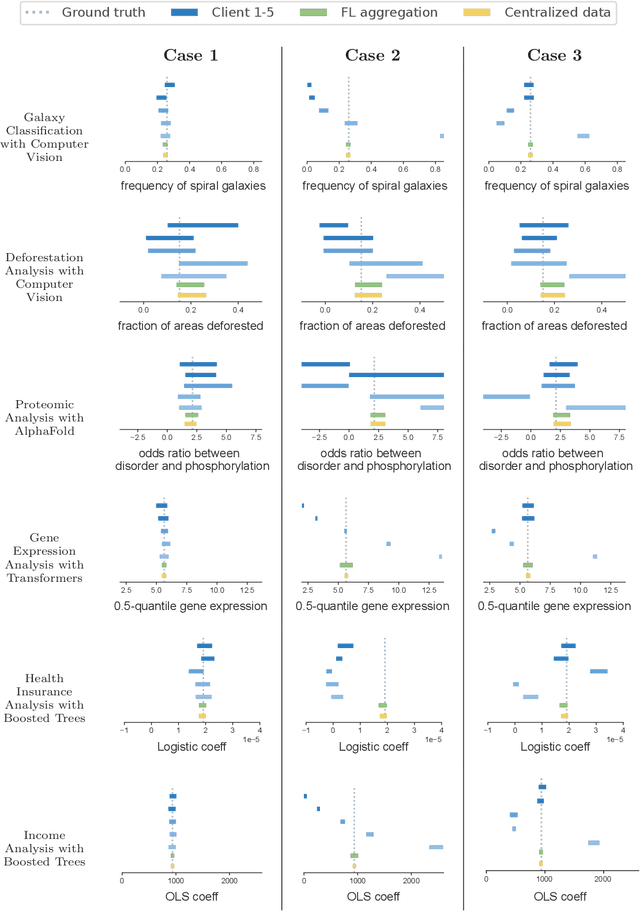
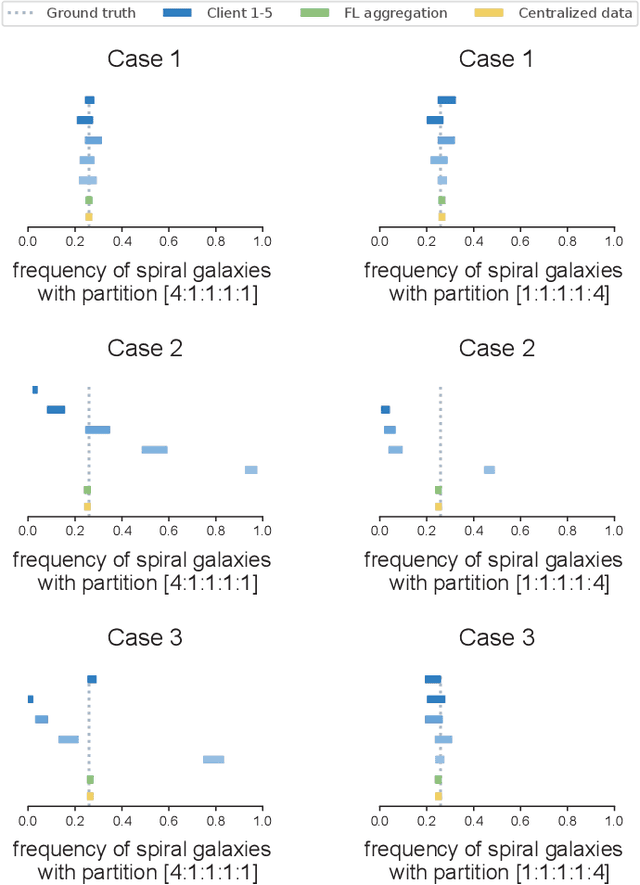
In various domains, the increasing application of machine learning allows researchers to access inexpensive predictive data, which can be utilized as auxiliary data for statistical inference. Although such data are often unreliable compared to gold-standard datasets, Prediction-Powered Inference (PPI) has been proposed to ensure statistical validity despite the unreliability. However, the challenge of `data silos' arises when the private gold-standard datasets are non-shareable for model training, leading to less accurate predictive models and invalid inferences. In this paper, we introduces the Federated Prediction-Powered Inference (Fed-PPI) framework, which addresses this challenge by enabling decentralized experimental data to contribute to statistically valid conclusions without sharing private information. The Fed-PPI framework involves training local models on private data, aggregating them through Federated Learning (FL), and deriving confidence intervals using PPI computation. The proposed framework is evaluated through experiments, demonstrating its effectiveness in producing valid confidence intervals.
Task-Oriented Diffusion Inversion for High-Fidelity Text-based Editing
Aug 23, 2024Recent advancements in text-guided diffusion models have unlocked powerful image manipulation capabilities, yet balancing reconstruction fidelity and editability for real images remains a significant challenge. In this work, we introduce \textbf{T}ask-\textbf{O}riented \textbf{D}iffusion \textbf{I}nversion (\textbf{TODInv}), a novel framework that inverts and edits real images tailored to specific editing tasks by optimizing prompt embeddings within the extended \(\mathcal{P}^*\) space. By leveraging distinct embeddings across different U-Net layers and time steps, TODInv seamlessly integrates inversion and editing through reciprocal optimization, ensuring both high fidelity and precise editability. This hierarchical editing mechanism categorizes tasks into structure, appearance, and global edits, optimizing only those embeddings unaffected by the current editing task. Extensive experiments on benchmark dataset reveal TODInv's superior performance over existing methods, delivering both quantitative and qualitative enhancements while showcasing its versatility with few-step diffusion model.
HiAgent: Hierarchical Working Memory Management for Solving Long-Horizon Agent Tasks with Large Language Model
Aug 18, 2024Large Language Model (LLM)-based agents exhibit significant potential across various domains, operating as interactive systems that process environmental observations to generate executable actions for target tasks. The effectiveness of these agents is significantly influenced by their memory mechanism, which records historical experiences as sequences of action-observation pairs. We categorize memory into two types: cross-trial memory, accumulated across multiple attempts, and in-trial memory (working memory), accumulated within a single attempt. While considerable research has optimized performance through cross-trial memory, the enhancement of agent performance through improved working memory utilization remains underexplored. Instead, existing approaches often involve directly inputting entire historical action-observation pairs into LLMs, leading to redundancy in long-horizon tasks. Inspired by human problem-solving strategies, this paper introduces HiAgent, a framework that leverages subgoals as memory chunks to manage the working memory of LLM-based agents hierarchically. Specifically, HiAgent prompts LLMs to formulate subgoals before generating executable actions and enables LLMs to decide proactively to replace previous subgoals with summarized observations, retaining only the action-observation pairs relevant to the current subgoal. Experimental results across five long-horizon tasks demonstrate that HiAgent achieves a twofold increase in success rate and reduces the average number of steps required by 3.8. Additionally, our analysis shows that HiAgent consistently improves performance across various steps, highlighting its robustness and generalizability. Project Page: https://github.com/HiAgent2024/HiAgent .
MMIU: Multimodal Multi-image Understanding for Evaluating Large Vision-Language Models
Aug 05, 2024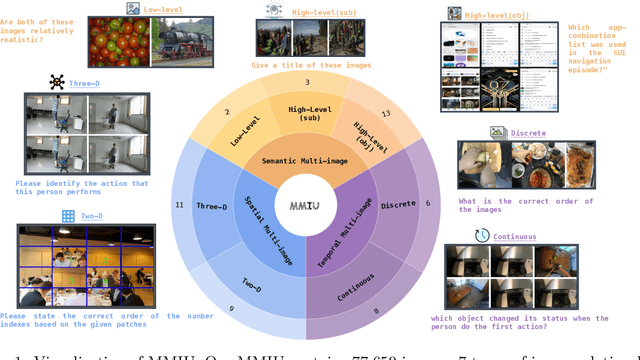


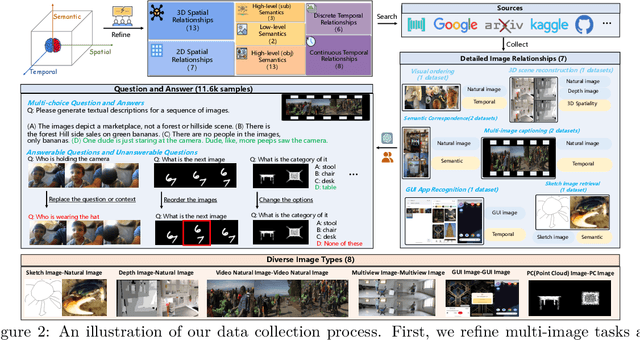
The capability to process multiple images is crucial for Large Vision-Language Models (LVLMs) to develop a more thorough and nuanced understanding of a scene. Recent multi-image LVLMs have begun to address this need. However, their evaluation has not kept pace with their development. To fill this gap, we introduce the Multimodal Multi-image Understanding (MMIU) benchmark, a comprehensive evaluation suite designed to assess LVLMs across a wide range of multi-image tasks. MMIU encompasses 7 types of multi-image relationships, 52 tasks, 77K images, and 11K meticulously curated multiple-choice questions, making it the most extensive benchmark of its kind. Our evaluation of 24 popular LVLMs, including both open-source and proprietary models, reveals significant challenges in multi-image comprehension, particularly in tasks involving spatial understanding. Even the most advanced models, such as GPT-4o, achieve only 55.7% accuracy on MMIU. Through multi-faceted analytical experiments, we identify key performance gaps and limitations, providing valuable insights for future model and data improvements. We aim for MMIU to advance the frontier of LVLM research and development, moving us toward achieving sophisticated multimodal multi-image user interactions.
AgentGen: Enhancing Planning Abilities for Large Language Model based Agent via Environment and Task Generation
Aug 01, 2024Large Language Model (LLM) based agents have garnered significant attention and are becoming increasingly popular. Furthermore, planning ability is a crucial component of an LLM-based agent, involving interaction with the environment and executing actions to complete a planning task, which generally entails achieving a desired goal from an initial state. This paper investigates enhancing the planning abilities of LLMs through instruction tuning, referred to as agent training. Recent studies have demonstrated that utilizing expert-level trajectory for instruction-tuning LLMs effectively enhances their planning capabilities. However, existing work primarily focuses on synthesizing trajectories from manually designed planning tasks and environments. The labor-intensive nature of creating these environments and tasks impedes the generation of sufficiently varied and extensive trajectories. To address this limitation, this paper explores the automated synthesis of diverse environments and a gradual range of planning tasks, from easy to difficult. We introduce a framework, AgentGen, that leverages LLMs first to generate environments and subsequently generate planning tasks conditioned on these environments. Specifically, to improve environmental diversity, we propose using an inspiration corpus composed of various domain-specific text segments as the context for synthesizing environments. Moreover, to increase the difficulty diversity of generated planning tasks, we propose a bidirectional evolution method, Bi-Evol, that evolves planning tasks from easier and harder directions to synthesize a task set with a smoother difficulty curve. The evaluation results derived from AgentBoard show that AgentGen greatly improves LLMs' planning ability, e.g., the AgentGen instruction-tuned Llama-3 8B surpasses GPT-3.5 in overall performance. Moreover, in certain tasks, it even outperforms GPT-4.